

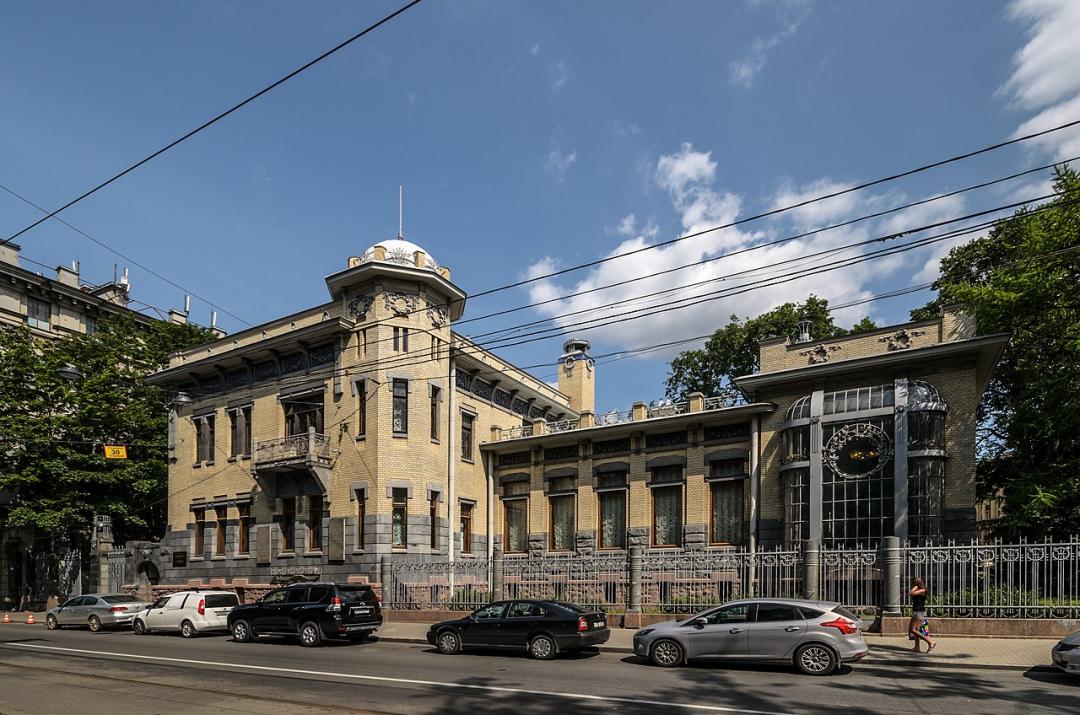
Until 1903, the site housed a wooden residential building and three non-residential structures. In 1903, the plot was acquired by Alexandra Ivanovna Tsekhova (Esther). Architect Vladimir Petrovich Tseidler built a stone house for her. The original building is a rare example of symbolism. Pastel tones of the walls, smooth contours of the windows and balconies, fairy-tale decor. On the fourth floor, along the entire facade, there are 6 herms supporting the cornice.
The owner of the house, Alexandra Ivanovna Tsekhova, was a seamstress and proprietor of a ladies' fashion atelier. Her atelier was located at 18-37 Karavannaya Street. Before the construction of the house on Kamennoostrovsky, she lived at 18 Karavannaya, then moved here, and after selling the house returned to Karavannaya, where her atelier remained all this time.
Judging by somewhat unclear hints, this lady was connected to one of the Lidvals, and her name was mentioned in satirical poems from the time of the first Russian revolution. Those interested may try to figure it out.
Vladimir Iosifovich Gurko was the Deputy Minister of Internal Affairs for agrarian issues. In 1906, a new famine broke out in several Russian provinces, and Gurko had to purchase grain for the starving. He decided to bypass the traditional state procurement procedure (either to save money, since grain traders, learning about state purchases, would try to raise prices, or simply to conveniently engage in the traditional Russian bureaucratic sport of kickbacks and embezzlement). Instead of announcing tenders, he turned to the Swedish subject Erik-Leonard Lidval (by the way, brother of the famous architect). According to one version, they met at Madame Esther’s establishment (however, according to another version, they were introduced by Ekaterina Sytova, the director of the women's choir at the "Aquarium" theater).
The moral of this fable is as follows:
Whatever fables you may scribble,
“Petersburg Gazette” is beyond morals,
Because the hundredth rumor says,
That the party organ "Esther-Lidval-toilet"
Is the "Petersburg Gazette".
And here is Averchenko:
The Story of One Story (Laughter through Tears)
The nightmare of war.
Dreams of freedom,
And crop failure...
Hungry year.
The people's moan.
Advance. Million!
Hungry typhus.
Luxurious lift
Esther. Corset.
Lidval. Toilet.
Supply – myth.
Million – for the lift,
Whip – for the people,
Million – kaput!
The Gurko-Lidval scandal is widely known. Erik Leonard Lidval — brother of Fyodor Ivanovich — was a well-known market seller of silent water closets and owner of gambling clubs.
“According to his account, on the eve of the Lidval story, when Gurko was departing for a foreign vacation, his accidental compartment neighbor in the international carriage was an already not young but still beautiful and elegant Frenchwoman of questionable morals named Esther, who ran a ladies' fashion salon on Karavannaya Street in Petersburg, equally dubious in its purposes. The first consequence of the unexpectedly established acquaintance between Gurko and his neighbor, as malicious tongues said, was that the partition between their compartments was slid aside, and the accidental neighbors continued their journey together, and this fleeting acquaintance supposedly did not end even after Gurko’s return to Petersburg… Sensing an opportunity for easy profit, she casually introduced Gurko to a very energetic man who seemed to him a businesslike American type. This man was Lidval.” Apparently, to entrust huge state funds to a person whose acquaintance arose from such a source, Gurko must have either had a pronounced risk-taking tendency or been a conscious and selfish adventurer.
The story became known in the Cadet newspaper "Rech," which began actively investigating the case.
Be that as it may, the case of missing money for the starving received publicity; the press, followed by the public, unanimously labeled Gurko a criminal and demanded blood. The political situation in the country at that time was not such as to ignore public opinion. Vladimir Iosifovich’s personal interest was not proven, and Gurko was brought to trial only on charges of abuse of power. He found high defenders at the Highest Court: the emperor, possibly to spite Stolypin, granted Gurko a pardon by personal decree, lifted the court ban on his public activities, and bestowed upon him the title of chamberlain. However, Vladimir Iosifovich’s reputation was ruined, and further government service was out of the question. Nevertheless, this did not prevent Gurko from later becoming a member of the State Council. The only ones who actually ended up in jail were the editor of the newspaper "Rech," Kramaley, and journalist Iznar — who were accused of libel and sent to prison for three months.
“In particular, at the trial on October 23, there was talk of the fashion salon ‘Esther,’ which in the 1900s was run by a certain Alexandra Tsekhova on Karavannaya Street in Petersburg. It was a ladies' clothing atelier, but the ladies could pay for their outfits ‘in kind’ (with sexual services). And it was in this ‘atelier’ that Gurko left sums far exceeding his salary as deputy minister; for many years he ‘oversaw’ Madame Tsekhova. Esther-Tsekhova confirmed at the trial (the session was open) that both Gurko and Lidval regularly visited her establishment. All newspapers (not only tabloid ones) wrote about this; the novel ‘Daily Bread’ (1907) by the popular fiction writer Jeronim Yasinsky was dedicated to this, and much later Bulgakov used these motifs in ‘Zoyka’s Apartment.’
In 1908, the house was bought from Esther by Obolonsky, a member of the board of the Azov-Don Commercial Bank.
In the 1910s, the building housed the main office of the "Belgian Society of Tramways and Electricity Application" and various shops.
Until 1955, the house had only stove heating (firewood stored in semi-basements for each apartment); the house was gasified in 1956. The windows facing the avenue had no frames — solid mirror display glass. During the war, from the side opposite the avenue, a heavy shell hit the house but ricocheted, knocking out the beam above the window inside, and exploded in the yard.
Sources:




Written by Jermaine
Discuss this with the author and others
No comments yet. Be the first to start the conversation.