

After Peter I captured the Swedish fortress Nienshanz on May 1 (12), 1703 (during the Great Northern War), the fortress of Saint Petersburg was founded and the city’s construction began. At that time, the territory that later became the Field of Mars was a swampy area with trees and shrubs, lying between the Neva River to the north and the Myya (now Moyka) and Krivusha (now Griboedov Canal) rivers to the south. In 1704, by order of Peter I, the Summer Garden was laid out with a wooden house — the royal residence.

Between 1711 and 1721, two canals were dug to drain the land: Lebyazhiy on the east side and Krasny on the west. As a result, a roughly rectangular plot of land was formed, initially called simply “Empty,” since the trees growing there were cut down. Thus, on Johann Homan’s plan of Saint Petersburg from the early 1720s, the place is labeled Leere Wiesen — “Empty Meadows.” The dug canals allowed the territory to be drained fairly quickly. Then the land was leveled, cleared, and seeded with grass. Several alleys were laid out for walking and horseback riding. From the 1720s, the name “Great Meadow” appeared.
Under Peter I, parades and troop inspections of the Preobrazhensky and Semenovsky regiments were held on the meadow. Fireworks — “amusement fires” — were lit on holidays. For example, in autumn 1721, after the signing of the Treaty of Nystad, celebrations were held in Saint Petersburg, and a triumphal arch was built on the field. The name “Amusement Field” arose.
Under Catherine I, the field was called “Meadow in front of the Summer House” or “Meadow in front of the Summer Palace,” as the Empress’s Summer Palace was built nearby.
From 1751, during the reign of Elizabeth Petrovna, the field began to be called “Tsaritsa’s Meadow” or “Tsaritsa’s Meadow.”
Between 1765 and 1785, under Catherine II, the Marble Palace was built on the northwest edge of the field. Military parades were held on the meadow.
In 1780, the Krasny Canal was filled in. Its former western embankment, called Krasnaya Liniya (Red Line) since 1738, was renamed Tsaritsynskaya Street in 1798.

During the reign of Paul I, at the beginning of 1799, an obelisk “To Rumyantsev’s Victories” (architect V. F. Brenna) was installed on the field in front of house No. 3 in memory of the victories of General Field Marshal Rumyantsev-Zadunaisky.
A couple of years later, in spring 1801, in the southern part of the field in front of the Mikhailovsky Castle by the Moyka River, a monument to Field Marshal A. V. Suvorov was erected. The Suvorov monument does not bear a portrait likeness; the sculptor created an allegorical figure in the image of the god of war Mars, in ancient Roman armor, wearing a helmet, with a raised sword in his right hand and a shield in his left. The solemn unveiling took place on May 5 (17), 1801. By that time, neither Suvorov nor Paul was alive; their sons, Prince Arkady Suvorov and Alexander I, attended the opening. At the same time, the obelisk “To Rumyantsev’s Victories” was moved closer to the Marble Palace.
On May 16, 1803, under Alexander I, on the day of the 100th anniversary of Saint Petersburg, carousels, booths, and other entertainment pavilions were set up on Tsaritsa’s Meadow.
In 1805, “Tsaritsa’s Meadow” was renamed “Field of Mars,” similar to the Field of Mars in ancient Rome and Paris, named after the god of war — Mars. However, the name “Tsaritsa’s Meadow” still persisted. The new name was associated with the erection of the Suvorov monument here, depicted as the god of war Mars. Since then, the territory has had a memorial-military character, connected with the installation of monuments to military figures.

In 1818, at the initiative of architect Carlo Rossi, the obelisk “To Rumyantsev’s Victories” was removed from the Field of Mars and relocated to a square on Vasilievsky Island, and the Suvorov monument was moved closer to the Neva, thus forming Suvorov Square.

On September 23, 1829, a thanksgiving prayer service was held on the Field of Mars to mark the conclusion of peace with the Ottoman Empire, ending the war of 1828–1829. Count A. Kh. Benkendorf described this in his memoirs: “At the end of autumn, the exchange of ratifications with the Ottoman Porte took place, and the sovereign (Nicholas I) ordered all troops stationed in Petersburg and its surroundings to be gathered on Tsaritsa’s Meadow, which, although the main part of the guard had just left Tulchin, still formed a considerable mass. In the middle of the square, a high and spacious pulpit was erected for the imperial family and court. Its steps were decorated with Turkish banners captured in Asia and Europe, and the troops formed dense columns around. At the sovereign’s command, all heads were uncovered, and the thanksgiving prayer began. Huge crowds stood behind the rows of troops and prayed together with them.”
On October 6, 1831, Nicholas I’s manifesto on the suppression of the Polish uprising of 1831 was announced, and a parade and solemn prayer service were held on the Field of Mars to mark the end of hostilities in the Kingdom of Poland.
In the 19th century, military parades in Saint Petersburg were increasingly held on the Field of Mars.

It became traditional to hold “Highest Inspections of the Guards Corps Troops” in May. For example, on May 6, 1833, a rehearsal of the Guards cavalry parade took place on Tsaritsa’s Meadow (Field of Mars) with the participation of a squadron of cadets under the command of Captain A. Stuneev. The 18-year-old Mikhail Lermontov took part in the parade rehearsal. The May parade was held before the departure of the Petersburg garrison to the Krasnoselsky camp. Fire brigade inspections were also held on the Field of Mars.
By the mid-19th century, the field gradually became the main place for public festivities in the city. In July 1874, the Alexander Garden was arranged in front of the Admiralty, after which the annual Easter and Maslenitsa festivities held there were moved to the Field of Mars.
In 1874, the city administration decided to lay new horse-railway lines along the streets of Saint Petersburg. Around the Field of Mars, the horsecar tracks ran on three sides: to the west along Tsaritsynskaya Street, to the east along the embankment of the Lebyazhya Kanavka, and to the north along Millionnaya Street, where they passed through Suvorov Square to the Trinity Bridge, then still a pontoon bridge. In the 1880s, tracks were laid on the south side along the Moyka River embankment.
On September 23 and 30, 1884, bicycle races were held on the Field of Mars. Bicycle races continued to be held there for several years afterward.
In 1897, during Easter week, due to troop inspections on Tsaritsa’s Meadow (Field of Mars), festivities were moved to Preobrazhensky Square. In January 1898, “the highest permission” of Nicholas II was granted to transfer all public festivities from Tsaritsa’s Meadow to Preobrazhensky and Semenovsky Squares.
In the winter of 1903, the World Speed Skating Championship was held on the Field of Mars. In 1903, the 200th anniversary of Saint Petersburg was celebrated on the Field of Mars. On May 16, 1903, in a solemn ceremony attended by Nicholas II and members of the imperial family, the drawbridge of the Trinity Bridge was opened. The program included a cannon salute and a religious procession. The traditional May parade also took place. This was the last military parade on the Field of Mars.
When the Russo-Japanese War began on January 27 (February 9), 1904, all court balls and other celebrations were canceled. During and after the Russo-Japanese War, the May parade was not held. However, on August 30, 1904, a ceremonial march of officials of the Life Guards Pavlovsky Regiment took place on the Field of Mars before Emperor Nicholas II during the parade on the occasion of the regimental holiday.
After Nicholas II issued the Manifesto on August 6, 1905, proclaiming the creation of a representative legislative body, the idea arose among the city’s architects to design the State Duma building on the Field of Mars. In 1906, a competition for the Duma building project was held. However, no project was realized, and the Tauride Palace was adapted for the State Duma sessions.
In the summer of 1907, near the Suvorov monument on the Field of Mars, at the initiative of full member of the Russian Astronomical Society and mechanical engineer Y. A. Mirkalov, a small public observatory was opened. In the autumn of 1907, city councilman I. D. Zubarev petitioned for the transfer of the Field of Mars from the military to the city administration.
In 1909, in the northern part of the Field of Mars along the axis of Suvorov Square, a temporary pavilion was erected for the panorama “Defense of Sevastopol” by artist F. A. Rubo. Architect V. I. Shene replicated the pavilion type in the form of a wooden ribbed dome, designed by von Hogen for Rubo’s panorama “Conquest of the Caucasus” at the All-Russian Art and Industrial Exhibition of 1896 in Nizhny Novgorod. The pavilion was built from January to March 1909 with “highest permission” and by order of the commander-in-chief Grand Duke Nikolai Nikolaevich. It was opened to the public on April 27, 1909. The pavilion stood until 1911.
In November 1910, a skating rink was built on the Field of Mars. In July 1911, in the presence of Emperor Nicholas II, a review of military trucks was held on the Field of Mars after a test motor rally. The rally was organized by the Military Communications Directorate to identify the most suitable truck type for the army. Fourteen vehicles participated. They traveled a route of 1,500 versts from Saint Petersburg to Moscow and back. In June 1912, a test run of passenger cars started from the Field of Mars. Nineteen Russian and 21 foreign cars participated. In the summer of 1912, a military-sports festival was held on the Field of Mars in honor of the 100th anniversary of the Battle of Borodino.
In the winter of 1913, an ice rink was flooded on the Field of Mars, where an international hockey match took place: the “Sport” team lost to the English club 2:6. Teams of the Skating Lovers Society and the Union Society also played.
In July 1914, a parade was held on the Field of Mars in honor of the visit of French President Raymond Poincaré to Russia. Grand Duke Konstantin Konstantinovich recalled: “...In July 1914, shortly before the start of the ‘Great War,’ a large parade of the capital’s guard units was held on the Field of Mars in honor of the visit of French President Raymond Poincaré to Russia. The parade ended with a cavalry charge. This charge was the highlight of the entire parade. At the end of the Field of Mars, all the cavalry present at the parade lined up — two divisions. Then, on the command of Grand Duke Nikolai Nikolaevich, the entire mass of cavalry rushed in a gallop toward the guest tent, where Emperor Nicholas II and the French president were watching the parade. The scene was truly majestic, even frightening. By order of Grand Duke Nikolai Nikolaevich, the entire galloping mass of cavalry stopped instantly before the royal retinue and guests. Officers lowered their weapons in salute, and the trumpeters played the Guards March...”
After the outbreak of World War I on August 1, 1914, the Field of Mars served as a mobilization point. Amid patriotic enthusiasm, the first mobilization was successful. There were no draft evaders; many volunteered to fight, and those remaining in the city generously donated to various war needs.
During the February Revolution from February 23–27, 1917, street fighting occurred in Petrograd, resulting in over 400 deaths and 1,382 injuries. In early March, at meetings of the Petrograd Soviet of Workers’ and Soldiers’ Deputies, the issue of burying the dead was discussed. Initially, burials were planned by districts, but the concept of a single burial site and centralized solemn funerals prevailed. Possible locations for the mass grave and memorial included the Field of Mars, Palace Square, Kazan Cathedral (Kazan Square), Tauride Garden, Znamenskaya Square, and the Summer Garden. Soldiers favored the Field of Mars, while workers preferred Palace Square, where they had experienced Bloody Sunday on January 9, 1905; initially, this option prevailed.
On March 5, the Petrograd Soviet adopted the following resolution: “To designate March 10 as the day of the great liberation of the people. The funerals shall be national, civic, without religious rites, which will be performed by the relatives of the deceased according to their beliefs. To perpetuate the memory of the victims of the revolution by erecting a monument on Palace Square. The day of the people’s liberation and the funerals of the victims of the revolution shall be observed by the entire population with the participation of all units of the Petrograd garrison, in full formation with banners and music. To establish the celebration of this day in the calendar.”
The next day, a group of artists and cultural figures sent an appeal to the Petrograd Soviet. Speaking on behalf of the “commission on arts affairs,” they stated that “the place on Palace Square is hardly well chosen, as this square is, from an artistic point of view, a fully completed architectural ensemble, not allowing cluttering with new monuments,” and proposed “to choose Kazan Square, a place of many speeches in favor of liberation, or the Field of Mars, where the first shots were fired, heralding the beginning of the Great Revolution,” referring to the “uprising” of the Pavlovsky Regiment, the first case of open mass confrontation between armed detachments. On Sunday, February 26, a shootout occurred on the Catherine Canal between a small mounted police detachment trying to disperse the crowd by firing across the canal and the fourth company of the Pavlovsky Regiment near the crowd. The Pavlovtsy fired across the canal at the police, then returned to their barracks located on the Field of Mars, where a shootout occurred between loyal and rebellious parts of the regiment.
Architect Ivan Fomin presented the viewpoint of the “Gorky commission” at the Petrograd Soviet’s funeral commission meeting: “The events that have now occurred are so important, so grandiose, that the monument to these events at the burial site of the victims must be a grand monument and must not be overshadowed by other monuments standing nearby. Therefore, Palace Square, which already has a large monument — a column, was recognized as inconvenient. We chose the square that is completely free, the grandiose Field of Mars...”
Also, on March 6, 1917, the board of the Society of Architect-Artists, in connection with the upcoming funerals of the “victims of the revolution” on Palace Square, sent a special commission to the Petrograd Soviet Executive Committee “to offer assistance” in preparing the burial site. The Executive Committee accepted the proposals, and the architects drew up a project for the placement of mass graves on Palace Square and a technical work plan. The discussion of the burial site location continued for several days, and on March 10, the Petrograd Soviet decided to move the funerals to the Field of Mars.
On March 16 [26], 1917, at the initiative of Prime Minister Prince Georgy Lvov, the Provisional Government adopted a resolution to perpetuate the memory of the “heroes of the revolution”: “to erect in Petrograd, at the state’s expense, a monument to all the hero-fighters for the freedom of Russia who fell victim in this struggle.” It was also decided to develop and announce the conditions of an all-Russian competition for the monument’s design. By March 22 [April 4], 1917, on the eve of the funerals, four mass graves were dug in the center of the square, each shaped like the letter “G.”
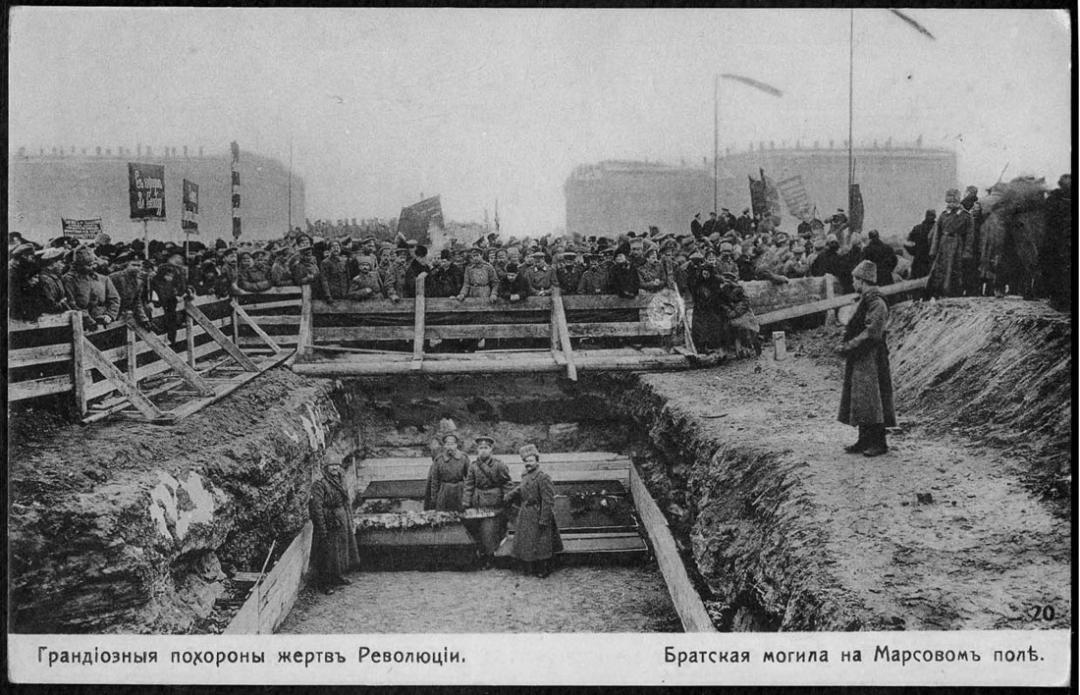
On March 23 [April 5], 1917, funerals for those killed during the February Revolution took place on the Field of Mars. Funeral processions from six different city districts proceeded to the Field of Mars. The procession routes were personally approved by the commander of the Petrograd Military District, General Lavr Kornilov. The chief organizer of the funerals was Isidor Ramishvili, a member of the Petrograd Soviet Executive Committee.

Representatives of the Provisional Government, members of the State Duma, and deputies of the Petrograd Soviet attended the ceremony. The total number of attendees that day was estimated by various sources to range from 800,000 to 1.5 million people. In the four mass graves, 184 people were buried, 46 in each. The very next day after the funerals, March 23 [April 5], the monument’s foundation was laid.
Eleven projects were submitted, and on May 18, 1917, a simple and inexpensive project by L. V. Rudnev titled “Ready Stones” was selected. In his project, Rudnev proposed to build the monument from granite blocks obtained after dismantling the warehouse complex known as Salny Buyan at the Novo-Admiralty shipyard expansion in 1914.
During 1917, the monument’s foundation was built. On April 18 [May 1], 1917, May Day was widely celebrated in Petrograd. Although the Russian Empire still used the Julian calendar, May Day was decided to be celebrated “on the same day as workers worldwide.” It was celebrated openly for the first time. Demonstrations took place along central streets, rallies were held in squares, including a manifestation on the Field of Mars.
After the armed uprising in Petrograd on October 24–26 (November 6–8), 1917, power in Petrograd passed to the Petrograd Military Revolutionary Committee, which also announced the overthrow of the Provisional Government of Russia. On October 27, the Bolsheviks formed a new temporary government of Russia until the Constituent Assembly convened — the Council of People’s Commissars, composed solely of Bolsheviks led by Vladimir Lenin. The management of various sectors was entrusted to commissions. The issue of monument installation fell under the commission on public education, headed by Anatoly Lunacharsky.
In spring 1918, after the move to Moscow, the Council of People’s Commissars adopted a plan for monumental propaganda of the October Revolution. On April 12, 1918, Lenin signed a decree “On the removal of monuments erected in honor of tsars and their servants, and the development of projects for monuments to the Russian Socialist Revolution,” and on July 30, 1918, a list of new monuments to be erected “in memory of revolutionaries and progressive cultural figures of all times and peoples” (69 names) was approved.
After the October Revolution, the new Petrograd Soviet again reviewed and approved Rudnev’s project. Construction of the monument was decided to continue. Although Rudnev’s project was recognized as the best in 1917, it seemed too monumental. In June 1918, the commission proposed that he revise the “Monument to Freedom,” as it was then called. It was planned to place an obelisk with a figure of a woman holding a banner at its top. Later, in 1935, Rudnev recalled working on the monument: “I will describe as an example how the idea of the monument to the victims of the revolution in Leningrad arose. Standing in the square, I saw how thousands of proletarians, passing by, said farewell to their comrades, and each organization, each factory left its banners, sticking them into the ground. I had the image — also from all corners of the city, inspired by one feeling, the proletarians of Leningrad brought stones and boulders and placed slabs with heroic inscriptions in appropriate places...”
Significant funds were allocated for the monument’s construction. The Petrograd Soviet and People’s Commissar of Education A. V. Lunacharsky, who headed the memorial construction commission, supervised the work. He also composed eight inscriptions for the end slabs. From November 1918, the Field of Mars was renamed “Square of the Victims of the Revolution.”
On June 20, 1918, the chief agitator of the Petrograd Soviet Bolsheviks, Commissar for Press, Propaganda, and Agitation V. Volodarsky, was assassinated. It was decided to bury him on the Field of Mars. The funeral took place on June 23, 1918. Thus, the first individual burial appeared on the Field of Mars.
In July 1918, after suppressing the anti-Bolshevik uprising in Yaroslavl, the 6th Latvian Rifle Tukums Regiment returned to Petrograd with the bodies of the fallen, including Red Army military commissar Semyon Nakhimson, commander of the 3rd company Indrikis Daibus, scout Karlis Liepin, riflemen Emil Peterson and Yuliy Zostin. On July 28, they were solemnly buried on the Field of Mars.
On August 30, 1918, the chairman of the Petrograd Cheka, Moisei Uritsky, was assassinated. It was also decided to bury him on the Field of Mars.
On November 7, 1919, the solemn opening of the Monument to the Fighters of the Revolution took place. The monument’s appearance is restrained in its architectural forms: a square-plan wall made of rectangular blocks of pink and gray granite, inside which are 12 memorial plaques with the names of the fallen heroes. Originally, the memorial, named “To the Heroes-Fighters for the Freedom of Russia Who Fell Victim in This Struggle,” was dedicated only to those who died in the February Revolution. However, new burials after 1918 turned the memorial on the Field of Mars first into a necropolis of Bolsheviks killed during the Civil War, and later into an honorary burial place.
In 1919, the architectural workshop of the Petrograd Council of Communal Economy (Sovkhozh) held a competition for the best layout of the Field of Mars. The head of the architectural workshop “Bureau for the Regulation of the Petrograd Plan,” architect I. A. Fomin, proposed to change the territory around the monument. The proposal by A. N. Benois to create a low parterre garden on the Field of Mars was supported.

V. I. Lenin with delegates of the 2nd Congress of the Comintern on the Square of the Victims of the Revolution (Field of Mars).
On May 1, 1920, a nationwide unified communist subbotnik was declared. Sixteen thousand people came to the Field of Mars in an organized manner. They laid alleys and created sites according to Fomin’s drawings. That day, sixty thousand trees and shrubs were planted on the square. Park development continued until 1926.
In 1922, at the initiative of the Comintern and the All-Russian Central Executive Committee, the idea arose to install a monument to the October Revolution on the Field of Mars. An international architectural competition was announced, but the project was not realized.
Between 1929 and 1932, memorial plaques with the names of the buried were installed inside the memorial on the graves. Burials continued until 1933. The last person buried on the Field of Mars on October 8, 1933, was I. I. Gaza, secretary of the Leningrad City Committee of the VKP(b), who died of tuberculosis. In 1934, 16 lanterns were installed in the park on the Field of Mars, which previously stood on the Nikolaevsky Bridge over the Neva (now the Annunciation Bridge).

In the summer of 1942, during the Siege of Leningrad, the field was completely given over to vegetable gardens. An artillery battery was also stationed there. In 1944, the area’s former name — Field of Mars — was restored.
On November 6, 1957, on the eve of the 40th anniversary of the October Revolution, the first “eternal flame” in the USSR was solemnly lit on the Field of Mars in the center of the Monument to the Fighters of the Revolution on the platform inside the granite enclosure. The torch for the memorial opening was lit by steelworker Zhukovsky from Open Hearth Furnace No. 1 of the Kirov Plant (formerly Putilov Plant, Krasny Putilovets) and solemnly delivered to the Field of Mars. The lighting of the gas burner to the sounds of the “Internationale” was entrusted to the oldest communist of Leningrad, a party member since 1898, Praskovya Ivanovna Kulyabko.
In 1965, the eternal flame on the Field of Mars was used to light the eternal flame in Veliky Novgorod, and on May 8, 1967, the Eternal Flame at the Tomb of the Unknown Soldier in Moscow. In 1967, a gas distribution station was built on the territory of the Mikhailovsky Garden, from which gas is supplied to the eternal flame. The gas pipeline, over 400 meters long, runs along the bottom of the Moyka River.
In the summer of 2003, the memorial complex on the Field of Mars was closed for restoration: the sunken granite slabs of the memorial were relaid, and a decorative fence was installed around the “eternal flame” burner. On November 14, 2003, the restored memorial complex “To the Fighters of the Revolution” on the Field of Mars was solemnly reopened, and the “eternal flame” was relit.
In the mid-2000s, the Field of Mars became one of the venues for protest actions (pickets and rallies) — in defense of political prisoners, for fair elections, against corruption, etc., and this status of the square as “a place for collective discussion of socially significant issues and expression of public sentiments of citizens” was legalized in December 2012 by a special governor’s decree. One of the largest actions on the Field of Mars was the unauthorized rally on June 12, 2017, attended by more than ten thousand people. As a result, 658 people were detained, including deputy Maxim Reznik and several journalists.
In August 2017, the Field of Mars was excluded from the list of “guide parks.”
Sources:
https://www.citywalls.ru/house30150.html
https://ru.wikipedia.org/wiki/Field_of_Mars_(Saint_Petersburg)




Written by Jermaine
Discuss this with the author and others
No comments yet. Be the first to start the conversation.