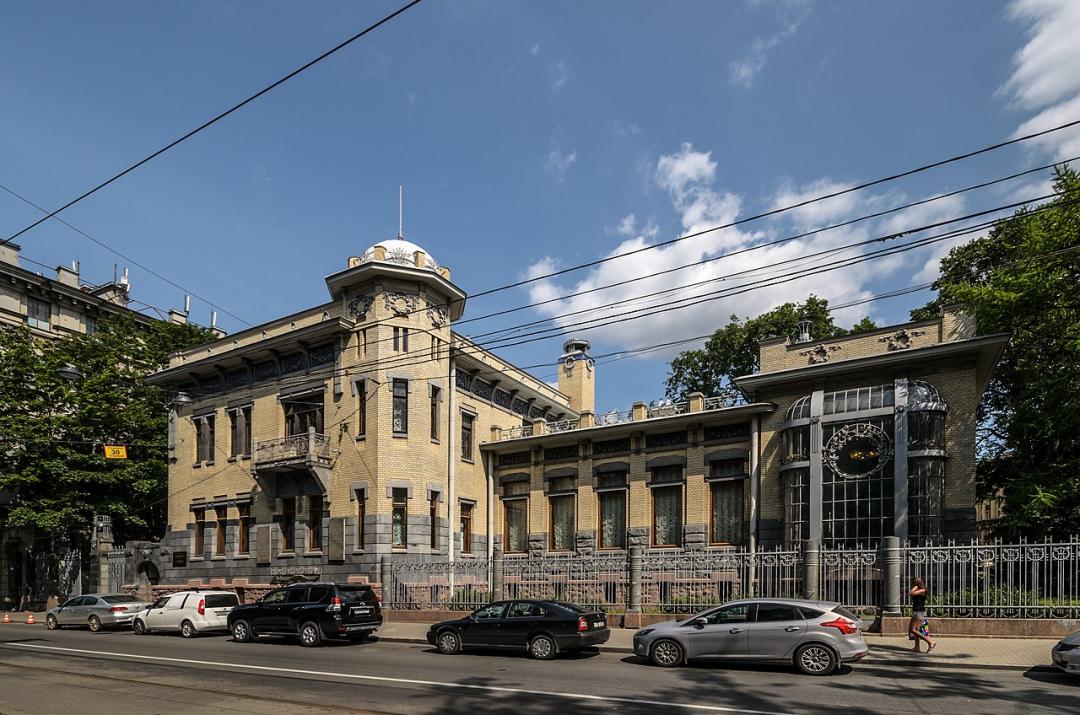
S. Yu. Witte Mansion - Andrey Petrov Children's Music School

Kamennoostrovsky Ave, 5, Saint Petersburg, Russia, 197046

On Kamennoostrovsky Prospect, next to the Lidval house, stands a modest white and blue mansion. This mansion is associated with Sergey Yulyevich Witte – one of the most significant figures in Russian history.

On Kamennoostrovsky Prospekt, next to the Lidval house, stands a modest white and blue mansion. This mansion is connected to Sergey Yulyevich Witte — one of the most significant figures in Russian history.

At the beginning of the 19th century, the plot belonged to retired commissioner Apraksin, then to Privy Councillor Bek, and later to the noblewoman Zelinskaya. In the 1870s, the plot was divided. Part of it went to the widow of Colonel Blyum. Until the end of the 19th century, there were wooden buildings here.

In 1898, the next owner of the plot, Shtremberg, built a three-story stone house here. The building's design was done by architect Ernest Frantsevich Virrich. By that time, the architect had only one independent work — the Assumption Cathedral in Omsk. However, he had considerable experience in technical work and in supervising construction as an assistant to renowned architects Shaub and Syuzor. And a bright professional future, as it turned out later. Ernest Frantsevich (Ernest-Friedrich) Virrich was born in Odessa on May 20, 1860. His parents — German Lutherans — belonged to the petty bourgeoisie and gave their son a good home education. In 1878, he arrived in St. Petersburg and enrolled in the Imperial Academy of Arts. After studying for five years in the painting department and receiving several medals for his works, he nevertheless decided that it was not his calling and transferred to the architecture department. (Many years later, outside Russia, his drawing skills would prove invaluable.) He graduated from the academy only in 1890 but was actively engaged in architectural activities during his student years. Interestingly, in the same 1898 when the mansion on Kamennoostrovsky was built, Virrich began designing and then constructing his most significant project — the ensemble of buildings of the Imperial St. Petersburg Polytechnic Institute, heading a specially created construction commission. For this work, Virrich received the title of Academician of Architecture.

After completing the construction, the owner of the new mansion on Kamennoostrovsky, Shtremberg, put it up for sale. The house looked unassuming but elegant: it was built in the eclectic style with elements of classicism, and the facade was decorated with pilasters of the Corinthian and Tuscan orders. "The mansion's floors are separated by a stepped cornice. The main entrance is framed by a strongly protruding vestibule, above which a balcony is arranged."


In the summer of 1898, the land and mansion were purchased by Sergey Yulyevich Witte's second wife, Maria Ivanovna Lisanovich, née Matilda Isaakovna Nurok. The marriage was preceded by a scandal, as Witte began seeing Lisanovich before her divorce and came into conflict with her husband. This could have cost Witte his career, as a scandalous marriage to a divorced Jewish woman (although she had converted to Orthodoxy) was not welcomed at the time. As a result, Witte's already not very warm relations with high society worsened even more. According to contemporaries, in her youth Matilda Ivanovna possessed attractive looks, skillfully used them, and brilliantly completed her ascent step by step up the ladder of great success. "Many hands reached out to her with offers to lean on them during her rise; she chose the strongest and was not embarrassed by their number." She was a woman of extraordinary intellect and, as Witte's wife, significantly influenced her husband: thanks to her, he stopped swearing and learned to somewhat understand and speak French and German "with a pitiful accent." Despite her persistent desire, even as Witte's wife, she never managed to be accepted at court; she was the only minister's wife to be persistently refused.

Sergey Yulyevich Witte moved into the mansion in 1903 from an apartment at Moika 45 after resigning as Minister of Finance and being appointed Chairman of the Committee of Ministers. In 1904, work on the mansion was completed for the official's family: the mansion was extended by one floor, and courtyard wings were added.

Once in this mansion, the count narrowly escaped death, and the proximity of Ida Lidval's income house, adjoining the ex-premier's mansion, played a certain role in the possibility of organizing the assassination attempt. At the end of January 1907, news spread across the capital: former Chairman of the Council of Ministers of the Russian Empire, Count Sergey Yulyevich Witte, narrowly escaped death from an explosion in his own home. Reporters eagerly relayed the details, sometimes so vividly that it seemed they themselves had defused the "infernal machine." The hero who saved the premier was the stoker Antonov.

"Bringing firewood, Antonov put it in the stove and began opening the flues," reported the next day, January 30, 1907, in the "Petersburg Gazette." "While removing the second flue, he felt the end of a rope in his hand. Thinking that the chimney sweep had left it in the pipe, Antonov pulled the rope. He had to pull for a long time, as the rope was at least ten sazhen (about 21 meters). The gentleman sitting at the round table became interested in the case and helped Antonov pull the rope. After pulling out about ten sazhen of rope, they noticed it became harder to pull — obviously, the rope was tied to something. Pulling harder, Antonov finally pulled out a small bundle wrapped in white cloth."

The gentleman who helped the stoker pull the rope was Witte's close associate Alexander Nikolaevich Gurev, who served as scientific secretary in the Ministry of Finance during Witte's tenure as head of the department. Gurev was also a contributor to the newspapers "New Time," "St. Petersburg Gazette," and "Russia." According to him, he had been visiting the count in the evenings for several months to compile a historical overview of Russia's finances during Witte's management of the Ministry of Finance.

Gurev and the stoker Antonov decided to cut open the cloth bundle extracted from the chimney and discovered a pine box with a small square hole, from which protruded a metal cap shaped like a screwed-on nut. They called the owner, and Witte, taking the object in his hands, calmly stated: "Perhaps there is some kind of bomb there. Better not to touch the box and notify the police."

The authorities arrived, carefully removed the box to the yard, and opened it. Under the lid, they found "a wooden dial, like those found in cheap kitchen clocks," and a mass resembling "semolina porridge or coarse sand" — later it was found to be nitroglycerin. The degree of fear rose even higher when an identical "gift" was found in the neighboring stove. It turned out that the devices could be triggered either by the hammer attached to the clock mechanism or by the stove's fire — the danger was serious.

The infernal machines were found precisely in those rooms on the second floor where Gurev worked. Apparently, the perpetrators were simply poorly informed about where Witte's office was located. The rooms where the ex-premier worked were equipped with opaque curtains. Only in the room where Gurev worked did the curtains let light through.

"It must be assumed that the perpetrators, having surveilled the house, noticed that late light in the count's apartment was regularly visible in this room, while all other windows were dark. They took this room to be the count's bedroom and surrounded it with infernal machines on both sides," noted the journalist.

The danger passed, and throughout January 30, high-ranking officials and representatives of high society visited the count with congratulations; many government telegrams were received in the ex-minister's name…

Meanwhile, the police began to investigate how the infernal machines got into the house. The doorman, who was constantly on duty at the main staircase, swore that no one could have carried such bulky objects past him unnoticed. If the perpetrator had risked entering the mansion through the back door, he would have had to pass through many inhabited rooms, so this route was also unlikely. It turned out that the terrorists climbed from the neighboring house and lowered the infernal machines down the chimneys from the roof. Therefore, soon the roof of Witte's mansion "along the entire line of the house adjoining the neighboring house" was fenced with a barrier of pointed rods intertwined with barbed wire for reliability. In addition, the fence was connected to an electric alarm system.

The investigation established that the explosives were planted by revolutionary-minded workers under the direction of Alexander Kazantsev, who, according to the preliminary version of the investigation, was an agent of the security department and simultaneously a member of the "Union of the Russian People." Why did the Black Hundreds dislike Witte? As noted by Doctor of Historical Sciences Sergey Stepanov, according to their logic, Witte was one of the secret leaders of the revolution...

However, the investigation soon stalled because Kazantsev was killed by one of the perpetrators, Vasily Fyodorov, who found refuge in France. Witte, outraged by the involvement of a government agent in the assassination attempt and the slow progress of the investigation, appealed to Prime Minister Stolypin in 1910. Stolypin replied that Kazantsev was neither a government agent nor a member of the "Union of the Russian People," and the only surviving identified criminal was not extradited by the French authorities.

On January 4, 1911, a special meeting of the Council of Ministers was held, which ruled that Witte's arguments "regarding the participation of government agents in the attempt on his life and the biased and improper conduct of the case" were unfounded. Emperor Nicholas II's resolution stated:

"I see no irregularities in the actions of the administrative, judicial, and police authorities. I consider this case closed."


The last pre-revolutionary photographs of the mansion are dated the day of Sergey Witte's funeral. He died in his home on February 28, 1915, from meningitis. The archival photo captures richly decorated horse-drawn carriages, torchbearers in top hats and liveries, and a crowd of people.


During the Soviet era, the building housed a preventive outpatient clinic, a daytime children's sanatorium, and a research institute for the health protection of children and adolescents. Since 1935 and to this day, a children's music school has operated here. Among its graduates is the famous violinist and conductor Spivakov.

Sources:

https://ru.wikipedia.org/wiki/Witte,_Sergey_Yulyevich

https://www.citywalls.ru/house677.html

https://xn--c1acndtdamdoc1ib.xn--p1ai/fan-zona/statii/bomba-dlya-eks-premera/

https://www.kommersant.ru/doc/4975343


Follow us on social media

More stories from Petersburg: Stories of Kamennoostrovsky Prospect

Income House of A. I. Tsekhova

Kamennoostrovsky Ave., 8, Saint Petersburg, Russia, 197101

The stone house in Art Nouveau style was built in 1903 by architect Zeidler for Tsekhovaya, who purchased this plot. Previously, there were three vacant buildings and a wooden residential house on this site. The facade of the house features small balconies and numerous windows with varied designs; on the fourth floor, the cornice is supported by six herms. The facade, in pastel tones, is richly decorated with white stucco floral ornamentation, which reveals fairy-tale motifs.

Cathedral Mosque

Kronverksky Ave, 7, Saint Petersburg, Russia, 197046

Already in the early years of the existence of Saint Petersburg, a Tatar settlement appeared near the Peter and Paul Fortress. In 1798, more than five hundred Muslim servicemen submitted a petition requesting the granting of a prayer house and the allocation of land for a cemetery.

Lidval. Income House, the Beginning of Northern Art Nouveau in Petersburg

Kamennoostrovsky Ave., 1-3, Saint Petersburg, Russia, 197046

The works of Fyodor Lidval began to play a significant role in the architecture of Saint Petersburg in the 1900s. In the first stage of his creativity (1897–1907), he was a prominent representative of the "Northern Modern" style; his explorations during these years were close to the aspirations of Scandinavian and Finnish architects. At the same time, Lidval's buildings did not contradict the historically established appearance of the city. The Lidval tenement house, one of the architect's early works, is usually cited as an example of a residential building in this style. The Ida Amalia Lidval tenement house — the first independent work of this outstanding architect — was commissioned by his mother.

Kshesinskaya's Mansion: How the Ballerina Fought the Bolsheviks

Kronverksky Ave, 1, Saint Petersburg, Russia, 197046

The Matilda Kshesinskaya Mansion is one of the legends of St. Petersburg. This historic building, erected at the beginning of the 20th century on Troitskaya Square in the northern capital, has remained almost unchanged to this day. The mansion belonged to the famous St. Petersburg ballerina and socialite Matilda Kshesinskaya, who was favored by Emperor Nicholas II himself. After the October events of 1917, the ballerina’s mansion came under the control of the Petrograd Soviet. Later, it housed the "Ilyich Corner," the Society of Old Bolsheviks, and the Museum of the Great October Socialist Revolution. After the collapse of the USSR, the building became home to the State Museum of the Political History of Russia. Everyone knows there is a museum on Gorkovskaya, but few remember that such a vivid and genuine history is connected to this beautiful house. The story of one of the most beautiful women of the era of the fall of the Russian Empire.

House with Towers — Rosenstein Income House

Bolshoy Prospekt P.S., 75, Saint Petersburg, Russia, 197101

The House with Towers – this is what the former income house of Konstantin Rosenstein in Saint Petersburg is called. It is a building rising above the others on Leo Tolstoy Square on the Petrograd Side. An unusual structure, reminiscent of an English medieval castle, appeared here at the beginning of the 20th century and became a decoration of this district of the northern capital.

Austrian Square

7 Mira St., Saint Petersburg, Russia, 197101

The name of the square is not historical. The square at the intersection of Kamennoostrovsky Prospekt and Mira Street (formerly Ruzheynaya) existed without a name for many years. Initially, it was intended to be called Viennese Square, but this name was too "waltzing," so in 1992 it was given the name Austrian Square.

Income House of A. F. Zimmerman

Kamennoostrovsky Ave., 61, Saint Petersburg, Russia, 197022

The house belonged to the hereditary honorary citizen, engineer Arthur Fedorovich Zimmerman.

Kavos Income House

Kamennoostrovsky Ave., 24, Saint Petersburg, Russia, 197101

The Kavos Income House at the intersection of Kamennoostrovsky Prospect and Bolshaya Monetnaya Street is one of the first residential buildings in St. Petersburg constructed in the Art Nouveau style. However, it is notable not just for this. The building is closely connected with two names without which the history of architecture in the Northern capital is inconceivable: Kavos and Benois. This 1897 building became the "flagship" of St. Petersburg Art Nouveau.

Income House of the First Russian Insurance Society - The House of the Three Benois

Kamennoostrovsky Ave., 26-28, Saint Petersburg, Russia, 197101

The income house of the First Russian Insurance Society, popularly known as the "House of the Three Benois," is a vast residential complex with pass-through courtyards opening onto Kamennoostrovsky Prospect, Bolshaya Pushkarskaya, Kronverkskaya, and Bolshaya Monetnaya streets. It was built between 1911 and 1914 based on the design by the architect brothers Leonty, Albert, and Julius Benois in the neoclassical style with elements of Art Nouveau.

Income House of E. K. von Lipgart - Workshop of E. K. von Lipgart

Kamennoostrovsky Ave, 16, Saint Petersburg, Russia, 197101

The income house of E.K. von Lipgart was built in 1904-1905 by the St. Petersburg architect of German origin V. Shaub. The style is late eclecticism with elements of Art Nouveau. In the courtyard of the house is the wing-workshop of E.K. von Lipgart, built in 1898-1899 according to the project of architect E.F. Virrich.

Income House of K. H. Keldal

Kamennoostrovsky Ave., 13/2, Saint Petersburg, Russia, 197101

Architect - Vasily (Wilhelm) Shaub - a St. Petersburg German, an active architect-builder of that era. Year of construction: 1902-1903. Style: Art Nouveau. It stands out for its rhythmic variety, play of textures and curved lines, and the introduction of plant ornamentation.

Imperial Alexander Lyceum

Kamennoostrovsky Ave., 21, Saint Petersburg, Russia, 197101

The Alexandrovsky Lyceum (Imperial Alexandrovsky Lyceum) is the name of the Tsarskoye Selo Lyceum after its relocation from Tsarskoye Selo to Saint Petersburg, as well as the complex of buildings in which it was housed.

The "Aquarium" Theater - "Lenfilm" Film Studio: This is Where Cinema Began

Kamennoostrovsky Ave, 10, Saint Petersburg, Russia, 197101

"Aquarium" – a theater-garden created in 1886 by entrepreneur G. A. Alexandrov. The garden occupied the area of the modern houses 10-12. A large aquarium was built in the garden (hence the name). The owner planned to hold lectures here about the life of fish and aquatic plants. The life of the "Aquarium" was full of vivid artistic events. The first film screening in Russia was arranged in the "Aquarium" theater, and here in the garden the first experimental screening of a sound film took place – a fragment of A. Rubinstein's opera "Demon" (1929). All the celebrities of that time, when visiting Petersburg, considered it an honor to perform or visit the establishment of merchant Alexandrov. Shalyapin and Utesov performed in the theater, and bankers, politicians, dignitaries, and "the very" Grigory Rasputin often frequented the restaurant. Also Tchaikovsky, Blok, Gorky.

Income House of G. A. Alexandrov

Kamennoostrovsky Ave., 12, Saint Petersburg, Russia, 197101

One of the income houses of the 1st guild merchant Georgy Alexandrovich Alexandrov is located at 12 Kamennoostrovsky Prospect. The house, in the Art Nouveau style, was built between 1905 and 1908 according to the design by architects Dmitry Andreevich Kryzhanovsky and Pavel Mikhailovich Mulhanov.

Income House of M. M. Gorbov

10 Mira St., Building A, Office 25, Saint Petersburg, Russia, 197101

But the main work of Vasily Shaub was the Gorbov income house, built in 1903, and it was not Art Nouveau, but eclecticism: the building, with its modest forms and a turret on the corner, resembled the first houses of the Peter the Great era. The building fit very well into the ensemble of the octagonal Austrian Square, and in 1907 it received an honorary prize at the competition for the most beautiful facades, organized by the City Duma.

Income House of V. M. Korzinin

Kamennoostrovsky Ave., 31-33, Saint Petersburg, Russia, 197101

One of the most successful examples of income houses in Saint Petersburg is the Korzinin building, which is located on the Petrograd side. The building was erected at the beginning of the 20th century, according to a design by Mulkhanov. Initially, the house belonged to the hofmeister and senator Musin-Pushkin.

Church of the Nativity of John the Baptist

Stone Island, located in the north of Petersburg, belonged since 1765 to Grand Duke Pavel Petrovich, heir to the throne and General Admiral of the fleet. By his order, in 1776, the construction of a hospice for disabled sailors, heroes of Chesma, was started on the island. At the same time, opposite the hospice, a church in a pseudo-Gothic style was laid according to the project of Felten, who was engaged nearby in the construction of a palace (the architect of which was Starov). The master stonemason Chiesa participated in its construction. Initially, the church was intended to be consecrated in the name of the apostles Peter and Paul and in honor of the Chesma battle. But the consecration of the temple took place on June 24, on the day of the Nativity of John the Baptist. It should be noted that this day was also a Masonic holiday, and the Grand Duke belonged to the lodges. The elegant structure, designed using Gothic forms, rose amidst the greenery of the park. The main volume of the church was pierced by pointed-arch windows. The bell tower and the round drum were topped with spires. The corner parts of the building were reinforced with buttresses, which were crowned above the cornice with small spires. The brick facades were not plastered. The pointed windows were highlighted with white casings. During later reconstructions, the open arched opening under the bell tower was bricked up. The outlines of the spires changed. The drum was covered with a conical top, and the bell tower with a four-sided pyramidal roof. The active Orthodox church is now located at the Kamennoostrovsky Palace. Many famous figures loved to rent summer houses on Stone Island: Derzhavin, Suvorov, and others. They all often visited the Ioannovskaya Church, and Pushkin even baptized three of his children there.

Women's School (Institute) of Princess Therese of Oldenburg

Kamennoostrovsky Ave., 36/73, Saint Petersburg, Russia, 197101

A closed women's educational institution of the Russian Empire, under the jurisdiction of the institutions of Empress Maria and part of the St. Petersburg educational district, existing from 1841 to 1918 in Saint Petersburg.

The House of the Emir of Bukhara

Kamennoostrovsky Ave., 44B, Saint Petersburg, Russia, 197101

A revenue house in Saint Petersburg, built in 1913–1914 by order of the Emir of Bukhara, Said Abdulahad Khan, for his son Said Alim Khan. The emir invited architect Stepan Krichinsky to design it, who had previously participated in the construction of the Cathedral Mosque. For the house project, the emir awarded the architect the Order of Noble Bukhara.

Palace of Culture named after Lensovet

Kamennoostrovsky Ave., 42a, Saint Petersburg, Russia, 197022

The Lensovet Palace of Culture is one of the most famous art centers in Saint Petersburg. The constructivist-style building is located in the very heart of the Petrogradsky District and has been attracting residents and tourists of all ages for 90 years. Originally, the architectural structure was called the Palace of Culture of Industrial Cooperation, and it only received its current name in 1960.

Income House of V. G. and O. M. Chubakovs

Kamennoostrovsky Ave., 38/96, Saint Petersburg, Russia, 197101

In 1910, honorary citizen V. G. Chubakov and his wife began the construction of a six-story residential building on the corner of Leo Tolstoy Square, based on a design by architect V. I. Van der Gucht.

M.K. Pokotilova Mansion

Kamennoostrovsky Ave, 48, Saint Petersburg, Russia, 197022

An elegant mansion in the Neo-Renaissance style, reminiscent of Italian villas, attracts attention with its beautiful decorative finishing details. Located at the intersection of Kamennoostrovsky Prospect and the embankment of the Karpovka River, it is styled as an Italian villa.

Income House of R. I. Bershtein

Kamennoostrovsky Ave, 54, Saint Petersburg, Russia, 197022

The majestic building stands out among its neighbors with a large ceremonial courtyard (such spaces are traditionally called cour d'honneur) and a powerful corner tower with a spire. Notably, this structure might never have appeared here: the original design by architect Kryzhanovsky did not include the construction of the tower.

Guardhouse of the Kamennoostrovsky Palace

Kamennoostrovsky Ave, 77, Saint Petersburg, Russia, 197376

The two-story building of the guardhouse of the Kamennoostrovsky Palace, officially referred to simply as the "wing with a greenhouse," was constructed in 1824 based on a design by the prominent St. Petersburg architect Ludwig Charlemagne.

The Dacha of Architect Voronikhin

Kamennoostrovsky Ave, 62, Saint Petersburg, Russia, 197022

At one time, there really was a wooden summer house (home) of the architect Andrey Nikolaevich Voronikhin here — the author of the designs for the Mining Institute building and the Kazan Cathedral.

Field of Mars

Mars Field, Lebyazhya Kanavka Embankment, 3, Saint Petersburg, Russia, 191186

A unique architectural ensemble surrounded by unique historical monuments of the Northern capital, a memorial cemetery, and at the same time a favorite summer recreation spot for the people of St. Petersburg.