

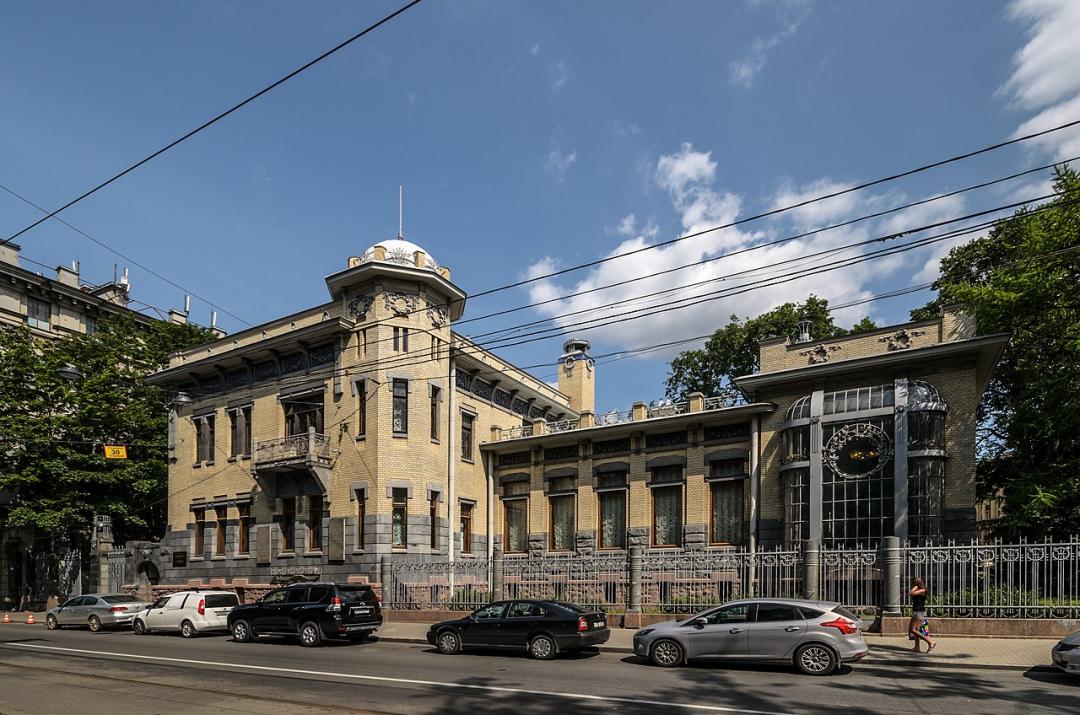
The House with Towers, or the Rosenstein Income House, resembles a medieval English castle. Its facade is decorated with two massive towers, which is why the building was named the "House with Towers." The building is located on Tolstoy Square, with its central part facing Kamennoostrovsky Prospect, and its side facades facing Bolshoy Prospect and Lev Tolstoy Street. The House with Towers was built between 1913 and 1915 in the neoclassical style with the participation of two architects — Rosenstein and Belogrud.
As Valery Grigorievich Isachenko writes in his book "Architects of Saint Petersburg," "it (the house) is one of the few in old Petersburg that opens up on three sides at once, which allows us to speak of a holistic plastic solution, natural for classical architecture...," "there is no true symmetry (in the classical sense) here; on the contrary, it is deliberately broken. But this is done not as straightforwardly as in Art Nouveau or Constructivism."

In turn, architectural historian Boris Mikhailovich Kirikov wrote: "The 'House with Towers' became the last in time and the first in significance structure on the new section of Bolshoy Prospect. The powerful dominant of Lev Tolstoy Square gained the status of one of the symbols of the Petrograd Side."
Karl Ivanovich Rosenstein, the landowner on the Petrograd Side, received permission to build the Income House in 1908. An engineer-designer and a teacher of physics and mechanics, he himself modeled the foundation of the future ensemble over two years.
Construction began, but soon Rosenstein realized he needed an assistant and invited the originally minded architect and artist Andrey Belogrud as a co-author. The latter had a love for medieval art and therefore introduced elements in the spirit of European Gothic into the project. The architect created a completely original composition modeled after the towers of Maxstoke Castle in Warwickshire, England. Symmetrical and hexagonal, they rise above the main building mass and attract the attention of passersby walking along Bolshoy Prospect. A decorative clock face with zodiac signs is embedded in the wall of one of the towers. The architect paid great attention to the facade details, which consist of pointed arches, windows and balconies of various shapes. The light, sand-colored walls are decorated with brown, lace-like trim. Besides its external beauty, the House with Towers is also very sturdy. The load-bearing beams between floors were I-beams. They saved the building during the Great Patriotic War when two blast bombs fell in front of it. The crater from the explosion stretched across the entire width of Bolshoy Prospect.
All utilities in the House with Towers are hidden: electrical wires run in copper pipes, plumbing and ventilation ducts, steam heating pipes — all are concealed within the thickness of the walls. A garage is arranged in the courtyard. The building’s equipment met the highest standards of the time: apartments had gas stoves, towel-drying radiators, built-in closets.
On the ground floor of the building is the Russian Entreprise Theater named after Andrey Mironov. Although Mironov never performed in this theater, it is said that his grandfather owned a deed to part of this house. The fate of the owner of the Income House, Rosenstein, is also interesting. With the arrival of Soviet power, he did not emigrate abroad like many property owners but continued working in his profession. The architect was one of the creators of the cities of Khibinogorsk (Kirovsk), Podporozhye, and the Verkhnesvirskaya Hydroelectric Power Station. Karl Rosenstein survived the Siege of Leningrad and continued working after the war.
Sources:
https://www.spb-guide.ru/page_21779.htm
https://www.fiesta.ru/spb/places/dohodnyy-dom-k-i-rozenshteyna-ili-dom-s-bashnyami/
https://ru.wikipedia.org/wiki/Дом_с_башнями
https://www.citywalls.ru/house563.html




Written by Jermaine
Discuss this with the author and others
No comments yet. Be the first to start the conversation.