Petersburg: Neo-Gothic

For Browsing

Pointed arches, tall slender turrets, wrought iron spires, tall windows, stained glass – all of this is the mysterious and majestic Gothic style. In the mid-18th century, after a prolonged period dominated by Classicism, Europe suddenly made a sharp turn toward Romanticism. Gothic castles and cathedrals of the 12th-13th centuries abruptly became models to emulate in construction, although not long before they had been considered old-fashioned and tasteless. At the end of the 19th century, during the Art Nouveau era in Russia, pseudo-Gothic buildings experienced a revival. Architects and patrons of the Russian Empire noticed new trends, but the country had no native historical Gothic architecture. Therefore, Russian and foreign architects working in St. Petersburg began borrowing features of medieval European Gothic architecture. Initially, individual elements were used, and then entire majestic carved facades were created. It was during these years that the buildings of the famous architect Yuri Felten, a student of the great Rastrelli, appeared. He was able to combine Gothic features of European architecture with traditional Russian elements in construction. This is how Russian Gothic, or pseudo-Gothic, came into being.

Chesme Church

Lensoveta St, 12, Saint Petersburg, Russia, 196135

An Orthodox church in Saint Petersburg, an architectural monument in the Neo-Gothic style, appeared on the Tsarskoye Selo Highway by order of Catherine II. Built near Moskovsky Prospekt, among the gray buildings of the Stalin era and the low-rise Khrushchyovkas, on a small square stands this white-and-pink marvel — an elegant and light church in the pseudo-Gothic style, with spire-like towers reaching toward the sky and tall pointed-arch windows. Opposite, behind a row of young lindens, the outlines of a once magnificent medieval castle can be seen. This unique architectural ensemble was created by the famous architect Felten. And the history of its creation goes back centuries.

Evangelical Women's Hospital

Ligovsky Ave., 4, Saint Petersburg, Russia, 191014

Евангелическая женская больница была основана в 1859 году по инициативе доктора Карла Карловича Майера и первоначально располагалась в арендованной квартире на Кирочной улице. В течение нескольких лет были собраны средства на строительство отдельного здания. Оно было построено в период с 1869 по 1871 год по проекту архитекторов Рудольфа Бернхарда и Отто Гиппиуса. В течение всего времени своего существования больница содержалась исключительно на частные пожертвования. В настоящее время здесь располагается Научно-исследовательский институт фтизиопульмонологии.

Chesme Palace

Office 32-08, 15 Gastello Street, Saint Petersburg, Russia, 196135

The Travel Entertainment Palace appeared on the Tsarskoye Selo tract by order of Catherine II. The project was undertaken by the famous architect Yuri Felten between 1774 and 1777, in honor of the Russian fleet's victory over the Turks in the Battle of Chesme. According to legend, the Empress, traveling to Tsarskoye Selo, received the joyful news of the glorious victory from a messenger at this very spot, nicknamed the "Frog Swamp" due to its marshiness. The architecture of the palace, created in the style of so-called "faux Gothic," clearly imitated the ancestral castles of feudal Europe. The building's plan was an equilateral triangle, with its corners reinforced by towers (a specific prototype often cited is the Longford Castle in England, which has a similar plan). The rooms are arranged around the perimeter of the Chesme Palace, and in the center is a large round Parade Hall, whose outer walls rise above the mass of the entire building in the form of a peculiar battlemented crown.

Lutheran Church of Saint Michael

Sredniy Prospekt V.O., 18, Saint Petersburg, Russia, 199053

On the Middle Prospect of the famous Vasilyevsky Island in the old part of the city, there is a beautiful spired church of the Evangelical Lutheran denomination. It is named after Saint Archangel Michael. The famous cathedral is located at 18/3rd Line, 32. The church’s architect was military engineer Karl Bulmering, and the renowned facade in the pseudo-Gothic style was created by architect Rudolf Bernhard. The congregation was established in 1731 in the building of the First Cadet Corps. Its first parishioners were cadets, teachers, and officers serving in the corps. Free access to the small house church was also granted to residents of the surrounding neighborhoods. In 1834, the congregation was named in honor of the Archistrategos Michael. In 1841, Emperor Nicholas I ordered the church to be moved to a private building but decreed that funds from the treasury be paid to the parish for it. At that time, the unified congregation was divided into German and Estonian communities. The Estonian congregation organized the Church of Saint John. The German congregation (about 2,000 parishioners) gathered in a private house on the 3rd Line of Vasilyevsky Island, where on August 16, 1842, the Church of Saint Archangel Michael was consecrated. Since the building could not accommodate all parishioners, after the reconstruction of the cadet school building, a Lutheran church was reopened there, consecrated on November 8, 1847. Until 1861, there was one parish serving both the church on Vasilyevsky Island and the cadet school. From 1861, the church in the cadet school was permitted to create its own parish, which from 1866 was called the “Church of Saint Michael on Cadet Line.”

Saltykova's Dacha

TD "Burda Moden, Akademika Krylova St., 4, Saint Petersburg, Russia, 197183

The history of this place begins in 1743. It was then that Baron Sergey Stroganov became the owner of the plot near the Chyornaya Rechka metro station. The construction of the building was undertaken by Petr Sadovnikov, a former serf of the Golitsyn family and an architect, while the decoration of the facades and interiors was supervised by Harald Bosse. The construction was completed in 1843. The building's facade faced Stroganovskaya Street (now Akademika Krylova Street). The mansion was surrounded by a landscaped park, part of which has been preserved as Stroganov Garden. The main entrance is marked by gates consisting of two pseudo-Tudor towers with battlements and loopholes. These have also survived to this day. One of the most famous Sherlock Holmes episodes, "The Bloody Inscription," was filmed here.

Church of the Nativity of John the Baptist

Stone Island, located in the north of Petersburg, belonged since 1765 to Grand Duke Pavel Petrovich, heir to the throne and General Admiral of the fleet. By his order, in 1776, the construction of a hospice for disabled sailors, heroes of Chesma, was started on the island. At the same time, opposite the hospice, a church in a pseudo-Gothic style was laid according to the project of Felten, who was engaged nearby in the construction of a palace (the architect of which was Starov). The master stonemason Chiesa participated in its construction. Initially, the church was intended to be consecrated in the name of the apostles Peter and Paul and in honor of the Chesma battle. But the consecration of the temple took place on June 24, on the day of the Nativity of John the Baptist. It should be noted that this day was also a Masonic holiday, and the Grand Duke belonged to the lodges. The elegant structure, designed using Gothic forms, rose amidst the greenery of the park. The main volume of the church was pierced by pointed-arch windows. The bell tower and the round drum were topped with spires. The corner parts of the building were reinforced with buttresses, which were crowned above the cornice with small spires. The brick facades were not plastered. The pointed windows were highlighted with white casings. During later reconstructions, the open arched opening under the bell tower was bricked up. The outlines of the spires changed. The drum was covered with a conical top, and the bell tower with a four-sided pyramidal roof. The active Orthodox church is now located at the Kamennoostrovsky Palace. Many famous figures loved to rent summer houses on Stone Island: Derzhavin, Suvorov, and others. They all often visited the Ioannovskaya Church, and Pushkin even baptized three of his children there.

Church of Peter and Paul in Pargolovo

38G5+75 Klypinykh Park, Saint Petersburg, Russia, 194362

The Church of the Holy Chief Apostles Peter and Paul is an active Orthodox church located in Shuvalovsky Park in the settlement of Pargolovo, now within the territory of Saint Petersburg. The parish belongs to the Saint Petersburg Diocese of the Russian Orthodox Church. It is part of the Vyborg Deanery. In the 1820s, the Pargolovo estate was owned by the widow of Count Pavel Andreyevich Shuvalov — Varvara Petrovna Shuvalova, who, after the death of her husband, married the Swiss Count Adolf Polier. The death of her second husband in 1830 deeply affected the countess. She decided to commemorate his memory. At Varvara Petrovna’s request, the architect Bryullov designed a crypt for the burial of her husband's ashes, constructed that same year in the Gothic style with a pointed cast-iron arch at the entrance. Soon after, Varvara Petrovna appealed to the ecclesiastical consistory requesting permission to build a stone church above the crypt, based on a design by the same Bryullov. She received permission, but with the condition that the crypt of the non-Orthodox count must remain outside the churchyard fence. Originally, it was planned to consecrate the church in honor of Saint Catherine the Great Martyr, but by early 1831, the future church was already recorded as the Church of the Holy Apostles Peter and Paul.

Mesmakher's Dacha

15 Vologdina St., Saint Petersburg, Russia, 194362

The dacha was built by architect Maximilian Mesmakher for his brother Georg, a well-known lawyer, on the territory of the former Shuvalov estate. Maximilian Egorovich began designing the dacha in the late 1870s, but construction was only completed in 1902. It is the only wooden building by Mesmakher that has remained unchanged.

Gothic Chapel in Peterhof - Church of Alexander Nevsky

VWJJ+8F Petrodvortsovy District, Saint Petersburg, Russia

The beloved home church of Nicholas I and his family is located in the western part of the former "Her Majesty's Own Dacha Alexandria." Resembling a medieval Gothic cathedral in miniature, the chapel serves as an impressive romantic decoration of the park, which is why it was named the Gothic Chapel (one of the meanings of the word "chapel" is a small home church for the prayers of a single family). It was built as the home church of the royal family and was used by the families of four generations of Russian emperors – Nicholas I, Alexander II, Alexander III, and Nicholas II. The church was consecrated in the name of Saint Blessed Grand Prince Alexander Nevsky. The church was mainly used during the summer.

New Peterhof Station Terminal

New Peterhof, Bratyev Gorkushenko St., 9, Saint Petersburg, Russia, 198510

In 1854, the owner of the Peterhof Railway, a prominent Russian financier and industrialist Baron von Stieglitz, involved the architect Benois in the design and construction of station buildings on his railway. The most important structure in this series was the station building of "New Peterhof." At that time, there were few railway stations in Russia, and the architect had to solve not only the challenging technical task of spanning large distances but also create an artistic image for a new type of building. The volumetric-planning and structural solution of the station building was progressive for the mid-19th century. The 20-meter span of the interior space with platforms is covered by a system of metal tubular trusses. This open structure forms a single rigid system with the building itself. The overall layout of the exterior part of the station is a reduced copy of the Catholic cathedral of the Italian city of Orvieto, whose restoration Benois participated in back in 1843.

Gothic well in Alexandria Park

VWJP+46 Petrodvortsovy District, Saint Petersburg, Russia

By the 1830s-1840s, metal gazebos became fashionable in Russia. For example, in the "Alexandria" park, there is an ornate gazebo called the "Gothic Well." In the "Alexandria" park, near the chapel built in the "Gothic style," stands an ornate gazebo forged from cast iron, called the "Gothic Well." It was created in 1835 based on the designs of the famous Russian artist and architect Charlemagne. The cast iron pavilion over the well was cast at the Berd factory.

Gothic Palace Stables

Avrova St., Building 2, Block 7, Saint Petersburg, Russia, 198510

The Palace Stables (also known as the Gothic Stables, Imperial Stables) are a complex of historic buildings in Peterhof. On the site currently occupied by the complex, there had been a stable yard since 1723. In 1846, architect Benois received an imperial commission to build a new Stable Yard. Demolition of the old structures (a total of 8 buildings made of wood and cobblestone) began in 1847. The new stables were constructed from 1848 to 1855. In total, the stables housed 328 horses. The complex included an arena, the equestrian department, residential houses for staff, a smithy, a veterinary clinic, a carriage house, haylofts, and fodder storage rooms.

Guardhouse (Gothic) with gates

Alexandria (upon request), Saint Petersburg, Russia, 198517

Not far from the Service Building is the main entrance to the park from the St. Petersburg Highway side. At the entrance in 1827, according to the project by A. Menelas, the Guardhouse was built in the forms of English Gothic, which is why the building is often called the Gothic Guardhouse. Currently, the building houses the International Fund for Assistance in the Restoration and Development of the State Reserve Peterhof "Capital of Fountains" and the park's excursion department.

Peterhof Post Office

Saint Petersburg Ave., 15, Saint Petersburg, Russia, 198510

The post office building was constructed using Gothic architectural techniques. It was designed to resemble a miniature medieval fortress, with slightly protruding corner sections interpreted as defensive towers.

Vsevolozhsky's Dacha

Saint Petersburg Ave., 49, Saint Petersburg, Russia, 198516

The Vsevolozhsky Dacha is an original building in the Neo-Gothic style, located at the corner of Razvodnaya Street and Saint Petersburg Avenue. The villa was built between 1836 and 1938, presumably by architect Fossati, featuring a central battlemented tower, small turrets at the main entrance, bay windows, and terraces.

The building of the V.I. Truveller estate.

Saint Petersburg Ave., 42, Saint Petersburg, Russia, 198510

In 1900, this building housed a telephone exchange. It is a two-story mansion with a three-story observation tower and a pointed arch connecting it to a small wing. This building was constructed in 1834-36 and was given as a dowry for the daughter Vera.

Farmer's Palace, Alexandria Park

Alexandria Park 19, Saint Petersburg, Petrodvorets, Saint Petersburg, Russia, 198510

The Farmer's Palace is the only one in Russia created specifically for Alexander II. Later, the palace became the true family residence of the emperor. All renovations and reconstructions were carried out exclusively under his supervision.

Arsenal

Sadovaya St., 7, Saint Petersburg, Russia, 196605

The Arsenal is a park pavilion built between 1819 and 1834, designed and supervised by architects Adam Menelas and Alexander Ton. It is one of the first Russian museums (the Imperial Museum of Arms). The building, in the "Gothic" style and crowned with battlemented towers, is located in the center of Alexander Park in Tsarskoye Selo, a suburb of Saint Petersburg. The very name of the building — Arsenal — reflects its function: the pavilion was used for storing and displaying the collection of medieval, European, and Eastern weapons of Nicholas I, which the emperor began to assemble while still a grand duke.

White tower and gate ruin

P9FR+C3 Pushkinsky District, Saint Petersburg, Russia

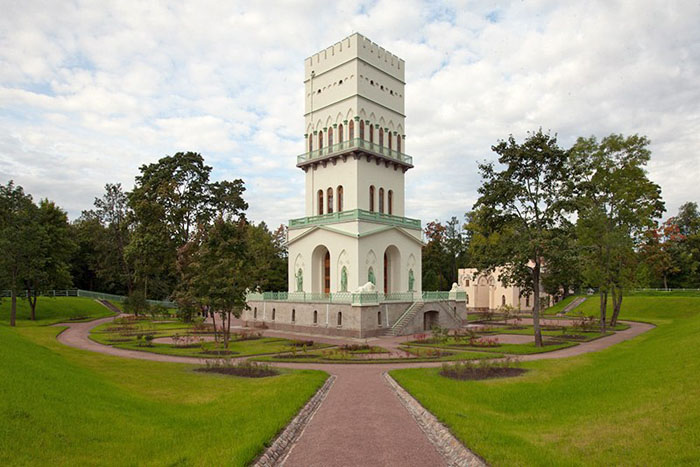
Off the main axis of the landscaped part of Alexandrovsky Park is a complex of structures inspired by the image of a medieval knight’s castle. It includes the Gate Ruin — two towers with a gate between them, as well as a moat and an embankment topped with a brick battlement. The dominant feature and core of the complex was and remains the White Tower — the "donjon," standing 37.8 meters tall, the main tower in European feudal castles, located within the fortress walls.

Tower Ruin Chapel

P98H+4X Pushkinsky District, Saint Petersburg, Russia

On September 15, 2018, the Chapel—the most romantic pavilion of Alexander Park—reopened to visitors after restoration. For more than seventy years, the building had been in a state of disrepair. Built in the 19th century in the form of a Gothic chapel ruined by time, the "Chapel" pavilion sustained numerous damages during the Great Patriotic War. Especially

Gothic gates

Catherine Park / Ekaterininsky Park, Saint Petersburg, Russia, 196603

Gothic Gates — decorative gates in the Catherine Park of Tsarskoye Selo. Created in 1777–1780 based on a design by Felten, taken from an English architectural publication. Several wooden carved models were made in Saint Petersburg and Yekaterinburg for the production of the cast-iron gates, on the basis of which the parts of the structure were cast at the Kamensky State Cast Iron Foundry.

Palace Power Station in Pushkin

Malaya St., 7-9, Saint Petersburg, Russia, 196601

The history of electric lighting in Tsarskoye Selo began in 1887; the first power station in Russia was housed in the Singing Tower and provided light to 3,000 lamps. By 1896, its capacity was no longer sufficient, and it was decided to build another power station. By 1896, Tsarskoye Selo had become the first European city with fully electric street lighting.

Renella Pavilion (Tea House or Gothic Cottage)

VXM4+Q3 Petrodvortsovy District, Saint Petersburg, Russia

The Renell Pavilion, or as it was sometimes called, the Tea or Gothic House, is one of the many diverse park pavilions that appeared in Peterhof during the reign of Nicholas I. "During the Empress's stay in Palermo (the wife of Nicholas I), she liked a Gothic house with multifaceted pointed towers at the corners of an elongated quadrangle. Rough sketches of this building made on the spot were sent to St. Petersburg with the order for Stakenschneider to build the Renell Pavilion according to them in Znamenka, on the shore."

P.K. Alexandrov's Dacha (Lviv Palace)

St. Petersburg Highway, 69, St. Petersburg, Russia, 198515

Everyone who has passed through Strelna has repeatedly seen the large sandy-colored neo-Gothic mansion standing near the Peterhof highway on the edge of a natural ledge. This is the former palace of Prince Lvov, one of the prominent and beautiful palaces of Strelna. And although the palace itself fits organically into the modern surroundings and is only about one and a half centuries old, the lands on which it was built have long been owned by a variety of people.

Cottage Palace

VWHW+95 Petrodvortsovy District, Saint Petersburg, Russia

The Cottage Palace (English: cottage) is the central architectural structure of the palace and park ensemble of Alexandria, built using elements of the Neo-Gothic style in 1826–1829 for the family of Emperor Nicholas Pavlovich according to the design by architect Menelas, with an extension by Shtakenshteider. In the film *The Adventures of Sherlock Holmes and Dr. Watson*, the Cottage "played" the role of Milverton's mansion.

The Mansion of Countess Kleinmichel

nab. Krestovka River, 10, Saint Petersburg, Russia, 197110

The mansion of Countess Kleinmichel, a remarkable architectural monument, is located in the northwestern part of Kamenny Island, on the bank of the Krestovka River, a tributary of the Malaya Nevka, which separates Kamenny and Krestovsky Islands.

German Reformed Church — Palace of Culture of Communications Workers

Bolshaya Morskaya St., 58, Saint Petersburg, Russia, 190000

The Palace of Culture of Communications Workers, the Communications Palace of Culture, is a former palace of culture located in the center of Saint Petersburg at 58 Bolshaya Morskaya Street. It was rebuilt from a German Reformed Church dating from 1862–1865, created under the direction of architects Harald Bosse and David Grimm.

Prince Orlov's Dacha

Frontovaya St., 2, Saint Petersburg, Russia, 198515

The Orlov Palace is a neo-Gothic palace that is part of the estate of the Orlov princes in Strelna, a suburb of Saint Petersburg. The palace was destroyed during the Great Patriotic War, but some buildings of the former estate have been preserved and are recognized as a cultural heritage site of Russia. As of 2016, the estate includes: a tower-ruin, Gothic gates, a grotto, a gatekeeper's house, a well, a stable yard (gates, a building with an Ionic portico, two stables, a smithy, an icehouse, two greenhouses), the Tuff Bridge, and "Parnassus."