

On April 5, 1841, at the initiative of Princess Therese of Oldenburg and Prince Peter of Oldenburg, the Princess of Oldenburg’s Women’s School was established, the main purpose of which was to educate girls from indigent families of all free estates.
The initial fund for establishing the women’s school came from Princess Therese’s “toilet money,” the savings from which were used to purchase a building at the corner of Kamennoostrovsky and Bolshoy Prospekt.
The school’s mission was “to educate young ladies of insufficient means, whose future must be secured by honest and noble work.” The institution was funded almost exclusively by tuition fees paid by the pupils. There were no state-funded pupils, only scholarship holders of Princess Therese; at one time, there were up to 30 scholarship holders of Prince Oldenburg.
On March 22, 1841, after the institute’s program was approved by the Ministry of Public Education, the minister of that department, Count Uvarov, gave permission and personally attended its opening. From 1841, the institute was incorporated into the St. Petersburg educational district, about which the trustee of this district, Dondukov-Korsakov, reported to Prince Oldenburg: “Having the honor to receive Your Serene Highness’s most esteemed letter dated April 3rd of this year, I consider it my duty to inform you that I regard myself fortunate to fulfill the wish of Your Serene Highness’s most illustrious spouse and with full readiness accept under the jurisdiction of the St. Petersburg educational district the educational establishment founded by Her Serene Highness, entrusting at the same time the current university rector, actual state councilor P. A. Pletnev, with permanent supervision of the academic part of this school…”

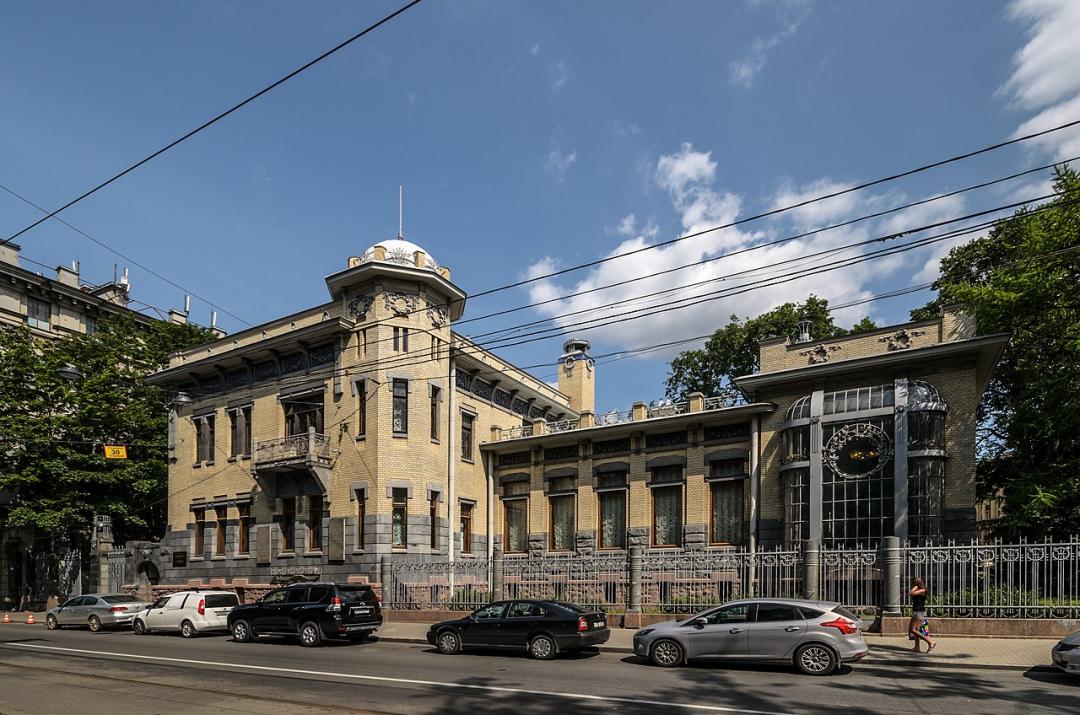
In 1841, Prince Peter of Oldenburg purchased a plot with a two-story house at the corner of Kamennoostrovsky and Bolshoy Prospekts for this educational institution. The building was constructed in 1838 according to the design of architect Tiblein. In 1853, a four-story wing was added to the old building, designed by the same architect. From 1893 to 1896, the institute building and its annexes underwent reconstruction under the supervision of architect Schaub; in 1897 under architect Lyutsedarsky; and in 1905 under architect Pretro. On January 16, 1842, the Church of the Resurrection of Christ was built and consecrated at the institute on Kamennoostrovsky Prospekt 36. In 1895, the church was reconstructed by architect Schaub. On January 24, 1896, the rebuilt church was consecrated by Bishop Nazary. From 1900 to 1914, the institute’s religion teacher and church rector was the future Metropolitan of Petrograd and Ladoga, Artemy.
In its first year, the school had thirty-five pupils. The initial course of study lasted six years, divided into three classes with a two-year course in each.
From 1844, graduates began receiving certificates modeled after those of other closed women’s educational institutions. From 1855, upon graduation, graduates were issued diplomas qualifying them as home tutors. From 1841 to 1860, the number of pupils increased from thirty-five to two hundred. The school curriculum included subjects such as Russian language and literature, arithmetic, geometry, natural history, physics, foreign languages, music, dance, the Law of God, needlework, household management, and homemaking. In 1879, at the initiative of Princess Alexandra of Oldenburg, a brief course in didactics, pedagogy, teaching and upbringing methods, and algebra was introduced. In addition to the core subjects, medical aid and typewriting were taught. From 1879, the school offered a general eight-class education with a one-year course in each, and the curriculum volume equaled that of other women’s institutes.
In 1871, after the death of Princess Therese of Oldenburg, the institute’s leadership was taken over by Prince Peter of Oldenburg and Princess Alexandra of Oldenburg. From 1881, after Peter of Oldenburg’s death, the institute’s trustees were his children — Prince Alexander Petrovich of Oldenburg and Princess Theresa Petrovna of Oldenburg.
In 1880, by decree of Emperor Alexander II, all employees of the Princess Therese of Oldenburg Women’s School were granted the rights of a women’s gymnasium of the Ministry of Public Education. In 1884, a special preparatory class was opened at the school to prepare children for admission to the first grade. From 1885, permission was obtained for the institute to award silver and gold medals to its graduates. On April 6, 1891, on the school’s fiftieth anniversary, by decree of Emperor Alexander III, it was transformed into the Princess Therese of Oldenburg Institute, and the curriculum began to be developed in accordance with the volume of subjects taught in women’s institutes. From 1914 to 1917, during World War I, a temporary military hospital was located on the institute’s premises. In 1917, after the October Revolution, the Princess Therese of Oldenburg Institute was closed. In 1917, the institute’s assembly hall was used for meetings of the All-Russian Peasant Union.
Sources:
https://www.citywalls.ru/house1123.html
https://ru.wikipedia.org/wiki/Princess_of_Oldenburg_Institute




Written by Jermaine
Discuss this with the author and others
No comments yet. Be the first to start the conversation.