

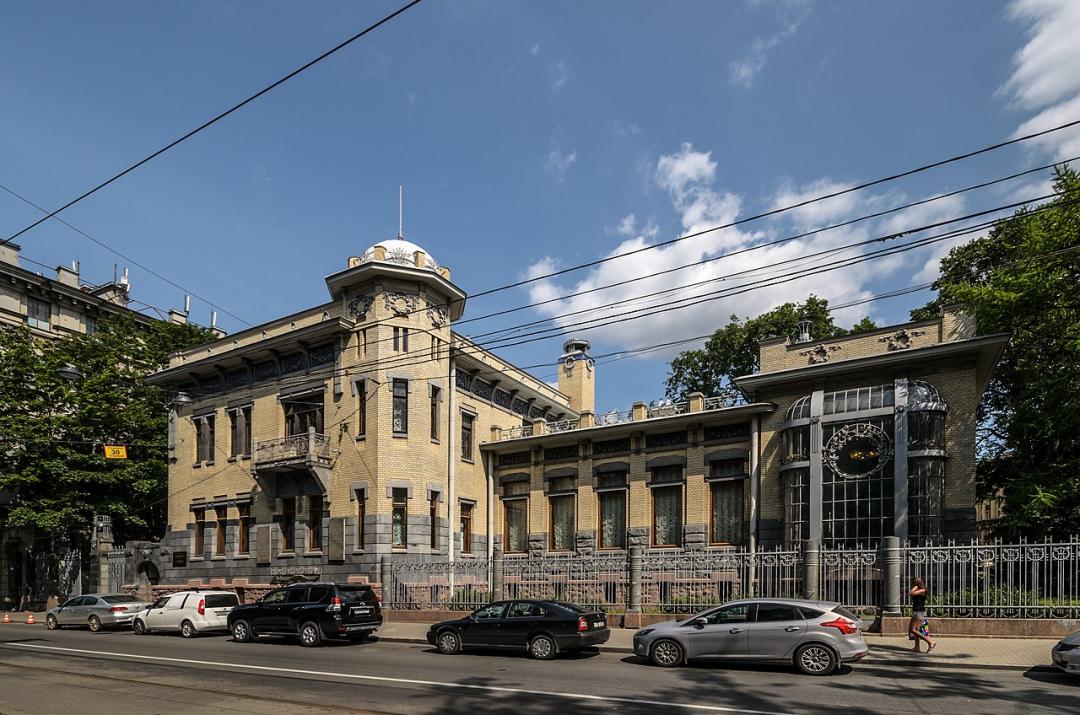
The name of the square is not historical. The first buildings at the intersection of Kamennoostrovsky Prospect and Bolshaya Oruzheynaya Street appeared in 1711: by order of the Armory Office, 19 clay huts were built for master weavers. Later, the Hamovny Yard was erected on the Fontanka Embankment, and the vacated houses were transferred to the Embassy Office. Until the beginning of the 20th century, a significant part of the land was occupied by gardens. The modern Austrian Square was outlined in the general plan of Petersburg in 1831, and its final octagonal shape was adjusted and approved in 1880. The construction of revenue houses began at the beginning of the 20th century. Besides the house built in 1900–1901 by Lepenberg (Kamennoostrovsky Prospekt, 18/11), the square’s ensemble was designed by architect Vasily Shaub. According to his projects, expressive buildings in the style of German Art Nouveau were constructed, and critics highly praised the originality and sophistication of their design. Unlike the classicism typical for the rest of Petersburg’s architecture, Shaub’s ensemble was created at the intersection of Jugendstil and Baroque. Only three of these buildings have survived to this day; one was destroyed during the Great Patriotic War. In its place, in the early 1950s, a building was constructed according to the project of architects Alexey Shcherbenko and Oleg Guryev. The entire square was characterized as “transplanted entirely from a German city,” yet it remained unnamed, and the houses were numbered separately by streets. According to one version, the square was conceived as a reduced copy of Copenhagen’s Amalienborg.
The square at the intersection of Kamennoostrovsky Prospect and Mira Street (formerly Ruzheynaya) existed without a name for many years. The idea to name the square arose quite unexpectedly in the autumn of 1992, when the city leadership had the thought to create a corner of Austria here. This was prompted by a certain similarity between the architectural style of the Russified German Shaub and the architecture of Vienna.
Initially, it was intended to name the square Viennese, but such a name was too “waltzing,” so it was given the name Austrian. This happened on October 29, 1992.
Sources:
Aleksey Erofeev: Petersburg in the Names of Streets. The Origin of the Names of Streets and Prospects, Rivers and Canals, Bridges and Islands
https://ru.wikipedia.org/wiki/Австрийская_площадь




Written by Jermaine
Discuss this with the author and others
No comments yet. Be the first to start the conversation.