Russia: Political Terrorism and Assassinations

For Browsing

Individual political terror

The First Shot or Do Not Touch My Anointed One

Palace Embankment, 2, Saint Petersburg, Russia, 191186

This shot split Russian history in two. It was destined to open a new era for a tall, fair-haired, sullenly silent young man.

They hunted him like a hare.

Palace Square, 6, Saint Petersburg, Russia, 191186

Alexander took off running from him like a boy. In front of the crowd's eyes, the Sovereign of all Rus' was fleeing from his own palace!

The beginning of professional terror, attempt number 4

Sickle and Hammer, Moscow, Moscow Region, Russia, 109544

What do they have against me, these miserable ones? Why do they chase me like a wild beast?

Carpenter bomber, attempt number 5

Dvortsovaya Sq., 1a, Saint Petersburg, Russia, 191186

Trouble literally came to the house of the Russian emperor

White scarf

Griboedov Canal Embankment, 2A, Saint Petersburg, Russia, 191186

..An explosion thundered from the Catherine Canal, covering Russia with a cloud.

Hemorrhoidal colic of Peter III

Krasnoselskoye Highway, 1, Ropsha, Leningrad Region, Russia, 188515

For now, she, Catherine II Alekseevna, felt relieved. Let one legitimate Russian emperor, Ivan VI Antonovich, still be alive and languishing in the casemate of the Shlisselburg Fortress. But she had gotten rid of her main rival, the also legitimate emperor Peter III Fedorovich.

Diamond of the Revolution

X828+2M Petrogradsky District, Saint Petersburg, Russia

Dora Vul'fovna Brilliant — revolutionary, member of the Socialist-Revolutionary Party (SRs) and their combat organization, participant in the assassination attempts on Minister of Internal Affairs Vyacheslav Pleve and Grand Duke Sergei Alexandrovich.

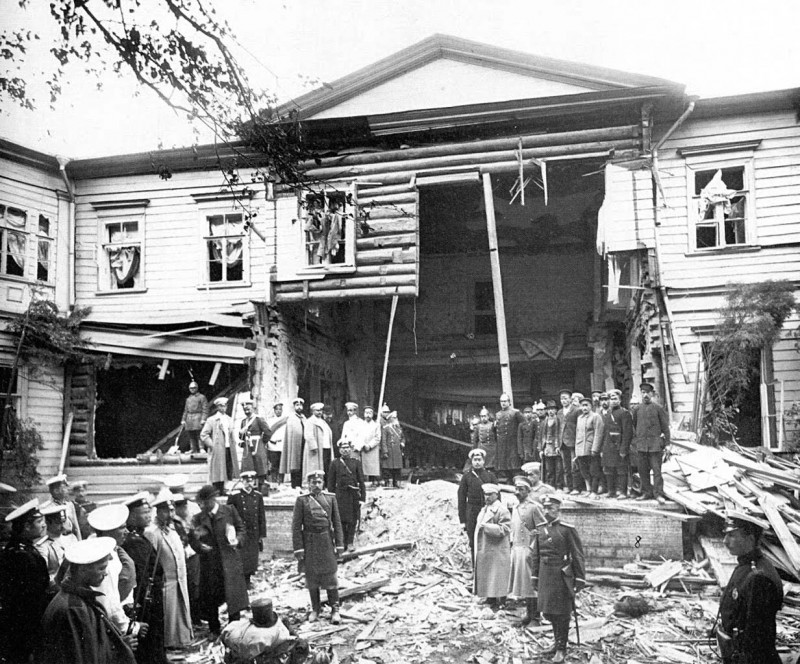
Explosion on Aptekarsky Island

Aptekarskaya Embankment, 6a, Saint Petersburg, Russia, 197022

The assassination attempt was carried out by the St. Petersburg organization of the "Union of Socialist-Revolutionary Maximalists," formed in early 1906. Stolypin provoked the hatred of the revolutionary segment of society by brutally suppressing the revolutionary movement.

"White Cross" Against Soviet Power: The Rise and Fall of the Most Unusual Gang

Novatorov Blvd, 73 building 4, Saint Petersburg, Russia, 198217

In the late 1980s, criminal groups began to appear in Russia, consisting of outright bandits as well as formerly law-abiding athletes, military personnel, and security officers. There were also quite unusual organized crime groups. For example, the "White Cross." The gang was organized by former police officers who operated within a firm political platform — they intended to overthrow the Soviet government.

"To Remake the World Anew…" - Dostoevsky and the Petrashevsky Circle Case

Territory. Peter and Paul Fortress, 14, Saint Petersburg, Russia, 197198

Dostoevsky was delivered to the Peter and Paul Fortress on the night of April 23 to 24, 1849, from the Third Department of His Imperial Majesty’s Own Chancellery on the Fontanka Embankment (modern No. 15), accompanied by a gendarme lieutenant. In “individual” carriages under the guard of gendarme officers, with intervals of 10–15 minutes, thirteen of the “main culprits” were sent to the fortress.

The Civil Execution of the Petrashevsky Circle Members

Pushkinskaya, Saint Petersburg, Russia, 191180

The Petrashevsky Circle was a group of young people who gathered in the 1840s around the official and writer Petrashevsky: utopian socialists and democrats striving to reorganize autocratic and serf-owning Russia. They aspired in words but practically accomplished almost nothing. They met on Fridays at Petrashevsky’s place or at someone else’s among the circle members, most often at the poets Pleshcheev’s or Durov’s, discussing pressing issues, reading poetry, and showing interest in theater and music. They didn’t even create a secret society. They didn’t have time. But almost a quarter of a century later, after the uprising on Senate Square, Nicholas I still feared the free-thinking youth. For their conversations, for their dreams of a bright future for their people, for reading the “forbidden” works of their idol Belinsky, 23 dreamers — each just over 20 years old — were arrested on denunciation and went through almost the same fate as the Decembrists.

S. Yu. Witte Mansion - Andrey Petrov Children's Music School

Kamennoostrovsky Ave, 5, Saint Petersburg, Russia, 197046

On Kamennoostrovsky Prospect, next to the Lidval house, stands a modest white and blue mansion. This mansion is associated with Sergey Yulyevich Witte – one of the most significant figures in Russian history.

The assassination of the Minister of Internal Affairs V.K. Pleve on July 15, 1904

Izmailovsky Ave., 31/163, Basement Floor, Saint Petersburg, Russia, 190005

On July 28, 1904, the Minister of Internal Affairs of the Russian Empire, Vyacheslav Konstantinovich von Plehve, was assassinated. By that time, this was not the first death of a Russian official at the hands of conspirators. This period can without hesitation be called a true manhunt. However, each such case resonated noticeably in society and remained a topic of conversation for a long time. For what reason was a man, wholeheartedly devoted to his country and the royal family, who managed to tame the "People's Will" and sincerely believed in victory over the revolution, killed?

The assassination of Chief of the Gendarmes Nikolai Vladimirovich Mezentsov - the first high-profile terrorist attack in Russia

Mikhailovsky Square, Arts Square, Saint Petersburg, Russia, 191186

On August 16, 1878, the editor of *Zemlya i Volya*, Stepnyak-Kravchinsky, stabbed the chief of the gendarmes, Mezentsev, with a stiletto in broad daylight in front of the Tsar's Mikhailovsky Palace in Petersburg (now the Russian Museum). The first high-profile terrorist attack in Russia.

The Mystery of the Assassination Attempt on Governor Trepov of St. Petersburg and the Fate of Vera Zasulich.

Admiralteysky Ave, 6, Saint Petersburg, Russia, 191186

In 1878, Vera Zasulich attempted to assassinate the St. Petersburg governor F. Trepov, seriously wounding him. In March 1878, the jury completely acquitted the defendant and released her from custody.