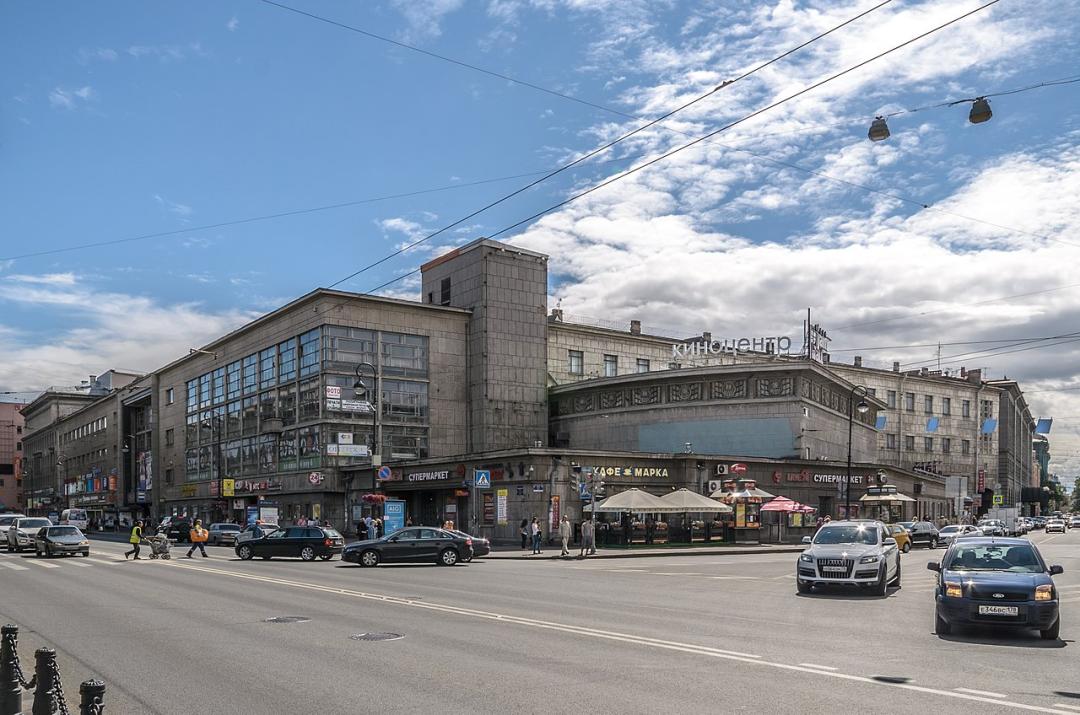
Palace of Culture named after Lensovet

Kamennoostrovsky Ave., 42a, Saint Petersburg, Russia, 197022

The Lensovet Palace of Culture is one of the most famous art centers in Saint Petersburg. The constructivist-style building is located in the very heart of the Petrogradsky District and has been attracting residents and tourists of all ages for 90 years. Originally, the architectural structure was called the Palace of Culture of Industrial Cooperation, and it only received its current name in 1960.

Previously, on this site in 1910, architects Belogrud and Ginger, with the participation of Sysoev, built the "Sporting Palace" of the Bashkirov brothers—Alexander and Nikolai—who were millers (the part facing the street has not survived, the rest was incorporated into the existing building during reconstruction). It housed the city's largest cinema, a restaurant, and a concert hall, but the main feature was the roller-skating rink—the "skating ring."

The current building was constructed between 1931 and 1938 based on a design by Levinson and Munz. A reinforced concrete shell of the former Sporting Palace was integrated with a theater hall seating 2,200, featuring an orchestra amphitheater and two balconies, surrounded by a circular foyer. To improve acoustics, the ceiling of the hall was shaped like a horn. On either side of the theater hall along the avenue were planned club and sports zones. The sports zone with a swimming pool was designed to be located at house No. 40, but this wing was never realized. Above the entrance to the Palace of Culture is a bas-relief strip symbolizing theatrical art, music, and labor. To the right of the giant glazed portal were library rooms, distinguished by suspended glass panels spanning three floors and wrapping around the building’s corner. Behind this volume, a tower cuts into the 200-meter horizontal block on the north side, intended to serve as the vertical axis of the composition and the dominant feature of the avenue, similar to Trotsky’s Kirov District Council. According to the original design, it was supposed to rise 46 meters, but its actual height is 30 meters. Levinson tried to have the tower completed but without success. At the base of the tower, at the corner of the avenue and the adjacent square, there is a group of volumes of varying sizes, dominated by the small sector-shaped hall (cinema hall). The stucco decorations of the cinema stage portal were created by sculptor Gromov.


The original name was the House of Culture of Industrial Cooperation (colloquially called "Promka"). The current name, in honor of the Lensovet (then the Leningrad Council of Workers' Deputies), and the status of a palace of culture were assigned in 1960.

In April 1935, at the initiative of Marshak, the first Children's Book Festival was held in this building, which became a tradition. The building housed numerous clubs, studios, lecture halls, a library, a theater hall, a cinema, and a winter garden. The palace remained open even during the blockade.

Currently, part of the building is occupied by various shops and offices, while another part is still used by clubs and studios. Concerts, theatrical performances, and lectures are held here from time to time. In the part of the building facing Shevchenko Square (Malyy Prospekt of the Petrograd Side, 89), until 2014, there was the "Gem-Hall" cinema.

The building belongs to the Federation of Trade Unions of St. Petersburg and the Leningrad Region and was managed by the cultural institution "Palace of Culture named after Lensovet." At the end of February 2007, LLC "Palace of Culture named after Lensovet" was established, with 51% of shares owned by the Federation of Trade Unions and 49% by CJSC "Petrovsky Builder," part of the "KONRAD" group of companies. The new owners intended to complete the fifty-meter tower designed by Levinson but never realized; however, this project faced public criticism and was not approved by KGIOP (Committee for State Control, Use and Protection of Historical and Cultural Monuments).

Construction of the House of Culture of Industrial Cooperation (now the Palace of Culture named after Lensovet) began in 1931. The project was created by architects Levinson and Munz. A large and very important site at the corner of Kirov Avenue and Shchors Avenue was allocated for construction. Before the revolution, a large building of the Skating Ring—a roller-skating rink—stood here. It was in a neglected state. It was decided to convert the Skating Ring, originally made entirely of concrete and reinforced concrete, into the auditorium of the House of Culture, while the front part of the old building, directly facing Kirov Avenue, was demolished and replaced with a new multi-story building spanning the entire width of the site.

The House of Culture, one of the largest in Leningrad and comparable to the previously built Moscow-Narva and Vyborg districts, included: a theater hall for 2,200 spectators, a large cinema, two lecture halls, large exhibition and dance halls, a foyer, a library, and numerous club rooms.

The cinema hall was designed as an additional volume adjoining the corner part of the building. The corner location of the site also determined the asymmetry of the composition. A tall tower, introduced into the corner part of the building and built to roughly half its planned height, enhanced the asymmetry. The fact that the tower, which was supposed to contrast with the elongated blocks, was not fully built negatively affected the overall appearance of the building.

During construction, the project was partially modified, mainly to "enrich" the facades—a rustication was added, and a sculptural frieze was introduced above the main entrance. All this was due to the changing direction of Soviet architecture at the time, as mentioned above. In fact, the modern interpretation of the composition, sharp and expressive in its own way, did not need any decorative additions.

Unfortunately, the quality of finishing work in the House of Culture named after Lensovet left much to be desired. Poor plastering, wooden window frames, and substandard glass all worsened the building’s exterior appearance.

The architects successfully utilized the old concrete shell of the Skating Ring. They divided it transversely into three parts: the main middle part housed the auditorium, while the other two, semicircular in shape, contained the foyer and the stage. The predetermined width of the hall with a large number of seats resulted in an excessively elongated shape. However, its architectural decoration was successful. A large amount of wood of various species was used in the interior finish.


The long, horizontally articulated four-story building under one roof had a dull, monotonous appearance. It was proposed to change the design to give the building a more interesting exterior. Because of this, construction was extended until 1938. During the project revision, to avoid monotony, the architects cut the facade through its entire height with two large, deeply recessed stained-glass windows framed in black granite, and the northern corner of the building was decorated with continuous glazing. Above the northern corner of the large building, a 50-meter rectangular tower was to be constructed (according to the project), but this idea remained unrealized. Among the interior spaces, the theater is of greatest interest, for which the architects used the old walls of the huge sports hall, where the theater foyer, the auditorium for two thousand seats (including orchestra, amphitheater, and two balconies), and a large technically equipped stage were comfortably accommodated. Construction was completed at the end of 1938. The northern facade of the Palace of Culture named after Lensovet (until 1960—the House of Culture of Industrial Cooperation) faces Malyy Prospekt (formerly Shchors Avenue), on its odd-numbered side.

Sources:

https://ru.wikipedia.org/wiki/Palace_of_Culture_named_after_Lensovet

https://www.lensoveta.ru/about/history/

https://www.citywalls.ru/house1126.html

Follow us on social media

More stories from Petersburg: Stories of Kamennoostrovsky Prospect

Income House of A. I. Tsekhova

Kamennoostrovsky Ave., 8, Saint Petersburg, Russia, 197101

The stone house in Art Nouveau style was built in 1903 by architect Zeidler for Tsekhovaya, who purchased this plot. Previously, there were three vacant buildings and a wooden residential house on this site. The facade of the house features small balconies and numerous windows with varied designs; on the fourth floor, the cornice is supported by six herms. The facade, in pastel tones, is richly decorated with white stucco floral ornamentation, which reveals fairy-tale motifs.

Cathedral Mosque

Kronverksky Ave, 7, Saint Petersburg, Russia, 197046

Already in the early years of the existence of Saint Petersburg, a Tatar settlement appeared near the Peter and Paul Fortress. In 1798, more than five hundred Muslim servicemen submitted a petition requesting the granting of a prayer house and the allocation of land for a cemetery.

Lidval. Income House, the Beginning of Northern Art Nouveau in Petersburg

Kamennoostrovsky Ave., 1-3, Saint Petersburg, Russia, 197046

The works of Fyodor Lidval began to play a significant role in the architecture of Saint Petersburg in the 1900s. In the first stage of his creativity (1897–1907), he was a prominent representative of the "Northern Modern" style; his explorations during these years were close to the aspirations of Scandinavian and Finnish architects. At the same time, Lidval's buildings did not contradict the historically established appearance of the city. The Lidval tenement house, one of the architect's early works, is usually cited as an example of a residential building in this style. The Ida Amalia Lidval tenement house — the first independent work of this outstanding architect — was commissioned by his mother.

Kshesinskaya's Mansion: How the Ballerina Fought the Bolsheviks

Kronverksky Ave, 1, Saint Petersburg, Russia, 197046

The Matilda Kshesinskaya Mansion is one of the legends of St. Petersburg. This historic building, erected at the beginning of the 20th century on Troitskaya Square in the northern capital, has remained almost unchanged to this day. The mansion belonged to the famous St. Petersburg ballerina and socialite Matilda Kshesinskaya, who was favored by Emperor Nicholas II himself. After the October events of 1917, the ballerina’s mansion came under the control of the Petrograd Soviet. Later, it housed the "Ilyich Corner," the Society of Old Bolsheviks, and the Museum of the Great October Socialist Revolution. After the collapse of the USSR, the building became home to the State Museum of the Political History of Russia. Everyone knows there is a museum on Gorkovskaya, but few remember that such a vivid and genuine history is connected to this beautiful house. The story of one of the most beautiful women of the era of the fall of the Russian Empire.

House with Towers — Rosenstein Income House

Bolshoy Prospekt P.S., 75, Saint Petersburg, Russia, 197101

The House with Towers – this is what the former income house of Konstantin Rosenstein in Saint Petersburg is called. It is a building rising above the others on Leo Tolstoy Square on the Petrograd Side. An unusual structure, reminiscent of an English medieval castle, appeared here at the beginning of the 20th century and became a decoration of this district of the northern capital.

Austrian Square

7 Mira St., Saint Petersburg, Russia, 197101

The name of the square is not historical. The square at the intersection of Kamennoostrovsky Prospekt and Mira Street (formerly Ruzheynaya) existed without a name for many years. Initially, it was intended to be called Viennese Square, but this name was too "waltzing," so in 1992 it was given the name Austrian Square.

Income House of A. F. Zimmerman

Kamennoostrovsky Ave., 61, Saint Petersburg, Russia, 197022

The house belonged to the hereditary honorary citizen, engineer Arthur Fedorovich Zimmerman.

S. Yu. Witte Mansion - Andrey Petrov Children's Music School

Kamennoostrovsky Ave, 5, Saint Petersburg, Russia, 197046

On Kamennoostrovsky Prospect, next to the Lidval house, stands a modest white and blue mansion. This mansion is associated with Sergey Yulyevich Witte – one of the most significant figures in Russian history.

Kavos Income House

Kamennoostrovsky Ave., 24, Saint Petersburg, Russia, 197101

The Kavos Income House at the intersection of Kamennoostrovsky Prospect and Bolshaya Monetnaya Street is one of the first residential buildings in St. Petersburg constructed in the Art Nouveau style. However, it is notable not just for this. The building is closely connected with two names without which the history of architecture in the Northern capital is inconceivable: Kavos and Benois. This 1897 building became the "flagship" of St. Petersburg Art Nouveau.

Income House of the First Russian Insurance Society - The House of the Three Benois

Kamennoostrovsky Ave., 26-28, Saint Petersburg, Russia, 197101

The income house of the First Russian Insurance Society, popularly known as the "House of the Three Benois," is a vast residential complex with pass-through courtyards opening onto Kamennoostrovsky Prospect, Bolshaya Pushkarskaya, Kronverkskaya, and Bolshaya Monetnaya streets. It was built between 1911 and 1914 based on the design by the architect brothers Leonty, Albert, and Julius Benois in the neoclassical style with elements of Art Nouveau.

Income House of E. K. von Lipgart - Workshop of E. K. von Lipgart

Kamennoostrovsky Ave, 16, Saint Petersburg, Russia, 197101

The income house of E.K. von Lipgart was built in 1904-1905 by the St. Petersburg architect of German origin V. Shaub. The style is late eclecticism with elements of Art Nouveau. In the courtyard of the house is the wing-workshop of E.K. von Lipgart, built in 1898-1899 according to the project of architect E.F. Virrich.

Income House of K. H. Keldal

Kamennoostrovsky Ave., 13/2, Saint Petersburg, Russia, 197101

Architect - Vasily (Wilhelm) Shaub - a St. Petersburg German, an active architect-builder of that era. Year of construction: 1902-1903. Style: Art Nouveau. It stands out for its rhythmic variety, play of textures and curved lines, and the introduction of plant ornamentation.

Imperial Alexander Lyceum

Kamennoostrovsky Ave., 21, Saint Petersburg, Russia, 197101

The Alexandrovsky Lyceum (Imperial Alexandrovsky Lyceum) is the name of the Tsarskoye Selo Lyceum after its relocation from Tsarskoye Selo to Saint Petersburg, as well as the complex of buildings in which it was housed.

The "Aquarium" Theater - "Lenfilm" Film Studio: This is Where Cinema Began

Kamennoostrovsky Ave, 10, Saint Petersburg, Russia, 197101

"Aquarium" – a theater-garden created in 1886 by entrepreneur G. A. Alexandrov. The garden occupied the area of the modern houses 10-12. A large aquarium was built in the garden (hence the name). The owner planned to hold lectures here about the life of fish and aquatic plants. The life of the "Aquarium" was full of vivid artistic events. The first film screening in Russia was arranged in the "Aquarium" theater, and here in the garden the first experimental screening of a sound film took place – a fragment of A. Rubinstein's opera "Demon" (1929). All the celebrities of that time, when visiting Petersburg, considered it an honor to perform or visit the establishment of merchant Alexandrov. Shalyapin and Utesov performed in the theater, and bankers, politicians, dignitaries, and "the very" Grigory Rasputin often frequented the restaurant. Also Tchaikovsky, Blok, Gorky.

Income House of G. A. Alexandrov

Kamennoostrovsky Ave., 12, Saint Petersburg, Russia, 197101

One of the income houses of the 1st guild merchant Georgy Alexandrovich Alexandrov is located at 12 Kamennoostrovsky Prospect. The house, in the Art Nouveau style, was built between 1905 and 1908 according to the design by architects Dmitry Andreevich Kryzhanovsky and Pavel Mikhailovich Mulhanov.

Income House of M. M. Gorbov

10 Mira St., Building A, Office 25, Saint Petersburg, Russia, 197101

But the main work of Vasily Shaub was the Gorbov income house, built in 1903, and it was not Art Nouveau, but eclecticism: the building, with its modest forms and a turret on the corner, resembled the first houses of the Peter the Great era. The building fit very well into the ensemble of the octagonal Austrian Square, and in 1907 it received an honorary prize at the competition for the most beautiful facades, organized by the City Duma.

Income House of V. M. Korzinin

Kamennoostrovsky Ave., 31-33, Saint Petersburg, Russia, 197101

One of the most successful examples of income houses in Saint Petersburg is the Korzinin building, which is located on the Petrograd side. The building was erected at the beginning of the 20th century, according to a design by Mulkhanov. Initially, the house belonged to the hofmeister and senator Musin-Pushkin.

Church of the Nativity of John the Baptist

Stone Island, located in the north of Petersburg, belonged since 1765 to Grand Duke Pavel Petrovich, heir to the throne and General Admiral of the fleet. By his order, in 1776, the construction of a hospice for disabled sailors, heroes of Chesma, was started on the island. At the same time, opposite the hospice, a church in a pseudo-Gothic style was laid according to the project of Felten, who was engaged nearby in the construction of a palace (the architect of which was Starov). The master stonemason Chiesa participated in its construction. Initially, the church was intended to be consecrated in the name of the apostles Peter and Paul and in honor of the Chesma battle. But the consecration of the temple took place on June 24, on the day of the Nativity of John the Baptist. It should be noted that this day was also a Masonic holiday, and the Grand Duke belonged to the lodges. The elegant structure, designed using Gothic forms, rose amidst the greenery of the park. The main volume of the church was pierced by pointed-arch windows. The bell tower and the round drum were topped with spires. The corner parts of the building were reinforced with buttresses, which were crowned above the cornice with small spires. The brick facades were not plastered. The pointed windows were highlighted with white casings. During later reconstructions, the open arched opening under the bell tower was bricked up. The outlines of the spires changed. The drum was covered with a conical top, and the bell tower with a four-sided pyramidal roof. The active Orthodox church is now located at the Kamennoostrovsky Palace. Many famous figures loved to rent summer houses on Stone Island: Derzhavin, Suvorov, and others. They all often visited the Ioannovskaya Church, and Pushkin even baptized three of his children there.

Women's School (Institute) of Princess Therese of Oldenburg

Kamennoostrovsky Ave., 36/73, Saint Petersburg, Russia, 197101

A closed women's educational institution of the Russian Empire, under the jurisdiction of the institutions of Empress Maria and part of the St. Petersburg educational district, existing from 1841 to 1918 in Saint Petersburg.

The House of the Emir of Bukhara

Kamennoostrovsky Ave., 44B, Saint Petersburg, Russia, 197101

A revenue house in Saint Petersburg, built in 1913–1914 by order of the Emir of Bukhara, Said Abdulahad Khan, for his son Said Alim Khan. The emir invited architect Stepan Krichinsky to design it, who had previously participated in the construction of the Cathedral Mosque. For the house project, the emir awarded the architect the Order of Noble Bukhara.

Income House of V. G. and O. M. Chubakovs

Kamennoostrovsky Ave., 38/96, Saint Petersburg, Russia, 197101

In 1910, honorary citizen V. G. Chubakov and his wife began the construction of a six-story residential building on the corner of Leo Tolstoy Square, based on a design by architect V. I. Van der Gucht.

M.K. Pokotilova Mansion

Kamennoostrovsky Ave, 48, Saint Petersburg, Russia, 197022

An elegant mansion in the Neo-Renaissance style, reminiscent of Italian villas, attracts attention with its beautiful decorative finishing details. Located at the intersection of Kamennoostrovsky Prospect and the embankment of the Karpovka River, it is styled as an Italian villa.

Income House of R. I. Bershtein

Kamennoostrovsky Ave, 54, Saint Petersburg, Russia, 197022

The majestic building stands out among its neighbors with a large ceremonial courtyard (such spaces are traditionally called cour d'honneur) and a powerful corner tower with a spire. Notably, this structure might never have appeared here: the original design by architect Kryzhanovsky did not include the construction of the tower.

Guardhouse of the Kamennoostrovsky Palace

Kamennoostrovsky Ave, 77, Saint Petersburg, Russia, 197376

The two-story building of the guardhouse of the Kamennoostrovsky Palace, officially referred to simply as the "wing with a greenhouse," was constructed in 1824 based on a design by the prominent St. Petersburg architect Ludwig Charlemagne.

The Dacha of Architect Voronikhin

Kamennoostrovsky Ave, 62, Saint Petersburg, Russia, 197022

At one time, there really was a wooden summer house (home) of the architect Andrey Nikolaevich Voronikhin here — the author of the designs for the Mining Institute building and the Kazan Cathedral.

Field of Mars

Mars Field, Lebyazhya Kanavka Embankment, 3, Saint Petersburg, Russia, 191186

A unique architectural ensemble surrounded by unique historical monuments of the Northern capital, a memorial cemetery, and at the same time a favorite summer recreation spot for the people of St. Petersburg.