Cathedral Mosque

Kronverksky Ave, 7, Saint Petersburg, Russia, 197046

Already in the early years of the existence of Saint Petersburg, a Tatar settlement appeared near the Peter and Paul Fortress. In 1798, more than five hundred Muslim servicemen submitted a petition requesting the granting of a prayer house and the allocation of land for a cemetery.


Already in the early years of Saint Petersburg’s existence, a Tatar settlement arose near the Peter and Paul Fortress. In 1798, more than five hundred Muslim servicemen submitted a petition requesting a prayer house and a plot of land for a cemetery. During the reign of Empress Catherine the Great, Muslims in the city enjoyed special favor from the authorities. They were granted numerous privileges, allowed to trade throughout the entire country and beyond. Moreover, the Muslim community of Saint Petersburg was entrusted with a mediating mission, establishing relations with Turkestan and Xinjiang. In 1803–1804, mosque projects were commissioned by the military department in Saint Petersburg, designed by architects Andrey Voronikhin and Luigi Rusca. Both projects remained unrealized. Prayer rooms were allocated in barracks. In 1862, officials refused the military guard akhun Muhammad-Ali Khantemirov permission to start collecting funds for the construction of a stone mosque with a minaret in Petersburg. According to the 1869 civil population census, out of 1,700 Muslims permanently residing in Petersburg, 1,585 were Tatars. In 1881, both Russian capitals were honored with a visit from the son of the Emir of Bukhara in connection with the coronation of Alexander III. By the beginning of the 20th century, about 8,000 Muslims lived in the city, but there was not a single mosque. The official request for mosque construction was sent by the head Muslim mufti Tevkelev to the Minister of Internal Affairs, Count Dmitry Andreyevich Tolstoy, back in the 1880s. Consent was obtained, but there were no funds for construction. On November 5, 1905, the Committee for the Construction of the Cathedral Mosque in Saint Petersburg was organized. It was approved by the Minister of Internal Affairs P. G. Stolypin in January 1906. The committee consisted of 20 Muslims, state and public figures, and merchants. Its organizer was the writer and publicist Akhun Bayazitov, and the chairmanship was given to Colonel Abdul-Aziz Davletshin.

The Spiritual Assembly closely monitored the fundraising. For example, it recommended Bayazitov transfer the collected funds from a private banking office to a branch of the State Bank, as was customary with the off-budget funds of the Spiritual Assembly. Thanks to this, in areas where State Bank branches existed, the collection of donations became more orderly.

The largest contribution was made by the Emir of Bukhara, Said-Abdulla-Ahad Khan, who paid for the land plot. The committee was granted the right to collect funds amounting to 750,000 rubles over 10 years throughout the Russian Empire. For this purpose, lottery tickets were issued and postcards with design views of the mosque were printed. The largest contribution was made by the Emir of Bukhara, Said-Abdulla-Ahad Khan, who paid 321,000 rubles for the land plot. He also donated 500,000 rubles for construction and organized fundraising among wealthy merchants of the emirate. For the mosque’s construction, the committee purchased a plot at the corner of Kronverksky Prospect and Konnaya Lane (house No. 7), which belonged to engineer I. Dolotsky. However, this was not enough. The mihrab (the sacred niche before which worshippers stand) had to face south, towards Mecca, which in this case was directly towards the facade of the house on the neighboring plot. This house was also bought on November 17, 1907. It housed ablution rooms, which must be used before entering the mosque. The building also accommodated the architects’ workshops, the construction office, and the committee’s reception. The remaining rooms were rented out, with the income going towards the mosque’s construction. Under the patronage of the emir, an architectural competition was held. The recommendations for this competition were developed by Akhun Bayazitov. It was required to build a two-tier mosque, with a choir, strict interior decoration, and an additional basement room to accommodate worshippers during annual Muslim holidays.

The results of the competition were summed up on March 11, 1908. A total of 45 projects were reviewed.


Vasilyev’s project was recommended by the judging commission for construction. Vasilyev proposed to take the Gur-Emir mausoleum in Samarkand as a model, which was ultimately realized. During the work, the architect involved his colleagues von Hogen and Krichinsky as co-authors. At that time, Hogen had great authority in government circles, which helped resolve many administrative and economic issues. Krichinsky was a member of the Muslim community, which was very important for the construction committee. He also built the house of the Emir of Bukhara on Kamennoostrovsky Prospect. According to legend, an underground passage was laid from that house to the mosque. Later, this architect supervised the finishing works of the temple building.

According to legend, an underground passage was laid from the house of the Emir of Bukhara on Kamennoostrovsky Prospect to the mosque. The mosque project and the application for permission to start work were submitted by von Hogen to the city administration on December 14, 1908. On April 3, 1909, Krichinsky was issued a certificate to carry out preparatory work and install a fence. At the same time, the project was sent for examination to the Academy of Arts. Overall, it was approved but received objections regarding the chosen location for the mosque. The disagreement was justified by the fact that the Muslim temple was located near the Orthodox Holy Trinity Cathedral and Peter I’s house, which violated the historical integrity of the center of Saint Petersburg. However, Stolypin, while generally agreeing with the arguments of the Academy of Arts, considered that it would be impractical to revoke the construction permit.

The solemn laying of the temple took place at 11 o’clock on February 3, 1910. It was timed to coincide with the 25th anniversary of the reign of the Emir of Bukhara and his visit to Saint Petersburg. According to the tradition of those years, a special silver plaque with an engraved commemorative text was ordered for the laying: “On February 3, 1910, in the presence of General-Adjutant Sheikh Abdul-Ahad Khan, Emir of Bukhara, and other honored guests, this mosque was laid on land donated to the Muslims of St. Petersburg by His Highness the Emir. May the believers praise the Almighty for the health of the main donor and all those who contributed with monetary donations or personal labor to the erection of this mosque.” In August 1911, N. V. Vasilyev drew up a project for the ablution house. In September, permission for construction was obtained, the wooden wing was dismantled, and by autumn 1913 a new building appeared in its place.

The first service in the mosque took place in February 1913, timed to the 300th anniversary of the Romanov dynasty.


The Saint Petersburg Cathedral Mosque became the northernmost mosque in the world. For a long time, it remained the largest. Its facade, although corresponding to all the canons of sacred architecture of Central Asia, has features of Northern Art Nouveau. The building is clad in gray granite. The mosque’s dome repeats the silhouette of the dome of the Gur-Emir mausoleum in Samarkand. The mosque is heated by steam, with electric ventilation and lighting. Masters from the village of Kikery near Gatchina, close to Petersburg, worked on the mosaic decoration of the portal, dome, and minarets. This is where the workshops of the Artistic Ceramic Production “Heldwein – Vaulin” were located.

The unique majolica of the temple was created by ceramic artist Pyotr Kuzmich Vaulin, grandfather of the famous Petersburg composer Andrey Petrov. In addition to Russian ceramists, Uzbek masters were involved in the work. The sketches of the medallions for the building’s facade were made by Crimean Tatar Ilyas Murza Boragansky, a well-known publisher and lecturer at the Faculty of Oriental Languages of the Imperial Petersburg University, owner of the “First Specialized Artistic and Artistic Electroprint.” Calligrapher Osman Akchokrakly was also involved. With the outbreak of World War I in 1914, the construction of the mosque slowed down, the inflow of funds decreased, and many builders were mobilized. Finishing work in the temple continued until 1918, and only from 1920 did regular services begin. In the late 1930s, the temple was closed and turned into a warehouse.

In 1956, the mosque building was handed over to the Muslim Religious Society, and restoration began. In 1968, the temple was granted the status of an architectural monument. During the mosque’s restoration, its dome was for the first time in the world clad not with ceramics but with more durable porcelain. Currently, the first floor houses a large main hall where men pray. The second floor is reserved for women. The third floor houses a Sunday madrasa school where lessons in Arabic and Tatar languages and the basics of Islam are taught.

Sources:

https://antennadaily.ru/2019/04/06/mosque-petersburg/

https://ru.wikipedia.org/wiki/Санкт-Петербургская_соборная_мечеть

https://www.citywalls.ru/house5457.html

Follow us on social media

More stories from Petersburg: Stories of Kamennoostrovsky Prospect

Income House of A. I. Tsekhova

Kamennoostrovsky Ave., 8, Saint Petersburg, Russia, 197101

The stone house in Art Nouveau style was built in 1903 by architect Zeidler for Tsekhovaya, who purchased this plot. Previously, there were three vacant buildings and a wooden residential house on this site. The facade of the house features small balconies and numerous windows with varied designs; on the fourth floor, the cornice is supported by six herms. The facade, in pastel tones, is richly decorated with white stucco floral ornamentation, which reveals fairy-tale motifs.

Lidval. Income House, the Beginning of Northern Art Nouveau in Petersburg

Kamennoostrovsky Ave., 1-3, Saint Petersburg, Russia, 197046

The works of Fyodor Lidval began to play a significant role in the architecture of Saint Petersburg in the 1900s. In the first stage of his creativity (1897–1907), he was a prominent representative of the "Northern Modern" style; his explorations during these years were close to the aspirations of Scandinavian and Finnish architects. At the same time, Lidval's buildings did not contradict the historically established appearance of the city. The Lidval tenement house, one of the architect's early works, is usually cited as an example of a residential building in this style. The Ida Amalia Lidval tenement house — the first independent work of this outstanding architect — was commissioned by his mother.

Kshesinskaya's Mansion: How the Ballerina Fought the Bolsheviks

Kronverksky Ave, 1, Saint Petersburg, Russia, 197046

The Matilda Kshesinskaya Mansion is one of the legends of St. Petersburg. This historic building, erected at the beginning of the 20th century on Troitskaya Square in the northern capital, has remained almost unchanged to this day. The mansion belonged to the famous St. Petersburg ballerina and socialite Matilda Kshesinskaya, who was favored by Emperor Nicholas II himself. After the October events of 1917, the ballerina’s mansion came under the control of the Petrograd Soviet. Later, it housed the "Ilyich Corner," the Society of Old Bolsheviks, and the Museum of the Great October Socialist Revolution. After the collapse of the USSR, the building became home to the State Museum of the Political History of Russia. Everyone knows there is a museum on Gorkovskaya, but few remember that such a vivid and genuine history is connected to this beautiful house. The story of one of the most beautiful women of the era of the fall of the Russian Empire.

House with Towers — Rosenstein Income House

Bolshoy Prospekt P.S., 75, Saint Petersburg, Russia, 197101

The House with Towers – this is what the former income house of Konstantin Rosenstein in Saint Petersburg is called. It is a building rising above the others on Leo Tolstoy Square on the Petrograd Side. An unusual structure, reminiscent of an English medieval castle, appeared here at the beginning of the 20th century and became a decoration of this district of the northern capital.

Austrian Square

7 Mira St., Saint Petersburg, Russia, 197101

The name of the square is not historical. The square at the intersection of Kamennoostrovsky Prospekt and Mira Street (formerly Ruzheynaya) existed without a name for many years. Initially, it was intended to be called Viennese Square, but this name was too "waltzing," so in 1992 it was given the name Austrian Square.

Income House of A. F. Zimmerman

Kamennoostrovsky Ave., 61, Saint Petersburg, Russia, 197022

The house belonged to the hereditary honorary citizen, engineer Arthur Fedorovich Zimmerman.

S. Yu. Witte Mansion - Andrey Petrov Children's Music School

Kamennoostrovsky Ave, 5, Saint Petersburg, Russia, 197046

On Kamennoostrovsky Prospect, next to the Lidval house, stands a modest white and blue mansion. This mansion is associated with Sergey Yulyevich Witte – one of the most significant figures in Russian history.

Kavos Income House

Kamennoostrovsky Ave., 24, Saint Petersburg, Russia, 197101

The Kavos Income House at the intersection of Kamennoostrovsky Prospect and Bolshaya Monetnaya Street is one of the first residential buildings in St. Petersburg constructed in the Art Nouveau style. However, it is notable not just for this. The building is closely connected with two names without which the history of architecture in the Northern capital is inconceivable: Kavos and Benois. This 1897 building became the "flagship" of St. Petersburg Art Nouveau.

Income House of the First Russian Insurance Society - The House of the Three Benois

Kamennoostrovsky Ave., 26-28, Saint Petersburg, Russia, 197101

The income house of the First Russian Insurance Society, popularly known as the "House of the Three Benois," is a vast residential complex with pass-through courtyards opening onto Kamennoostrovsky Prospect, Bolshaya Pushkarskaya, Kronverkskaya, and Bolshaya Monetnaya streets. It was built between 1911 and 1914 based on the design by the architect brothers Leonty, Albert, and Julius Benois in the neoclassical style with elements of Art Nouveau.

Income House of E. K. von Lipgart - Workshop of E. K. von Lipgart

Kamennoostrovsky Ave, 16, Saint Petersburg, Russia, 197101

The income house of E.K. von Lipgart was built in 1904-1905 by the St. Petersburg architect of German origin V. Shaub. The style is late eclecticism with elements of Art Nouveau. In the courtyard of the house is the wing-workshop of E.K. von Lipgart, built in 1898-1899 according to the project of architect E.F. Virrich.

Income House of K. H. Keldal

Kamennoostrovsky Ave., 13/2, Saint Petersburg, Russia, 197101

Architect - Vasily (Wilhelm) Shaub - a St. Petersburg German, an active architect-builder of that era. Year of construction: 1902-1903. Style: Art Nouveau. It stands out for its rhythmic variety, play of textures and curved lines, and the introduction of plant ornamentation.

Imperial Alexander Lyceum

Kamennoostrovsky Ave., 21, Saint Petersburg, Russia, 197101

The Alexandrovsky Lyceum (Imperial Alexandrovsky Lyceum) is the name of the Tsarskoye Selo Lyceum after its relocation from Tsarskoye Selo to Saint Petersburg, as well as the complex of buildings in which it was housed.

The "Aquarium" Theater - "Lenfilm" Film Studio: This is Where Cinema Began

Kamennoostrovsky Ave, 10, Saint Petersburg, Russia, 197101

"Aquarium" – a theater-garden created in 1886 by entrepreneur G. A. Alexandrov. The garden occupied the area of the modern houses 10-12. A large aquarium was built in the garden (hence the name). The owner planned to hold lectures here about the life of fish and aquatic plants. The life of the "Aquarium" was full of vivid artistic events. The first film screening in Russia was arranged in the "Aquarium" theater, and here in the garden the first experimental screening of a sound film took place – a fragment of A. Rubinstein's opera "Demon" (1929). All the celebrities of that time, when visiting Petersburg, considered it an honor to perform or visit the establishment of merchant Alexandrov. Shalyapin and Utesov performed in the theater, and bankers, politicians, dignitaries, and "the very" Grigory Rasputin often frequented the restaurant. Also Tchaikovsky, Blok, Gorky.

Income House of G. A. Alexandrov

Kamennoostrovsky Ave., 12, Saint Petersburg, Russia, 197101

One of the income houses of the 1st guild merchant Georgy Alexandrovich Alexandrov is located at 12 Kamennoostrovsky Prospect. The house, in the Art Nouveau style, was built between 1905 and 1908 according to the design by architects Dmitry Andreevich Kryzhanovsky and Pavel Mikhailovich Mulhanov.

Income House of M. M. Gorbov

10 Mira St., Building A, Office 25, Saint Petersburg, Russia, 197101

But the main work of Vasily Shaub was the Gorbov income house, built in 1903, and it was not Art Nouveau, but eclecticism: the building, with its modest forms and a turret on the corner, resembled the first houses of the Peter the Great era. The building fit very well into the ensemble of the octagonal Austrian Square, and in 1907 it received an honorary prize at the competition for the most beautiful facades, organized by the City Duma.

Income House of V. M. Korzinin

Kamennoostrovsky Ave., 31-33, Saint Petersburg, Russia, 197101

One of the most successful examples of income houses in Saint Petersburg is the Korzinin building, which is located on the Petrograd side. The building was erected at the beginning of the 20th century, according to a design by Mulkhanov. Initially, the house belonged to the hofmeister and senator Musin-Pushkin.

Church of the Nativity of John the Baptist

Stone Island, located in the north of Petersburg, belonged since 1765 to Grand Duke Pavel Petrovich, heir to the throne and General Admiral of the fleet. By his order, in 1776, the construction of a hospice for disabled sailors, heroes of Chesma, was started on the island. At the same time, opposite the hospice, a church in a pseudo-Gothic style was laid according to the project of Felten, who was engaged nearby in the construction of a palace (the architect of which was Starov). The master stonemason Chiesa participated in its construction. Initially, the church was intended to be consecrated in the name of the apostles Peter and Paul and in honor of the Chesma battle. But the consecration of the temple took place on June 24, on the day of the Nativity of John the Baptist. It should be noted that this day was also a Masonic holiday, and the Grand Duke belonged to the lodges. The elegant structure, designed using Gothic forms, rose amidst the greenery of the park. The main volume of the church was pierced by pointed-arch windows. The bell tower and the round drum were topped with spires. The corner parts of the building were reinforced with buttresses, which were crowned above the cornice with small spires. The brick facades were not plastered. The pointed windows were highlighted with white casings. During later reconstructions, the open arched opening under the bell tower was bricked up. The outlines of the spires changed. The drum was covered with a conical top, and the bell tower with a four-sided pyramidal roof. The active Orthodox church is now located at the Kamennoostrovsky Palace. Many famous figures loved to rent summer houses on Stone Island: Derzhavin, Suvorov, and others. They all often visited the Ioannovskaya Church, and Pushkin even baptized three of his children there.

Women's School (Institute) of Princess Therese of Oldenburg

Kamennoostrovsky Ave., 36/73, Saint Petersburg, Russia, 197101

A closed women's educational institution of the Russian Empire, under the jurisdiction of the institutions of Empress Maria and part of the St. Petersburg educational district, existing from 1841 to 1918 in Saint Petersburg.

The House of the Emir of Bukhara

Kamennoostrovsky Ave., 44B, Saint Petersburg, Russia, 197101

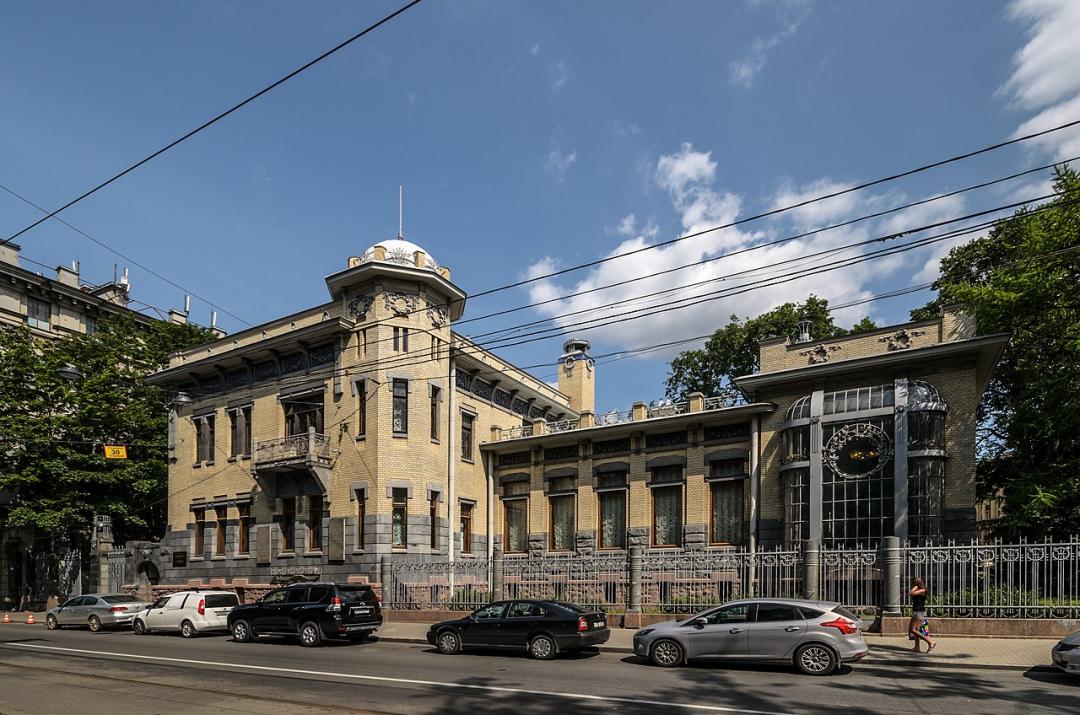
A revenue house in Saint Petersburg, built in 1913–1914 by order of the Emir of Bukhara, Said Abdulahad Khan, for his son Said Alim Khan. The emir invited architect Stepan Krichinsky to design it, who had previously participated in the construction of the Cathedral Mosque. For the house project, the emir awarded the architect the Order of Noble Bukhara.

Palace of Culture named after Lensovet

Kamennoostrovsky Ave., 42a, Saint Petersburg, Russia, 197022

The Lensovet Palace of Culture is one of the most famous art centers in Saint Petersburg. The constructivist-style building is located in the very heart of the Petrogradsky District and has been attracting residents and tourists of all ages for 90 years. Originally, the architectural structure was called the Palace of Culture of Industrial Cooperation, and it only received its current name in 1960.

Income House of V. G. and O. M. Chubakovs

Kamennoostrovsky Ave., 38/96, Saint Petersburg, Russia, 197101

In 1910, honorary citizen V. G. Chubakov and his wife began the construction of a six-story residential building on the corner of Leo Tolstoy Square, based on a design by architect V. I. Van der Gucht.

M.K. Pokotilova Mansion

Kamennoostrovsky Ave, 48, Saint Petersburg, Russia, 197022

An elegant mansion in the Neo-Renaissance style, reminiscent of Italian villas, attracts attention with its beautiful decorative finishing details. Located at the intersection of Kamennoostrovsky Prospect and the embankment of the Karpovka River, it is styled as an Italian villa.

Income House of R. I. Bershtein

Kamennoostrovsky Ave, 54, Saint Petersburg, Russia, 197022

The majestic building stands out among its neighbors with a large ceremonial courtyard (such spaces are traditionally called cour d'honneur) and a powerful corner tower with a spire. Notably, this structure might never have appeared here: the original design by architect Kryzhanovsky did not include the construction of the tower.

Guardhouse of the Kamennoostrovsky Palace

Kamennoostrovsky Ave, 77, Saint Petersburg, Russia, 197376

The two-story building of the guardhouse of the Kamennoostrovsky Palace, officially referred to simply as the "wing with a greenhouse," was constructed in 1824 based on a design by the prominent St. Petersburg architect Ludwig Charlemagne.

The Dacha of Architect Voronikhin

Kamennoostrovsky Ave, 62, Saint Petersburg, Russia, 197022

At one time, there really was a wooden summer house (home) of the architect Andrey Nikolaevich Voronikhin here — the author of the designs for the Mining Institute building and the Kazan Cathedral.

Field of Mars

Mars Field, Lebyazhya Kanavka Embankment, 3, Saint Petersburg, Russia, 191186

A unique architectural ensemble surrounded by unique historical monuments of the Northern capital, a memorial cemetery, and at the same time a favorite summer recreation spot for the people of St. Petersburg.