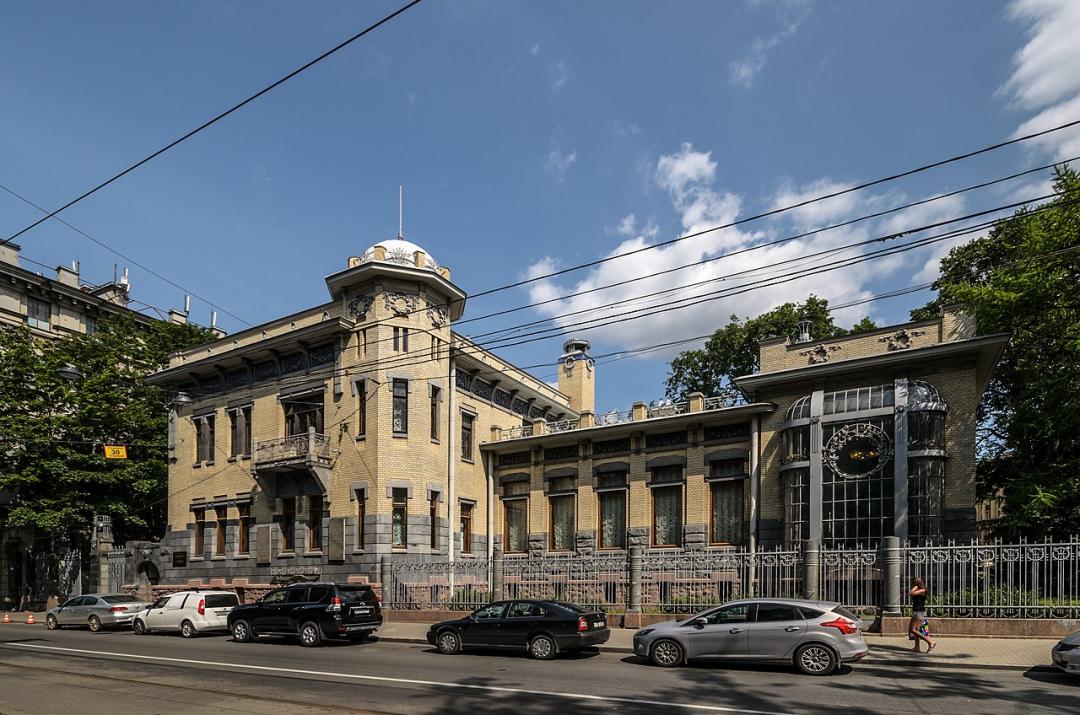
Income House of the First Russian Insurance Society - The House of the Three Benois

Kamennoostrovsky Ave., 26-28, Saint Petersburg, Russia, 197101

The income house of the First Russian Insurance Society, popularly known as the "House of the Three Benois," is a vast residential complex with pass-through courtyards opening onto Kamennoostrovsky Prospect, Bolshaya Pushkarskaya, Kronverkskaya, and Bolshaya Monetnaya streets. It was built between 1911 and 1914 based on the design by the architect brothers Leonty, Albert, and Julius Benois in the neoclassical style with elements of Art Nouveau.


The income house of the First Russian Insurance Society, popularly known as the “House of the Three Benois,” is a huge residential complex with passage courtyards opening onto Kamennoostrovsky Prospect, Bolshaya Pushkarskaya, Kronverkskaya, and Bolshaya Monetnaya streets. It was built in 1911–1914 according to the design by the architect brothers Leonty, Albert, and Yuliy Benois in the neoclassical style with elements of Art Nouveau.

This is one of the most well-equipped houses of the early 20th century, a true “city within a city,” with advanced engineering communications (sewerage, water supply, steam heating, lifting machines, telephones). It had its own power station, boiler room, laundry, garbage incinerator, and snow-melting facility. The complex was maintained by twenty janitors. Each entrance had a doorman. The building featured a novelty — several dozen built-in garages. In total, about 250 apartments were planned here, making the house “the largest residential complex in St. Petersburg at the beginning of the 20th century,” as it was described nearly a hundred years ago.

We are talking about house numbers 26–28 on Kamennoostrovsky Prospect. In fact, this is not just a house but an entire residential complex — it occupies almost an entire block of the Petrograd side.


In the city, this building is called the “Benois House” or the “House of the Three Benois,” since it was built according to the project of three representatives of the famous architectural family — the brothers Leonty and Albert and their cousin Yuliy Benois.

Almost a century ago, the house on Kamennoostrovsky set the direction for urban development. Today, the House of the Three Benois has gained nationwide fame thanks to countless crime TV series — the building is located near “Lenfilm” and the St. Petersburg television studio. Besides its convenient location (film crews of “cop” series save on everything and choose locations close to their technical base), the house stands out for its labyrinth of interconnected passage courtyards — there are more than a dozen of them, intricately connected.

The courtyards are numbered — supposedly for the convenience of visitors, but this numbering, marked with large painted signs at the gateways, is extremely confusing. It’s better to be patient and wander through the courtyards leisurely, without aiming to exit at a specific point.


The address of this huge, solid multi-apartment building could also include the nearby streets — Kronverkskaya and Bolshaya Pushkarskaya — since the side wings of this enormous structure face them. Essentially, this is the largest and most well-equipped residential complex in pre-revolutionary Petersburg.

Commissioned by the First Russian Insurance Society, the design and construction of this residential complex with 250 apartments were carried out by three architects sharing the surname Benois. Their full names were Leonty Nikolaevich, Albert Nikolaevich, and Yuliy Yulievich. Architect Gunst also participated in creating this unique residential building.

The huge house was designed and built in the popular neoclassical style of the early 20th century and received architectural and sculptural decoration corresponding to this concept. The northern and southern wings of the building are connected by a double-row Doric colonnade made of red Gangut granite. The same stone clads the plinth of the buildings, and small fragments of it, laid out as a mosaic, decorate the walls of the first floor in the inner courtyard. Elegant low colonnades, sculptures, mascarons, ornaments with griffins, dolphins, and horns of plenty complement the house’s decoration.

Great attention was paid during the design and construction of the house to creating comfort and coziness. The house had an autonomous power station, boiler room, laundry, garbage incinerator, snow-melting facility, telephone communication, was equipped with elevators, and fireplaces were installed in the apartments. The building on Kamennoostrovsky Prospect was maintained by janitors, guards, stokers, doormen — more than 100 people in total. Renting an apartment consisting of 5–7 rooms cost a decent sum; the tenants were wealthy Petersburgers: urban planners, theater figures, writers, composers, scientists, and officials.

After October 1917, some residents of the “House of the Three Benois” were consolidated, and their apartments turned into communal flats. Some premises were allocated by the new authorities to people they considered more valuable: for example, party officials, including the leaders of Leningrad. Therefore, the house is famous for its outstanding residents. Over the years, famous composers, artists, theater and film figures, writers, architects, scientists, party and state officials, and Soviet military leaders lived here.

Before the revolution, the writer Mikhail Chekhov, the brother of Anton Pavlovich Chekhov, lived here and published the magazine "Golden Childhood." The ballet artist Nesterovskaya was joined here by Prince Gavriil Konstantinovich of imperial blood, who moved from the Marble Palace.

Several organizations were also housed here. In the pre-revolutionary period, three infirmaries and the office of the Aral-Caspian Railway were located in the wing facing Bolshaya Pushkarskaya Street, and in 1918 a club and the editorial office of the Finnish communists’ newspaper, as well as the House of Enlightenment, appeared.

On August 31, 1920, a mass murder occurred in apartment No. 116 on the fifth floor of the main building. This was the so-called “Kuusinen Club,” essentially the headquarters of the Communist Party of Finland in Russia, where Finnish communists fled after their defeat in the civil war in their country in 1918.

The majority of the party elite settled in Petrograd and lived a luxurious life, unlike ordinary party members who lived in poverty. The brewing conflict was resolved by an opposition group with weapons in hand with the aim to “remove the leadership and the gap separating it.” Among the victims (8 killed, 10 wounded) were leaders of the Finnish Communist Party, including Jukka Rahja, brother of Lenin’s comrade who accompanied Ilyich to Smolny on the night of the October Revolution. The shooting at the “Kuusinen Club” caused a wide resonance, but the truth was attempted to be concealed. The dead were buried at Mars Field as victims of the White Finns.

Then the first residents were replaced by proletarian leaders. From April 1926 until his death, the apartment with windows facing the prospect was occupied by Sergey Mironovich Kirov, head of the Leningrad Regional Committee of the CPSU. The memorial museum named after him moved here in 1956 and currently welcomes visitors as a branch of the State Museum of the History of St. Petersburg.

After Sergey Kirov’s assassination in 1934, mass repressions began. Over four years, residents of 55 apartments in the House of the Three Benois were arrested.

Many residents of the house made significant contributions in various fields, and their names entered the country’s history: Marshals of the Soviet Union Govorov and Shaposhnikov, actors Cherkasov (“Alexander Nevsky”) and Babochkin (“Chapaev”), scientific director of the Institute of the Human Brain of the Russian Academy of Sciences, academician Bekhterev, and others. Memorial plaques on the wall facing Kronverkskaya Street testify to the creative personalities of the house.

Composer Dmitry Shostakovich lived and worked in apartment No. 5 of the wing on Bolshaya Pushkarskaya Street from 1937. In this house, he wrote the first three parts of his Seventh (Leningrad) Symphony. A memorial plaque with a bas-relief of Shostakovich is installed on the Bolshaya Pushkarskaya side, and his bust is placed in the courtyard opening onto Kronverkskaya Street.

Memorial plaques installed on the residential complex on the Kronverkskaya Street side inform passersby about the creative people who once lived here.

After the revolutionary events of 1917, many apartments in this house became communal. The best apartments were allocated to leading party and Soviet workers. In April 1926, the service apartment No. 20 in house 26–28 on Krasnykh Zor Street (formerly Kamennoostrovsky Prospect) was given to Sergey Mironovich Kirov, the first secretary of the Leningrad Regional and City Committees of the VKP(b). He lived here with his wife Maria Lvovna Markus until the last day of his life, December 1, 1934. In 1955, apartment No. 20 became a museum.


The Kirov Museum is a unique monument of the Stalin era. In the memorial apartment, besides five living rooms (in four of which the original furnishings are fully preserved), you will see two hallways, a bathroom, and a kitchen (recreated in the 2000s). In the former maid’s room, there is an interactive game “Take What They Give,” which tells about the ration card system of the 1920s–1930s in Leningrad. Other museum halls feature exhibitions: “S.M. Kirov’s Office in Smolny,” “For Our Happy Childhood…” and the multimedia exhibition “The Entire Kamennoostrovsky Prospect in a Box.”

Since 1999, the “Ostrov” theater has been performing in the basement of the “House of the Three Benois” on the Kamennoostrovsky Prospect side. Its foyer houses a small museum dedicated to the beloved Russian writer and playwright Alexander Volodin.

Walking along Kamennoostrovsky Prospect, it is impossible not to peek into the open parade courtyard of this beautiful house. The rows of columns framing the entrance seem to draw you inside this perfectly organized space from architectural and technical points of view.

Sources:

http://www.ipetersburg.ru/dom-treh-benua/

https://www.citywalls.ru/house559.html

https://www.companybest.ru/publications/24-peterburg/2859-tekhnicheskoe-chudo-dom-trekh-benua.html

https://kudago.com/spb/news/dom-tryoh-benua-ego/


Follow us on social media

More stories from Petersburg: Stories of Kamennoostrovsky Prospect

Income House of A. I. Tsekhova

Kamennoostrovsky Ave., 8, Saint Petersburg, Russia, 197101

The stone house in Art Nouveau style was built in 1903 by architect Zeidler for Tsekhovaya, who purchased this plot. Previously, there were three vacant buildings and a wooden residential house on this site. The facade of the house features small balconies and numerous windows with varied designs; on the fourth floor, the cornice is supported by six herms. The facade, in pastel tones, is richly decorated with white stucco floral ornamentation, which reveals fairy-tale motifs.

Cathedral Mosque

Kronverksky Ave, 7, Saint Petersburg, Russia, 197046

Already in the early years of the existence of Saint Petersburg, a Tatar settlement appeared near the Peter and Paul Fortress. In 1798, more than five hundred Muslim servicemen submitted a petition requesting the granting of a prayer house and the allocation of land for a cemetery.

Lidval. Income House, the Beginning of Northern Art Nouveau in Petersburg

Kamennoostrovsky Ave., 1-3, Saint Petersburg, Russia, 197046

The works of Fyodor Lidval began to play a significant role in the architecture of Saint Petersburg in the 1900s. In the first stage of his creativity (1897–1907), he was a prominent representative of the "Northern Modern" style; his explorations during these years were close to the aspirations of Scandinavian and Finnish architects. At the same time, Lidval's buildings did not contradict the historically established appearance of the city. The Lidval tenement house, one of the architect's early works, is usually cited as an example of a residential building in this style. The Ida Amalia Lidval tenement house — the first independent work of this outstanding architect — was commissioned by his mother.

Kshesinskaya's Mansion: How the Ballerina Fought the Bolsheviks

Kronverksky Ave, 1, Saint Petersburg, Russia, 197046

The Matilda Kshesinskaya Mansion is one of the legends of St. Petersburg. This historic building, erected at the beginning of the 20th century on Troitskaya Square in the northern capital, has remained almost unchanged to this day. The mansion belonged to the famous St. Petersburg ballerina and socialite Matilda Kshesinskaya, who was favored by Emperor Nicholas II himself. After the October events of 1917, the ballerina’s mansion came under the control of the Petrograd Soviet. Later, it housed the "Ilyich Corner," the Society of Old Bolsheviks, and the Museum of the Great October Socialist Revolution. After the collapse of the USSR, the building became home to the State Museum of the Political History of Russia. Everyone knows there is a museum on Gorkovskaya, but few remember that such a vivid and genuine history is connected to this beautiful house. The story of one of the most beautiful women of the era of the fall of the Russian Empire.

House with Towers — Rosenstein Income House

Bolshoy Prospekt P.S., 75, Saint Petersburg, Russia, 197101

The House with Towers – this is what the former income house of Konstantin Rosenstein in Saint Petersburg is called. It is a building rising above the others on Leo Tolstoy Square on the Petrograd Side. An unusual structure, reminiscent of an English medieval castle, appeared here at the beginning of the 20th century and became a decoration of this district of the northern capital.

Austrian Square

7 Mira St., Saint Petersburg, Russia, 197101

The name of the square is not historical. The square at the intersection of Kamennoostrovsky Prospekt and Mira Street (formerly Ruzheynaya) existed without a name for many years. Initially, it was intended to be called Viennese Square, but this name was too "waltzing," so in 1992 it was given the name Austrian Square.

Income House of A. F. Zimmerman

Kamennoostrovsky Ave., 61, Saint Petersburg, Russia, 197022

The house belonged to the hereditary honorary citizen, engineer Arthur Fedorovich Zimmerman.

S. Yu. Witte Mansion - Andrey Petrov Children's Music School

Kamennoostrovsky Ave, 5, Saint Petersburg, Russia, 197046

On Kamennoostrovsky Prospect, next to the Lidval house, stands a modest white and blue mansion. This mansion is associated with Sergey Yulyevich Witte – one of the most significant figures in Russian history.

Kavos Income House

Kamennoostrovsky Ave., 24, Saint Petersburg, Russia, 197101

The Kavos Income House at the intersection of Kamennoostrovsky Prospect and Bolshaya Monetnaya Street is one of the first residential buildings in St. Petersburg constructed in the Art Nouveau style. However, it is notable not just for this. The building is closely connected with two names without which the history of architecture in the Northern capital is inconceivable: Kavos and Benois. This 1897 building became the "flagship" of St. Petersburg Art Nouveau.

Income House of E. K. von Lipgart - Workshop of E. K. von Lipgart

Kamennoostrovsky Ave, 16, Saint Petersburg, Russia, 197101

The income house of E.K. von Lipgart was built in 1904-1905 by the St. Petersburg architect of German origin V. Shaub. The style is late eclecticism with elements of Art Nouveau. In the courtyard of the house is the wing-workshop of E.K. von Lipgart, built in 1898-1899 according to the project of architect E.F. Virrich.

Income House of K. H. Keldal

Kamennoostrovsky Ave., 13/2, Saint Petersburg, Russia, 197101

Architect - Vasily (Wilhelm) Shaub - a St. Petersburg German, an active architect-builder of that era. Year of construction: 1902-1903. Style: Art Nouveau. It stands out for its rhythmic variety, play of textures and curved lines, and the introduction of plant ornamentation.

Imperial Alexander Lyceum

Kamennoostrovsky Ave., 21, Saint Petersburg, Russia, 197101

The Alexandrovsky Lyceum (Imperial Alexandrovsky Lyceum) is the name of the Tsarskoye Selo Lyceum after its relocation from Tsarskoye Selo to Saint Petersburg, as well as the complex of buildings in which it was housed.

The "Aquarium" Theater - "Lenfilm" Film Studio: This is Where Cinema Began

Kamennoostrovsky Ave, 10, Saint Petersburg, Russia, 197101

"Aquarium" – a theater-garden created in 1886 by entrepreneur G. A. Alexandrov. The garden occupied the area of the modern houses 10-12. A large aquarium was built in the garden (hence the name). The owner planned to hold lectures here about the life of fish and aquatic plants. The life of the "Aquarium" was full of vivid artistic events. The first film screening in Russia was arranged in the "Aquarium" theater, and here in the garden the first experimental screening of a sound film took place – a fragment of A. Rubinstein's opera "Demon" (1929). All the celebrities of that time, when visiting Petersburg, considered it an honor to perform or visit the establishment of merchant Alexandrov. Shalyapin and Utesov performed in the theater, and bankers, politicians, dignitaries, and "the very" Grigory Rasputin often frequented the restaurant. Also Tchaikovsky, Blok, Gorky.

Income House of G. A. Alexandrov

Kamennoostrovsky Ave., 12, Saint Petersburg, Russia, 197101

One of the income houses of the 1st guild merchant Georgy Alexandrovich Alexandrov is located at 12 Kamennoostrovsky Prospect. The house, in the Art Nouveau style, was built between 1905 and 1908 according to the design by architects Dmitry Andreevich Kryzhanovsky and Pavel Mikhailovich Mulhanov.

Income House of M. M. Gorbov

10 Mira St., Building A, Office 25, Saint Petersburg, Russia, 197101

But the main work of Vasily Shaub was the Gorbov income house, built in 1903, and it was not Art Nouveau, but eclecticism: the building, with its modest forms and a turret on the corner, resembled the first houses of the Peter the Great era. The building fit very well into the ensemble of the octagonal Austrian Square, and in 1907 it received an honorary prize at the competition for the most beautiful facades, organized by the City Duma.

Income House of V. M. Korzinin

Kamennoostrovsky Ave., 31-33, Saint Petersburg, Russia, 197101

One of the most successful examples of income houses in Saint Petersburg is the Korzinin building, which is located on the Petrograd side. The building was erected at the beginning of the 20th century, according to a design by Mulkhanov. Initially, the house belonged to the hofmeister and senator Musin-Pushkin.

Church of the Nativity of John the Baptist

Stone Island, located in the north of Petersburg, belonged since 1765 to Grand Duke Pavel Petrovich, heir to the throne and General Admiral of the fleet. By his order, in 1776, the construction of a hospice for disabled sailors, heroes of Chesma, was started on the island. At the same time, opposite the hospice, a church in a pseudo-Gothic style was laid according to the project of Felten, who was engaged nearby in the construction of a palace (the architect of which was Starov). The master stonemason Chiesa participated in its construction. Initially, the church was intended to be consecrated in the name of the apostles Peter and Paul and in honor of the Chesma battle. But the consecration of the temple took place on June 24, on the day of the Nativity of John the Baptist. It should be noted that this day was also a Masonic holiday, and the Grand Duke belonged to the lodges. The elegant structure, designed using Gothic forms, rose amidst the greenery of the park. The main volume of the church was pierced by pointed-arch windows. The bell tower and the round drum were topped with spires. The corner parts of the building were reinforced with buttresses, which were crowned above the cornice with small spires. The brick facades were not plastered. The pointed windows were highlighted with white casings. During later reconstructions, the open arched opening under the bell tower was bricked up. The outlines of the spires changed. The drum was covered with a conical top, and the bell tower with a four-sided pyramidal roof. The active Orthodox church is now located at the Kamennoostrovsky Palace. Many famous figures loved to rent summer houses on Stone Island: Derzhavin, Suvorov, and others. They all often visited the Ioannovskaya Church, and Pushkin even baptized three of his children there.

Women's School (Institute) of Princess Therese of Oldenburg

Kamennoostrovsky Ave., 36/73, Saint Petersburg, Russia, 197101

A closed women's educational institution of the Russian Empire, under the jurisdiction of the institutions of Empress Maria and part of the St. Petersburg educational district, existing from 1841 to 1918 in Saint Petersburg.

The House of the Emir of Bukhara

Kamennoostrovsky Ave., 44B, Saint Petersburg, Russia, 197101

A revenue house in Saint Petersburg, built in 1913–1914 by order of the Emir of Bukhara, Said Abdulahad Khan, for his son Said Alim Khan. The emir invited architect Stepan Krichinsky to design it, who had previously participated in the construction of the Cathedral Mosque. For the house project, the emir awarded the architect the Order of Noble Bukhara.

Palace of Culture named after Lensovet

Kamennoostrovsky Ave., 42a, Saint Petersburg, Russia, 197022

The Lensovet Palace of Culture is one of the most famous art centers in Saint Petersburg. The constructivist-style building is located in the very heart of the Petrogradsky District and has been attracting residents and tourists of all ages for 90 years. Originally, the architectural structure was called the Palace of Culture of Industrial Cooperation, and it only received its current name in 1960.

Income House of V. G. and O. M. Chubakovs

Kamennoostrovsky Ave., 38/96, Saint Petersburg, Russia, 197101

In 1910, honorary citizen V. G. Chubakov and his wife began the construction of a six-story residential building on the corner of Leo Tolstoy Square, based on a design by architect V. I. Van der Gucht.

M.K. Pokotilova Mansion

Kamennoostrovsky Ave, 48, Saint Petersburg, Russia, 197022

An elegant mansion in the Neo-Renaissance style, reminiscent of Italian villas, attracts attention with its beautiful decorative finishing details. Located at the intersection of Kamennoostrovsky Prospect and the embankment of the Karpovka River, it is styled as an Italian villa.

Income House of R. I. Bershtein

Kamennoostrovsky Ave, 54, Saint Petersburg, Russia, 197022

The majestic building stands out among its neighbors with a large ceremonial courtyard (such spaces are traditionally called cour d'honneur) and a powerful corner tower with a spire. Notably, this structure might never have appeared here: the original design by architect Kryzhanovsky did not include the construction of the tower.

Guardhouse of the Kamennoostrovsky Palace

Kamennoostrovsky Ave, 77, Saint Petersburg, Russia, 197376

The two-story building of the guardhouse of the Kamennoostrovsky Palace, officially referred to simply as the "wing with a greenhouse," was constructed in 1824 based on a design by the prominent St. Petersburg architect Ludwig Charlemagne.

The Dacha of Architect Voronikhin

Kamennoostrovsky Ave, 62, Saint Petersburg, Russia, 197022

At one time, there really was a wooden summer house (home) of the architect Andrey Nikolaevich Voronikhin here — the author of the designs for the Mining Institute building and the Kazan Cathedral.

Field of Mars

Mars Field, Lebyazhya Kanavka Embankment, 3, Saint Petersburg, Russia, 191186

A unique architectural ensemble surrounded by unique historical monuments of the Northern capital, a memorial cemetery, and at the same time a favorite summer recreation spot for the people of St. Petersburg.