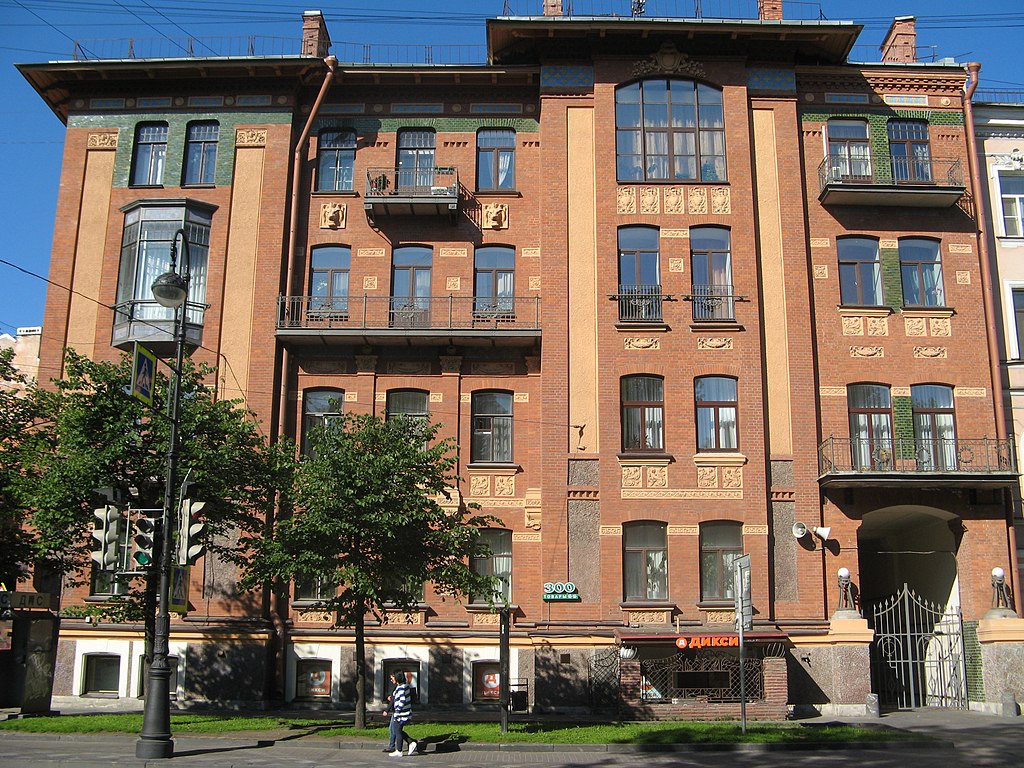

The Kavos Income House at the intersection of Kamennoostrovsky Prospect and Bolshaya Monetnaya Street is one of the first residential buildings in St. Petersburg built in the Art Nouveau style. However, it is notable not just for this. The building is closely connected with two surnames without which the history of architecture in the Northern capital is unimaginable: Kavos and Benois. This 1897 building became the "flagship" of St. Petersburg Art Nouveau.
The Kavos surname appeared in Russia at the very end of the 18th century when the Venetian composer Caterino Albertovich Kavos (born Catarono Camillo), who left his homeland after the fall of the republic, settled in St. Petersburg. The Russian Empire was favorable to the republican: throughout his life, Caterino Kavos taught at the Imperial Theatrical School, the Smolny Institute, and the St. Petersburg Noble Boarding School, held the post of director of all Imperial opera orchestras, composed music for thirty-two Russian operas and many other works.
His heir, Albert Caterinovich, expressed his passion for beauty differently by becoming an architect—a specialist in theater design. His most famous project in St. Petersburg was the Mariinsky Theatre building, constructed in 1860. It is no surprise that his son, Caesar Albertovich, continued his father's work and soon became an academician of architecture and the author of many architectural masterpieces in St. Petersburg, while his daughter Camilla married Nikolai Leontievich Benois, who held the positions of chief architect of Peterhof and the Imperial Theaters, and chairman of the St. Petersburg Society of Architects. It is also clear why their son, Leonty Nikolaevich Benois (who is the author of more than forty different architectural structures only in the Northern capital), developed the mansion project for his cousin, Caesar Kavos’s son—Evgeny Caesarovich.

Originally, the building at the intersection of Kamennoostrovsky and Bolshaya Monetnaya, completed in 1897, was precisely a mansion: two stories on a high basement. Many sources say that the prototype of the house was a certain French villa that inspired the project’s author. At the same time, the house became the "flagship" for one of the directions of St. Petersburg Art Nouveau: clarity, strictness of forms, minimalism in plaster decoration, an elegant yet rational style. In other words, the distinctive signature of Leonty Benois, characteristic of most of his works. Although around the same time, the architect was also building structures in the Neo-Russian style—such as the Church of St. George in Gus-Khrustalny, the Russian Chapel in Darmstadt, and the Alexander Nevsky Cathedral in Warsaw.
The client of the building, Evgeny Kavos, and his wife, professional artist Ekaterina Sergeyevna Zarudnaya-Kavos, were not only relatives of architect Leonty Benois but also close friends. According to the architect, the model was a certain French villa that he really liked, and thanks to his friendship with the owners, he had complete freedom in creative decisions. The city administration approved the building project on August 12, 1896, and construction was completed the following year. Contrary to the common practices of the time, the main decoration of the facades was not stucco and plaster but contrasting combinations of color and texture of finishing materials: natural stone, brick, granite chips, terracotta reliefs, and cement. For the first time in the city, Staritsa limestone was used—it was laid in the high basement, occupying almost an entire floor. The two-story mansion received high praise from contemporaries for its expressive "New French style" and artistic design. In the fall of 1907, the building became one of the five prize-winners in the "competition for the beauty of houses" held by the City Administration. After construction was completed, the couple opened an art salon at home, frequently visited by prominent cultural figures of the time: Ilya Repin, Anatoly Koni, Ivan Tolstoy, and others.
The mansion acquired its modern appearance—as an income house—in 1907 when Benois’s student and assistant, architect Androsov, rebuilt the building, adding two floors while preserving the original stylistic features. In 1912, a wing was built along Bolshaya Monetnaya Street, separated from the main building by a projecting risalit and slightly differing in decoration. The plaster in the finish was replaced by facing brick, terracotta, majolica, and split granite. Ornamental inserts and lion masks attract attention (this is apparently where the French "roots" of the building are traced). The entrance to the courtyard is decorated with two lanterns. Another distinctive feature is that the decoration of the inner courtyard part practically does not differ from the facade. Unlike many St. Petersburg "wells," the courtyard of the Kavos house is as solid and respectable as the facade, with the grand staircases facing the courtyard. Creating a holistic living environment is also a tradition of Art Nouveau, although it is not often observed in St. Petersburg architecture.
Androsov served as Benois’s assistant, was inspired by his works, and tried to preserve his teacher’s stylistics. At the beginning of the 20th century, the mansion was visited by artists Ilya Repin, Arkhip Kuindzhi, and Pavel Chistyakov. They were invited to watercolor evenings by Evgeny Kavos’s wife. During this period, historian Ivan Grefs, geographer Emil Legaft, and scientist Heinrich Grafito lived in the house. The architect rebuilt and expanded the mansion, which became an income house, and in 1912 added a large additional wing—which can be seen in photographs to differ slightly in decoration from the main building.
The income house is interesting for its decoration—ornamental inserts and lion masks on the facade attract attention. Two beautiful lanterns are located in front of the courtyard entrance. Inside the entrance hall, one can notice an antique chandelier and bas-reliefs on the theme of "Mowgli."
During World War I, the famous ballerina Matilda Kshesinskaya organized a hospital for soldiers here at her own expense.

The literary and artistic circle named after Herzen, founded in 1905 by Kotlyarevsky and Bogucharsky, also held meetings in the house.
Architectural historian B. M. Kirikov wrote that "the building is characterized by a departure from eclectic stereotypes with an unusual sense of form for St. Petersburg architecture... Leonty Benois acted from the position of a master of the old school, responding to fresh trends. He relied on the experience of the 'brick style' and, at the same time, according to his own admission, was 'inspired' by a villa in France that he 'really liked.'"
Sources:
https://www.fontanka.ru/2021/12/20/70328990/
https://www.citywalls.ru/house6408.html
https://ru.wikipedia.org/wiki/%D0%94%D0%BE%D0%BC_%D0%9A%D0%B0%D0%B2%D0%BE%D1%81%D0%B0
https://www.kommersant.ru/doc/2617724




Written by Jermaine
Discuss this with the author and others
No comments yet. Be the first to start the conversation.