

Grobin is first mentioned in the 13th century as the location of the Teutonic Order’s castle Seeburg (Grobin, now in ruins), but the history of the settlement on this site dates back to the Viking era. Ancient chronicles state that the Svea authorities long ruled over a certain tribe living far from them called the Curonians. However, for a long time the Curonians rebelled and did not recognize their authority. Knowing this, the Danes, at the time when the bishop had already arrived in Svealand, gathered many ships and sailed to that land, intending to plunder the goods of its inhabitants and subjugate them. This state had five cities.
Thus, the people living there, upon learning of their arrival, gathered together and bravely fought and defended themselves. Having won and slaughtered half of the Danes, they plundered half of their ships, seizing gold, silver, and much other loot.
Hearing this, the aforementioned King Olaf and the people of Svealand, wishing to earn the fame of those who managed to do what the Danes had not, especially since the Curonians had previously been subject to them, gathered an innumerable army and came to those lands. First, they unexpectedly approached a certain city of their state called Seeburg, which housed seven thousand warriors, and completely devastated, plundered, and set it on fire.
Archaeological materials suggest that under the fortress’s protection lived settlers from Gotland who cultivated the land. The large population of the settlement is evidenced by the discovery of 3,000 Scandinavian burial sites. One source of income for the settlers was apparently the collection of tribute from the native Curonians. Marija Gimbutas highlights Grobin as a buffer zone through which Western technologies penetrated the lands of the Slavs and Balts.
In the 6th–8th centuries, this was the largest known colony of Scandinavian traders and warriors in the Baltic countries. Arrivals from the island of Gotland and mainland Sweden established their settlement on a hill by the then-navigable Alande River. Historians believe that this was the site of the Curonian castle Seeburg mentioned in 9th-century chronicles. To the east of the hillfort, an ancient settlement stretching 2 km was discovered, which historians suggest could have been one of the first cities in Eastern Europe.
The earliest written evidence of the administrative-territorial division of Latvia appears in the essay by the Hamburg-Bremen bishop Rimbert, "Life of St. Ansgar" (circa 875), which speaks of Courland as a kingdom (regnum) consisting of five city possessions (civitates) and two cities (urbes) — Jurpils (Grobin) and Apule (now in Lithuania).
Swedish archaeologist Birger Nerman, conducting excavations since 1929, discovered that long before the Crusaders, there was a Viking colony here comparable in size and importance to Old Ladoga. He found three separate burial grounds dating approximately from 650 to 800 AD. In one burial containing about a thousand cremated remains, weapons and brooches typical of the art developed on Gotland were found. Another burial ground belonged to the same type. The third burial ground had completely different features. Burial mounds were built over its graves, and the items found indicate contacts between the inhabitants of Grobin and residents of the Lake Mälaren valley in central Sweden.
The heyday of the Scandinavian colony in Grobin was in the 8th century. By the 9th century, its economic significance declined, probably due to the rise of competing trade and craft centers in Prussian lands — Kaup and Truso. Due to this early decline, the existence of the Scandinavian colony in Curonian lands was not reflected in written sources. It is likely that the Vikings themselves called the city Seeborg, meaning “fortress by the sea.”
Based on finds of flattened arrowheads, Nerman established that in the mid-9th century, the Scandinavian settlement was at the center of large-scale military actions that probably led to its final abandonment. He associates these data with the report of the invasion of Eastern Europe by a large army of Swedish King Olaf, conveyed to us by the Bremen archbishop Rimbert in the Life of St. Ansgar.
Today, Grobin is a satellite of the modern Latvian city of Liepaja and represents a typical small town of Kurzeme with a very long history and rich cultural-historical heritage. The town is located 11 kilometers from Liepaja. Nowadays, little testifies that Grobin’s history begins long before the founding of Liepaja; it is an example of how a former suburb over centuries outpaces the old center in development, which gradually fades from the historical scene.
Near Grobin was a large "fort" surrounded by an earthen rampart. Arrowheads and ceramics of the Mälaren type were found on its territory. Most likely, this settlement is the very Seeburg, Seeburg, or Saeburg (Jurpils) (sea fortress), the city of seven thousand warriors mentioned in the chronicle of Archbishop Rimbert of Bremen in the Life of St. Ansgar. Rimbert’s work also indicated the existence of a "fort" in Apulia, which, according to the author, was south of Grobin in Courland (modern Apūle in northwestern Lithuania), where one of the largest ancient "forts" in the Baltic was indeed discovered. It is even possible to suggest that the many arrowheads found in the embankment before the "fort" are evidence of Swedish raids on the territory of modern Lithuania.
The settlers in these lands were Vikings from the Swedish island of Gotland (from Gotland to the coast where Liepaja now stands is only 175 km in a straight line — less than from Liepaja to Riga). The Vikings behaved towards the local Curonians like feudal lords and collected tribute from them.
Nowadays, there is considerable doubt that Seeburg is exactly Grobin. Some Latvian researchers believe that Seeburg was located closer to the Lithuanian border. The Grobin hillfort is now marked on maps as Skabaržkalns (Skabarzkalns), literally translated as "Hornbeam Hill," from the hornbeam tree, which is, by the way, the origin of the name Grobin. Another version suggests that in the Curonian language, gruobs means "shard." In any case, in the western part of Grobin on the bank of the Alande River, on the Skabaržkalns hillfort (5 meters high), one of the strongest Curonian castles stood in the 9th–13th centuries.
An ancient city was discovered at the hillfort, where small test excavations were conducted in 1952. Its ancient inhabitants were probably buried in the Priedulai (Priediena) burial ground. Already in 1249, the wooden Curonian castle on the left bank of the Alande, surrounded by a moat, was well known to foreign merchants. After the conquest, the Germans used it as a stronghold for a long time. In 1260, after the Battle of Saule, the Curonians regained the castle, but in 1263 the Livonian Order burned it down.
In the 13th century, the Crusaders built their stone castle Grobin near the Curonian hillfort. It was the castle of the Order’s vogt, subordinate to the Kuldiga komtur. There is no exact data on the date of the castle’s construction. Historian Arndt believed the castle was built by the master of the Livonian Order Dietrich von Groningen, but the master held office until 1245, and the division of lands between the Order and the bishop took place in 1253, when, according to historians, the castle already existed. Historical documents mention the Alande River flowing past the Order’s castle (huse to Grobin), but it is assumed that the Order at that time owned the Curonian castle located 200 meters south of the modern castle.
In 13th-century chronicles, Grobin is mentioned only once, when in 1263 Order troops set out from Kuldiga to suppress a Curonian uprising. They burned the Curonian castles Lazu, Merki, and Grobin. According to the chronicle of Hermann Wartberge, the Grobin castle was built by the Order’s master Goswin von Herike (1345–1360). Officially, Grobin castle is first mentioned in a chronicle in 1399.
In 1328, the need arose to strengthen the southern part of the Livonian state, and a stronghold — the castle in Grobin — appeared, but it is unknown whether this new castle was built on the site of the then-ruins or on Skabaržkalns. This second castle was managed by a vogt subordinate to the Kuldiga komtur. As you can see, there is no full clarity either in the dates or in the location of the castle.
After the construction of the Order castle in the 13th century, Grobin became the district center and formally subordinated Liepaja until 1920. In the Middle Ages, Grobin developed as a settlement of craftsmen and merchants around the castle. City rights were granted in 1695.
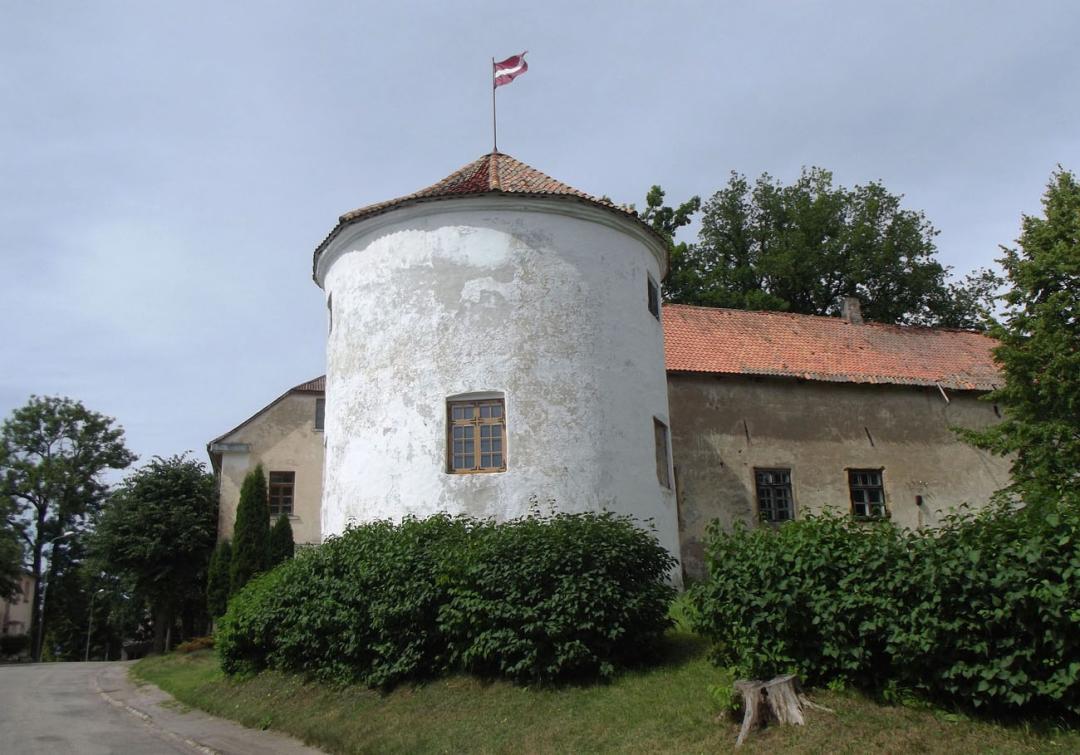
Grobin castle was built as a settlement for the vogt on the Livonian-Prussian route. It was then an impressive rectangular building with a three-story residential building and a tower. The building housed a chapel, a common dining room, and a hallway. The tower contained bedrooms. Later, the wall around the castle was strengthened and embrasures were made. The castle was built using bricks along with rough and unprocessed field stones.
From 1428 to 1560, 14 vogts ruled Grobin castle. It is known that Goswin von Asseberg was already vogt in Grobin in 1426. Later, in the 16th–17th centuries, the castle was rebuilt and housed the residence of the Dukes of Courland. Later, the system of residential buildings was rebuilt, and for some time landlords lived here. Famous Courland falcons (in another source — hawks) were bred here for hunting. In 1559, the first witch trial in Latvian history took place at the castle walls.
In 1560, the last master of the Livonian Order, Gotthard Kettler, leased the castle to the Prussian Duke Albrecht of Brandenburg. The duke fortified the castle and arranged an armory here. In 1609, the Duke of Courland Wilhelm Kettler reclaimed the castle. He married the Prussian princess Sophia, and Grobin castle was part of her dowry.
In the 17th century, earthen fortifications were built around the castle. During the Polish-Swedish war in 1659, the castle was captured by Swedish troops under Count Robert Douglas. In 1660, when the Swedes briefly captured Duke Jacob (Jekabs) of Courland, he was held in Grobin castle. The Swedes released Duke Jekabs two years later and returned the castle to him. What he saw in Courland shocked him. Only a third of the population remained alive in his once prosperous capital Jelgava, all castles were plundered and destroyed, fields neglected, and manufactories burned.
Jekabs locked himself in the Grobin residence and pondered. The decision was the only possible one in this situation: to start all over again. But when everything was restored, organized, and became even better, in 1678 the Swedes invaded Courland again, and this time the devastation was even worse...
In 1661, an envoy of Austrian Emperor Leopold, Baron August Meyerberg, traveled through Courland to Moscow to Tsar Alexei Mikhailovich. He was accompanied by the imperial court painter Storno, who drew 131 landscapes during the journey. Sixteen of them relate to Latvia. The caption to the drawing depicting Grobin read: "Grubin, a small town and castle three miles from Ober-Barthau, belongs to the Duke of Courland, who in April 1661, with his duchess wife, children, and full court staff, was here."
At the end of the 17th century, high-ranking persons often visited the castle. During the Northern War, the castle was captured by the Swedes, and Swedish King Charles XII lived here for several days. The castle was home or a stopover for the Dukes of Courland Jekabs and Friedrich-Kazimir, Polish and Saxon King Augustus II the Strong, Prussian King Frederick William III, and others. In the 18th century, the castle housed the administration of the Grobin district.
It is now hard to believe that once there was a time when a small fishing village stood where Liepaja is now, and Grobin was a seaport, with ships entering the Alande River, on which Grobin stood (now the Grobin reservoir).
From the castle, which lost its military significance and was abandoned from the late 18th century, several wall ruins have survived. In the travel notes of Ulrich von Schlippenbach in 1809, it is said that Grobin castle was already uninhabited and gradually falling into ruin. Since the 18th century, the castle has been owned by the city, which arranged a park around the ruins. The castle was located on the bank of the Alande River, now dammed to form the Grobin reservoir. The reservoir waters wash the castle from the west and south.
The castle’s plan resembles a quadrangle with an area of 58 x 34–38.6 meters, with a tower and gates on the western side. Moats were dug on the east and north sides. It was built of brick and stone to protect the road from Livonia to Prussia and was constructed in two phases. From the oldest — 14th century — the southern building and fortress wall in the northwest corner have survived. The southern building had three floors and an attic with a shooting gallery. There was a cellar under the building, now filled in. The total height of the red brick walls was 12 meters. The second construction phase occurred in the 17th century. Buildings were erected along the eastern and northern walls. The eastern building had exits only to the inner courtyard. From the northern building, only the outer wall with eight windows and gates 3.56 meters wide have survived to this day. The western building was divided into three rooms. There was a cellar under the building. The outer wall may have survived from the first construction phase. In the 17th century, an earthen rampart was also built around the castle.

In the 1970s, under the guidance of architect I. Stukmanis, conservation work was carried out on the castle ruins. Inside the castle is now a stage where concerts are held. Slightly south of the ruins on the right bank of the Alande, one can see the small Curonian hillfort Skabaržu-kalns.
Opposite the castle stands a church. The Grobin Lutheran Church was built in 1664 by order of the Duke of Courland Jekabs Kettler. In 1892, the church was extensively renovated at the expense of the manor owner of Kapsēde, Baron G. von Manteuffel. On June 24, 1941, the church was hit by Soviet artillery fire opposing the advancing Nazi troops and completely burned down.
The coat of arms of the city of Grobin was approved on March 11, 1846, along with other coats of arms of the Courland Governorate. Its description: "In a silver field, a crane standing on one leg, holding a stone in the raised other leg."
The coat of arms with the crane was granted to the city by the Duke of Courland Friedrich Kazimir in 1695. However, at that time, the shield’s field was black. On the modern city coat of arms, the shield is also black. In heraldry, the crane with a stone in its raised claw symbolizes vigilance (it is believed the crane holds a stone to avoid falling asleep):
A more detailed version says that the stone in the crane’s claw reminds residents to be vigilant and cautious. It is believed that if the crane falls asleep, the stone will drop from its claw and awaken the guard. Interestingly, similar bird images were found during archaeological excavations on the Swedish island of Gotland.
Like every castle, Grobin castle has its own legend. Next to the castle stands a Lutheran church. It is not the same church, but one like it once stood there. As usual, there was an underground passage from the church to the castle. At that time, a notorious womanizer named Golshuk lived in the district. He behaved terribly, worse than any Don Juan. He wooed girls, seduced them, then abandoned the dishonored. If a girl did not want to be seduced, he took her by force.
Honest knights tried to catch Golshuk, but he was cunning and cautious, and they could not capture him. But one day he was caught. He was locked in the castle dungeon. The curious daughter of the cook, whose father served in the castle, begged the guard to show her the prisoner through a small opening. The girl’s name was Fetisa. The guard was in love with the cook’s daughter and could not refuse her. Fetisa fell in love with the prisoner at first sight. At night, she stole the keys to the secret passage from her father, sneaked into the dungeon, and freed Golshuk. When they escaped the castle, Golshuk, instead of fleeing, began to seduce the girl out of old habit. While the lovers were cooing, the guards noticed the escape and caught them red-handed. The cunning Golshuk managed to escape, but the girl was seized and locked in the same dungeon from which she had freed Golshuk. It was announced throughout the district that if Golshuk appeared at the castle, the girl would be released, but she had to spend 20 years in the dungeon until a new castle owner freed her.
By the way, six hoards of coins, silver ingots, and jewelry were found in the castle. Who knows, maybe the main treasure has yet to be found.
Sources:
https://www.castle.lv/latvija/grobina.html Project by Renāta Rimša




Written by Jermaine
Discuss this with the author and others
No comments yet. Be the first to start the conversation.