

The places where the city of Ventspils now stands were inhabited in ancient times. Near the mouth of the Venta River, there are burial mounds made of stone slabs called the "giants' graves" — the oldest megalithic monuments; these graves, in their internal structure, resemble the well-known dolmens. Local tribes traded even with the Phoenicians, ancient Romans, and Greeks, selling them amber.
It is hypothetically assumed that the name of the Venta River is mentioned on the so-called Schenhem or Sjonhem (Sjonhem, Gotland Island, Sweden) runic inscription on a stone (around 1100 AD), since at that time the Scandinavians had contacts with the inhabitants of the lower Venta. The inscription reports that a certain Likvos (in other sources - Liknat) died in Vindau (Uindau). Until the 11th century, the Venta was used for raids by the Scandinavians, who penetrated deep into the territories inhabited by the Curonians on light vessels and plundered them. To protect their lands from devastating raids, the Curonians built fortified wooden castles on the Venta.

Historians currently have neither archaeological nor documentary evidence that before the 13th century there was any settlement of local inhabitants on the site of the present-day city of Ventspils. The location of the castles of the Wends or Curonians mentioned in many places on the site of the Order castle built in the 13th century is historically hypothetical, but in the texts of later authors it took on an affirmative form. In particular, there are claims that in the territory of modern Ventspils on the left bank of the Venta River, at its mouth into the Baltic Sea, there stood a fortified Curonian castle in the 10th century.
The conquest of the Courland part of present-day Latvia — the so-called Kursa — by the crusaders began in the first half of the 13th century. The name Winda, most likely meaning the land of the Curonian people, is first mentioned in 1231 in a treaty between the papal legate Baldwin of Alna and the Curonian chiefs.
On April 19, 1242, another papal legate, Wilhelm of Modena, allowed the Order to build a castle or city on the bank of the Venta (buwene eyn borgh oder eyn Vestunge oder eun Stat), although many historians believe this refers only to the castle Goldingen (Kuldīga). There are no documentary records of the exact time of the castle's construction.
In 1252, the Bishop of Courland agreed with the Livonian Order to build 11 churches in Kursa, including in Bandava and the lands of Venta three churches — one episcopal and two Order churches. It is possible that one of them was the parish church in Ventspils mentioned in 1298.
The mouth of the Venta River is first mentioned in historical sources in 1253 in a treaty on the transfer of Curonian lands under the Order's control. Ten years later, in 1263, a special agreement was concluded on the division of the seaports of Kursa between the master of the Livonian Order and the Bishop of Courland. The port at the mouth of the Venta passed under the Livonian Order's authority.
Somewhere around this period, at the end of the 13th century, the crusaders erected a stone castle Vindau (Windau) 1 km from the mouth of the Venta River; it is assumed that the castle could have been built about 10 years before 1290.
In 1290, the Order's master Halt, confirming the incomes of the Kuldīga and Ventspils commanderies, subordinated the commander of Ventspils to the commander of Kuldīga and ordered to send two Order brothers from Ventspils Castle to Embūte Castle. It is in this document that the castle Vindau is first mentioned in historical sources as an already existing structure where the commander of the Livonian Order lived and where the Order convent was located.
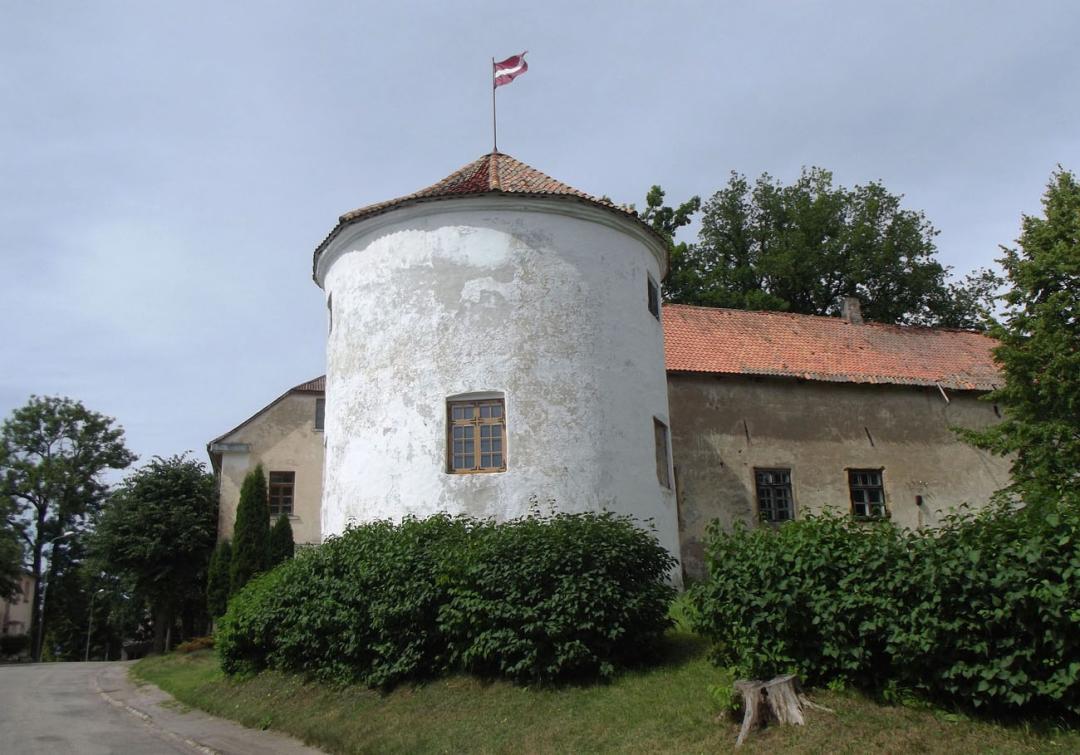
The oldest part of the Order castle, built on the site of the presumed former Curonian settlement, was a separate donjon tower for the protection of the important sea harbor and navigation on the Venta River in the 13th century. At the same time, it was the residence of the regional administrator — the commander. Possibly, the castle was originally surrounded by a moat connected to the Venta, making it a "water castle" protected on all sides by water barriers. Today, traces of the moat are not visible in the city's terrain.
There is also a lack of information about the presumed outer bailey — in the 17th century, the castle was surrounded by earthen fortifications, and later this area was built up.
According to architectural historians, the castle has three main early construction periods. Initially, before 1290, a square tower measuring 10x16x30 meters with a total area of about 1,133 square meters and a surrounding fortress wall with sides of 32.5 x 33.5 meters around the inner courtyard were built. The walls were about two meters thick.
For the castle inhabitants, the tower served as the last refuge in times of danger, so the entrance to the tower was arranged at a safe height from the ground, accessible by a quickly raised wooden ladder. On the second floor, there was a room where one could hide during a siege. To keep warm, the knights heated a fireplace.
The time of the second construction period is disputed among historians. Some attribute further construction to the 14th century, as by the mid-century the Livonian Order had strengthened enough to afford building a new stone castle. A popular layout of the time was used, consisting of four interconnected wings with a square inner courtyard. The old tower was preserved and incorporated into the southeast wing of the castle.
The castle was built from boulders and bricks, featuring the only protruding altar part of a chapel in Latvia in the eastern wing. The castle chapel is considered the oldest surviving church in the Courland part of the country. The old walls about 2 meters thick were included in the castle plan, becoming part of the outer walls.
Originally, the castle wings were two-storied, and the attic housed a shooting gallery. The castle in Ventspils was one of the smallest Order castles.
The value system of the crusaders is evidenced by the order of the castle's construction, guided by a specific plan. First, the outer defensive wall was built. Then the chapel. Next came the knights' dormitory and refectory (remter) in the west. After that, the assembly hall (chapter hall) with a hypocaust heating stove in the northern wing, and in the south — the kitchen with a chimney.
The last part built was the gatehouse on the east, next to the tower. The gate did not have a drawbridge wooden grille, as was common in other medieval castles. Therefore, security was reinforced by the foreburg buildings and fortress wall.
During construction, some changes to the original plan occurred, the reasons for which remain unknown. For example, in the chapter hall and rooms of the western wing, instead of the planned vaulted ceilings, there were wooden flat ceilings for some time. In some rooms, vaults were built only at the end of the 15th — beginning of the 16th centuries.
The castle had three above-ground floors and a basement. The lower floor housed utility rooms; on the middle floor, in the northeast corner was a chapel, and to the north — a two-nave hall overlooking the Venta and the sea. Since the kitchen's location is unknown, it is impossible to determine whether this was the chapter hall or the convent refectory.
The western wing of the castle apparently contained bedrooms. The upper floor was likely used for storage and castle defense. In the southeast corner was a square watchtower with an original height of 19.3 meters, apparently intended for observing the sea waters. Next to the tower were the main castle gates leading to the inner courtyard, around which ran a wooden covered walkway.
The commander of Ventspils Castle participated in the Order's military operations. For example, it is known that on March 22, 1484, near Riga, close to Daugavgrīva, the Riga forces defeated the Livonian Order forces, capturing 23 respected Order brothers, including the commanders of Jelgava, Ventspils, and Sonnenberg (Estonia). Judging by the list of commanders, it was Kersten von Selbon, also known as Christian von Seelbach von Zeppenfeld. He was luckier than the Riga commander, who drowned in that enterprise.
A settlement of German colonists soon formed near the Order castle, built in an economically and strategically advantageous location. Its existence as early as the 13th century may be evidenced by a document dated August 16, 1298, where Master Gotfried von Rogge and the Courland cathedral chapter agreed that the chapter would transfer its rights to the city church in Memel (now Klaipeda) to the Order and take the parish church in Ventspils for themselves. The location of the Ventspils church has been identified in the block between the current Nabagu, Jana, and Pils streets. Around it was the oldest cemetery of Ventspils residents.
Since 1369, an impression of a seal with elements of the Ventspils city coat of arms has been preserved — the oldest known image in the city's history. However, the first time Ventspils is mentioned as a city is in a document dated 1378. The heraldic description of the Ventspils coat of arms: a red field, with a knight's cross in the upper part and a hunting horn in the lower part.
On the 1369 seal, the two main elements of the coat of arms — the knight's cross and the horn — are clearly distinguishable. These elements did not change for many centuries. The basis of the coat of arms is a net, because this is an ancient fishing place. At the top is a large cross with expanded ends as a symbol of the crusaders' power. Under the cross is a horn, which knights blew while hunting. This means that the Ventspils region had famous hunting grounds.
During the Livonian Order period, Ventspils was known as a port city; in the 15th century, it became part of the trading association of Northern countries — the Hanseatic League. There is very little information about Ventspils during the Order state. In the following centuries, the oldest city documents, citizen lists, and information about the oldest buildings were lost. However, there is no doubt that in the 14th century, the inhabitants of Ventspils acquired city rights. They are first mentioned in a 1378 document but were granted earlier.
Several visitation acts from the 15th century about Ventspils have been preserved. From the 1442 inspection protocol, it is mentioned that five knights and two priests lived in the castle; they had weapons for 32 people and 34 horses; the castle also housed 6 cannons and 20 crossbows with 30 quivers of arrows (1,800 pieces) and half a barrel of gunpowder.
In 1451, the protocol mentioned that only seven Order brothers, the commander, and servants were in the castle. In 1488, the castle's food and weapon supplies were counted to provide for troops in case of military actions — everything needed here was about one-tenth more than in Kuldīga.
Ventspils Castle was located far from the borders with Lithuania and Russia, where the main military clashes occurred, so the castle was almost never attacked. With the advent of firearms, the castle was surrounded by an additional wall with corner towers.
In the 15th century, during the third construction period, a third floor was added to the wings, and the tower's height was increased (to 38.5 meters); vaults were built on the first and second floors, and at the same time, the chapel and large rooms were decorated with wall and ceiling paintings. The main tower of the medieval castle in Ventspils is considered the oldest lighthouse in the Baltics. However, reliable information about the tower's function as a lighthouse dates to the mid-17th century.
At the end of the 15th century, the room on the tower's second floor was apparently converted into the living quarters of the highest Order official — the commander. The walls depict flowers, buds, and grape clusters, which seemingly transform the heavy architectural room into a grapevine-covered arbor.
In the 16th century, on the vaults of the knights' bedroom and the chapter hall, plant ornaments were painted in gray and black on a light background. On the second floor of the southern wing, a relatively large area preserves paintings from the late 16th — early 17th century. The window opening is surrounded by bluish-gray acanthus branches outlined in black. Above the window was a text, which unfortunately can no longer be read because the plaster was removed precisely in that place.
After the Livonian War, the castle was owned by the Duchy of Courland. During the Swedish-Polish war, the Courland dukes could not remain neutral. As vassals of the Polish king, they had to fight on his side. Soon the Swedes invaded the duchy. In 1603, Swedish troops occupied the then most important Ventspils harbor in the duchy.
The era of Duke Jacob's rule (1642-1682) is considered the time of the city's greatest prosperity. Vindau housed a large shipyard of the Duchy of Courland; it was from here in the 17th century that maritime expeditions set off to the New World and Africa with the aim of founding full-fledged colonies of this miniature but very wealthy state.
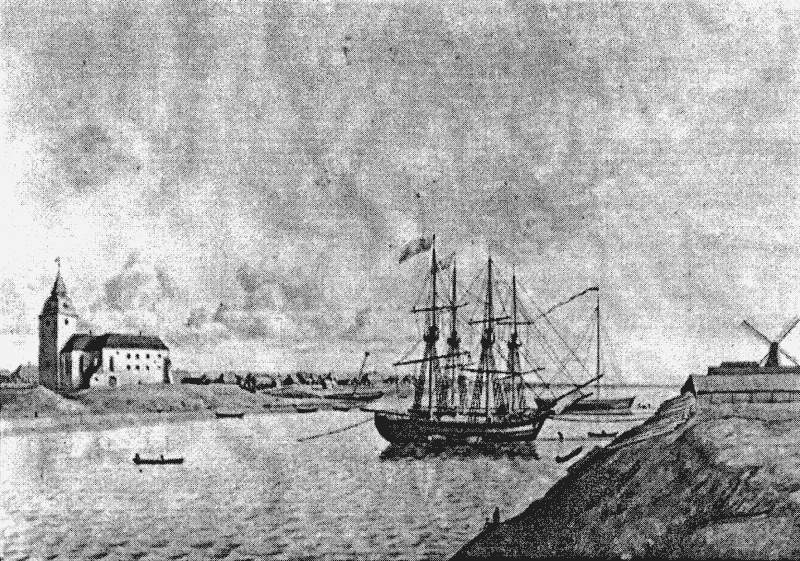
Of the six shipyards operating in Courland, the most important was in Ventspils. Dutch shipbuilders worked in the port; over 40 years, 79 merchant and 44 warships were launched from the shipyard, most of which (mainly warships) the duke sold abroad. Europe was at war, and Courland ships commanded high prices. England, France, and Venice purchased warships. Merchant ships transported goods from one warring power to another, sailing under the neutral Courland flag.
At that time, coastal fortifications and the first piers, as well as warehouse buildings, were built near the castle. Next to the castle is the hill Balastkalniņš. The hill formed from ballast sand that sailing ships brought from shores all over the world and dumped near the castle.
During the duchy period, the castle housed the hauptmann — the duke's administrator — and a garrison. Administratively, Ventspils was the center of the Ventspils hauptmann district of the Kuldīga oberhauptmannschaft of the Duchy of Courland. Hauptmanns were castle commanders. Although during the duchy period oberhauptmanns and hauptmanns lived in the same castles as commanders did during the Order times, their rights and duties differed. A significant difference was that due to celibacy, commanders and other Order brothers could not marry. In contrast, during the duchy period, hauptmanns could start families. Consequently, weddings and other family celebrations of hauptmanns and their families took place in the castles.

During another Polish-Swedish war (1655-1660), from April 1659 to September 1660, the castle was again occupied by the Swedes. Then the Poles recaptured the castle and city. The Swedes occupied the city four times. During the fighting, Ventspils was burned, and the castle was severely damaged. Especially heavy damage was inflicted on the walls from the sea and the Venta River side.
Duke Jacob was captured and imprisoned for several years; the invaders took the ships in Vindau, ruthlessly plundered the entire duchy. The total damage from the Swedish invasion amounted to over six million silver talers for the duchy (at today's silver prices — over one hundred million dollars). This was a terrible blow to the duchy, whose entire population barely reached 200,000 people.
In the second half of the 17th century, the castle was restored and rebuilt, but it had already lost its importance as a fortress. The castle's heyday was over. At this time, some vaults were partially replaced by wooden ceilings. The outer defensive wall was dismantled, and earthen fortifications were piled in its place.
At the turn of the 17th-18th centuries, only part of the castle premises was used. In 1710, during a plague epidemic, most of the city's population died. At the end of the 18th century, the castle came under the control of Imperial Russia, and a city church was housed there. From 1701 to 1706, the castle's early chapel and convent hall served as a church for the Evangelical Lutheran community, as the city church was destroyed in 1659 during the Polish-Swedish war. The church interior was made by famous Courland woodcarvers.
In 1710-1711, a plague epidemic swept through Ventspils, killing most of the population. On March 27, 1795, when the Duchy of Courland was annexed to the Russian Empire, Vindau was a remote provincial town with about 1,000 inhabitants. The city was renamed Vindava in Russian style. The German population of the city was supplemented by officials, merchants, and military personnel coming from Russia.
In 1795, work began to strengthen the banks of the Venta and build breakwaters. In 1853, the shipyard resumed operations. From the second half of the 19th century, the county town of Vindava began to prosper again thanks to its port, which was a significant competitor to neighboring Libau.
In 1798, during the heyday of Classicism, the castle tower acquired a Baroque-style spire, similar in silhouette to the Riga Dome Cathedral. In the 18th century, city residents were unable to build a new church on the site of the destroyed one and until 1835 attended the church arranged in the castle. In 1835, a new Lutheran church was built.

From 1798 to 1802, the Russian Sofia Musketeer Regiment was quartered in the castle. For its needs, a hospital, an Orthodox church, and a regimental office were arranged in the castle. According to other sources, the Orthodox church in the castle was opened in 1745 and existed there until 1801 (also according to other sources — until 1928).
The oldest surviving plan of Ventspils Castle dates to 1789. After 1827, the castle facades were modernized. An ensemble symbolizing the severity and power of the Empire was formed. It was united by the Empire style, which was fashionable and most suitable for this purpose at the time. Today, we see the restored castle precisely in this Empire "shell."
Around 1827, the castle was rebuilt and adapted for government institutions. On the second floor, next to the church, an apartment for the hauptmann was arranged, and on the third floor, a prison was located. In 1832, after extensive repairs, a district prison was established in the castle, which existed in one form or another until 1959.
In the second quarter of the 19th century, an observation pilot post was equipped in the tower. In 1851, it was destroyed by a storm, and in 1867, a tall pyramidal wooden structure was built above the castle tower, housing a new pilot post 13.8 meters high. The spire lasted until 1897.
The next major renovations of the castle took place in the 1870s. In 1875-1877, a stone gallery was built in the inner courtyard on the site of the former wooden gallery, becoming a vivid example of the then-popular "brick style." The red-painted wall was stitched with white mortar. On the arches of the first floor, the joint pattern was corrected, even specially chiseled for this purpose. There is no similar gallery in any castle of the Baltic region.
Some old castle rooms of the Order brothers were partially replanned, divided by internal partitions, and toilets were installed. The interiors were repeatedly altered over the centuries; there is nothing medieval left even in the details of the interior decoration.
In the mid-19th century, two buildings were added next to the castle, housing a women's prison, prison kitchen, and apartments for service personnel. For one and a half centuries, this was an uncomfortable and unwelcoming place that Ventspils residents avoided.

In the 1894 book by the scientist from the University of Dorpat, Feitelberg, "An Attempt at a Medical-Topographical Description of the City of Vindava," it was said: "Above all of Vindava rises a massive building, a castle built by German knights in the 13th century." Overall, this description of Vindava does not sound inspiring. For example, the book states that the city not only lacked a water supply but also lacked wells with clean water, and water was delivered to homes by water carriers until late evening, as in the Middle Ages.
The center of Riga was already lit by electricity, while in Vindava, kerosene lamps polluted the air. As for the diet of the poor residents: "The food of Latvians and the rest of the poorest Christian population consists mostly of black bread, herring, potatoes..." In short, a small provincial town, by no means the most advanced in the region.
In the prison of Ventspils Castle was imprisoned a participant of the 1905 revolution, writer A. Austrinš; after World War II, poet K. Ekabsons was imprisoned there and died there. During World War I, when German troops occupied Ventspils in 1915, the castle housed a prisoner-of-war camp. On February 24, 1919, German Landwehr units captured Ventspils.
During the Latvian Republic period from 1920 to 1940, the castle also served as a prison. The prison remained there until 1959. On October 23, 1938, a monument to sailors and fishermen, whose graves lie at the bottom of the sea, was opened on Ostas Street near the castle.
In 1939, construction of bases for the needs of the Soviet Army began in Ventspils. Its units entered Ventspils according to the treaty between Latvia and the USSR signed in 1939. On July 1, 1941, Ventspils was occupied by German troops; on May 9, 1945, Ventspils was liberated from them. After World War II, from 1959 to 1983 inclusive, the castle was occupied by the Soviet army. The castle was used as a border guards' base, who left it only in 1983 when a new building was constructed for them.
After the Soviet troops left the castle, it was abandoned for some time until in the 1980s it was decided to house a museum there. From 1985 to 1991, exploratory and restoration works began but were not completed due to the change of power in the country.
In the late 1980s, during ill-conceived reconstruction works, hundreds of square meters of original plaster were removed from the castle, resulting in the loss of much of the interior decoration. However, on the untouched surfaces under later layers of plaster and paint, unique wall paintings from the 15th, 16th, and 17th centuries were discovered, unique for the history of Latvian architecture and art. The oldest of these include a fragment of the "devil's head" with a stylized lily flower on the second floor of the tower and consecration crosses in the former chapel.
For the first time in the study of architectural monuments, the castle's stone walls were probed using radio waves. Bricked-up entrances and other openings were discovered. Chemical analysis of the mortar determined the age of the masonry, allowing the creation of a plan of the initial construction.
Finally, one important question should be clarified — are there ghosts in the Livonian castle? An old castle cannot be without them! Yes, there is. The local ghost is the Black Piglet, who walks the corridors and clatters its hooves on the stone floor slabs on the eve of major political events in Ventspils and Latvia. But where did the Black Piglet come from?
When excavations were carried out in the castle territory at the end of the 20th century, blackened piglet bones were found in anatomical order where the castle kitchen was. A piglet is a valuable product; no one would just burn it. Why were the bones charred? The only time the castle was attacked was in 1659 during the Second Northern War. The Swedes occupied Courland, took the castle, and during the battle, a fire started. The fortress was slightly damaged, but the destruction was minor.
Most likely, the piglet died during the castle's defense. Perhaps it was about to be roasted on a spit but was not finished. There is also a version that the dish was already prepared but not eaten. There are no other legends or ghosts about the castle. Probably, this is the only old castle in Courland with such a gap in history, most likely because it was a prison for a long time, albeit with living quarters for the chief and a church.
Another round of restoration works began in 1996. In 1997, the castle facade was renovated, and its territory was landscaped. Initially, it was planned to give the castle a medieval appearance, but in 1995 it was decided to restore the castle as it was at the beginning of the 19th century. In 2012, the last works on restoration and reconstruction were underway.
Sources:
https://www.castle.lv/latvija/ventspils.html Project by Renāta Rimša




Written by Jermaine
Discuss this with the author and others
No comments yet. Be the first to start the conversation.