


The history of Daugavpils goes back to the distant past. Archaeological monuments found on the banks of the Daugava River and Lake Stropi testify that the current territory of the city has been inhabited since ancient times. The main Latgalian fortress was located upstream, in Nauene. It is mentioned in the Scandinavian sagas of the 5th century, when the inhabitants of Gotland traveled along the Western Dvina (the Daugava had many names at different times: Eridan, Vina, Turun, Khozin, Rodan, Dina, Duna, Dzvina, Western Dvina) to Rus and further to Byzantium. The ancient settlement of the Dvina region is evidenced by finds of Roman coins from the 1st century BC to the 4th century AD on the right bank of the Daugava near Daugavpils, as well as a deposit of Roman coins and various archaeological finds in Vecpils (Nauene). In the mid-13th century, the Livonian Order crusaders, aiming to keep the local Latgalian population under control and to resist Russian and Lithuanian princes, created strongholds on the Daugava River (Duna). One of these points was the Duna Castle on the bank of the Daugava, in Nauene, 19 km upstream from modern Daugavpils. Here passed trade routes from Pskov and Novgorod to Vilnius, and from Polotsk to Riga. In German, this place was called Nowenene and Duenaburg, Duneburc; in Russian in the 15th century — Navchin, Nevgin.
The Nevgin fortress was part of the principality of Ersika (Ersike). Prince Vsevolod (Visvaldis) was a vassal of the Polotsk prince, whose principality was part of Kievan Rus. Even in those distant times, during the rapid development of trade, German feudal lords and merchants sought to concentrate their trade interests in the east, creating a foothold for advancing deeper into Russian lands. The Vecpils (Nauene) fortress was located on a steep right bank of the Daugava valley, 25 meters high, between two ravines.
Due to frequent invasions by Russian and Lithuanian troops, and also to keep the local population under control, the Order decided to create strongholds in Latgale on the border with Rus and Lithuania. One of these points was to be the Duna Castle (Dinaburg).
Its history begins with an excerpt from the Livonian Order chronicle: “The new master Ernest of Rastenburg, upon arriving in Riga and familiarizing himself with the situation, saw that he would have to deal mainly with the Lithuanians, who had increased their raids. To protect the Order’s possessions from Lithuania, there was no other way than to build new fortresses and maintain permanent German garrisons in them, which in wartime could resist invasions... The site for the new fortress was chosen on the bank of the Duna (Daugava), about two hundred versts from Riga. The new master gathered an army and, taking with him everything needed for the construction and supply of the fortress, moved to the designated place and in the summer of 1274 laid the fortress, named Dinaburg.”
In the Rhymed Chronicle ("Reimchronik"), the castle is dedicated the following lines:
Only the host that was there,
Circled this hill,
When the master stood on the spot,
He said to the knight brothers:
“This important hill
Promises us much good.
We will build a castle on it
And save ourselves from troubles.
We will subdue many infidels,
Even Traiden the Wicked.”
In 1274, the master of the Livonian Order Ernest von Ratzburg (Ratzeburg, Rossburg) chose the site for the new castle near the ancient Latgalian settlement, later turned into a stronghold of the Russian principalities — Nevgin (Nauene). The castle was built under the protection of troops, using stone as the building material. In 1275, the construction of the castle was fully completed. Besides using the castle to impose and strengthen German rule in Latgale, which leaned toward Rus, the Order intended to use it as a control point at the crossroads of trade routes. At that time, merchant routes crossed here, leading along the Daugava from Polotsk to the Gulf of Riga, and overland from Novgorod and Pskov to Lithuania. The castle, designed according to the defensive structures of that time, was built of field stones and had solid walls with loopholes. The entrance to the castle was from the east, through a drawbridge. The gates were typical for Order castles, with their side buildings forming the eastern wing. It is assumed that this wing was the oldest part of the castle. The castle was irregular in plan, taking into account the terrain relief. At that time, the castle was considered large: 120 paces long and 40 wide. Around it was a forecourt, enclosed by a defensive wall more than two and a half meters thick. The castle stood on a high narrow hill between two deep ravines, with streams flowing at their bottoms. This allowed, with the help of a small dam, to surround the castle with difficult-to-overcome water barriers. The entrance was on the eastern side, protected by a drawbridge and two gates. The building rose 24 meters above the river level and had three large cellars and two crypts connected by secret passages. Additionally, there were underground passages from the castle toward Rēzekne, Ludza, Līksna, and Ilūkste.
Russian and Lithuanian princes repeatedly tried to destroy the knightly outpost built near them. For example, in 1277, taking advantage of Master Ratzburg’s departure to Riga, the Grand Duke of Lithuania Traiden the Wicked besieged the castle around 1277. The Lithuanians built four huge movable towers for the assault. The attackers, including Russians, were unsuccessful: they had to destroy the siege engines and retreat beyond the Daugava. Only 35 years later did the Lithuanians capture and destroy the castle. There is a version that the castle was destroyed by the Order brothers themselves to free their vassal Johann Iksküll, who was held captive there by the Lithuanians. In 1313, the master of the Livonian Order Gerhard von Jork (Joke) restored the castle. In 1396, the Lithuanians destroyed the castle again, and the Order once more rebuilt it. In 1403, the Grand Duke of Lithuania Vytautas, entering into war with the Order, invaded Latgale, ravaging it with fire and sword. The castle was destroyed again. The crusaders restored it, but in 1418 Vytautas burned it down once more.
For a month, day and night, he stormed the castle using four huge movable stone-throwing machines. The fortress suffered serious damage, but it could not be taken. In response, Master Ratzburg launched a military campaign deep into Lithuania in the winter of 1278 but suffered a shameful defeat. Lithuanian troops destroyed 70 knights, many warriors, and captured the knightly banner. This indicated that the Teutons could hardly count on victory outside the castle. At the beginning of the 14th century, the Lithuanians captured the castle, destroyed its garrison, and demolished all fortifications. But in 1313, Master Gerard Jork restored it in its original place. Moreover, assigning great strategic importance to the castle, the Order began its improvement in 1374. Master Goswin Gerike strengthened the castle with four tall towers, turning it into a powerful fortress from which knights raided neighboring Polotsk and Lithuanian lands.
In response, Lithuanian and Russian troops invaded the Dvina province in 1396, 1403, and 1418, dealing with the sword-bearers with fire and sword, razing Dinaburg to the ground. However, the Order persistently rebuilt the castle.

Dinaburg Castle was supplied with significant military and food reserves. It became the residence of the komtur (commander), the head of a substantial knightly garrison, who controlled almost all of Latgale. The komtur had an oval seal depicting the castle’s coat of arms: a shield divided by a line into two parts. In the upper half was a sacrilegious image of the Virgin Mary with the infant in her arms, and in the lower half, a knight kneeling and embracing the castle wall (two impressions of this seal are kept in the local museum).
The castle’s favorable location at the crossroads of trade and strategic routes ensured the rapid growth of a trading settlement, which the Order tried to turn into a major trade center. For some time, a Riga trading office operated here. However, due to frequent wars, these plans were not destined to be realized.
In 1410, a grand battle took place near Grunwald. The Livonian Order did not suffer in this battle, but its positions were sharply shaken. In 1435, relying on castles along the Daugava, the Order raided Lithuanian lands. When the crusaders were returning to Dinaburg, the Lithuanians gathered forces, caught up with them near Lake Sveta, and inflicted a heavy defeat. The master of the Order and many knights were killed. For a long time, peasants in the lake area found rusty swords, armor, and chainmail during fieldwork. Livonia’s weakness was explained by its political fragmentation, primarily internecine wars between the Order and the Riga archbishop.
In the mid-15th century, the Livonian Order, using the Dinaburg Castle garrison, repeatedly invaded Russian lands, threatening Pskov. In the mid-16th century, the castle was living its last years. Already in the early 15th century, it could not withstand attacks by Lithuanian troops, who captured and burned it twice (in 1403 and 1418). In 1480, there was an invasion of Livonian troops into Rus. A 20,000-strong army of the Grand Duke of Moscow Ivan III launched a retaliatory campaign into Livonia and occupied Dinaburg Castle in 1481. But as long as the Livonian Order was still relatively strong, the castle was rebuilt each time. Thanks to its advantageous territorial location, a small urban-type settlement — a trading posad — also remained near the castle. Only the Livonian War, which finally shook the foundations of the Livonian Order, led to the destruction of the old Duna Castle.
In 1481, Ivan III’s 20,000-strong army took Dinaburg among other cities. Taking advantage of Russian support, the Latgalians rose against the German feudal lords. Later, Ivan III forced the Order’s master Walter von Platenberg to sign a treaty to pay tribute to the Moscow principality for 50 years. Russian troops left the fortress, and the Germans reoccupied Dinaburg and, relying on the knightly garrison, brutally suppressed the Latgalian uprising. Livonia did not fulfill its debt obligations. Moreover, it incited Poland and Sweden to war against the Russians. For many centuries, economic and political interests of various states clashed on the shores of the Baltic Sea. The struggle for access to the sea was often the cause of long bloody wars.
For the Russian state, seeking economic ties with Western Europe, the Baltic Sea was of paramount importance. But Livonia strongly hindered Russia. It concluded a treaty with Lithuania, contradicting the previous treaty of the Order with the Moscow state. Understanding the consequences of such a treaty well, Ivan IV (the Terrible) began active military actions against Livonia.
In 1558, under the pretext of non-payment of tribute for the Yuryev land, once belonging to the Kiev princes, Russia began war against the Livonian Order. According to legend, Ivan the Terrible sent the enemy a whip with the inscription: “I cannot and will not tolerate the insult done to me and my people. God sends me to punish you to bring you to obedience!”
On January 22, 1558, Russian troops simultaneously entered Livonia on three fronts. In 1559, after defeating Master Fürstenberg near Wenden (Cēsis) and capturing him, Russian troops led by Tsar Ivan the Terrible besieged the castle commanded by Prince Sokolinsky. The castle was bombarded for a short time and surrendered on August 11, although it had enough people and good fortifications. Poles and Germans inside the castle were able to leave its walls freely.
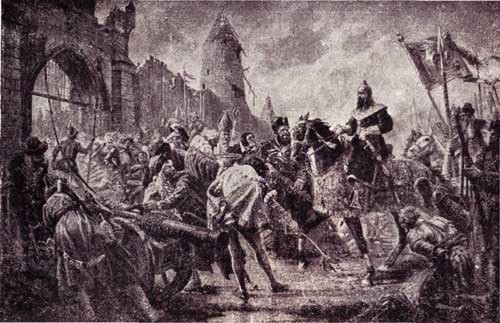
For some time, the tsar lived here, leaving Colonel Plater as commandant in his place.
Unable to hold back the rapid advance of Russian troops and foreseeing his defeat, the last master of the Livonian Order, Gotthard (Gotgard) Kettler, in response to the proposed assistance in 1559, was forced to pledge a number of castles along the Daugava, including Dinaburg, with all their territories, population, and incomes, to the Polish king Sigismund Augustus. The castles passed to Poland. The Polish king promised the Order to defend Livonia and share future conquests in Russia with it. Later, fearing a new Russian invasion, Kettler recognized himself as a vassal of the Polish king. In 1559, the Poles retook Duna, helped by commandant Plater: by getting the Russian garrison drunk, he let the Poles in at night, who were under the command of the Lithuanian hetman Hodkiewicz. After the collapse of the knightly order, Sigismund Augustus was proclaimed ruler of Livonia. Livonia and part of the territory belonging to Poland were renamed Inflanty (from the Polish name Livland). Dinaburg became the main city of the Inflanty voivodeship. The castle concentrated the administrative management of all Latgale, and from 1577 housed the residence of the Catholic bishop.
On July 25, 1577, Ivan the Terrible with his troops again entered Livonia. The campaign was successful. The tsar took cities one after another, “like catching birds with glue.” After a two-week siege, on August 11, 1577, Dinaburg was stormed. During the assault, Russian troops used huge cannons throwing super-heavy cannonballs (up to 20 poods). The fortress walls could not withstand the fire of these cannons, made by the comrades of Andrey Chokhov, who cast the famous Tsar Cannon.
Approach to the fortress wall was made using siege parallels. The parallels were reinforced with strongpoints where artillery was placed and infantry introduced to repel enemy sorties from the castle. This was new in military affairs. Having captured Dinaburg, Ivan the Terrible lived there for some time. But due to frequent destruction and the further development of artillery, Dinaburg Castle lost its former military significance. Ivan the Terrible, who had relatively deep military knowledge and great combat experience, understood this well. He ordered the knightly castle to be demolished to the ground and to begin constructing new fortress ramparts at the confluence of the Shunitsa River into the gray Daugava, 19 km downstream. Some historians have another version that it was the Polish king Stephen Báthory.
As a result of the long Livonian Wars, the Order ceased to exist. The old Dinaburg Castle, like other castles in Latvia, lost its significance and was never rebuilt. Even in the early 19th century, the ruins of the castle were visible on the surface. However, the remains of the walls were dismantled and used for the construction of a new fortress in Daugavpils. It is known that local peasants dismantled stones and bricks and sold them to the contractor delivering materials for the fortress construction. In 1888, excavations were carried out in Nauene under the guidance of architect and art historian Neumann, which established the fortress plan and provided material for reconstructing the appearance of its fortifications. Today, ruins and a model of the castle can be seen in Nauene. From the fortress, there is a wide panorama of the Daugava valley. It is worth noting the sad fate of this early medieval monument. Despite the “highest order” in 1826 to protect all remains of ancient monuments and fortresses, “strictly forbidding the destruction of such buildings,” in October 1861 the provincial chamber of state property sold the remains of the walls and foundations of the castle at public auction to contractors for dismantling for 1067 rubles.
Today, only the outlines of the foundation remain of the progenitor of the Dinaburg fortress, known as the "Old Castle."
Sources:
https://www.castle.lv/latvija/naujene.html Project by Renāta Rimša
https://dwaiu.narod.ru/kazak/dinaburg.html
https://www.hrono.ru/land/landd/dvinsk.php
Written by Jermaine
Discuss this with the author and others
No comments yet. Be the first to start the conversation.