


The Bauska Castle is located in a picturesque place — on a spit near the confluence of the Musa and Memele rivers. People have settled here since ancient times (according to archaeologists, as far back as 3500 years ago) along the banks of the three largest Zemgale rivers — Lielupe, Memele, and Musa. Bauska Castle, once referred to in historical sources as Bauschkenborch, Bauskenburg, Powszke, Bawsenborg, Boske, Bowsenborch, Bauske, was built on the site of a fortified settlement of the Balts from the late Bronze Age, during the reign of the Livonian Order’s master Heidenreich Finke von Overberg (1439-1450). The Livonian Order built the fortress to strengthen its power over Zemgale, protect the border with Lithuania, and control the trade route from Lithuania to Riga, which crossed the Memele here. Bauska Castle was not only a fortification but also the center of the district, from where the vogt (administrator and judge in the Order’s possessions) exercised legal, financial, and military administrative functions over his territory.

The reasons for building the castle in this location were quite serious. In 1410, the Teutonic Order suffered defeat at the Battle of Grunwald. The Livonian Order, a “branch” of the Teutonic Order established in Latvia and Estonia, also suffered losses after intervening in the dispute over the princely throne in Lithuania. The decisive battle took place on September 1, 1435, near the Šventoji River, where the Order suffered the greatest defeat in its history (even more crushing than the Battle on the Ice in 1242 and the Battle of Durbe in 1260). The master of the Livonian Order, Kersdorf, died in this battle. Since then, Lithuanian troops began to harass Livonia, whose metropolis Riga was only two cavalry marches from the Lithuanian border. To protect the Lithuanian direction, it was decided to erect a new fortress at the confluence of the Musa and Memele rivers, where the main road to Riga passed.
The first known mention of the construction of Bauska fortress was found in a letter from the Order’s master Heidenreich Finke von Overberg to the Revel (Tallinn) town hall, dated 1443. Why Tallinn? Because there was no one to build the castle — the area around Bauska was devastated by wars, and the few survivors were thinned out by a smallpox epidemic. The entire southern outskirts of central Latvia were depopulated, and at least five hundred builders were needed to construct the castle. It was decided to go to Russia and bring people from there. At that time, Veliky Novgorod was at war with Moscow and lacked the strength to fully protect its western border. The knights invaded a poor but densely populated part of Novgorod’s possessions near the town of Yama. The captives turned out not to be Russians but Ugro-Finns from the Votian tribe, partly Finns. As a result, not only was the fortress built, but the deserted area was repopulated again.
It is believed that the construction of the castle was completed in 1451. Near the castle, on the peninsula formed by the deposits of the Memele and Musa rivers, a small settlement of craftsmen and fishermen arose, called Vairogsmiests (Schildburg), which was abolished in 1584 by order of the Duke of Courland, Gotthard Kettler. Vairogsmiests is first mentioned in documents in 1518 under the name Bauska. There was also a church, a school building, and an inn. According to linguists, the town’s name came either from the word bauska — “bad meadow,” or from bauze — “head,” the top of a hill.
The vogt’s residence was built taking into account the terrain relief according to a peculiar planning system: the towers were placed not at the corners, as usual, but in the middle of the fortress walls; the thickness of the wall sections vulnerable during a siege was twice that of the others; the gates were squeezed between two tall semicircular towers of different diameters. Until 1495, the castle was subordinate to the Jelgava (Mitau) Komtur.
During the Livonian War, on August 31, 1559, a defensive treaty was signed in Vilnius by the master of the Livonian Order Gotthard Kettler and the Polish chancellor Mikołaj Radziwiłł. According to this treaty, the Polish state promised to provide troops to the Livonian Order to fight Russia. As payment for the assistance, the Livonian Order was to temporarily transfer several border regions and fortresses to Poland. Bauska fortress was handed over to the Polish king’s governor in December 1559.
The most famous in history is the last vogt of Bauska, Heinrich (Indrikis) von Galen, who, together with Landmarschall Schall von Bell from Sigulda, his brother the Komtur of Kuldīga, and Kristof von Sieberg, vogt of Kandava, gathered the remnants of their troops in 1560 and fought Russian forces near Ermes (Ergeme). The attempt to resist a stronger enemy ended in the knights’ defeat, with more than 500 killed.
In 1561, the last Riga archbishop Wilhelm of Brandenburg received Bauska fortress from the Poles in exchange for the castle in Koknese. On March 3, 1562, the Livonian Order was dissolved, and its last master Gotthard Kettler became Duke of Courland and Semigallia, swearing allegiance to the Polish king Sigismund II Augustus. At the end of the year, the castle was transferred to the duke’s personal property. In 1568, the duke convened the 2nd Courland Landtag at Bauska fortress, where, among other things, it was decided that the Landtags would be held in Mitau (Jelgava) in winter and in Bauska in summer. The Landtags of the Duchy of Courland were held here in 1568, 1590, 1601, and later.
As chronicler Balthasar Russow writes, during the Livonian War, Duke Magnus negotiated in Bauska: “To settle matters with the king and avoid retribution from Ivan the Terrible, Duke Magnus secretly left Oberpahlen [now Põltsamaa in Estonia] with his wife for Pilten. From there, in 1578, he came to Bauska, where he entered into negotiations with Prince Mikołaj Radziwiłł, the Voivode of Vilnius and Lithuanian Hetman. The negotiations ended in 1579 with Duke Magnus placing all his possessions, including the bishopric of Pilten, under the protection of Lithuania, while retaining rights for his brother, the Danish king.” Three years later, the Livonian War ended with the Peace of Jam Zapolski on January 15, 1582.
At the same time, construction began on the new Bauska Castle to replace the eastern foreburg of the old fortress. After Gotthard’s death in 1587, the court and chancellery of the duchy moved to Bauska Castle and remained there until 1596, which is considered the year the castle’s construction was completed, as evidenced by a stone relief found in the ruins with the inscription “Soli Deo Gloria Anno 1596.”
That year, as foreseen in Duke Gotthard’s will, an act dividing the duchy between the sons of the old duke — Friedrich and Wilhelm — was signed at the Kalnamuiža castle in the town of Tērvete. Duke Friedrich, together with his court, moved to Jelgava. In 1605, the Landtag met in Bauska for the last time.
Bauska is believed to have received city status in 1609 when Duke Friedrich granted the city a coat of arms featuring a lion.
In 1621, at the start of the Polish-Swedish war, Swedish troops occupied Riga and Jelgava. Duke Friedrich Kettler’s court temporarily relocated to Bauska Castle, where it remained until 1624. In 1625, Swedish troops, coming from Lithuania, surrounded Bauska Castle and managed to capture it thanks to the betrayal of a local burgher. Bauska Castle was the first fortress captured by Swedish King Gustav II Adolf in a battle under his personal command. The Swedes stayed in the castle until 1628, when Polish commander Aleksander Gosiewski forced them to leave without a fight.
On August 16, 1642, Duke Friedrich died, and the throne was taken by the son of his brother Wilhelm — Jacob. In 1658, Swedish troops again invaded Zemgale, occupied Jelgava, took the duke’s family prisoner, and forced the surrender of Bauska and Dobele castles to the Swedes. To retake Bauska Castle, Polish commander Aleksander Polubiński besieged it several times but failed to capture it. The Swedish troops left the devastated castle after the signing of the Treaty of Oliva in 1660. The castle was heavily damaged during the war.
In 1700, Russian Tsar Peter I and King Augustus II of Poland arrived in Bauska. A legend survives that both monarchs had breakfast together on a large stone still lying at the corner of Kalnu and Rupniecibas streets. At the beginning of the Great Northern War, Swedish troops captured Bauska Castle in 1701.

In Frauenburg (now Saldus) on August 23, 1701, the Swedish king signed an order to build fortifications in Bauska. Major General Carl Magnus Stuart was tasked with creating a plan for new earthworks. Extensive reconstruction work began. At the end of August 1705, Russian troops took control of all Courland. On September 14, the Swedish garrison surrendered the castle to the Russians without a fight. In March 1706, Russian Tsar Peter I ordered his generals to raze the Jelgava and Bauska fortifications to the ground. The explosions mainly affected the bastions and earthworks, as well as the southern part of the new castle.
After the Great Northern War, Duke Ferdinand Kettler never returned to Courland. In 1710-11, the Great Plague raged in Bauska, killing one-third of the population. The survivors secretly began dismantling the castle ruins for their household needs. At the end of the 18th century, during the Tadeusz Kościuszko uprising, the Russian troops sent to Bauska could no longer use the castle as a residence because it was destroyed. In 1795, when the Duchy of Courland was annexed to Russia, the Bauska district became Bauska County of the Courland Governorate.
In 1812, German troops from Prussia, conquered by Napoleon, invaded Courland. They occupied Jelgava and Bauska (on July 6), where they stayed from July to December. The invaders planned to restore the Duchy of Courland and annex it to Prussia. France was defeated in the war. By autumn 1812, Prussian troops were forced to leave Courland.
Many legends are associated with the Bauska Castle, as with others. For example, it is said that plans of the castle’s dungeons are preserved in the Royal Library of Stockholm, indicating exactly where the local nobility’s treasures and even the duke’s golden carriage are buried. These rumors long intrigued amateur archaeologists. At the end of the 19th century, the owner of the estate in Mežotne, Paul von Lieven, began excavations of a secret passage allegedly located between the estate and the castle, but nothing is known about the results of these searches, and most likely, this is also a legend. During the 1905 revolution, the first open rally took place on the ruins of Bauska Castle on October 25, attended by about 2,000 workers.
In 1973, work began to restore part of the castle — the residence of the Dukes of Courland. Today, visitors can explore the fortress ramparts, the ruins of the Order’s castle, and climb the observation deck in the central tower, which offers a picturesque view of the surroundings. The museum offers a tour of the ducal residence. An exhibition titled “The New Bauska Castle — History, Research, Restoration” is open here.
The Old Castle — the Livonian Order fortress in Bauska — was built at the confluence of the Musa and Memele rivers. The castle’s length was about 124 meters, width 43 meters, and total area 5,230 square meters. Five towers were connected by a thick fortress wall, with buildings of various sizes attached inside for the garrison’s needs. The entrance was on the eastern side of the fortress between two four-story towers. Several floors were built above the gates, connecting the towers. In front of the gates was a defensive moat with a drawbridge.
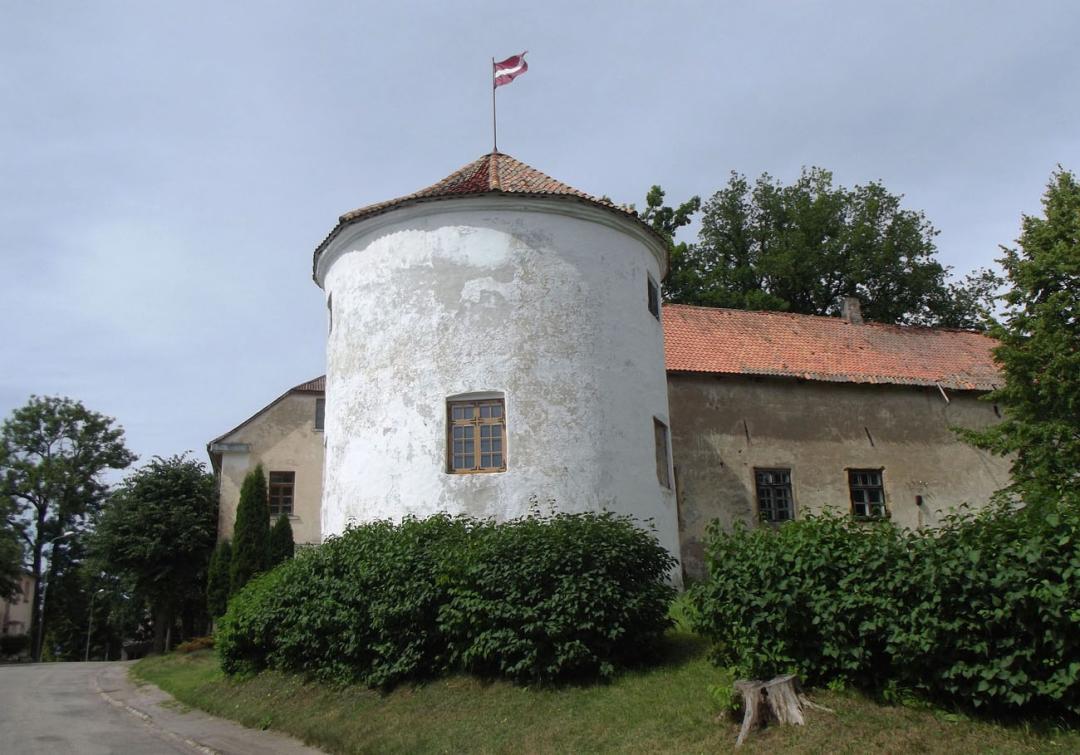
The large semicircular tower, sometimes called the “Guard of the Hill,” is adjoined at the rear by a quadrangular annex of the same height. Its rooms were used jointly with the large tower. The first floor of the tower was covered with a cylindrical vault, and the walls had three loopholes. On the second floor was a magnificent four-pointed star-shaped vault in the vogt’s residence. The tower walls here reach 4 meters thick. In the northwest corner, the fireplace and chimney remain, and in the south — an exit to the danzker. The third and fourth floors of the large tower were intended for the castle’s defense. The basement under the large tower was used as a prison. Already in the 16th century, the political opponent of the Order’s master Burkhard Waldis, author of biting fables and epigrams, was imprisoned here.
On the north side of the gates is the second, smaller tower. At the cellar level, the towers were connected by an underground passage. The second floor of the small tower was adapted for living quarters. The first and top floors, as well as the superstructures above the gates, were used to defend the gates. Along the fortress wall, 1.7 meters thick, connecting the small tower with the northwest quadrangular tower, was a three-story building. The second floor of this building was covered with cross vaults.
The northwest tower protrudes northward, providing flanking fire for the northern tower. In the middle of the western wall, a tower with rounded corners was built. There was a cellar with a vaulted ceiling and loopholes on three sides on the first floor. It is difficult to judge the upper part — it collapsed, and old images of this tower do not show it. Between the northwest and western towers, there was a small gate in the fortress wall.
In the middle of the southern fortress wall, 3.6 meters thick, a quadrangular tower was built, adapted for the use of cannons. This is confirmed by chimneys in the central loophole. The shape and location of the tower indicate an early stage of firearm use. Further development of military art led to placing towers at the fortress corners to increase the firing area. It is difficult to judge the tower’s height. In old drawings, it is half-ruined, but it is clear that it was lower than the towers by the gates. The loopholes on the second floor of the southern wall suggest there was an annex — a building or gallery. The courtyard of the fortress was paved with slabs of unprocessed dolomite. Drainage was made from the same material. There was a well in the middle of the courtyard.
Originally, the fortress gates were protected by a dry moat and a drawbridge over it. Behind the moat stood a wooden palisade. Later, the moat was filled in, and a foreburg was built in the eastern part of the citadel. Three fortress walls and two corner towers formed an enclosed courtyard with gates in the southern wall near the southeast tower. Inside the new fortress, separate stone buildings were attached to the walls. Outside, along the eastern wall, a moat was dug, which was filled in at the beginning of the 17th century.
The New Castle — the residence of the Dukes of Courland. In the 1570s, the foreburg buildings of the old fortress were partially demolished to build the residence of the Dukes of Courland on the freed territory. The old fortress wall and towers were preserved during construction. Three horseshoe-shaped two-story buildings and two towers formed an enclosed courtyard.
The layout of the rooms is simple — a series of enfilade-connected rooms. On the second floor of the northern building were representative rooms and the duke’s apartments. The eastern building housed living quarters on both floors. The lower floors of the northern and southern buildings contained storage and utility rooms. In the southern building near the gates was a guardroom; on the other side of the gates, in the southeast tower, was a carriage house. The second-floor rooms could be accessed by a narrow staircase in the wall or directly from the courtyard via an external staircase.
According to archival materials and archaeological excavations, the old fortress was also used at this time. The loopholes on the second floor of the northern wing were converted into windows. The first floor housed a brewery and bakery, and the tower cellars were used as ammunition storage and prison. At the end of the 16th century, during the construction of the new castle, new earthworks were also made around it, which continued to be improved until the early 18th century. The main attention was paid to strengthening the most accessible eastern side. By 1625, a rondel around the southeast tower, a protective moat, two bastions, and a wooden palisade were built. In the second half of the 17th century, the western side was probably strengthened, and reconstruction of the eastern bastions began.
The system of ramparts was further improved in the early 18th century. Under the guidance of Swedish engineers, the ramparts and bastions on the eastern side were expanded toward the town. The fortifications of the old fortress were rebuilt the most. New earth ramparts were piled closer to the banks of both rivers, moving them away from the fortress wall. At the edges of the earthworks, in front of the drawbridges, ravelins were built.
The external staircase and rich interior decoration were partially lost in the 17th century and completely destroyed in 1706 during the Great Northern War when the castle and palazzo were blown up.

In the late 19th century and the 1930s, partial conservation and restoration of the castle were carried out. In 1821, the castle’s cellars were filled in by order of Russian Tsar Alexander I, and the passages were sealed. Since 1959, extensive archaeological excavations, reconstruction, and conservation have been underway. As a result of the excavations, many finds and comprehensive information about the principles of heating systems and stoves of that time were obtained. In 1976, archaeological research of the castle began. It was established that before the castle, a fortified settlement existed on this site as early as the 1st century BC (old bone, flint, and stone items, and shards of clay vessels were found). In 1980, the reconstruction of the buildings built during the reign of the Duke of Courland was carried out.

The castle is closed to tourists in winter, but construction work is in full swing here even now. In December 2007, near the main defensive moat, while laying communications through the earth ramparts, builders discovered a 17th-century cannon. It is assumed that it was cast at one of the cast-iron foundries of the Duchy of Courland and was probably one of the cannons destroyed by order of Peter the First.
Legend of Bauska Castle
When Bauska Castle was being built — in the mid-15th century — the work was entrusted to a famous, highly talented master. He developed the construction plan. Under his leadership, the castle began to be built, but in the midst of the work, Lithuanian scouts, intending to hinder the erection of a powerful fortress that would undoubtedly become a strong fortified point of the Livonian Order, which was constantly at war with Lithuania, infiltrated the construction site. Two guards at the entrance to the under-construction castle simply overslept the raid, confident that no one would dare attack the unfinished fortress.
Lithuanian warriors killed the master — the construction supervisor — and destroyed the plans, not knowing that a copy of the plans was kept elsewhere — precisely for such cases. The castle was completed according to the master’s plans but was blown up a century and a half later. Even before the castle’s destruction, it was captured, looted, and burned. And although this is the usual fate of fortresses, the master is still offended by people for such treatment of his creation. Therefore, every full moon, exactly at midnight, he rises to the restored tower of Bauska Castle and builds a wall. The ghost of the master has been seen by hundreds of witnesses. The figure of a man fiercely laying stones at the top of the tower causes understandable horror in people. Sometimes two ghosts of the guards who overslept the scouts appear near the master. They bring stones and mortar. On especially gloomy and stormy nights, these guards descend to the castle gates, where the drawbridge was located, through which the enemy penetrated inside, and saw the bridge until morning. If they manage to saw through the nonexistent bridge before the first cock crows, the castle will be reborn in its former glory, and they will be forgiven for sleeping on duty.
Sources:
https://taina-lv.blogspot.com/2009/09/blog-post_6244.html
https://balticcars.eu/bauskij-zamok/
http://www.ambermarks.com/_Pieminekli/GarieApraksti/BauskasRaj/Bauska/EBauskas_vid_pils.htm




Written by Jermaine
Discuss this with the author and others
No comments yet. Be the first to start the conversation.