

The first mention of Krustpils Castle dates back to 1237. At that time, Riga Bishop Nikolaus de Magdeburg von Nauen built Kreutzburg Castle, which became the first fortress of the crusaders in Latgale. Over time, various name variants existed: Kreicburg, Kreutzburg, Cruszeborg. Latvian peasants simply called it Krisburg. Krustpils was referred to in Latin chronicles as Crutzeborch, by Germans as Kreutzburg, and by Slavic peoples as Kryzhborg or Krushbark.
Usually, people coming from other cities are somewhat surprised that in Cēsis there is Cēsis Castle, in Bauska – Bauska Castle. You arrive in Jēkabpils, but here is Krustpils Castle. This is because until 1962 there were two different towns here. This side was Krustpils, and across the river was the town of Jēkabpils. A similar situation existed in Daugavpils, where the town of Grīva on the left bank of the Daugava was a separate town and was merged into Daugavpils in 1952.
When the bridge over the Daugava was built in 1962, there was a dilemma about what to name this city. Because Krustpils was twice as old as Jēkabpils, but since the word "cross" was not very favorable at the time, it was decided that the city could not be called that. They wanted to name the city Jēkabpils because Duke Jēkabs was German, everything around was German, so the city remained Jēkabpils,” says Inese Berķe, director of the Jēkabpils Historical Museum.
In 1318, the castle was first mentioned in serious documents. That year marked the end of the war between the Riga Archbishop and the Livonian Landmeister of the Teutonic Order. The war lasted 21 years, from 1297 to 1318. The castle was also mentioned in 1354 in a document clarifying the boundaries of the possessions of Archbishop Fromhold Fifhusen and his vassals, the Tiesenhausen brothers. A complaint from the same archbishop to Pope Innocent VI in 1359 is known, stating that the Livonian Order had again occupied seven archiepiscopal castles (Turaida, Koknese, Limbaži, Vainīši, Smiltene, Lielvārde, and Krustpils), depriving him of income amounting to 6,830 Riga marks and 66,000 gold guilders. Livonia Landmeister Gerhard von York promised to return the seized archiepiscopal castles. Not voluntarily, of course, the pope forced him. The castles had to be returned, including Kreutzburg.
In the winter of 1375, Kęstutis (Kastetis), Grand Duke of Lithuania, with his army, ravaged the Tiesenhausen fiefs in Krustpils, Pļaviņas, Berzaune, Ergli, Piebalga, Cesvaine, and Baltava for eight days. According to the testimony of six captured Lithuanians, they lost more than 1,000 horses and 50 men due to bad weather and deep snow during the raid; another 50 fell through the ice on the Daugava near Ersiki Castle (castrum Geretzeke).
In 1416, militant monks again took Kreutzburg from the current archbishop and held it for ten years, until 1426, collecting taxes from the surrounding territories during that time.
In 1479, Order Master Berndt von der Borch, during large-scale clashes in the so-called "Priests' War" (Pfaffen-Krieg), occupied 13 castles (including Krustpils) in the territory of the Riga Archbishopric for 14 days. In 1484, the castle was still in the hands of the Order. This war could have ended with a complete victory for the knight-monks and the subjugation of the archbishop to the Teutonic Order. But for some reason, the Landmeister also went to plunder Pskov, where he was completely defeated, and in 1483 the pope removed von der Borch from office.
In the Middle Ages, a castle settlement formed near Krustpils Castle, as with many other castles, presumably originally located near the current church between the Daugava and Dzirnupīte or Donaviņa. The castle settlement of Krustpils was first mentioned in documents in 1511, when Riga Archbishop Jasper Linde leased a place for a tavern there to a certain Johann Asherman.
In 1558, the Livonian War began. Kreutzburg was unlucky here as well. It was captured three times by Russian troops, or rather three and a half times. However, no one particularly defended the castle. It was not even guarded. In February 1559, a Russian corps of about 10,000 men crossed the Daugava and occupied Kreutzburg, quite literally in passing. The Russians set fire to the castle and moved on with their affairs.
In 1561, the Russian army again captured Kreutzburg, but then a truce occurred, a brief pause in the long war, and the castle had to be abandoned according to the Treaty of Vilnius, along with other fortified towns of Latgale. Kreutzburg became the property of the Polish king and entered the Polish-Lithuanian Commonwealth.
Then the castle was occupied by the army of Magnus, King of Livonia. Magnus, although a Danish prince, was a protégé and junior ally of Ivan the Terrible, even married to the tsar’s niece. In 1577, Magnus quarreled with Ivan and began establishing contacts with the King of Poland. Ivan sent an army against him. Magnus’s men blew up Kreutzburg and retreated. The castle was occupied by the tsar’s army. The Russians repaired Kreutzburg and left a small garrison in the castle.
In 1582, under the Yam-Zapolsky truce, the Russian army had to leave Livonia, including Kreutzburg. According to etiquette, the Russians blew up the castle before leaving.
The next owner of Krustpils, Nikolai V (1585–1659), son of Nikolai IV and Gertrude von Korff (née von Rosen), was a colonel in the Polish army and voivode of the Wenden (Cēsis) district. He began improving the castle in 1622, but the Swedes took the castle, damaging the fortifications. During the Polish-Swedish war in 1626, a fierce battle took place near Krustpils. Aleksander Gonsewski, supported by Lew Sapieha (Prince Lew Ivanovich Sapieha), the great Lithuanian hetman, forced Swedish General Horn and King Gustavus Adolphus to retreat toward Dahlen (Dole) Castle. It is said that near the castle, Polish soldiers tore the helmet off the head of Swedish King Gustav II Adolf, and only at the last moment did he barely escape the battlefield.
Polish King Stephen Báthory granted the castle and surrounding lands as a fief to Nikolai Korff because Baron Korff helped him capture Daugavpils in battle. Korff wrote that he was probably the only Lutheran in the Polish army to be given such a castle. He was very proud of this. The Korff family held it until the early 20th century. For 300 years, the Korff dynasty owned Kreutzburg Castle.
Only in 1602 did von Korff obtain a privilege from the new King Sigismund III for perpetual ownership of Kreutzburg. Of course, the surrounding lands brought good income, but the castle itself remained in ruins.
The next owner of Krustpils, Nikolai V (1585–1659), son of Nikolai IV and Gertrude von Korff (née von Rosen), was a colonel in the Polish army and voivode of the Wenden (Cēsis) district. He began improving the castle in 1622, but the Swedes took the castle, damaging the fortifications. During the Polish-Swedish war in 1626, a fierce battle took place near Krustpils. Aleksander Gonsewski, supported by Lew Sapieha (Prince Lew Ivanovich Sapieha), the great Lithuanian hetman, forced Swedish General Horn and King Gustavus Adolphus to retreat toward Dahlen (Dole) Castle. It is said that near the castle, Polish soldiers tore the helmet off the head of Swedish King Gustav II Adolf, and only at the last moment did he barely escape the battlefield.
After that, Kreutzburg Castle was part of Sweden for a short time. By the Treaty of Oliva in 1660, it was returned to the Polish-Lithuanian Commonwealth. Near the castle stood a church built between 1683 and 1685, whose tower is crowned with a Baroque helmet and a lantern with a spire above it.
Of course, the Swedes reached Kreutzburg, captured the castle, and there was no way to avoid casualties and destruction, whether accidental or deliberate.
Kreutzburg returned to the possession of von Korff only in 1630. There seemed to be a brief pause in the Polish-Swedish wars, and Nikolaus resumed restoring the castle.

In the autumn of 1771, concluding the military campaign against the Bar Confederation, Russian commander A. V. Suvorov stayed in the castle. In 1772, the first partition of the Polish-Lithuanian Commonwealth occurred, and the Inflanty Voivodeship, which included Kreutzburg, was incorporated into Russia. The Korffs began serving the Russian Empire and did so quite successfully; many became generals.
On the site of the ancient church stands a new one, built in 1818 in the Russian Empire style, but the old tower miraculously survived.
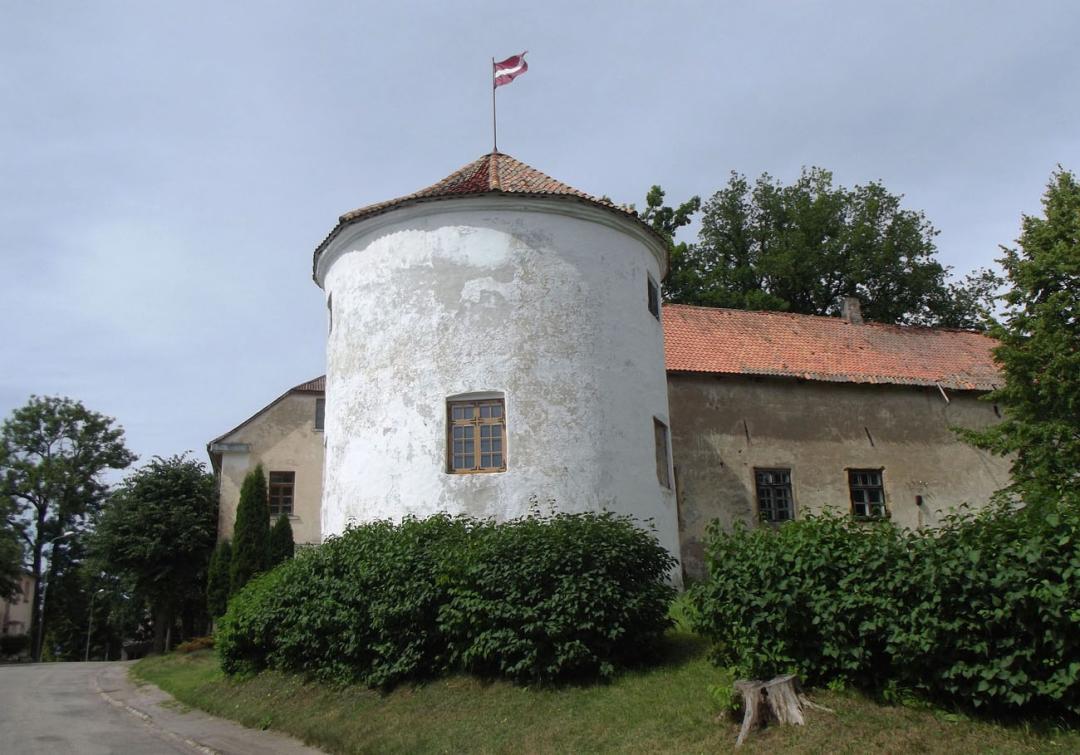
In 1849, another Nikolaus (Nikolai) von Korff initiated a major reconstruction of Kreutzburg Castle. After that, the castle looked roughly as it does today. Most of the castle became a residence for the baron and his family, with the lower part housing utility rooms for servants. A water tank was installed in the castle tower, and the chambers had hot water and a flush toilet (at a time when this was a rarity even in Western Europe).
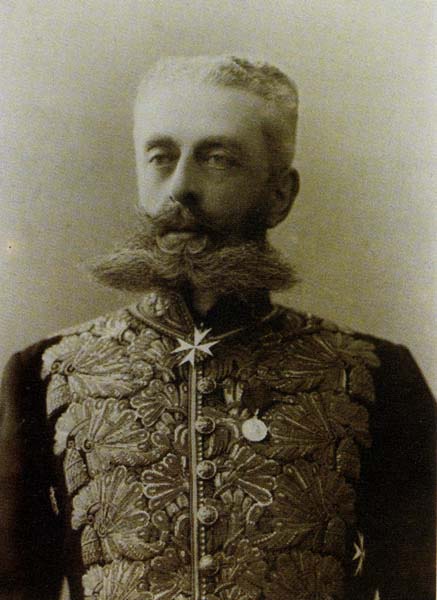
In 1902, Nikolai Korff, chamberlain of the Russian Court since 1894, installed a telephone line to the castle.
Krustpils Castle was quite lucky because it was rebuilt after each war and did not change owners for 300 years. And since the Korff family had a tradition of naming the eldest son Nikolai, 13 Nikolais lived in this castle over three centuries.
The castle was not empty in the 20th century either. In 1919, the baron left the castle, and for 20 years the Latvian Army settled here, specifically the Latgale Artillery Regiment. If any of you have seen the multi-part film "The Long Road in the Dunes," the episodes where Arturs was in the army were filmed right here, in our castle courtyard, presumably to make the environment more authentic.

Later, after the war, the Soviet army was here for 50 years, so the castle was a military object for 70 years. In 1994, the army left the castle. Latvia gained independence in 1990, but due to interstate agreements, the army only left in 1994. The army already knew it would leave and did not particularly maintain the castle. It was unheated, and radiators burst.
In 1994, Krustpils Castle was transferred to the Jēkabpils Historical Museum (a survey conducted then showed that residents wanted to see a museum here), and a period of painstaking restoration began.
Krustpils Castle, as expected, has its ghosts and legends. It is said that during the baron's time, in the building with fifteen guest rooms, no one wanted to stay in one of them—people said it was restless there. There is also a sad and somewhat surprising story about the castle’s ghost, the Brown Lady, with various versions.
"Several years ago, an elderly lady came to us and said she was the great-granddaughter of our Brown Lady. This was the first time someone claimed to be a relative of the ghost, so to speak. We, of course, questioned her about the details. It turned out that in her family, a legend was passed down from generation to generation that in the mid-1800s, a maidservant became pregnant by the baron. She gave birth to a son but was ashamed and decided to jump into the Daugava out of shame. She gave the child to her friend to raise. The child grew up, and the lady who came to us was his great-granddaughter," the museum director said. There is another version of this story.
The baron von Korff’s son fell in love with a poor girl who worked in the kitchen. So much so that he decided to marry her. Something had to be done about this. The poor girl was lured into the dungeon and walled up there. So she still wanders the castle, sometimes trying to return to her kitchen duties and rattling dishes there. Because the maid wore homespun clothes, she was called the Lady in Brown. However, all who saw her claim the ghost was white.
Many have seen her. One bartender, who stayed overnight in the castle, even told the girl to go away because she disturbed his sleep. The ghost left, but in the morning the castle door to the bar collapsed, and it was impossible to open it; they had to break the door down. Not a very harmful ghost, but she demands respectful treatment. Sometimes the ghost girl knocks glasses off the table. It seems they fall by themselves. But she does not do it out of malice, just carelessly.
Several legends are associated with the castle:
Krustpils Castle was built long ago by a very wealthy baron. He had some misunderstandings with the devil, but the baron believed that since he had a lot of money, even the devil could not stop him. However, everything the builders erected during the day, the devil dismantled at night, throwing stones into the Daugava, so much so that a rather large island formed there. The baron realized he had to solve the problem because the bottom of the chest where he kept his finances was already showing. Following useful advice, the baron lured a Polish worker into the far tower, got him drunk, and ordered his men to wall him up in the tower’s wall. The devil liked this; he stopped causing trouble, no longer destroyed the castle, but began to consider the far tower his dwelling and occasionally stayed there.
Another legend says that in one of the castle rooms, formerly the baroness’s boudoir, there is a magic mirror. It is still there. This mirror, it can be understood, served not just one baroness but many, passed down from mother-in-law to daughter-in-law. If a baroness looked into this mirror before a ball, she was guaranteed overwhelming success with the cavaliers. If on the wedding day the baron saw his bride’s reflection in this mirror, he would see her as young and beautiful all his life. The secret is simple: the von Korffs usually married very young women when already quite old. So by the time the husband died, the baronesses had not aged much.
The former furnishings of the castle in the 19th and 20th centuries can be judged by the remains of its former splendor. Many years spent here by various armies took their toll—walls were repainted, floors replaced, rooms divided, and the beautiful wooden staircase leading to the second floor was destroyed because walking in heavy boots on a fragile wooden staircase was not easy.
But the staircase was restored. Descendants of the Korff barons helped to learn about the furnishings, furniture, room layout, and purpose by sending photographs from the family archive. The Korff castle was lucky again because many other castles and estates are very difficult to restore simply because there are no drawings or photographs showing how the building looked even 100 years ago. The dining room where the family and guests dined was also restored based on photographs.
During the Latvian and Soviet armies’ presence, this hall was a dance hall. The floor was worn down, so to speak, by dancing heels. Imagine, the army was here for 70 years.
The fountain visible from the count’s balcony has now been restored. Next is the park’s landscaping, and city residents already come here to relax.
Of course, the pride of the castle is the great hall. In recent years, the ceiling, floor, fourteen windows, and, of course, the beautiful chandelier have been restored.
"This chandelier was also made based on photographs from that time. As you can see, it hangs quite low. Now we have electric bulbs, but back then, imagine, there were candles. To prevent fires and soot, the chandelier had to be lowered quite low. We also see a beautiful fireplace in this hall, which is also, so to speak, half restored and half newly made.
Sources:
https://rus.lsm.lv/statja/novosti/samoupravlenija/kak-krustpilsskiy-zamok-iz-armeyskogo-obyekta-stal-muzeem.a418605/
https://pikabu.ru/story/brodim_po_srednevekovyu_zamok_krustpils_kreytsburg_8575887
https://www.castle.lv/latvija/krustpils.html Project by Renāta Rimša
http://www.ambermarks.com/_Pieminekli/GarieApraksti/JekabpilsRaj/Jekabpils/EKrustpils_vid_pils.htm




Written by Jermaine
Discuss this with the author and others
No comments yet. Be the first to start the conversation.