The remains of the church and castle are located on Saint Meinard's Island in the reservoir of the Riga Hydroelectric Power Plant, on the southern outskirts of the town of Ikšķile, 28 kilometers southeast of Riga, on the right bank of the Daugava River, 7 km downstream from the confluence with the Ogre River. Before the flooding, the castle stood on a high limestone rocky shore. Ikšķile was the castle of the Bishop of Livonia, later the castle of a vassal of the Riga bishop, and for a long time the castle was also occupied by the Livonian Order. The Church of St. Mary in the castle complex is a unique site, considered the first Catholic church in Latvia. The church and castle are the first stone structures in the history of Latvia (1184-1185).
In the mid-12th century, German ships began to enter the Daugava River more frequently for barter trade with the tribes living along the riverbanks. Trade brought great profits to foreigners. The "Rhymed Chronicle" states: "they took it into their minds to multiply this property." Gradually, German sailors learned this waterway—they knew which wind would be favorable, how to overcome the rapids of Rumba, Vedmere, and others, how to navigate boats between large and dangerous rocks. They learned not only the water route but also gradually established friendly relations with the tribes living along the Daugava. At first, the arrivals of foreigners were met with stones and arrows, distrustful of them, but soon these traders were awaited here. From the mid-12th century, traders' trips became regular: "...from that time they often traveled in large numbers to the lands of the Livs..." The German boats began to venture further upstream, becoming bolder. Among the banks, a steep dolomite "mountain" on the right bank of the Daugava opposite some island stands out—later the site of Ikšķile. The Germans had the idea to winter in these places, build warehouses for their goods, to conduct trade year-round.

"Then deeper into the interior lands, they traveled about six miles up the river. There lived pagan foreign tribes with whom they traded and stayed there as long as it took to build themselves a dwelling, which happened with permission." So from the very beginning, this was a deliberate action, cleverly trying to present it as an accident, "torn sails during a storm." This trade was often unequal, as Tacitus already wrote that the Balts, receiving payment for unprocessed amber, which had previously lain on the seashore, were very surprised. Various methods were used to develop trade: "...they gladly treated some pagans with tasty wine." As an ancient legend says, with the arrival of the first traders, the locals called them "collectors" because they had baskets on their heads, which always amazed the Livs. Indeed—on old engravings of that time, the traders wore hats with wide brims on their heads.
In old documents and chronicles, Ikšķile is mentioned as the fortresses Ukskul, Ikskul, Ikeskola, Juksküll, etc. According to legend, where Ikšķile now stands, there was once a Liv settlement. Along the Daugava wandered traders of various peoples. Among them were Germans. Landing ashore, they asked what the settlement was called. Some Liv, in his native language, answered: “üks küll” — “one village,” thinking they were asking about the number of villages here.
Chronicler Balthasar Russow calls this fortress a castle: "Bremen merchants repeatedly returned with their goods. Other merchants also appeared in large numbers. They were all well received. This continued for a long time, and fortune smiled upon them. Eventually, they advanced further inland, about six miles, unloaded goods with the permission of the pagans, and many merchants stayed there. After that, the pagans gave them the right to build a warehouse for goods. Then they built a magnificent house and castle or fortress on some hill by the Daugava, as they could settle here peacefully. And this castle was called Ikšķile. The pagans did not think anything bad could come of this. Soon after, the castle of Dole was built. These were the first Christian fortresses in Livonia. After some time, a priest came with the merchants to preach, some monk Meinard from Segeberg."
By order of Pope Alexander III, specially trained missionaries were to be sent to the Baltic lands. In this regard, Archbishop Hartwig II of Bremen, who oversaw the lands of Eastern Europe, between 1180 and 1184 sent the Augustinian monk Meinard (Meinardus) from the Segeberg convent of the Bremen bishopric along with merchants, accompanied by two disciples—Jan and Tom. Meinard was given detailed instructions and money from both Rome and Bremen.
After a three-week voyage, Meinard, together with the merchants, entered the mouth of the Daugava, sailing upstream, learning the trading places of Daugavgriva, the settlement of Riga, the Liv settlements on Sala (Dole), and finally reaching the main trading settlement in Ikšķile. Possibly, some priest had arrived in Ikšķile with merchants before Meinard, as the Livs seemed to understand his function; they received Meinard as a guest, and local rulers brought him gifts.
The chronicles do not mention that Meinard needed a translator; his relations with the Livs were direct. Some scholars believe that when conquering the Slavic provinces—the Wends—the Germans acted similarly as elsewhere, preparing missionaries from among the locals. Possibly, Meinard knew Lithuanian and Prussian languages, related to the Wendish language, which could have facilitated mutual understanding on the banks of the Daugava. Initially, historiography considered that Meinard visited Livonia with German merchants as their priest and possibly scribe before the 1160s. However, new research shows that the activity of German merchants eastward through the Baltic Sea appeared only from the 1180s.
Around 1180, Meinard arrived in Ikšķile, where the Germans created a warehouse for goods in the Liv settlement, staying there even in winter. His goal was to spread Christianity among the Daugava Livs. Since the Daugava Livs were under the dependence of the Polotsk prince, Meinard sought permission from the latter to carry out this mission. Having received the prince's permission, Meinard tried to spread Christianity peacefully.
About this, Karamzin wrote about the Germans in Livonia: "At this time, according to the oldest Livonian chronicler, the Polotsk Prince Vladimir was famous for his power: he ruled up to the mouth of the Dvina, and his authority over the southern Chud land was so well known that the pious elder Meinard, a zealous German Catholic, arriving around 1186 with German merchants in Livonia, asked him for permission to peacefully convert the local pagans to Christianity: to which Vladimir willingly agreed and even sent Meinard with gifts from Polotsk, not foreseeing the harmful consequences soon to be revealed to the Russians from the ambition of the Popes and Roman clergy. Meinard succeeded in his important task: he founded the first Christian church in Ikšķile along with a small fortress (not far from present-day Riga); he taught the pagans the Law and military art for their safety; he baptized willingly and unwillingly; in short, he established the Latin Faith there."
Sluchyevsky recorded in the "Riga Gazette": "It is true that the first German preacher Meinard, whose tomb we saw in Riga Cathedral, received 'permission' to preach among the pagan Livs from Vladimir of Polotsk and to build a church in Ikšķile; it is true that according to the contemporary 'Rhymed Chronicle,' the lands of the Selonians, Livs, and Latvians before the arrival of the sword-bearers were under Russian control."
Was it the Polotsk prince or the Pskov prince? The Pskov chronicle of Metropolitan Eugene reports: "In the year 1186. Around this time, Meinard, a German monk, arriving at the mouth of the Dvina with Bremen merchants, kindly asked permission from the Pskov prince Vladimir, who then ruled these lands, to convert the Livonians and Chuds to Christianity." However, subsequent events unfolded without the "kind permission of the Pskov prince."
Initially, Meinard preached in the merchants' settlement, but having received additional funds from the Pope and the Archbishop of Bremen, he purchased a small plot of land near Ikšķile on the steep bank of the Daugava to build a church. Most likely, the names sounded somewhat different, but the German ear perceived these local names as such. The Ikšķile Church of St. Mary was built of wood in 1184 and only in 1185 of stone.
Successes were modest—if even some pagans were baptized, for them it was only a small performance involving them, as they easily washed away the faith in the pure waters of the Daugava, sending it back to the sea, specifically back to Germany. It is assumed that missionaries and their assistants engaged not only in baptism but also studied local customs, learned about disagreements among local tribal leaders to wisely apply this knowledge later.
It should be noted that Ikšķile was located in a strategically important place (a land route from north to south crossed the waterway here, often used by Lithuanians in their military raids). During one Lithuanian attack, Meinard hid in the forest with the Livs. When the danger passed, he promised the Livs to build a stone castle if they accepted baptism. Liv castles were wooden and unreliable in defense. The Livs agreed, and Meinard, inviting stonemasons from the Swedish island of Gotland, built two castles for the Livs in 1185 and 1186—the first in Ikšķile in summer 1185 (according to Henry's Chronicle), next to the already built church, and the second in Salaspils (Kirchholm). They became the first stone structures in Livonia, even before the founding of Riga.
The locals, unfamiliar with stone architecture, naively believed that if the castle was tied with ropes, it could be pulled down into the river. "At the same time, neighboring pagan Semigallians, hearing about the stone castle's construction and not knowing that stones were bonded with mortar, came with large ship ropes, intending, as they thought, to pull the castle apart. But they retreated, carrying many of their wounded on stretchers, struck by arrows..." From this excerpt of Henry of Latvia's Chronicle, it follows that before the German-Scandinavian expansion in the 12th century, the Baltic peoples simply laid stone upon stone. The most they knew was stone masonry with earth filling and without binding mortar. A strong push would cause the masonry to collapse. The matter was the availability of building material. The ancient Estonians on the islands used stone due to a shortage of wood. The Livs and Semigallians had no shortage of trees and therefore preferred wooden construction. As Pastor Bielenstein wrote: "Nevertheless, news of mighty iron men building a castle near Ikšķile and a town downstream reached Semigallia."
Henry of Latvia's Chronicle consists of four books; Meinard is mentioned in the first book. A quote about Meinard from the chronicle: "In the Segeberg monastery was a priest of the Order of Blessed Augustine, Meinard, a man of venerable life, grayed with honorable age. Simply for the sake of Christ's cause and only for preaching, he arrived in Livonia with merchants: Teutonic merchants, having befriended the Livs, often traveled to Livonia on a ship along the Dvina River. Meinard began to reproach the Livs for their folly because they had no fortifications. He promised to build a castle if they decided to become and be children of God. This pleased them; they promised and solemnly confirmed that they would accept baptism. Since a fifth of the castle was built with the preacher's funds, it became his property, and he had previously acquired land for the church. As soon as the castle was completed, the baptized returned to paganism, and those not yet baptized refused Christianity. Meinard, however, did not abandon his cause." Later, when the castle's graves were excavated, it was noticeable that part of the castle belonged to the Livs.
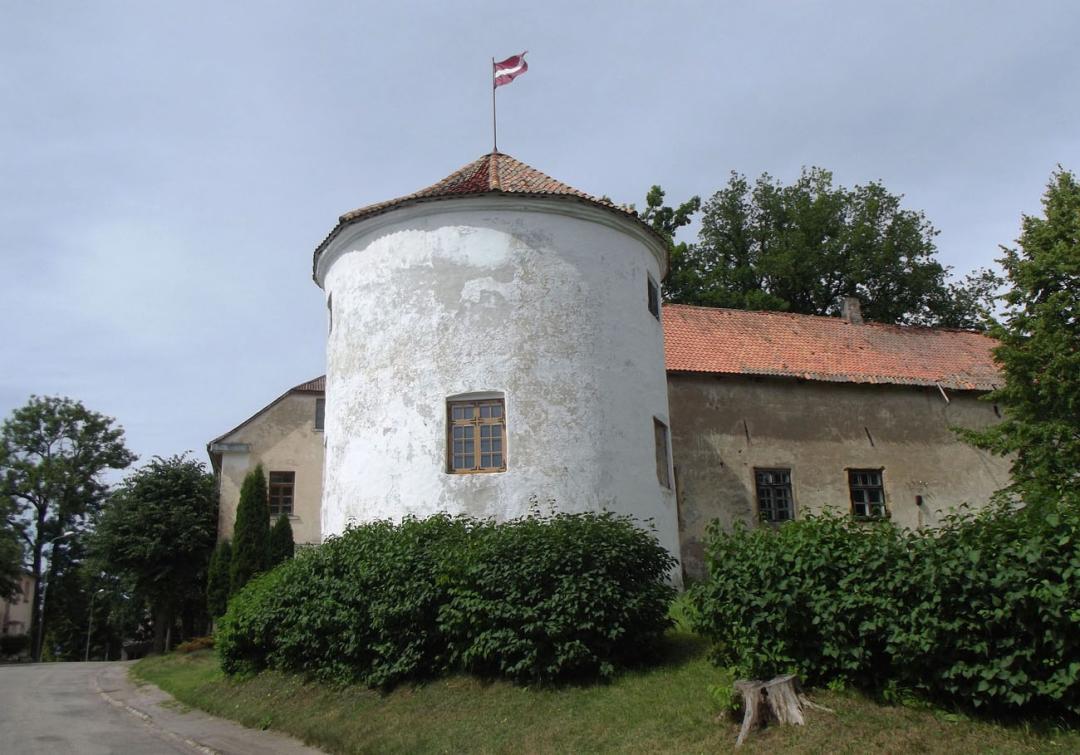
The Ikšķile castle was built on the right bank of the Daugava amid an existing Liv settlement. The castle was built next to the church, creating a single construction complex. From the south, it was protected by a steep dolomite cliff about 6 meters high; from the east, by a moat still visible in the 20th century. At the same time, it served as a descent to the Daugava, cut into the rock during the castle's construction. On other sides, moats were no longer visible in the 20th century, and their possible existence was not checked in excavations. The church and castle were located next to each other along the Daugava bank: the church on the western side, the castle on the eastern.
In Ikšķile, two churches were successively located on the same site. There is no consensus on their dating, so the older is conventionally called the 12th-century church, and the later the 13th-century church. Only the lower part of the 12th-century church's foundation walls remains. The second church was built by masters from Gotland, modeled after churches on their island. It is believed that the Gotlanders introduced Romanesque architecture and vaulted structures to Latvian history. The 13th-century church, built of dolomite stone, had a two-nave naos divided in the middle. The nearly square choir on the eastern side was separated by an arch. The church has a central cross-shaped vault support and is separated from the choir by a round Romanesque column, uniquely dividing its triumphal arch into two parts. Its unusual crowning, a bundle of three half-columns resting on spherical consoles, is virtuoso. The main entrance was originally in the southern wall from the castle courtyard side; the northern wall had embrasures. The church was built of roughly hewn limestone blocks, previously covered with thin plaster; the outer edges of architectural and structural details were carefully hewn. When the church was extended, two protective walls formed a closed courtyard in the southwest and southeast corners, connecting to the castle built in the eastern part of the complex.
The castle was initially built as two separate structures, not connected by doorways. The smaller building was on the western side near the church. The basement floor remains, where at the eastern edge of the room, excavation revealed remains of a limestone vault and on the cobblestone floor, a Latin cross laid out from larger flat stones. This possibly tower-like structure is considered part of Bishop Meinard's castle.
The second, larger castle building, about 40x20 m in plan and possibly originally belonging to the Livs, was enclosed by a defensive wall. It included an elongated quadrangular area with eastern corners reinforced by buttresses. The only possible gate location was at the northernmost end of the eastern defensive wall. Excavations of the wide courtyard uncovered foundations of several buildings, apparently built at different times and not existing simultaneously.
The Pope promised to protect Livonia—the "Land of Mary"—just as Palestine was called the "Land of Her Son." The origin of this Marian cult (Land of Mary) is attributed to Meinard, who dedicated his first stone church, later the Ikšķile Cathedral, to the Blessed Virgin. Bishop Albert, moving the cathedral from Ikšķile to Riga, intensified this dedication by naming the Riga church after the Virgin Mary assumed into heaven. This was ahead of its time, as the dogma of the Assumption was proclaimed only by Pope Pius XII in 1950.
According to Arnold of Lübeck's chronicle, the bishopric in Livonia was founded in 1186. Meinard and the bishopric are first mentioned in Pope Clement III's bull of 1188, which confirmed Meinard as bishop and the Ikšķile bishopric as property of the Bremen church. In 1186, Bremen Archbishop Hartwig II consecrated Meinard as bishop. In 1188, Pope Clement III approved the creation of the Ikšķile bishopric (episcopatus Ixscolanensis) "forever" within the Bremen archbishopric. Thus, Meinard became the first bishop of the "Ikšķile bishopric in Rus" founded in 1186. To create a bishopric, a large number of baptized people was necessary; Ikšķile did not come close to this number, but there was a reason for such haste: in the baptism of pagans, Germany competed with Denmark (Lund bishopric) and Sweden (Uppsala bishopric), conquering lands on the Estonian coast. It was necessary to secure the conquered sphere, exclude it from possible redistribution of influence, and the lower Daugava, the key to the East, was especially valuable. Borders rapidly expanded—Pope Celestine III sent his bull praising Meinard's merits in baptizing the Livs not to the Ikšķile bishopric but to Livonia.
However, things went not too well for Meinard afterward, like any ruler hoping to manage with a carrot but forgetting the stick: "The preacher was, of course, troubled in spirit, especially as his property was gradually plundered, his people beaten, and the Livs decided to expel him from their lands. When the aforementioned bishop realized the Livs' stubbornness and his cause was collapsing, he gathered clerics and brethren, decided to return, and went to merchant ships already departing for Gotland at Easter. Here, the deceitful Livs, fearing that Christian troops would come later, tried hypocritically with tears and other means to keep the bishop. ...In sorrow, he could not hold back tears and went to Ikeskola [Ikšķile], his home. He appointed a day to gather people for exhortation about the promised baptism, but the Livs did not come and did not fulfill their promise. Therefore, after consulting with his people, he decided to go to Estonia to join merchants wintering there to sail to Gotland. Meanwhile, the Livs prepared his death during this journey, but Anno from Toreida [Turaida] warned him and convinced him to return. Thus, after many hesitations, the bishop returned to Ikeskola (Ikšķile), unable to leave the country. ...Bishop Meinard, after many hardships and sorrows, lay down and, seeing he was dying, summoned all elders of Livonia and Turaida and asked if they wanted to be without a bishop after his death. Shortly after, the bishop ended his days."
Historian Gustav Manteuffel, in a brochure published in Warsaw in 1902, claims that Bishop Albert solemnly transferred Meinard's mortal remains from Ikšķile to the new Riga Cathedral in 1226-1228 but does not specify the date or source. It is known that Manteuffel did not invent this information and would not spread it if it were unreliable. The transfer happened after 1225. This is also suggested by the so-called episcopal chronicle, which mentions that Meinard's remains were buried before or under the altar of the Holy Blood in Riga, explained by the cathedral still being under construction. Historian B.U. Hauker also allows that the transfer of Meinard's remains to the new Riga cathedral to emphasize his importance could have occurred in 1229-1230 in the presence of papal legate Baldwin of Alna. Another opinion is that the remains were reburied at the end of the 14th century by Riga Archbishop John IV.
A quote from Andris Upīts's literary work "On the Edge of Centuries": "Monk Meinard brought not only knights to this land. Among them were some merchants, and before that, swindlers and usurers. Some were highway robbers and sea pirates threatened with inevitable gallows in their homeland." But this was well characterized earlier by the 13th-century English philosopher, Franciscan monk Roger Bacon: "There is no doubt that all the unbelievers beyond Germany would have long been converted if not for the cruelty of the Teutonic knights... they do not desire peace, as they want to subjugate these peoples and enslave them. The sons of the slain become enemies of the Christian faith forever and try as much as possible to harm the crusaders."
The second bishop of Livonia, Berthold, was abbot of the Lokum monastery in Germany (1180s). He was consecrated bishop in Bremen in winter 1196-97. In 1197, arriving in his Livonian bishopric, he settled in Ikšķile castle but died the next year in battle near Riga, not reaching Ikšķile. The third bishop, Albert, in 1202 made Riga his residence. Thus, Ikšķile's significance as the bishop's main castle and residence of the Cathedral Chapter disappeared.
The successor to Berthold as bishop of Ikšķile and Salaspils was Albert, the nephew of the Archbishop of Bremen, a high-ranking priest, essentially a clever politician. On March 28, 1199, Albert, aged 34, was named the new bishop of Ikšķile. This appointment drastically changed the bishop's fate and opened a new chapter in Latvian history. The "inheritance" Albert received in Ikšķile was unpleasant. His predecessor, Bishop Berthold, had tried to force local pagans to accept Christianity by force but died in battle. In spring 1199, local pagans declared they would kill any missionary who did not leave the Daugava mouth before Easter. The new bishop's possessions were limited to two small fortifications in Ikšķile and Salaspils. With support from Pope Innocent III, German King Philip of Swabia, and Danish King Canute IV, in 1200 Bishop Albert, along with Count Conrad of Dortmund and Herbert of Iburg (now Badiburg), and a crusader army on 23 ships, arrived in the Liv lands and settled in Ikšķile. Several major and minor clashes with the Livs occurred. Taking hostages—the sons of Liv leaders—Albert ensured a brief peace.
In Oskar Eger's four-volume "World History," there is an interesting episode: Finally, Prince Vladimir declared war on the dangerous newcomers: he besieged Ikšķile and could not take Kirchholm in 1200 because the Russians, skilled archers, according to the ancient Livonian chronicler, did not know how to use slings; although they adopted this weapon from the Germans, they poorly threw stones and hit their own. Vladimir lifted the siege upon hearing that many foreign ships were approaching Livonia's shores and returned to Polotsk by the Dvina. The fleet that frightened the Russians was Danish: King Valdemar, pleasing the Pope, went to defend the new Livonian Church; he docked at Ösel, wanted to establish a fortress there, but suddenly changed his mind, leaving and sending the Archbishop of Lund, the famous scholar Andreas, who as the Roman legate was to promote the Catholic faith's success in these lands. Soon, most inhabitants were baptized, seeing that their insignificant idols, destroyed by Christian axes, could not protect themselves."
Henry of Latvia's Chronicle describes Bishop Meinard's funeral "with weeping and groaning," characterized as show and hypocrisy. Such an assessment is understandable, considering the chronicle's goal—to justify the activities of Albert, the third bishop of Ikšķile, who abandoned Meinard's peaceful path and, to overcome the Livs' fickleness, organized military campaigns. Possibly, Ikšķile could have served the Germans instead of Riga, but rapids and shallows on the Daugava, like the Rumbula rapids, posed threats to German ships. In 1201, Bishop Albert moved to Riga, which seemed safer to the Germans. When Bishop Albert Buxhövden moved the seat to Riga, in 1201, he granted the Ikšķile castle as a fief to one of his close associates, Knight Conrad of Meyendorf, who had accompanied the bishop since his first trip to Ikšķile. In building Riga, Bishop Albert was helped by Knight Daniel and the "nobleman" Conrad of Meyendorf (Meyendorf is west of Magdeburg). For his loyalty, the bishop granted him the castles of Lielvārde and Ikšķile. Still, in 1201, four-fifths of Ikšķile officially belonged to the Livs.
In 1203, Ikšķile castle was armed with formidable stone-throwing weapons for that time. The Polotsk prince saw how his benevolent attitude toward the "missionary baptizers" ended and, in 1203, Vladimir of Polotsk, together with Visvaldis of Ersika and Lithuanians, attacked Livonia, besieged Ikšķile, Salaspils, and even reached Riga but was defeated and fled. During this campaign, the prince besieged Ikšķile castle. At that time, only baptized Livs were inside, who promised the prince money without resistance, after which he lifted the siege, as he came to collect tribute (according to chroniclers).
In 1204, when Bishop Albert went to Germany for new crusader reinforcements, Lithuanians, together with more than three hundred unbaptized Livs from Aizkraukle and Lielvārde, raided Riga through Ikšķile. The Livs, arriving for negotiations, did not ask for peace but for help to drive the Germans out of Liv lands. An uprising was being prepared. Livs Kirhans and Leians, who tried to speak in defense of the Germans, were killed on the spot—torn apart with ropes (the bishop later canonized them as holy martyrs and buried them in the Ikšķile church near Meinard and Berthold).
Chronicles mention that Knight Conrad of Ikšķile participated with Bishop Albert in many military campaigns. In 1205, when the Semigallians, fearing Lithuanian superiority, offered him to start a fight with them, he did so, saying: "It is more honorable to die for Christ than to flee and disgrace my people." Chroniclers, especially Henry of Latvia, try to portray Conrad as a brave man (in Old German, "Konrat" means brave, bold counsel). Documents and chronicles continue to mention Conrad in connection with Ikšķile. Albert, together with Conrad of Meyendorf, to whom he had long ago granted the castle as a fief, sent his brother Rotman to announce that "he himself with several pilgrims would come, and they should receive him respectfully to negotiate with Conrad on how to maintain peace." (Pilgrim—a wandering priest, a traveling saint; in this case, men going to war received full absolution but did not join the Order. One might say—a wandering robber.)
But peace negotiations did not take place, as the Ikšķile inhabitants, learning of the bishop's arrival, prepared to flee, knowing from experience that nothing good awaited them. At first, the Livs tried to negotiate with Conrad, wanting to know the bishop's reason for coming. Early in the morning, they called Conrad for talks and, according to the chronicler, wanted to kill him secretly, but he, "well aware of their cunning," first put on his chainmail and only then went out to the Livs, giving the "right answer" to each question. These negotiations did not convince the Livs, who gathered children and women into boats and fled upstream along the Daugava. Conrad and his warriors took the opportunity to start robberies: "When the pilgrims saw that the newly converted Livs had fallen so much that forgetting the faith, they returned to their old ways—like dogs to their vomited food—and inflamed by God's wrath, they chased the fleeing ones."
The Ikšķile inhabitants, reaching Lielvārde, sought refuge in the forest with local Livs. The knights burned Lielvārde castle, and the Livs fled further to Aizkraukle, followed by the Germans, where "their castle was burned with God's mercy." The fugitives were forced to make peace and give hostages. On the way back to Ikšķile, pilgrims were ambushed in a dense forest near the road to Memekille (later Memenciem, Memeni, Miemeni) by inhabitants of Lielvārde and Ikšķile, who arrived first by secret forest paths. Then Conrad and his warriors felt that "the inhabitants of Ikšķile were unworthy of the castle." Before returning to Riga, the crusaders provided Conrad with protection. To have food, the Germans harvested grain from Liv fields "partly with sickles, partly with swords." Defending against "pagans" who tried to protect the hard-grown harvest, "they all mowed armed." The castle was filled with grain to the top, and an attempt to gather the rest ended with "Livs coming out of the forests killing seventeen knights, some martyring them—offering them as sacrifices to their gods." This led to the complete expulsion of the Livs from the castle they had built: "they were completely pushed aside by the fortified castle of Ikšķile." Thus, Conrad of Meyendorf strengthened his fief, again taking what supposedly belonged to him for four years.
Although the Ikšķile castle was granted to Conrad of Meyendorf as a fief in 1201, he settled there only in summer 1205 when the crusaders established their rule. Many crusaders (about 20) were left as Conrad's guards due to the Livs' rebellion. These crusaders formed Conrad's vassal family, gathered the grain sown by the Livs, and delivered it to Bishop Albert in Riga. According to Indrikis: "So that they [crusaders] in case of battle..."—thus for the maintenance of the crusaders. After the Livs' attack on the Germans in autumn 1205, Conrad remained the sole lord of the castle.
In summer 1206, several Livs managed to reach Polotsk to urge the prince to hasten to help. The prince gathered a strong army and sailed down the Daugava. After a short battle near Ikšķile, the Polotsk troops advanced and surrounded Salas castle. Conrad and his archers repelled the attack on Ikšķile. After 1206, permanent German garrisons were stationed in Holm and Ikšķile.
Initially, the rights of so-called "fief men" were limited. A fief lord could hold a fief while fulfilling vassal duties, but gradually they sought to expand their rights. A fief could be used by the vassal's sons, and daughters received dowries. Over time, inheritance rights expanded further, covering distant relatives of daughters up to the fifth generation. Conrad's fief (around 1209) was inherited by his son, Conrad the Younger. In the act of subjugating Visvaldis of Ersika to Bishop Albert in 1209, among others, is the signature of Conrad of Ikšķile.
In 1224, after the bloody destruction of Visvaldis's castle in Ersika, Bishop Albert temporarily granted half of this castle as a fief to Conrad Meyendorf, who married Visvaldis's daughter, thus becoming his son-in-law. A 1224 document shows that Conrad of Meyendorf was already called Conrad of Ikšķile under the new fief. After Conrad's death, his widow married Johann Bardewis. In 1257, Bishop Albert Sauerber gave the Ikšķile land and castle as a fief to Johann von Bardewis.
The younger Bardewis was called the grandson of old Conrad, possibly the younger son of Conrad adopted by his stepfather. Conrad and his son were called "Conrad Meyendorf of Ikšķile," "Conrad of Ikšķile." The Bardewis officially adopted the name of their estate instead of a surname and called themselves "von Uexküll." This family had wide roots, some later appearing in Estonia. The Ikšķile castle belonged to this family for six generations until the 15th century, after which it returned to the Riga archbishopric.
The period after 1223 was most favorable for vassals to strengthen their power, as Rus groaned under the Mongol-Tatar yoke and could not defend its rights in Livonia. In 1286, a major battle between the Semigallians and German invaders took place in Ikšķile. In 1287, the Semigallians attempted to attack Riga again and devastated the Ikšķile district. This was the last time the Semigallians showed their military strength to the Germans.
In 1225, papal legate Wilhelm of Modena briefly stayed in Ikšķile. He held a requiem for the first Livonian bishops in the Ikšķile church. The Order already in 1226 expressed claims to papal legate Wilhelm of Modena, wanting one-third of Ikšķile castle. The Order's interest in Ikšķile did not fade. On the left bank of the Daugava—in Selia—the Order had large landholdings. Ikšķile castle, built on the right bank, served as their administrative center. By 1238, Ikšķile and Holm became part of the Riga bishopric.
Pope Alexander IV, in his bull of March 31, 1255, issued in Naples and still kept in the Vatican archives, mentions the rights and possessions of the newly established Riga archbishopric, when Albert II Sauerber was archbishop, listing the archbishopric's property, including castles in Riga, Turaida, Lielvārde, Reskule (i.e., Ikšķile), Riemene (Malpils), Dole, Salaspils, Koknese, Asote, and Liepene (Lipushka), as well as the Ersika fortress.
Riga Bishop Nicholas issued a decree on August 16, 1248, in Turaida, confirming the property granted by Bishop Albert and subsequent additions, continuously managed by the Cathedral Chapter, including the Ikšķile church with its tithe.
Although the rule that a fief could not be sold or pledged was still in force, major vassals ignored it and acted more freely. Already in 1305, Ikšķile castle was pledged to the Order. Archbishop Frederick (1303-1340, Czech), fighting the Order and major vassals, compiled in 1305 an extensive list of accusations against the Order since its foundation. One of the 230 accusations states that the Order "occupied Ikšķile." This is one of the most important documents of the time, mentioning not only the Order's oppression of the bishop, unauthorized land seizures, and church property robbery but also oppression and destruction of local peoples, travel restrictions in Vidzeme, ambassador killings, destruction of Riga and Gdańsk, and the Order brothers' vile life.
In 1306, the Order forced the Bardewis family to formally pledge Ikšķile for 300 marks. The archbishop disagreed. The same year, the Order wrote a long letter of justification but had no intention of returning the seized possessions. The investigation of accusations against the Order was entrusted to papal legate Francis Moliano, who confirmed their validity on all points. The investigation materials are on parchment over 60 arshins long. But there was no result; sometimes the Order paid the bishop some sum but generally continued the same policy. In the 14th century, Ikšķile castle was repeatedly mentioned in disputes between the Order and the archbishop. Although the Order often seized Ikšķile, the bishop's vassals sometimes regained the castle.
In 1325, on Good Friday, Bishop Frederick, in the presence of the papal legate, with all bells ringing and unlit candles, cursed the Order and their allies—the vassals—and imposed an interdict forbidding any worship. The Order was not upset, and relations among the Germans became more hostile, leading to war. A third party—the city of Riga—also expressed its interests. A destructive war began, lasting almost 300 years, during which estates, castles, and churches were destroyed. For example, the Order's troops besieged Riga for a whole year, finally capturing and severely damaging it in 1330. One can imagine how raids affected the lives of people in the area, including Ikšķile: troops had to be maintained, battles fought, and fields devastated.
Additionally, in 1313-1315, Livonia suffered crop failures, terrible famine, and plague. Entire districts died out, especially near major roads (near Ikšķile, two such roads: the Daugava and the Riga-Polotsk or Russian road). During these years, a strange event occurred—the disappearance of herring in the Baltic Sea, the main food for the poorest population layers. The church interpreted this as God's punishment for the Order's sinful deeds. The winter of 1322-1323 was unusually cold—"all trees froze and stood leafless in summer," and the Baltic Sea completely froze, so people traveled from Livonia to Germany by sleigh over the ice, where taverns were organized.
During continuous struggles, ownership along the Daugava often changed. In 1382, Ikšķile castle was again pledged to the Order's master, but later Herman Ikšķile tried to reclaim it, claiming he had held the fief for fifteen years. The Order agreed to return the castle on condition of paying the pledge money. In 1386, the castle was again in the hands of the Ikšķiles, but they pledged it again on August 10, 1388 (in June of the same year, Robin Elk protested to the Riga Cathedral Chapter). Herman Ikšķile pledged the castle for 4,000 marks, explaining his dire situation, confirmed by his brother Otto. The bishop protested the pledge, but to no avail. It is unclear whether the Ikšķiles regained the castle. Documents show Herman Ikšķile reconciled with his deceased brother's daughter and widow, mentioning the church in his will but not the castle.
In 1390, the bishop, having obtained Lithuania's consent to accept baptism, held friendly negotiations with Jogaila. Not wanting these two powers to unite, the Order started a war and took many possessions from the bishop, including Ikšķile castle. Pope Boniface, influenced by the bishop's complaints, again cursed the Order in 1391, but the Order did not intend to return Ikšķile. The Order and vassals claimed that the Riga archbishopric had long recognized the legality of a vassal pledging or transferring his fief to anyone from his estate.
More and more major vassals and landowners sided with the Order, which promised them greater rights over peasants. At this time, a fierce struggle for supreme church power—the so-called "Great Schism"—occurred between Popes from Avignon and Rome. The church had to yield to the Order to secure its support, but hatred remained. The Riga bishop figuratively said the Order behaved like a wolf in a sheepfold. These internal wars and troubles weighed heavily on the peasants. The "terrible plague" repeatedly broke out, such as in 1415 and 1427-1428, coming through the Prussian border and killing 10,000 Livonians.
The Order's masters often stayed in Ikšķile, as evidenced by documents issued there in 1411, 1417, 1418, and 1420. After the Valk landtag decision on December 4, 1435, the former Cathedral Chapter land on the left bank of the Daugava from Berzemünde to Ikšķile passed into the Order's hands. Thus, the Order's vogt castle in Salaspils had a direct connection with extensive Order property in Selia. Therefore, the Order's interest in Ikšķile decreased.
In 1448, Riga awaited its new bishop Sylvester; his colorful procession passed through Ikšķile. Former Prussian Order master from Rome traveled through Prussia, Courland, Semigallia. On the left bank of the Daugava opposite the Ikšķile church, a solemn meeting was organized, and the bishop was given a plot of land opposite Ikšķile—the later Berkava. It later belonged to Ikšķile and Vidzeme, unlike the surrounding lands on the left bank of the Daugava, which belonged to Courland. From Ikšķile, the new bishop sailed downstream on a festively decorated ship covered with a canopy of expensive fabrics, while residents lined the riverbanks to see the spectacle.
In the 15th century, Ikšķile castle belonged to the archbishop himself. This is also evidenced by a treaty concluded in Salaspils on November 30, 1452, between the Livonian Order and the archbishop. It called Ikšķile the church castle of the archbishop. Although Ikšķile castle was initially built as the bishop's residence, it was later leased as a fief, so its layout and the number and size of buildings could have been partially influenced by the vassals' needs.
The interests of the Order and the church still did not coincide. Internal wars spared no one in Ikšķile. Archbishop Sylvester Stodewescher excommunicated the Livonian Order master and officers, Riga council, guild aldermen, all Riga burghers, and residents and imposed an interdict on Riga on May 11, 1477. The master and Riga complained to the pope, who ordered the interdict lifted, but the archbishop did not obey. The "war of priests" (Pfaffen-Krieg) began. Sylvester sought help from the Swedish king, and in 1478, shortly before Christmas, over 200 Swedish soldiers arrived in Salaca. Master Berndt von Borch was so angry that in early 1479, he invaded the archbishopric and occupied its castles, including Ikšķile, "without a sword blow or gunshot" in 14 days.
In 1484, in a major battle near Ikšķile between the Order and Riga, the entire district along the Daugava from Riga to Koknese was completely devastated. The struggle became especially fierce during the rule of Order master Walter von Plettenberg (1494-1535), when Ikšķile castle was destroyed. In 1522, due to internal strife between the Order and the bishop, Ikšķile castle was completely destroyed. The destruction was such that restoration made no sense, and the remaining walls were decided to be demolished.
The prevailing opinion is that Ikšķile castle was destroyed at the turn of the 15th-16th centuries due to prolonged struggle between master Walter von Plettenberg and the Riga archbishop. However, it is known that in the mid-16th century, Ikšķile castle was still inhabited. Archbishop Jasper Linde issued a document at Ikšķile castle on October 6, 1552, dividing the archbishopric's castles among the Cathedral Chapter lords. The list of grain incomes of Riga archbishopric districts, preserved from the time of archbishop's secretary Wilhelm-Markus Grevendal, mentions Koknese castle with subordinate castles Laudona, Krustpils, Lielvārde, Ikšķile, noted as grain warehouses.
On May 15, 1522, part of the old castle walls was given by Riga Archbishop Jasper Linde as a fief to Hans Borch and his sons to build a tavern near the church. Descriptions survive indicating the tavern's boundaries: Daugava bank, lime kiln, Apinya garden, and castle moat. This tavern is mentioned in the 1590 revision. The existence of the tavern is evidenced by found barrel stoppers, bottle glass, and clay shards, as well as folk songs lamenting a drunken husband, brother, son. At the end of the 16th century, the old castle was dismantled to the foundation, partially built over by manor buildings, and elsewhere only grassy mounds remain.
Already in 1522, a lime kiln was installed in one part of the castle, processing not only limestone from the Daugava banks but also dolomite from the old castle walls. In 1590, it was mentioned that the kiln yielded about 300 zlotys profit each spring. The church had a somewhat different fate. Built before the castle but later included in the castle's defensive walls, it served as its chapel. After the castle's destruction, documents noted it was in disrepair (1582) but gradually regained independence. In the 15th century, instead of former fief castles and vassal estates, manorial farms and private estates increasingly formed, including in Ikšķile. Landowners expanded agriculture, and in the 16th century, a vassal became the full owner of the fief. The reformist movement (in fact, a German national movement against the Pope to gain independence under Lutheranism) strengthened landowners' power. Previously, by feudal law, castles and estates were state property, and the landowner had only usage rights. After the user's death, the bishop could transfer the property at his discretion to direct descendants or others. Some local rulers' families, mainly those cooperating with Germans and their descendants, initially had private ownership rights in Livonia. Gradually, the nobility expanded inheritance rights, and more often castles and estates turned from state property into private family estates.
In the 16th century, buildings of manors were partially built on former castle sites. These years were not favorable for construction due to the long Livonian Wars, when Russia, Poland, Lithuania, and Sweden disputed free access to the sea in the Daugava-Gauja river basin. The Livonian "barrier" especially hindered Russia, sparking a struggle to regain former Polotsk principality lands. In 1559, main Russian army regiments, after staying three days near Riga, retreated along the right bank of the Daugava, devastating the area. The army moved swiftly, covering about 400-500 km in 40 days, likely mainly along major roads, where destruction was greatest. Salaspils, Ikšķile, and Krustpils were destroyed. In 1559, the Order ceded the neighboring Lielvārde district to Lithuania by treaty. In 1560, Polish-Lithuanian troops under Hodkewicz ravaged the same area retreating from Cēsis to the Daugava near Ikšķile and Salaspils.
Even the movement of Polish-Lithuanian troops without battles was a heavy burden for peasants. Especially troublesome were mercenary groups who recognized no discipline and plundered everything. Reports to the Riga master state that in autumn 1560, Polish-Lithuanian troops in the Lielvārde and Ikšķile area "without any restraint" committed violence against Latvian peasants, robbing movable property, livestock, grain, money, and other possessions, trampling fields and burning houses. Survivors of war, famine, and plague were even more miserable than the dead. To save their lives, peasants hid in dense forests and swamps, and when hostilities subsided and they returned, they found everything destroyed and often left their former homes for other districts. Large population movements were observed in Ikšķile—many came from Courland, i.e., the left bank of the Daugava. Peasants, unable to endure military devastation, sometimes secretly attacked small military units, provoking wide reprisals against guilty and innocent alike.
Polish commanders admitted they could not control their troops, who actively plundered conquered territories and, as the chronicler says, "made the population poor." Peasants suffered especially during troop regroupings, which occurred almost continuously back and forth along the right bank of the Daugava. Polish revision documents read: "Devastation occurred from both our soldiers and Muscovites, as well as plague." There were no seeds, a shortage of labor, estates and castles were destroyed. The economic foundations of estates collapsed, as they fully depended on peasants.
Ikšķile remained in the hands of the Riga archbishopric until the secularization of the archbishopric in 1566, when the castle became property of the Polish treasury. In 1577, Ikšķile was under Riga's control, and the Riga people made several unsuccessful campaigns to regain Lielvārde. Ikšķile also served as a base for Polish-Lithuanian troops fighting Russians. In 1583, a truce with Sweden was concluded, and hostilities temporarily ceased. Restoration of farms was necessary, but the situation was difficult. The Ikšķile estate was completely destroyed, as were its peasant farms along the Daugava and roads. Slow recovery began after long wars, but internal unrest continued.
Polish times were not the happiest for Ikšķile. Even disregarding military devastation, plagues, and famines, the Ikšķile estate changed hands frequently. The estate passed to the Polish king, who immediately pledged it to raise money for military expenses. In 1570, the estate was pledged to Jakob Hintzen, and a week later, Stephen Báthory pledged it to the city of Riga. There is no exact information on the time of Ikšķile castle's destruction. Possibly, it happened in 1579 when Riga destroyed Lielvārde and Salaspils castles during the Livonian War to prevent Muscovite forces from fortifying near Riga. Although Ikšķile is not mentioned in documents in this context, it should be remembered that Ikšķile was on the route between Lielvārde and Salaspils.
In 1586, the estate was simultaneously pledged to syndic Welling and syndic Hilchen, leading to continuous disputes over rights. Both Welling and Hilchen forbade peasants to cultivate fields, driving them off the land, claiming the estate as their property. A Riga town representative went to defend the city's rights in the Polish Sejm. Since under Polish rule, the estate steward could not be a German feudal lord, Ikšķile was managed for a long time by Polish newcomers.
About 1590, the Ikšķile estate was given as a fief to steward Matthias Lennek, and from this time, descriptions of the manor buildings survive. It differed greatly from our concept of a manor, but peasants lived in dugouts, turf huts, and low wooden log houses without windows, so the Ikšķile manor might have seemed a beautiful castle to them. The 1590 revision described only wooden manor buildings and a lime kiln; stone buildings were not mentioned. The entire estate was fenced with a palisade—a common type of defensive wall made of thick, sharpened stakes driven one meter into the ground and fastened inside with horizontal logs. On the eastern side of the fence stood wooden gates reinforced with iron.
To the left of the gates was a wooden house with a shingle roof, a fireplace in front, and, as a special luxury, doors with hinges. (Peasant houses sometimes had pieces of leather or fabric instead of doors, and if doors existed, they were fastened with bast or leather.) Behind was a beautiful room with a simple stove, hinged doors, and three glass windows. From it, one could enter two rooms, each with hinged doors and one window, and beneath the building was a stone cellar. This was probably the main manor building. Nearby was a stone church with seven glass windows and hinged doors, with a storage shed under its roof at the end. A little further was a bathhouse clad with hewn boards, with a small room above with two glass windows. A small room above a wooden pantry. A wooden kitchen, new, with a shingle roof. Another small wooden house with a canopy and another wooden house with hinged doors and glass windows. Emphasis was placed on glass windows, which were smoky and opaque, recently replacing pig bladders or mica pieces—a luxury for peasants in their low, dark huts.
After Lennek's death, his wife took over the estate and later transferred rights to steward Theodor Schenking, who managed the estate until 1604. Although the rule of leasing estates to Poles no longer applied, Ikšķile remained under various Polish authorities until 1621, who disregarded Riga's pledge rights.
On March 29, 1601, Swedish troops under Duke Charles (later King Charles IX) from Södermanland approached the Daugava. Radziwiłł, preparing to meet the Swedes, sent ahead Cossack detachments under Sitsinsky to devastate the area along the Daugava, spreading fear among peasants. The Swedes retaliated by sending reconnaissance detachments to "plunder and devastate" enemy-occupied territory. After prolonged battles near Koknese, Radziwiłł's troops stopped the Swedish advance. Swedish inspectors following the advancing troops acknowledged the greatest destruction was along the Daugava. Polish-Lithuanian troops again engaged in plundering, and their commander Dembiński lamented that his troops spared neither peasants nor military warehouses, calling their behavior "lawlessness, murders, and plundering—unheard of."
In 1605, Swedish Duke Charles had 20,000 soldiers when he received information from a captured Polish officer that Polish army units under the famous commander Charles Hodkewicz (who defeated the Swedes near Koknese and Valmiera), joined by regiments of the Courland duke, were gathering near Ikšķile. Charles IX decided not to wait for the Poles at the walls of loyal Riga but to meet them. The result was the Battle of Kirchholm (Salaspils).
Victims of the plague that swept through Livonia in 1603 were recently buried, and already in 1605, military actions resumed near Ikšķile. The Ikšķile estate remained under Polish control. Only in the second half of the 17th century did it pass to various Riga merchants and burghers. Compared to surrounding estates, Ikšķile was not fragmented and had only two half-estates: Spenhusen and Pikenhof (later Pikalne). In the first half of the 17th century, the estate was in poor condition, and its peasants lived in terrible poverty.
When in the early 17th century Vidzeme and Riga came under Swedish rule, King Gustav II Adolf gifted the Ikšķile estate with castle and Salaspils to the city of Riga, which owned them until 1940. The 1632 Swedish revision called Ikšķile a ruined castle (Uxul ein zerstoert schlos). The church's fate was variable; by 1630, both church and pastorate were destroyed. In 1656, it was among six churches destroyed by Alexei Mikhailovich's troops. Rebuilt almost from scratch and again destroyed, it lay in ruins. Records alternated between good condition and destruction.
In 1669, the church was mentioned in good condition, but by 1674, restoration work was underway: damaged vaults partially covered with boards, altar room covered with a wooden vault attached to a newly tiled roof. The bell was without a roof and hung on two beams through the fronton's windows. The war left intact only the pillory near the church, always mentioned as fully intact with all handcuffs and an iron neck ring.
Just as the Livonian Wars quieted, a new wave of hostilities swept the Daugava banks. In 1700, the Great Northern War began, renewing the struggle of Russia and its allies for dominance in the Baltic lands. From the first days, Ikšķile was involved. In July 1700, Polish King Augustus II crossed the Daugava on a floating bridge between Tome and Sprestiņi, moving along the Daugava toward Riga, trying to block it. In 1700, Polish-Saxon troops met Swedish forces under Welling near Koknese and were defeated. The Ikšķile estate was again devastated, being on the troop route.
In 1701, battles of Charles XII near Riga in Mazjūrpava were close and sensitive for Ikšķile. In 1709, Sheremetev's army moved along both banks of the Daugava to Riga, devastating a large area and besieging Riga for eight months. Epidemics, famine, and the great plague of 1710 swept through Ikšķile, taking their toll. In 1721, after the Great Northern War, the estate had to be revived from ashes and devastation.
During the Great Northern War, the Ikšķile church was among 25 churches destroyed by Sheremetev's army. It was restored in 1725 but had defects—bell with a crack, lack of benches, no floors or fence. There was no fence in 1739, but it was noted that burials no longer took place near the church, so a cemetery fence was unnecessary. In 1754, the church was rebuilt entirely of stone, plastered, with white-painted interior walls and stone slab floors. In 1765, a new vaulted burial chapel was built for Riga burghers, who had to pay for burials. Other sources say the Ikšķile cemetery has existed since 1773 and is one of Latvia's oldest. The pillory and log for criminals remained in place.
In 1755, the right to lease the Ikšķile estate was granted to Privy Councillor Senator Otto Herman Fittinghof. By then, he owned many estates in Vidzeme and was sometimes called the uncrowned king of Vidzeme. Evidence shows Fittinghof was proud that from his family estates in Alūksne and Lubāna, he could ride to Riga, changing horses only on his estates. The city's holdings somewhat hindered him, so he tried to acquire Ikšķile, even as a leased estate. Fittinghof was an educated landowner (he founded the Riga theater, built the Musse house), and his family (wife from the famous general Minikh's family, daughter of Julian Krudener, the so-called preacher of the Holy Alliance) was close to the royal throne.
The church on the high Daugava bank continued to suffer. Just restored, it was destroyed by major floods in 1771. Given the high banks, it is hard to imagine what flood could have covered the church so deeply. Even in 1886, a copper plate in the church bore the inscription: "Anno 1771 den 13 April reichte das Wasser bis zum diesen Strich" ("In the year 1771, on April 13, the water reached this mark"). Accounts of glassmaker payments after floods remain in Ikšķile residents' memory. On the opposite Daugava bank, this event was marked by a red fieldstone with a carved cross and the year "1771." The stone was near the Vevers house, on a high bank, exposed to rain, wind, and sun, appearing beautiful. When the Riga hydroelectric power station was built, it was moved to the Dole museum but, far from the Daugava, under large park trees, it became moss-covered and overgrown, losing its shine.
In 1773, stonemason Haberland repaired the church walls. In 1776, the revision noted with concern that the stocks had disappeared! (Punishments, of course, remained for quite some time!)
The church then looked as in I.K. Brotz's 1792 drawing: a small stone building with tiny windows, without a tall, slender tower—seemingly squat and simple. To the east, small stone ruins visible above ground were all that remained of the castle. In 1804, the church underwent major reconstruction—four new windows, a new roof, and a bell chain.
In 1812, Napoleon's troops, Prussian regiments, arrived on the opposite Daugava bank, firing heavily and disturbing services. In 1825, a new sacristy was built, where the estate tenant Poreš promised to build a new stove.
In summer 1829, artist K. Ungern-Sternberg traveled for a month from Alūksne to Koknese, then along the Daugava to Riga and back to Valka, visiting Ikšķile on August 9. In 1839, researcher F. Kruze sketched the church and surroundings. In 1863, renowned architect Johann Daniel Felsko began designing a major church reconstruction. In 1879, architect Boxlaf sketched plans of the castle remains visible on the surface.
The Ikšķile church preserved its original appearance longer than the castle. Inside, it was ascetically white, with dark carved wood furnishings and a richly decorated altar. This oldest cult building in Latvia was radically rebuilt in 1879 by Riga architect Johann Daniel Felsko. The old church was partially demolished and incorporated into a new building block. Despite having to demolish parts of the church walls, the architect tried to preserve the church's architectural features. He designed the church entrance as a double arch—the same arch crowned the altar entrance of the first church. Above the entrance appeared a sculpture of Bishop Meinard. The church received a beautiful, slender Gothic-style tower rising high above the surroundings. During foundation earthworks for the new church part with altar and entrance, ancient burials and still-preserved underground parts of medieval castle structures were destroyed. A bottle with reconstruction information and a half-kopeck coin were sealed into a round pillar, found in 1962.
In 1864, Baron Boris von Juxküll (Ikšķile) from Estonia, whose family originated in Ikšķile, erected a small modest monument to the first Livonian bishop near the church. One side of the memorial stone bears the inscription (translated into Russian): "In memory of the founder of this church, Bishop Meinard, and the brave preacher of faith, Ikšķile warrior Conrad Meyerdorf." On the other side: "This monument was dedicated by the free baron attached to the Estonian knightly order, owner of Vigala by the sea, Boris von Ikšķile."
In 1903, when K. Lewis of Menar inspected and described the Ikšķile castle ruins, the site was a grassy mound of construction debris, with a later-built estate outbuilding in the middle. In its foundation, K. Lewis of Menar tried to discern any remains of the old castle.
During World War I, in autumn 1915, the Russian army, retreating, preserved a bridgehead on the left bank of the Daugava—the Ikšķile forward fortifications. From March to October 1916, two Latvian rifle battalions were sent to support Russian troops defending against German forces. Under German artillery fire and gas attacks, many soldiers died, and the place was called the Island of Death. Battles continued until July 1917. Russian army commander-in-chief General Kornilov surrendered the Island of Death to the Germans in August 1917. The XII Army headquarters abandoned the army and fled to Cēsis. Latvian rifle regiments decided to fight the Germans; a reinforced concrete monument was erected on the Island of Death in their memory (1924, architect E. Laube).
At the same time, the Ikšķile church housed forward Russian artillery lines and was shelled directly by German artillery, fearing observation and fire correction from its bell tower by Russian troops (Latvian riflemen). The church roof was destroyed, and the tower was half demolished by shells.
The church stood in this semi-ruined state for many years. However, the Monument Protection Office rejected restoration of the old church. In the early 1930s, the vaults were still intact, walls strong—services were held there in summer. Time did not spare the old church; stones and bricks were sold from the walls (possibly without the Monument Protection Office's knowledge).
After building a new church in 1933 and wartime destruction, the old church was finally abandoned. A new church was built in Ikšķile. This church was once robbed by Stanislav Rogalyov (1941-1984)—a Soviet serial killer and rapist, the bloodiest maniac in Soviet Latvia's history. The silver cross stolen from the Ikšķile church was exchanged by Rogalyov's accomplices for 500 cartridges.
During World War II, in 1942, excavations, surveys, and architectural studies were conducted at the Ikšķile castle site under the German army historian Ashmann, who probed walls and searched for foundations of German castles.
Later, the church ruins were temporarily on the front line. A bridge was built at the crossing, connecting Zemgale and Vidzeme. In the last war summer (August 24), four Soviet tanks from Jelgava broke through the forest to the bridge and tried to shell it; shells also fell on the church ruins. German "Tigers" met the tanks; after fierce fighting, Soviet tanks were destroyed and burned. During the war, the area before the bridge was mined. Mines were found only during archaeologist J. Graudonis's expedition but had already claimed four schoolchildren's lives.
After the war, the church was on the "Budeskaln" farm territory, and director Brok allowed complete dismantling of the old southern portal and central pillars excavated in 1927. Bulldozers leveled the ground, mixing cultural layers; old walls were dismantled, and for some time, the church area was a pig and calf pasture, with a latrine inside.
Due to the Riga hydroelectric power station construction, extensive research was conducted on stone castle territories along the Daugava. The church and castle remains in Ikšķile were fully uncovered. The most interesting discovery was the foundation of an even older church beneath the walls of the building previously considered the first church. However, as earlier publications show, 20th-century research methods could not reliably distinguish medieval construction periods or convincingly show changes in the castle and church over 800 years. Several articles are devoted to Ikšķile castle's construction history, but authors do not agree on dating construction periods.
When building the hydroelectric power station, the church fell into the flooding zone. In 1974, the lower Daugava valley was flooded by the Riga reservoir after raising water levels by 17.7 meters above sea level. Only two land areas remained above water, forming small islands—one in the reservoir's middle holds the church ruins. For better preservation, the church was half-buried, so only its meager remains are visible. There was debate about an element of the oldest church—a column possibly built in the 12th-13th centuries. German specialists proposed moving it from the flooding zone, but the project was rejected.
In 1988, the island was named after Saint Meinard. Bishop Meinard was canonized on September 8, 1993. Thus, in 1993, Pope John Paul II restored the cult of Saint Meinard in Latvia, and the small island became a pilgrimage site. A ten-meter metal cross and a stone altar were installed on the island. For conservation, a metal roof canopy was erected over the ruins in 2002.
On September 24, 2010, a monument to the Apostle of Latvia—Saint Meinard—was unveiled in Ikšķile.
With the lowering of the Daugava water level, it is now possible to walk to Meinard's Island in Ikšķile, where the oldest stone building in the Baltics is located.
Sources:
https://rus.lsm.lv/statja/novosti/samoupravlenija/na-ostrov-sv-meynarda-teper-mozhno-popast-peshkom.a468359/




Written by Jermaine
Discuss this with the author and others
No comments yet. Be the first to start the conversation.