

In the northwestern part of the Tukums district, on the picturesque bank of the Abava River (98 km from Riga, 30 km from Tukums), stands the Kandava Knight’s Castle — one of the oldest castles of the Livonian Order in Western Latvia, the former residence of the vogt of the Kuldīga commandery. But the history of the place began long before the construction of the Order’s castle. The name "Kandava" comes from the Livonian language (Candowe — a place near water or in a corner), which corresponds to Kandava’s geographical location in a bend of the Abava River.

Archaeological excavations indicate that in the Abava valley near Toyata there was a human settlement as far back as the Stone Age, whose primitive inhabitants engaged in hunting and fishing. Later, the local people took up animal husbandry. In the 10th century, the Abava valley was inhabited by Livs, as confirmed by excavations near Sabile. Communicating with the Curonians, they gradually adopted their language and customs.
The Kandava Curonian castle, which was one of the centers of the land of Vanema, and the town near the large Prussian route on the right bank of the Abava valley existed already in the 10th–12th centuries. In Livonian, "Vanema" means "Old Land." There are many ancient hillforts in the Abava valley and its surroundings, where Curonian castles once stood. The largest castles stood in Kandava, Sabile, and Buses. Less significant hillforts and fortified settlements were located in Valgale, Strazde, Pure, and near the Chapuli farmstead (halfway between Kandava and Sabile).
Kandava is first mentioned in 1230 in a treaty between the rulers of nine districts of Eastern Courland and the Riga Cathedral Chapter of St. Mary’s Church, the Sword-Brothers Order, and the Riga magistrate. The last mention of the Kandava Curonian castle is in the treaty of papal legate Baldwin of Alna with the Curonians dated January 17, 1231. According to this treaty, the Curonians pledged to accept Christianity and fight against pagans; in return, Courland retained its independence and old rights.
In 1231–32, the Sword-Brothers Order attacked Courland, destroying, killing, and capturing inhabitants, and took away the treaty book of papal legate Baldwin. In spring 1236, free inhabitants of the Kandava district participated in the united army of the State of Mary in a military campaign to Lithuania and on September 22 in the Battle of Saule against Lithuanians and Semigallians.
In spring 1242, the new master of the Livonian Order, Dietrich von Groningen, forced the Kandava and other Curonians to participate in the construction of the Kuldīga stone castle. In 1245, Master Dietrich von Groningen with his army invaded Courland and destroyed the Vanema state, which included Kandava; thereafter, this area was called "Peaceful Courland" (Vredecuronia). As a result of the military actions, the Curonian castles were demolished and destroyed. Political and economic life was subordinated to the Kuldīga komtur.
Today, Liela Street leads to the ancient Abava valley, to Abavas Street. On its northern side, about 200 meters toward the Riga-Ventspils highway, rises the Kandava hillfort. At this site (called the Ancestors’ Hillfort, Devil’s Bed, sometimes Baznīckalns) stood the Kandava Curonian castle. According to legend, there was once a large castle with a church and many underground passages. The castle collapsed, leaving only a deep passage in the hill leading to the Abava.
The oldest drawing and plan of the Kandava hillfort were published in 1842 in F. Krause’s work "Necrolivonica" or "Livonian, Estonian, and Courlandic Items Before the Spread of Christianity." In 1869, the hillfort was measured by the German scholar Pastor A. Bielenstein, and in 1922 by Latvian historian and hillfort researcher E. Brastiņš. The latter found a tortoise-shaped saktā (brooch) here, worn by Livonian women. Such a saktā was characteristic of ancient Scandinavians.
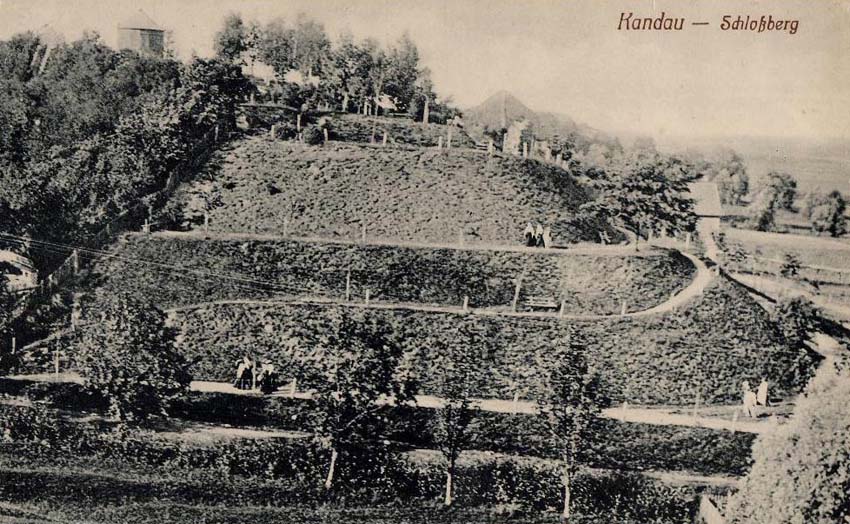
At the Baznīckalns hillfort, Germans baptized the locals because the elevation resembled a tower.
On April 4, 1253, the Livonian Order and the Pope divided the conquered Curonian lands between themselves, with Kandava going to the Livonian Order. The crusaders decided to build their new castle not on the old Curonian hillfort but a little further away. The castle’s location was chosen to overlook the Abava valley.
According to archaeological excavations, the Livonian Order’s stone castle was built on the top of the main bank of the ancient Abava river valley. At the center of the promontory was the castle’s main core — the castellan’s keep (castella). The castle was built from boulders, with window and door openings laid out in brick. The fortress wall was built in the second half of the 13th century, and the main three-story castellan’s keep was erected at the beginning of the 14th century.
It is assumed that construction began around 1253–1254 under Order Master Eberhard von Seine (Berhard von Seine) and was completed under Burkhard von Hornhausen. Historian Arndt mentions 1257 as the founding year, but there is no documentary evidence for this date. The castle is first mentioned in historical sources in 1312.
The castle was intended as the residence of the local magistrate. The Livonian Order convent was located in the castle. The number of knight brothers in the castle was four, and there was one priest brother. It was the residence of the vogt, a subordinate to the Kuldīga komtur, who was the Order’s land judge. His duties included overseeing the districts of Kandava, Sabile, Talsi, and part of the Tukums district, collecting taxes, administering justice, and more. During the Livonian Order’s rule, 17 vogts served here from 1383 to 1560.
Kandava was subject to a special tax — a honey tax — because there were many apiaries in the area. The 13th century was turbulent for Kandava’s inhabitants. In 1256, the Kandava district was raided by Samogitians. In early 1257, men from Kandava participated in the Order’s military campaign in Samogitia. In 1257, there was an unsuccessful battle with the Samogitians near Klaipėda. In summer 1259, when the Samogitians invaded Courland, Kandava men took part in the unsuccessful Battle of Škėde against the Samogitians. In summer 1260, Lithuanians devastated the Kandava district. On July 13, 1262, Kandava men participated in the Battle of Durbe. From 1260 to 1264, men from Kandava took part in the Order’s fight against Lithuanians and independent Curonians.
Around 1267–1270, the Kandava vogt was relocated to Sabile Castle, built before 1258 and subordinate to the Kuldīga vogt. In 1277, Tukums came under the Kandava vogt’s authority, where stone castle construction began around that time. From late 1278 to March 1279, men from the Kandava-Sabile area participated in a major Order military campaign in Lithuania. In 1279–80, they took part in two military campaigns of the Kuldīga komtur in Dobele and an attack on the Semigallian king Namejs; in 1281, in the burning of Dobele town and subjugation of the Tervete Semigallians; in spring 1289, in the devastation of Semigallia; in 1290–91, in the Kuldīga komtur’s campaign in Lithuania; in 1291, in the victory over Lithuanian king Maseina; on June 1, 1298, in the unfortunate battle near Turaida against the Riga forces; and on June 29, in the victorious battle near Adazi against the Riga forces and Lithuanians.
About 1305–1310, the Sabile vogt was moved back to Kandava. In 1312, the Kandava Order castle is mentioned in documents for the first time. In 1315, frosts destroyed all spring crops, causing a terrible famine. On May 15, 1318, the Order’s master Gerhard von Jorke was in the castle and issued several documents there.
In 1334, the castle was expanded. The main part of the castle housed the meeting hall for the Order brothers, a dining room, bedrooms, and a chapel. The castle stored weapons, armor, and food collected as taxes. Workshops of local craftsmen and stables were located in outbuildings near the fortress wall. The castle also served as a postal station and overnight stop on the Riga-Königsberg road. A rider could reach Kandava from Riga in one day, from Kandava to Kuldīga on the second day, and to Grobiņa on the third.
Since the castle was located on important trade routes with lively communication between Livonia and Germany, a settlement formed around the castle in the 14th century. German craftsmen and merchants also settled here. In 1366, the place Kandava was mentioned for the first time. In 1366 and 1397, Kandava is referred to as an opidum — a fortified settlement. In 1496 and 1499, it was called Hakelwerk (a small town), indicating its growth. In 1534, a tavern is mentioned, and in 1536, a blacksmith.
Today, Kandava’s historic center attracts visitors with its old town buildings. However, this development with the old Market Square formed only at the end of the 19th century after the fire of 1881, when stone and brick buildings began to replace wooden houses.
In 1329–30, Kandava men participated in the siege of Riga. In 1348, men from Kandava took part in the military campaign of Master Goswin von Herike in the Saulė region of Semigallia. In 1375, Kandava men participated in the Order’s military campaign in Lithuania. In late March 1377, the Grand Duke of Lithuania, Kęstutis, captured and devastated the Kandava district. In 1379, a plague close to an epidemic swept the district.
In 1390, men from Kandava took part in the Order’s military campaign to Kaunas and Vilnius; in 1391 and 1394, in unsuccessful campaigns in Lithuania; in 1398, before Easter, in the devastation of Samogitia; in 1402 and 1403, in raids on Lithuania; in 1406, 1407, and 1409, in the Order’s military campaign against Pskov; and in autumn 1410, in Prussia against Poles and Lithuanians.
French knight Gilbert de Lannoy, traveling through Courland in 1413–14 on the route Liepāja-Grobiņa-Kuldīga-Kandava-Riga, passed through many Curonian, Livonian, and Semigallian settlements, writing: "From Livonia to Courland, I went to Riga (Righe) in Livonia through many towns, castles, and commanderies, which also belong to the rulers of Livonia... then went to Kuldīga (Guldinghe), which was a fortified town, then to Kandava (Cando) — a castle and other towns and castles in Courland and Samogitia, which belong to the rulers of Livonia; I also traveled through many Semigallian, Curonian, and Livonian villages (villaiges des Zamegaelz, des Corres et des Lives), each with its own language."
In 1416, the Tukums district was separated from the Kandava district. In 1418, a plague swept the area. In 1434, the Sabile district was separated from Kandava. In 1435, people from Kandava took part in the Order’s unsuccessful campaign in Lithuania and the deadly battle at the Svēta (Šventoji) River against the Poles. Around 1440, the Kandava amt (state land district) was founded. In 1453, men from Kandava participated in the Order’s military campaign against Riga and Archbishop Silvester Stodewescher.
In 1476, an Order brick kiln near Kandava was mentioned. In 1479, men from Kandava took part in the Order’s fight against Archbishop Silvester Stodewescher; in 1481, in an unsuccessful campaign against the Muscovites; in 1482–84, in the Order’s fight against Riga. In 1484, Riga forces invaded Kandava. In 1487, Kandava men took part in the unsuccessful Battle of Turaida against Riga, and in 1501–03, in the fight against the Muscovites. In 1540, Lutheranism began spreading in the area.
In 1541, the Kandava castle housed five Order brothers with two armored and two war horses. There were 15 cannons and 7 crossbows. (A list of food in the castle at that time is known, including 92 pieces of pork, 24 barrels of fish, etc.). In 1556, Kandava men took part in the Order’s fight with the Riga archbishop. In 1557, they participated in a military campaign in Pasvalys against the Poles.
On August 2, 1560, Kandava men led by Christoph von Sieberg, vogt of Kandava, took part in the unsuccessful Battle of Ergeme against Russian troops. From March 6, 1562, the Kandava district became part of the newly formed Duchy of Courland.
After the Livonian Order dissolved and Courland became a duchy, in 1562 the castle housed the Kandava hauptmann, managing the districts of Kandava and Sabile, which became a special district of the duchy under the Kandava hauptmann. The dukes of Courland often visited the castle. In 1586, after Duke Gotthard Kettler’s death, the Kandava district was assigned to the Courland part of his son Wilhelm. In 1617, Wilhelm was deposed, and the Kandava district was subordinated to the united Duchy of Courland and Semigallia under Duke Friedrich.
When the son of Swedish King Johan III, Sigismund III, who converted to Catholicism, tried to lead Lutheran Sweden, he was expelled, triggering the Polish-Swedish war for the Swedish throne in 1600. In 1605, the Swedes landed a 4,000-strong army near Pļienciems, captured the undefended Tukums, destroyed it, and moved on to Kandava.
The town flourished in the 17th century under Duke Jacob, when manufactories producing linen cloth, saltpeter, and a gunpowder mill operated.
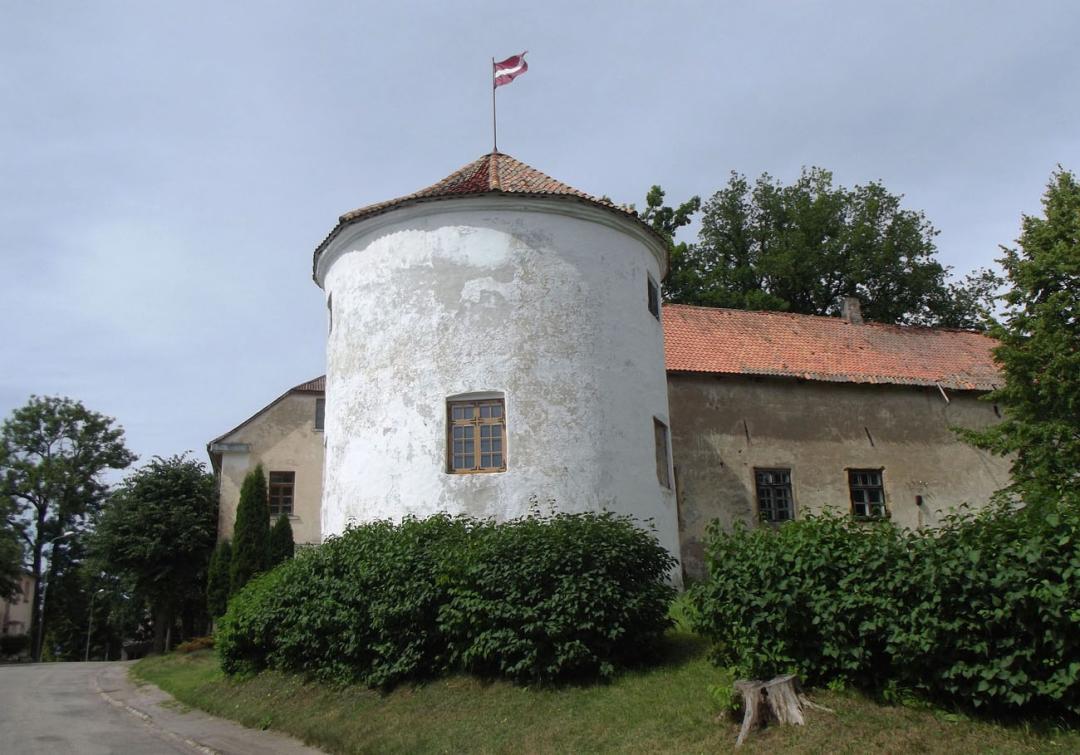
The best-preserved tower, located 28 meters from the eastern wall, is now called the Powder Tower. In literature, it is also called the Spring Tower. Its low position relative to the castle hill suggests it may have served as the first line of defense or a watchtower.
A tower outside the castle’s defensive walls, which served as an outer fortification during the Order’s time, survives only in Kandava. Some historians suggest it was a well tower, as groundwater is easily accessible on this slope. Between the tower and the main castle was a 12-meter wooden drawbridge with one intermediate support, which has not survived.
In the 17th century, the Powder Tower with a four-sided roof was built on the remains of the medieval fortification. It has survived to this day and is an almost square two-story structure. It is assumed the tower was once higher by one or more floors. The old wooden inter-floor ceilings have not survived.
During Duke Jacob Kettler’s time, gunpowder was stored in the tower, hence its current name. Since there are no signs of water or wind devices necessary for gunpowder production at the tower site, it is believed none existed here. Legends say that underground passages and cellars remain from ancient times, where aged wine is still stored. Such equipment might have been in the tower:
After Duke Jacob was captured on October 9, 1658, in Jelgava, Kandava residents rebelled against the Swedes and fought the invaders until they were expelled from the land’s borders. On June 16, 1659, the Swedes swiftly captured Kandava Castle, where all the local residents had fled. The Swedes slaughtered and tortured the refugees with unheard cruelty.
In August 1701, the Kandava district was occupied by the Swedes. By 1703, after the Swedish invasion, the castle was uninhabited. In 1705, the Swedes completed the occupation, but the Russians arrived. In 1706, the Russians left, but the Swedes returned, bringing diseases and heavy requisitions that devastated the peasants’ economy.
In autumn 1709, the Swedes completely left Courland. The Russians returned, but their main forces moved against Riga. Typhus and piroplasmosis raged in the Kandava district. The town was heavily devastated during the Great Northern War; after the plague epidemic (1710), almost the entire population died (only two out of 600 survived).
In 1736, part of the outer castle wall collapsed, but Kandava peasants still paid the ancient "castle construction" tax. By 1739, the castle was in a semi-ruined state. It was inhabited until 1750, when its poor condition forced the manager to move to town. The hauptmanns of the districts of Durbe, Saldus, Skrunda, Kandava, and Dobele opposed the new Duke of Courland, Ernst Johann Biron.
In the memoirs of the Duchess of Courland, Gideon-Henrich von Sass is mentioned, appointed Kandava hauptmann by Duke Peter Biron’s order on April 16, 1783, and serving until 1786. He was Kuldīga oberhauptmann; as land marshal, he led six landtags, was a noble delegate, and owner of the Škede and Lutrini estates.
Around 1790, by order of the Kandava hauptmann, a prison was arranged inside the Powder Tower walls. In 1819, Kandava lost its significance, and the hauptmann post was moved to Talsi. Kandava was governed by a local chief (local rights since 1625).
In 1840, permission was granted to demolish the 3-meter-high castle walls to prevent falling stones from harming pedestrians. Stones from the ruins were allowed for use in local house foundations. Much of the stone from the castle ruins was used in building the Kandava hotel.
Today, it is difficult to judge what the castle looked like — only fragments of information about its layout remain, and the existing watercolor painted in 1794 shows only ruins. Until the late 20th century, the castle ruins belonged to the Russian emperor.
In 1870 and 1881, large fires ravaged the town, destroying many wooden houses. Stone buildings began to be constructed, with foundations made from stones from the castle walls. In 1870, the castle’s entrance gates and relatively high walls still survived in places. In 1898, the ruins of the Order castle were separated from the Kandava parish and transferred to the Kandava municipality.
After 1898, when the castle territory was transferred to local government, a park was laid out here. In 1902, the castle ruins were cleared of debris and rubbish, and a park was also arranged on its territory. In 1903, Karl von Lewis of Menar published the results of his research on Livonian castles, including the proposed plan of the Kandava castle layout. In 1905, revolutionary rallies calling for strikes and struggle against landlords took place at the Order hillfort.
In the 19th century, the eastern castle tower passed into private hands, was rebuilt, and was used as housing until the 1930s. Near the Powder Tower, the Unity Grove (Vienības birze) was planted in 1935. Restoration work on the tower began in 1957 but was never completed.
During the archaeological survey of Latvian castles in the 2000–2001 season, the dimensions of the walls in the Kandava castle ruins were clarified — the defensive wall on the western edge at ground level is 2 meters thick, but above that, its thickness decreases to less than 1.1 meters. The Powder Tower or danzker tower under the roof has begun restoration work, but the interior rooms are not yet built. On the tower’s western side, two wall fragments were uncovered that were not marked on the early 20th-century plan.
Today (2012), the roof and parts of the walls are in catastrophic condition. They are attempted to be renewed every 15–20 years, but locals still amuse themselves by throwing stones onto the Powder Tower roof from the height of the castle hill, breaking the tiles.
The ruins of Kandava Castle can still be seen at the Brūniņi (Knight’s) hillfort. In the square on Pils Street at the foot of the hillfort, near the fountain, there is a model of Kandava Castle. Complete information about the castle’s original appearance has not yet been found, and the model was created based on measurements of the ruins and general ideas about the appearance of Livonian Order castles. The hotel near the castle is a former mikveh, a ritual bath used for purification in Judaism.
The town has the oldest stone bridge in Latvia, which underwent major repairs in 1997. Until 1873, there was a ferry across the Abava, and footbridges were arranged for pedestrians. The cobblestone bridge over the river was built on the initiative of Karl von Firks in 1873. The bridge is 66 meters long with four arches. Construction took place on dry land; then a new channel was dug for the Abava, and the old one was filled in.
During Soviet times, several badges featuring the Kandava coat of arms and views of the most notable city monuments — the Powder Tower and the bridge — were issued.
Kandava has the hillfort of the knight’s castle and the hillfort of ancient Latvians. It is located somewhat outside the town, by the road leading to the station. This hillfort resembles a completely truncated cone, with a small mound still on the hilltop. People say that long ago a church collapsed here. Therefore, the hill is called Baznīcas kalns (Church Hill). A path leads to the top, with bushes and lindens growing along its edges. Several lindens and other trees have also grown on the small mound. This is approximately what the ancient Latvian hillfort in Kandava looks like.
There is a legend — on the hill in Kandava there was a graceful castle and a large church. Many underground passages and cellars ran beneath the ground. When enemies came to fight, the castle was supposedly lowered into the cellars, and when the enemies left, the castle was raised again. When the evil enemy — a German — came, the castle collapsed and never rose again. On Sunday morning, one can hear the church bells ringing. If you climb the hill, you can see a depression, said to be where the castle collapsed. People let a goose into the depression, and it swam out along the Abava.
There is another version: On the left bank of the Abava near Kandava, there is a hillfort where, according to stories, a castle collapsed in ancient times. There is a hole in the middle of the hill. A long pole fell into this hill so deep it became invisible. The legend about how the castle collapsed is as follows:
The castle was ruled by a very harsh lord, who was also very stingy. He gave no food to the poor. One festive evening, when the lord was sitting at the table, an old man came and asked for food. But the lord drove him away. Then the poor man got angry and said: "You did not give me food, and you yourself will eat no more." As soon as he said this, the castle collapsed.
Source:
https://www.castle.lv/latvija/kandava.html Project by Rinata Rimša
https://restinworld.ru/stories/latvia/6821/1.html




Written by Jermaine
Discuss this with the author and others
No comments yet. Be the first to start the conversation.