

At the beginning of the 13th century, a powerful wooden castle of the Semigallians stood here. Very strong for those times, although wooden. The Semigallians resisted the invading conquerors for a very long time, longer than anyone else. In 1219, the first serious clash with the German crusaders occurred: the ruler of the Semigallians, Viestur (Viestard), fought against the knights of the Sword Order near Mežotne. From 1236 to 1250, there was relative peace in Semigallia, until in 1250 the Order invaded Semigallia and forced the Semigallians to pay tribute. A few years later, the division of these lands began between the Livonian Order, the Archbishop of Riga, and the Riga Cathedral Chapter. In connection with this, Dobele was first mentioned in a historical document in 1254 — an act on the division of Semigallia, according to which Dobele came under the control of the Sword Order, and later the Livonian Order.
Dobele Castle is first mentioned in documents in 1254, when there was a fortified wooden castle here — the administrative center of the Dobele district of Semigallia. During the Livonian Crusades, fierce battles with the German crusaders took place in the vicinity of Dobele.
Between 1279 and 1289, the castle withstood six sieges by the Livonian Order troops. The first attack was led by the Vogt of Kuldīga (vogt — one of the highest order officials), which the Dobele defenders repelled with reinforcements from Tērvete. The vogt, who was initially trustfully received in the Semigallian castle of Dobele, secretly led the order brothers right into the city. The Rhymed Chronicle also tells how the conquerors, during one of the attacks on Dobele, captured and killed 300 people, but failed to take the castle.
Enemies wandered among the sleeping bodies
Those who did not wake up — did not have time to scream.
The legend preserved the count of the fallen:
There were no fewer than three hundred of them.
Men and women were struck down,
— Those who fell into the hands of the crusaders,
All who could not hide in the castle.
The enemies burned that town to the ground...
After many unsuccessful attacks on Dobele Castle, the crusaders adopted a different tactic. Having fortified themselves in the castle of Svetaiskalns (near Tērvete), they began to ravage Semigallia — burning crops, devastating the surroundings to starve the population. Only after the fall of Tērvete Castle, when the Dobele district was almost surrounded on all sides, and after the merciless devastation of the Dobele surroundings by the Order’s master Kuno Hacigenstein, famine struck the region. The Semigallians put up strong resistance to the enemies, who failed to capture the castle. When the entire surrounding area was devastated, in 1289 the Semigallians burned their own castle and, undefeated, moved into the territory of the Grand Duchy of Lithuania.
After the conquest of the Semigallian tribes by the crusaders, their lands passed to the Livonian Order. To consolidate their power, the Order needed a strong stronghold. The place where the Semigallian castle once stood suited the crusaders for building a new stone castle. A flat site on the high right bank of the Berze River rose 15 meters above the river. The hill was protected by the river on the east, deep ravines on the south, and a dug moat on the north and west, the bed of which is still visible, although it no longer holds water.
According to the chronicle of Hermann Wartberge, the master of the Livonian Order, Eberhard von Monheim, began construction of the stone castle in Dobele in 1335. Further construction and strengthening of the castle continued from 1345 to 1359 under master Goswin von Herike. The Lithuanians, possibly together with the Semigallians, attacked Dobele in 1345-1346, trying to retake it from the Germans, but failed.
The ancient Semigallian hillfort was located on the northeastern edge of the hill. It was separated from the rest of the hill by a wide and deep moat. This moat was filled in by the Germans, who, building their castle, expanded the hillfort southward. Remains of the moat behind the stone walls are still visible today.
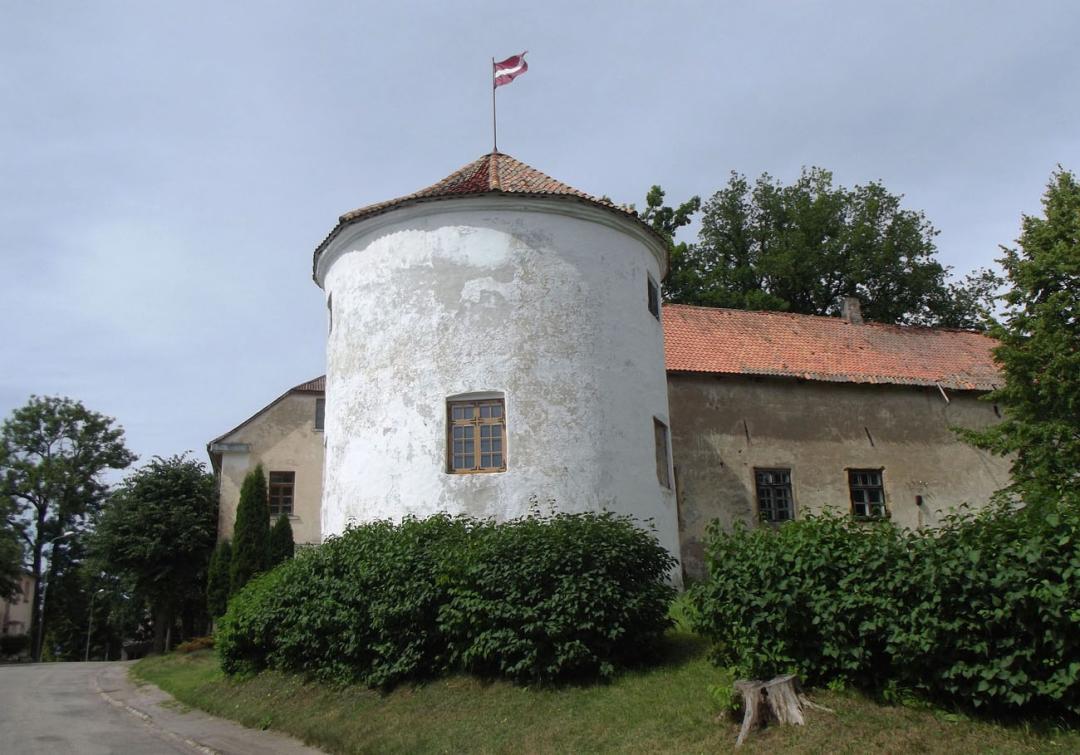
The stone castle of the Livonian Order was built on the right bank of the Berze River, on the site of the Semigallian castle. The ruins of the Order’s castle are still visible in the northern part of the hill. A long building along the eastern wall (facing the river) was built later, during the Duchy of Courland period (see below). The castle occupied a trapezoidal area in plan. It consisted of four buildings surrounding a small enclosed courtyard.
The first building in the castle — the convent building — was constructed on the northern edge of the castle square. Then, to the south of it, the main building was erected, whose stone walls have been best preserved. The main building’s roof had four small towers typical of medieval castles, decorated with arched openings. Similar decorations are visible in the northern part of the stone enclosure. In the 16th century, a chapel was built in the southern part of the castle, which was expanded in the 17th century and converted into a church. Also in the southern part was the forecastle (outer bailey) measuring 95 by 145 meters in plan. The western wall had a quadrangular tower next to the entrance gate.
The castle housed the residence of the Dobele Komtur (district governor). In the history of the castle, 15 komturs are known. The lands of the Livonian Order were divided into komturships and vogtships, numbering 30-40 until the 15th century, and in the 15th century, respectively, 9 komturships and 11 vogtships. In the territory of Latvia during the existence of the Livonian Order (1237–1562), there were the Kuldīga, Ventspils, Dobele, Jelgava, Riga, Cēsis, Alūksne, Daugavpils, and Wolkenberg komturships.
The Komtur of Doblen Castle was one of the highest officials of the Livonian Order, having the right not only to command his military units but also to conduct independent invasions into enemy territory. The Germans stationed a fairly large garrison in Dobele Castle. There is still no information whether the Order concluded an agreement on the extradition of fugitives with its vassals in the Latvian regions, but documents of the Dobele Komtur and the master of the Livonian Order testify that the Livonian Order and its high officials de facto approved the decision of the knights’ assembly in Wiemel (Estonia) in 1482 on the extradition of runaway peasants.
In the 14th century, Lithuanian troops often invaded Semigallia; it is possible that descendants of the Semigallians who had fled to Lithuania also participated in these raids. Around 1365, a widespread peasant uprising occurred here, which was suppressed by armed force. During the Livonian Order’s rule, there were no towns in Semigallia. Their emergence was hindered by the proximity of Riga.
Several small settlements — small craft centers and trading posts — such as Jelgava, Bauska, Dobele, and Selpils arose along major trade routes. Since these settlements were not protected by stone walls like Riga, they were often attacked and devastated during wars and invasions, hindering their normal development.
Nevertheless, along with the castle, a settlement developed around it. In the 15th century, a settlement of merchants and craftsmen appeared on the left bank of the Berze, mentioned in 1444 as the “posad” (settlement) of Dobele. In 1495, a new church and a market square around it appeared. From the late 15th century, fairs were regularly held twice a year in Dobele.
In the winter of 1345, the Lithuanian lord Algirdas, together with Kęstutis, invaded Semigallia, captured Tērvete Castle, and set fire to Jelgava Castle, but in 1346 destroyed Mežotne. Possibly at the same time, they attacked Dobele. From 1335 to 1347, the Livonian Order built a stone castle on the site of the burned Semigallian castle, around which a settlement of craftsmen and merchants eventually developed.
The last Komtur of Doblen Castle was Tis von der Recke, to whom the Order’s master Wilhelm von Fürstenberg in 1559 gifted the castle forever. In 1562, the state of Livonia ceased to exist. Tis von der Recke refused to submit to the Duke of Courland and Semigallia, Gotthard Kettler, who after fierce fighting captured the castle in 1566, took Recke prisoner, and forced the rebellious vassal to renounce possession of the region and be content with only Jaunpils Castle.
In 1579, 1613, and 1628, the Courland Landtags were held in Dobele Castle. After the adoption of the constitution of the Duchy of Courland and Semigallia in 1617 (Formula regiminis — “Formula of Government”), the court was held in the Dobele lord’s palace (Hauptmann).
Since then, Doblen Castle passed into the possession of the Duke of Semigallia-Courland. The settlement of Dobele was included in the Duchy of Courland — a vassal state of Poland — and became a district center.
During the Duchy of Courland, the castle was managed by commandants, the last of whom was Captain Christoph-Georg von Offenberg. A clearer administrative division was established by the “formula of government” developed by the 1617 assembly of decrees (mainly concerning the duke’s share, the so-called domain). The duchy was divided into 4 Oberhauptmannships, which in turn were subdivided into 8 Hauptmannships: in Courland 6 — Ventspils, Grobiņa, Durbe, Skrunda, Saldus, Kandava; in Semigallia 2 — Bauska and Dobele. The Hauptmanns were responsible only for the peasants of the duke’s estates. In private estates, the landlords themselves represented the highest administrative and judicial authority.
In 1568, the Duke of Courland Gotthard Kettler presented Dobele Castle as a gift to his wife — Princess Anna of Mecklenburg — as her widow’s portion. From 1579 to 1628, several landtags of the duchy were convened in the castle. One of them was secretly organized by the landlords to direct their actions against the duke and complain about him to the Polish king. On July 2, 1616, the castle experienced an earthquake.
During the reign of Duke Jakob in the mid-18th century, the town began a rapid economic boom — water mills with flour mills and sawmills, a fulling mill, a distillery, a vinegar factory, and other productions operated.
In 1620, Dobele was surrounded and occupied by the Swedish troops of King Gustav II Adolf. During the Polish-Swedish war, in 1621, 1625, 1658, and 1659, the castle was held by the Swedes. Each time the castle was subjected to looting and destruction. In 1629, Dobele and nearby peasants destroyed a Polish detachment of 50 men who were marauding and robbing the population here.
In 1658, the Swedish army invaded Semigallia, occupied Jelgava, took the family of the Duke of Courland prisoner, and forced the surrender of Bauska and Dobele castles. Swedish King Gustav II Adolf spent several days in Doblen Castle. From 1642 to 1649, the widow of Duke Friedrich, Elisabeth Magdalena, lived in the castle with her son, Duke Jakob (Jēkabs). From 1642 to 1649, the castle was rebuilt — the duke’s widow found it too old-fashioned, and she also took care of the construction and decoration of the castle church and the planting of trees around the castle.
In the forecastle along the eastern wall, a two-story residential building, the so-called “palast” (palace), was built in the traditions of Western European Renaissance. An open gallery was attached to the facade facing the inner courtyard. Extensive cellars were located under the building. Small buildings were also attached along the other walls. New gates were pierced in the western part of the fortress walls.
Fragments of several eras have reached us — the wall and guardroom and the convent building were built during the Order’s times, while the gates and palace date from Magdalena’s time. The castle’s architecture was enriched by an open arcade in the courtyard, and the facades were decorated with luxurious sgraffito decoration. At this time, the chapel was expanded and converted into a church.
In 1658, during the captivity of Duke Jakob, the castle was acquired by the Swedes. That same year, the Courlanders, together with the Poles, tried to recapture the castle but failed and were expelled again.
In 1660, after the Treaty of Oliva, Duke Jakob regained the castle, and a long additional building was constructed on the eastern wall, but the castle’s fortifications were not restored. In 1661, Baron August Meyerberg, envoy of the Austrian Emperor Leopold, traveled through Courland to Moscow to Tsar Alexei Mikhailovich.

He was accompanied by the court painter of the Austrian emperor, Storno, who drew 131 landscapes during the journey. Sixteen of them relate to Latvia, including a view of Doblen Castle.
In 1701, the palace was again occupied by the Swedes, and Swedish King Charles XII stayed in the palace for 6 days. During the war, the town and castle suffered heavy damage.
The last castle manager, G. Offenberg, with his family, which according to legend consisted of 22 daughters and one son, were the last inhabitants of the castle (during the plague of 1710, they locked themselves in the castle and let no one in, thus almost the only survivors among all the inhabitants of Dobele). It is known that the castle was inhabited until 1730 (dates vary in different sources from 1729 to 1736), and church services were still held in the castle church.
In 1736, the castle roof collapsed. Local residents gradually began to dismantle the walls and buildings, using the stones for building their houses. On the hillfort, the last Duchess of Courland, Dorothea, arranged a beautiful park, from which there was a wonderful view of the Berze River valley and the craftsmen’s town.

On June 24, 1870, the Courland Latvian Song Festival — one of the first in Latvia, since the first general song festival was held in 1873 — took place on the ruins of Dobele Castle. In 1915, German Emperor Wilhelm II reviewed a military parade at the foot of the castle.
In 2018, conservation of the ancient walls began, restoration of part of the palace-monastery building, as well as construction of a multifunctional exhibition hall, exhibitions, and a viewing platform. During construction work at the entrance to the chapel in the basement, an undisturbed cultural layer was discovered containing rings, brooches, keychains, amulets, a spiral, fragments of a ring, a bracelet fragment, beads, buckles, spikes, spearheads, crossbow bolts, an anvil, needles, a key, a fishing rod, lead sinkers, and even hazelnuts.
Sources:
https://www.castle.lv/latvija/dobele.html Project by Renāta Rimša
https://lv.wikipedia.org/wiki/Dobeles_pils




Written by Jermaine
Discuss this with the author and others
No comments yet. Be the first to start the conversation.