


Valmiera is located 100 kilometers north of Riga and 50 kilometers from the border between Latvia and Estonia. The city is divided into two parts by one of Latvia's most beautiful rivers – the Gauja. Since the 13th century, the city was called Wolmar, and since 1917 – Valmiera. The ruins of the medieval castle of the Livonian Order are one of the main tourist attractions in Valmiera, as the history of the city itself begins with the appearance of this castle, and because remnants of the walls, fragments of interior decoration, as well as a wide moat that once surrounded the castle, have been preserved.
Archaeological excavations indicate that people lived around Valmiera as far back as 8,000 years ago. Historians have different theories about the founding of Valmiera. Some believe that the town arose near a major overland trade route (Riga-Tartu, Riga-Pskov, Riga-Novgorod), and the waterway along the Gauja was known here since the 11th century. According to this, the founders were the Latgalians, on whose territory Valmiera was located. Historical documents show that at the end of the 12th century, the territory of Valmiera was part of the state of Talava. This version is also linked to the search for the Beberina hillfort.
It was assumed that before the construction of the stone castle, there was a settlement called Beverin or Beberina here. According to some historians, who still cannot find Beberina, the ancient hillfort lies directly beneath the castle at a depth of 4-5 meters. Several attempts have been made to excavate the supposed hillfort, but so far, apart from weapons, coins, and some tools, nothing else has been found. The latest excavations, led by archaeologist Tatiana Berg, also yielded no confirmations—although there was indeed a wooden castle on the site of the medieval stone one, it was also built by the crusaders.
There is another version – historians believe that in the early 13th century, at the mouth of the Ratsupite River, there may have been a Latgalian castle called Autine, where around 1208 the chieftain Varidot (Varidotis) ruled. His possessions were part of the ancient land of Talava, whose inhabitants practiced Orthodoxy and were subjects of the Pskov princes.
This leads us to the third version of Valmiera’s founding – some historians believe that the founder was a relative of Riga’s bishop Albert Buxhövden, the exiled Pskov prince Vladimir (Waldemar), whom the bishop appointed as vogt of Autine in 1212. According to this version, the name Valmiera, Wolmar, comes from the name Waldemar. In Russian chronicles, the city of Valmiera was called Vladimerets.
In 1214, the Valmiera district was subordinated to invading German feudal lords. However, the first uprisings soon broke out. To maintain his rule, the Riga bishop appointed the former Pskov prince Vladimir as governor. As early as 1210, a Pskov detachment, together with crusaders, participated in a campaign against the Estonians of the southwestern land of Sontagan. This military alliance was accompanied by the marriage of Theodoric Buxhövden, brother of Riga’s bishop Albert, to the daughter of Pskov prince Vladimir Mstislavich. But the Orthodox clergy of Pskov opposed the marriage of the princess to a relative of the Catholic bishop. The church’s authority was decisive in stirring up discontent in Pskov against Prince Vladimir. At the instigation of the prince’s opponents, he was expelled from the city in 1211 and, together with his family, went to Livonia, where he served Bishop Albert for some time.
Although Valmiera was a bishopric possession in the early 13th century, later, during the division of lands, it passed to the Livonian Order, which began building a castle here around 1224. The exact date of the castle’s founding is unknown; it is assumed to have occurred shortly after the territorial division. The castle itself is not mentioned in 13th-century chronicles, but in subsequent centuries it is frequently referenced in chronicles, as many important historical events took place here. When building the fortification, the natural terrain was used as additional protection. The castle was protected on three sides by natural barriers – the fast-flowing Gauja and the Ratsupite River, also known as the Bishop’s Channel.
Tour guides often tell tales that the knights of the Order forced local residents to use stones taken from sacred places of sacrifice for the castle’s construction, thereby destroying sacred altars, which supposedly led to various terrible events afterward. Another legend says that during the construction of Valmiera Castle, barrels were driven around the district, and all residents had to deliver milk every morning, regardless of how many cows they had – one or two. Lime was mixed with milk, which is why the old masonry is so strong. These legends are not supported by historical research.
Valmiera Castle had a regular layout, with an outer bailey, and later towers were added at the corners of the front fortified walls. The walls were 3.5–4 meters thick. In a 14th-century chronicle by Herman of Wartberge, it is noted that the master of the Livonian Order, Willekin of Endorp (also called Wilhelm Schurburg in other sources), together with Riga’s archbishop Johann of Lune, founded churches in Valmiera, Cēsis, Burtnieki, and Trikāta, in the Order’s domain. It is believed that Willekin participated in laying the new stone castle and marked the city’s boundaries. There is an interesting point here, not yet fully clarified by historians: whether the castle in Valmiera was first laid simultaneously with the church in 1283, or the stone building replaced the previous wooden one from 1224, or the earlier stone castle was expanded by von Endorp.
Downstream on the Ratsupite River, a mill pond was created, which protected approaches to the castle from the east and north. From the south, the natural barrier was the Gauja River. On the west side, a moat was dug, separating the castle from the settlement. The main castle and the outer bailey formed an irregular quadrilateral plan with sides measuring 100 meters in length and 30–50 meters in width. The fortress wall followed the terrain and reached 2.25 meters in thickness. Residential and service buildings were attached along the walls. Two watchtowers stood at the corners of the outer bailey. The entrance passed through the settlement, the outer bailey, and over a drawbridge across the moat into the main castle.
In Livonia, the most important were: the Order castle Wenden (Cēsis), which for a long time was the residence of the Order’s master; the Order castles Wolmar (Valmiera), Neiermühlen (Ādaži), Kirchholm (Salaspils), Arrasch (Araiši), Trikaten (Trikāta), Rüen (Rūjiena), Burtnek (Burtnieki), Ermes (Ergeme), and Rodenpois (Ropaži).
To the right of the bridge over the Gauja stands the Valmiera Lutheran Church of St. Simeon, which was built during the Livonian Order period from 1283 to 1287 and now forms part of the city’s overall medieval ensemble together with the castle ruins on Brūnu iela.
In 1323, Valmiera was granted city status. In 1365, the city was mentioned in chronicles as a member of the Hanseatic League of North German cities. This also contributed to Valmiera’s development. In the first volume of the register book of the Lower Town of Lübeck, the names of Livonian cities are repeatedly mentioned. The frequency of mentions indicates the city’s role in international trade. During this period, Riga is mentioned 97 times, Tartu 95 times, Cēsis 40 times, Reval (Tallinn) 19 times, Valmiera 3 times, Pärnu and Straupe 2 times, Viljandi once.
Immediately after the Battle of Grunwald in 1410, when the Teutonic Order was defeated, the rulers of Livonia realized that unified actions of all rulers were necessary. In 1422, bishops and representatives of the Livonian Order gathered in Valmiera and decided that all important issues concerning the governance of Livonia would henceforth be discussed jointly. Such assemblies – Landtags – were agreed to be convened annually. Landtags were mostly held in Valka or Valmiera. They included clergy, high members of the Order, vassals, and representatives of the largest cities.
Since Valmiera was located in the center of the confederation of Livonian states, it was a convenient place for holding Landtags (German: Landtag – regional assembly) and Stadttage (city assemblies) from the 14th to the 16th centuries. The latter were held in Valmiera 32 times. In the late 15th and early 16th centuries, many decisions of historical significance were made there (for example, regarding the attitude toward Luther’s teachings, peace treaties with Russia, and so on). In 1554, the Reformation triumphed in Livonia. The Landtag convened in Wolmar (Valmiera) proclaimed freedom of religion throughout its territory. The faith of Latvian peasants depended on the religious affiliation of their German lord.
Over time and under different rulers, the city’s name was written differently – Wolmar, Woldemer, Wolmahr, Wolmaria. Regarding the names: Muhammad al-Idrisi from Morocco is known as the author of large-format maps created in 1154. Swedish researcher Ekblom deciphered many names on Idrisi’s map, for example, Falamus (Valmiera), Medsuna (Mežotne); these decipherings should be accepted with a high degree of probability. On a fragment of the iconographic map of Northern Europe by Olaus Magnus in 1539, the following geographic names on the territory of present-day Latvia are deciphered: Velmar (Valmiera), among others. The Venetian map of Ptolemy from 1548: Prussia and New Livonia. On this map "Mar de Livonia" there is the name Velmar (Valmiera). The Livonia map by Possevin from 1582 (original stored in the Vatican archives) mentions Volmer, Volodimar (Valmiera).
Wars and fires destroyed the city, but the inhabitants always rebuilt it. The city defensive walls around the 14th century adjoined the walls of the outer bailey, forming a single fortification. From the former city defensive system, only the defensive moat and fragments of the castle walls remain today. Valmiera is one of the few cities that remained enclosed within city fortification walls until the 18th century, similar to Riga, Cēsis, and Koknese. Since the city was located in front of the castle, to capture the castle, one had to first take the city. This circumstance ensured a shared fate for the city and castle during wartime. Gilbert de Lannoy, who visited Valmiera during his travels in 1413-1414, called it a strong and fortified city. In the Middle Ages, it was indeed a significant city fortified with ramparts, moats, and walls.
The Valmiera Agreement, concluded on March 30, 1491, between the Livonian Order and Riga, marked the end of the armed conflict between the Order and Riga, which existed during the struggle between the Livonian Order and the Riga archbishop. The Order dictated its demands to Riga, and according to the agreement, the Order regained all its former possessions, which had been temporarily transferred to Riga, ships, and new lands in the Riga patrimonial district. All Riga fortifications were placed under the Order’s control, Riga was denied a political alliance with Sweden, and henceforth all complaints had to be considered by the archbishop. Riga failed to free itself from its feudal lord – the Livonian Order.
Two cannonballs embedded in the buttress of the northern facade of St. Simeon’s Church testify to an unsuccessful attack on the city in 1560 by the troops of Peter Shuisky. In 1562, during the Livonian War, the troops of Russian Tsar Ivan the Terrible destroyed the surroundings of the city but failed to storm the Valmiera fortress. The fortress was occupied by the troops of Duke Magnus, King of Livonia. Chronicler Balthasar Russow writes about this: "And also the inhabitants of Valmiera, together with the duke’s men, captured the castle and its governor and handed them over to Magnus. The Russian prince did not authorize Duke Magnus to occupy these two castles, Cēsis and Valmiera, as well as Koknese, but the duke secretly hoped to save these fortresses from the Russians and later hand them over to the King of Poland, as previously agreed with the king and the duke of Courland, but Polubensky, the governor of Valmiera, informed the Grand Duke of his secret plans. Since the Russians knew about the duke’s plans, they did not interfere with Magnus’s actions to capture the castles to free themselves from unnecessary troubles. And the cunning enemy thought about what to do so that the castles would return to the hands of the King of Poland again."
In 1577, Russian troops again surrounded Valmiera and for the first time managed to capture the city. The men of Duke Magnus, who was related to Ivan the Terrible, naïvely surrendered to the Russians. About 70 people were cut to pieces, the castle and city were partially destroyed, and the inhabitants were taken captive. It is known that during the Livonian War, Russian Tsar Ivan the Terrible and Prince Kurbsky were at Valmiera Castle at different times. From Livonian Volodimerets, or Wolmar, Kurbsky wrote a letter to Ivan the Terrible, accusing him of persecuting honest and worthy comrades-in-arms. The angry sovereign replied with a long letter justifying his autocratic rights. Thirteen years later, Ivan IV, who had not forgotten the rebellious prince, wrote him a second letter from Wolmar occupied by Russian troops. Kurbsky’s reply was his third letter, written in Polotsk, taken by Stephen Báthory in 1579. This correspondence between the bold prince and the powerful opponent then ceased.
In 1582, the castle was annexed to the Cēsis bishopric. By decree of Stephen Báthory on December 4, 1582, the Livonian bishopric was established with its residence in Cēsis. Its foundation (land holdings) included the estates of Valmiera, Trikāta, Burtnieki, and others, as well as houses in Cēsis, Pärnu, and Tartu.
During the Polish-Swedish war in 1600, Valmiera was captured by the Swedes under the command of Karl Gyllenhielm but was almost immediately handed over to the Poles. In 1607, there was another large-scale Swedish invasion of Livonia. The Swedes, commanded by Count Mansfeld, occupied Cēsis and Burtnieki but got stuck near Valmiera, which was stubbornly defended by Wolmar von Fersenbach (son of the famous Livonian mercenary commander Jürgen von Fersenbach). In January 1622, King Gustav II Adolf of Sweden entered Valmiera as the victor. Then in 1657, the Poles again controlled the city. This game of "tag" continued until 1658 when the castle was once again captured by the Swedes under Count Douglas but was no longer returned to the Poles.
The city suffered great damage from the plague epidemic of 1623-1625 and destructive wars. In 1633, Valmiera was visited by Adam Olearius, who mentioned in his travel notes that the castle, where many extensive rooms were still in use, received the delegation from the local "chief or commandant." Olearius also wrote that the city was in a heavily ruined state.
After conquering Vidzeme in 1622, Swedish King Gustav II Adolf gave it, along with Cēsis and Smiltene, to his state chancellor Count Axel Oxenstierna. Gustav II Adolf’s gift to Chancellor Oxenstierna was truly royal. He received all the former Cēsis bishopric, which included 13 estates. Along with the estates, the gift included two cities – Cēsis and Valmiera. During Swedish rule, the city began to revive. At this time, by Oxenstierna’s order, the castle was strengthened, earthen ramparts were built, and bastions erected. The Polish-Swedish war devastated Livonia. To increase income, the Swedish government began to bring colonists into the devastated areas. The largest colony was in the Valmiera area, consisting of Finns. Then in 1657, the Poles again controlled the city. This game of "tag" continued until 1658 when the castle was once again captured by the Swedes under Count Douglas but was no longer returned to the Poles. Shortly after 1681, the castle fortification walls were demolished.

During the Great Northern War, on September 4, 1702, the city was captured and destroyed by the troops of Boris Sheremetev. The castle was burned at that time and was never restored afterward. At the end of the century, the outer castle walls were also demolished to build residential houses. In 1772 and 1774, the city, still recovering from the horrors of the Great Northern War, burned again. In 1783, Valmiera was granted the rights of a district city.
In 1772 and 1774, the city, still recovering from the horrors of the Great Northern War, burned again. In 1783, Valmiera was granted the rights of a district city.Latvian historians of the 1920s-30s practically did not study medieval castles, as stone castles of the Livonian period were considered entirely the heritage of German feudal culture. The excavations carried out in some castles (Cēsis, Valmiera) had other goals: in Cēsis in 1927, they hoped to find the treasures of former castle inhabitants, while in Valmiera in 1937-38, they tested the hypothesis of whether the stone castle was built on the site of an ancient Latvian hillfort or settlement.

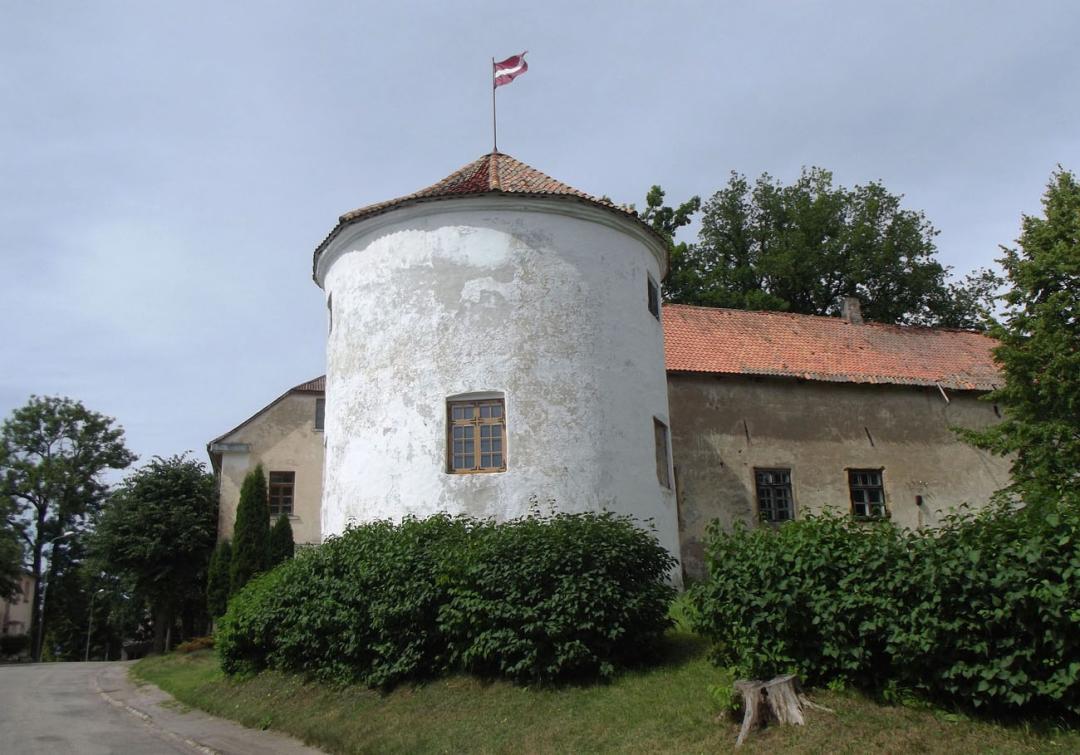
From the main castle, small fragments of the outer walls have survived to this day. The western, southwest, and northwest walls of the first outer bailey have partially survived to a height of about two floors. Three large window openings are still visible in the western wall. At the top of the northern wall of the outer bailey was a guard passage, which now remains up to 5 meters high and where several embrasures are still visible. On the castle grounds, some 18th-19th century buildings have partially survived, forming a small core of the historical center of Valmiera.

Not far from the museum, on the right bank of the small Ratsupite River at its confluence with the Gauja, is Valterkalniņš – a former medieval fortified site. Valterkalniņš was part of the fortifications of the Order castle. The hill was named in the 19th century after a Valmiera resident, Lutheran bishop Fr. Walter. Thanks to him, the teacher’s seminary Cimze was founded in Valmiera. Some historians, such as A. Bielenstein and V.E.K.A. Balodis, believe that the ancient castle Autine stood on this hill. Other historians searched for the ancient castle Beberina in Valmiera, but archaeological excavations did not confirm this. At the foot of Valterkalniņš, the Ratsupite flows into the Gauja.
There is yet another legend: the German castle was built on the bones of the ancient hillfort’s ruler Beberina. It was from here that the city’s history actually began, later named Valmiera. The first excavations in search of the ancient hillfort began after World War II. Local residents themselves brought money necessary for archaeological work. Many ancient weapons and jewelry were found then, but the Beberina hillfort was not reached. In recent years, excavations have been conducted by Riga archaeologist Tatiana Berga. She is convinced that the hillfort must be located directly under the ruins of the German castle, but only at a great depth. The latest excavations took place when there was a need to build a new museum building on the territory of the ruined castle (its collections number more than 60,000 items). Local historian Regina Martenberga said that psychics were often invited here, who, looking into the mysterious, unknown world to ordinary mortals, claimed that the hillfort is at a depth of 4–5 meters, and part of it is buried under the Gauja. By the way, there are indeed many underground passages under the river. I personally know where they exit and who went down there, the historian said. However, about twenty years ago, they were filled in (only small meter-deep depressions were left), because sometimes people entered them and disappeared forever... It is not yet possible to conduct such thorough excavations because it is too expensive. It is a pity because there is a great desire to see the world of Beberina, according to legends – the largest hillfort in these parts. Moreover, there was another hillfort nearby – Luki, which served as a kind of observation point before the domains of the mysterious Beberina. For now, we can only guess when archaeologists will find ancient settlements. Archaeologists work in the city center every summer. Tatiana Berga and colleagues have already uncovered almost 150 meters of fortress wall and several buildings – a craftsman’s workshop engaged in metal and bone processing, as well as a dwelling dating back to the 14th century, the oldest in Valmiera’s history. And the fragment of the city gate, discovered several years ago and leading toward Riga, can now be seen through the transparent glass of the sidewalk by anyone interested.
Sources:
https://www.castle.lv/latvija/valmiera.html Project by Renāta Rimša
http://kxk.ru/castles/v1_209310__.php




Written by Jermaine
Discuss this with the author and others
No comments yet. Be the first to start the conversation.