

The ruins of Marienhausen Castle (Vilak) are located in the town of Viļaka, 245 km from Riga, 27 km from Balvi, and 6 km from the Latvian-Russian border, in the middle of the freshwater glacial Viļaka Lake at the western end of a small island. The territory of the present Balvi region in the early 13th century was part of the Latgalian-inhabited Atzele region. The land of Atzele, referred to as terra Adzele, was mentioned in 1224 when the Riga bishop Albert and the master of the Livonian Order Folkwin divided the conquered Latgalian lands. According to the 1224 treaty: "Moreover, the region called Gauyiena (Atzele), besides the above, belongs to them (the Order), but to us (the Riga bishop) from this region come Berezne, Pornuve, Abelen, and Abrene." At that time, on the island in Lake Viļaka, there was a castle of the ancient Latgalians — the center of the Purnava district of the Atzele land.
Soon after the founding of German fortifications on the island, the ancient name gradually gave way to the new castle district name — Viļaka or Marienhausen. Other names found in chronicles include Villack, Vilacke, Villak, Maryenhauszen, Vleh, and in medieval Russian documents — Vlekh. The name Marienhausen (House of Mary) is connected to the fact that Pope Innocent III at the 1215 council dedicated the newly converted lands of Livonia to the Blessed Virgin Mary. This land then became known as Terra Mariana (Terra Mariana – "Land of the Virgin Mary").
A widespread legend in Latgalia says that after the death of a German feudal lord who owned lands around Lake Razna and the castle Folkenberg, three daughters remained — Rosalia, Lucia, and Maria. The daughters divided their father's inheritance into three parts and each built a castle. Around the stone castles, three towns grew. Rosalia founded Rozitten (Rēzekne), Lucia gave her name to Lucina (Ludza), and Maria gave her name to Marienhausen (phonetically more accurately Marienhausen - Marienhausen). Historians with a less romantic view believe that in 1293 a castle of the Livonian Order was built on the lake island by order of Archbishop Johann II Fecht. Most likely, the fortress was originally wooden.
The Viļaka district belonged to the Riga archbishop. Historians believe that wooden fortifications in Viļaka were built in 1293 by order of Archbishop Johann II Fecht. This date is mentioned as the founding time of the Viļaka monastery of Cistercian monks in a document from the Belarusian historical archive. Other historians think that in 1293 a wooden castle of the Livonian Order was built on the lake island. For example, Armin Tuulse believed that the Viļaka castle existed already in the 14th century and was radically rebuilt in the 15th–16th centuries.
Researcher of Livonian castles Karl Levis of Menar in 1922 suggested that the mention of Frauenburg in the chronicle of Herman of Wartberge in 1342 could indicate the existence of the castle, unless it referred to the second border fortification of the Riga archbishopric, Vastseliina in Estonia. However, in published collections of documents of Ancient Livonia, the name Viļaka does not appear until the 16th century. However, the name of the Purnava land is known from the 16th century, for example, in 1501 the Order master Walter von Plettenberg in a letter to Lübeck noted that the Russians attacked and devastated the archbishop's property in Purnava (Purnow), as well as the Order-owned Ludza parish and Alūksne. At that time, Purnava apparently referred to a wider district that included several settlements, including Viļaka.
According to the materials of the Valmiera Landtag, the Viļaka castle was built by the Riga archbishop in the early decades of the 16th century to protect the borderlands. Due to border agreements, the archbishop had an arrangement with the Russians not to build strong fortresses near the border. However, the final border settlement was delayed, and from the late 15th century, the military threat from the Russian side increased. Therefore, to oversee the border, a wooden castle was built in Viļaka at the end of the 15th or beginning of the 16th century. In 1516, at the Valmiera Landtag, it was recognized that this castle was in poor condition and needed to be rebuilt.
The construction of the stone castle on the island took place during the time of Riga archbishop Jasper Linde, who is mentioned in chronicles as a decent and economical ruler of the archbishopric and a builder of castles. At least thirty monastic knights permanently resided in the castle.
It should be noted that to guard the borders, the Livonian Order, the Courland bishop, and the Riga archbishop created a system of castles—mainly on the Order’s territory—that stretched from southwest to southeast along the Lithuanian border and then from southeast to northeast along the Russian border. The Order’s castles resembled fortified monasteries, and monasteries resembled fortresses and were therefore also called "castra," for example, the Daugavgrīva monastery near Riga and Falkenau or Padise in Estonia. Similarly, episcopal castles without convents were usually built large and included premises for all services as well as for regional administration. The first such castle after the founding of Riga was built in Turaida in 1214, and the last was Viļaka (Marienhausen), strengthening the eastern border of the state.
Viļaka was a fortified monastery and a so-called water castle, whose defense was mainly ensured by its location on an island in the middle of the lake, and on the eastern side, the castle area was separated from the rest of the island by an artificially dug moat connected to the lake. The fortifications were erected on a small elevation. The moat was dug about 12 meters from the castle wall, and a strip of free land 10–12 meters wide was left at the water level of the lake around the castle.
Initially, a wide quadrangular structure in the form of a tower was built, the construction time of which may be close to the time of building border castles of the Dorpat bishopric — Kirrumpää and Neuhäusen. An important role, along with the tower lying on the island shore, was played by a wooden structure, which was later reinforced in the late Middle Ages.
Soon after, the entire fortification was built of stone; this last construction period contributed significantly to the later development of Livonian castle architecture. In plan, the stone fortification was an irregular polygon with four towers: one square and three round. In the northern part of the courtyard was a residential building 8 m wide. After analyzing the castle plan, Armin Tuulse in 1942 suggested that the oldest part of the Viļaka castle fortification dates to the 14th century. He identified three construction periods by the castle layout: in the 14th century, a large quadrangular tower-like building was built; in the second period under Archbishop Michael Hildebrandt, the castle was reinforced with wooden structures; and Archbishop Jasper Linde completed the stone castle construction and built round towers in 1516.
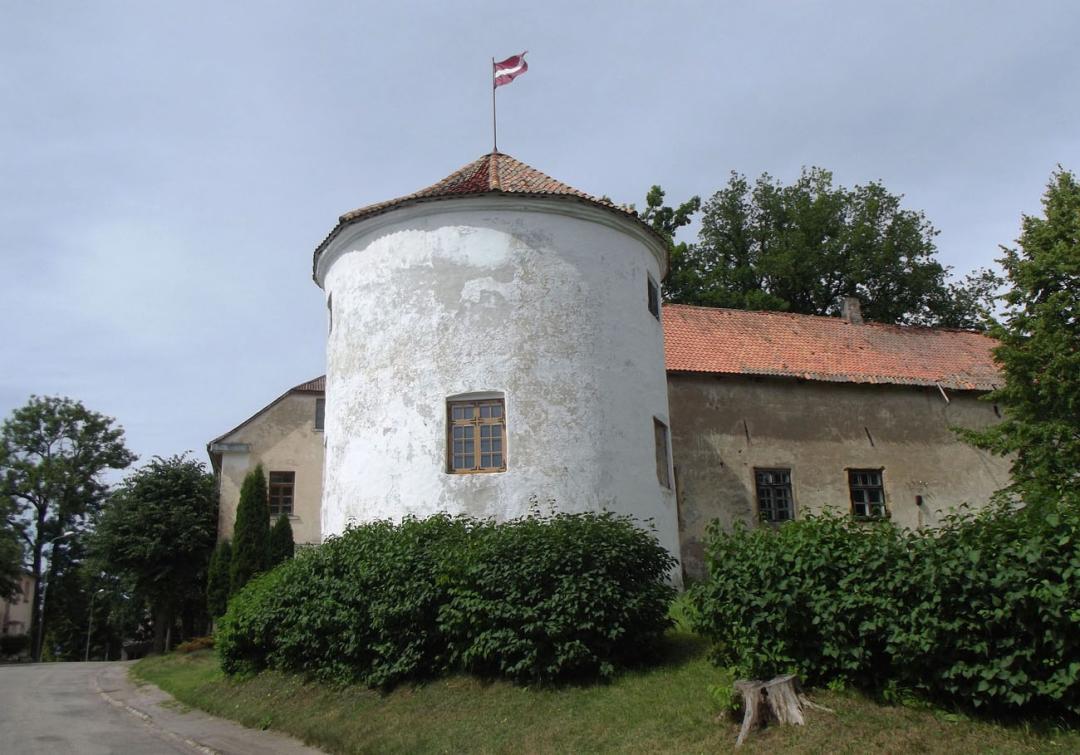
In the 15th and early 16th centuries, large round towers with thick walls and embrasures for firearms were added in the middle or at the corners of the walls to the castles or foreburgs, almost fully projecting from the straight wall. A characteristic example of a castle fortified with projecting artillery towers is Viļaka castle.
The castle walls are about 1.6 meters thick, mainly made of boulders in rich lime mortar. However, on the northeast edge, a fragment of the wall 1.2 meters thick next to the square tower is made of rubble dolomite stone. Possibly, the upper parts of the other castle walls were also made of dolomite, since in 1797 the castle description mentioned rubble stone as building material. Another possibility is that different stones indicate two construction periods. The entrance was presumably in the southern wall of the castle, where the surrounding wall has now been completely demolished.
Viļaka is mentioned in the list of grain revenues of the Riga archbishop’s districts, preserved from the time of the archbishop’s secretary Wilhelm — Mark Grevendal. The list names the archbishop’s main castles — grain warehouses (Rauna, Limbaži, Koknese) and two border castles — Gulbene and Viļaka. Most of the archbishop’s castles served economic purposes as food storages and local administrative centers. These castles were smaller and simpler built than the archbishop’s main castles.
In the already mentioned mid-16th-century list, besides residences, the following grain warehouses are noted: Smiltene, Piebalga, Cesvaine, Dzerbene, Salacgrīva, Vainīži, Turaida, Laudona, Krustpils, Lielvārde, Ikšķile, Gulbene, and Viļaka. All these castles were used to stockpile food, but only some castles had economy as their main function. In the 1555 list of Livonian castles, Viļaka is mentioned as an archbishop’s castle with a castle settlement near the Russian border.
At the beginning of the Livonian War in 1558, Viļaka was unsuccessfully besieged by Russian troops. In 1559, the Order master and Riga archbishop pledged the fortresses Marienhausen, Luban, Asherat, Dünneburg, Rozitten, Lucen to the Polish king, with the condition to pay him seven hundred thousand guilders after the war; the king promised to support Livonia with all his forces, restore its territorial integrity, and share future conquests in Russia with the Order. Encouraged by this treaty, Master Ketler returned to Livonia. The next year, a small garrison of Polish soldiers was stationed in Viļaka castle.
In 1561, Marienhausen became part of the Duchy of Livonia, which later transformed into the Inflanty Voivodeship within the Polish-Lithuanian Commonwealth. In 1577, the castle, which had 25 people and seven cannons, surrendered without a fight to the army of Ivan IV the Terrible, who captured and devastated the castle. Historian Zimin describes it as follows: "Learning about the small number of Polish troops in Livonia, on July 13, 1577, Ivan IV with his eldest son Ivan set out from Pskov. His younger son Fyodor, D.I. Godunov, and Boris Fedorovich were left in Novgorod. Ivan’s army in the Livonian campaign numbered about 30,000. The campaign included the Tatar cavalry of Simeon Bekbulatovich. On July 18, the troops approached the town of Vlekh (Marienhausen). Its garrison, numbering only 25 men, preferred to surrender without resistance."
Those Polish and German defenders of castles who surrendered without resistance were released, while those who hesitated were taken prisoner. But Marienhausen itself was presumably subjected to significant devastation for the first time.
The Livonian War brought destruction to towns and estates, but peasants suffered the most from military requisitions. In 1577, at the very end of the Livonian War, Prince Alexander Polubensky wrote to the Lithuanian nobility that peasants were equally hostile to both landlords and Polish garrisons. In some places, such as Cēsis, Ludza, Rēzekne, and Viļaka, peasants managed with the help of ladders to capture castles, expel Polish garrisons, and temporarily settle there themselves, freeing themselves for some time from the feudal yoke, which after the Livonian War the feudal lords put back on them. The situation became so serious that the Polish government, starting to put the affairs of the Duchy of Livonia in order, was forced to also address the peasant question.
Some sources state that the castle in Viļaka was restored in 1582. In that year, the Poles formed the Viļaka starostwo, and in the 17th century, it remained part of Poland along with the rest of Latgalia. During the Polish period, the starosta (administrator) of the nearest district lived in this castle.
On the map of Lithuania from Mercator’s atlas "Atlas sive Cosmographicae meditationes," published in Duisburg in 1595, Marienhaus is indicated (clearly marked with a circle in the middle of the lake). On the map of the Grand Duchy of Lithuania by Makowski, printed by V. Janson in Amsterdam in 1613 and being the first original map of Lithuania, fragments of the "Livonian part" (Livoniae pars) are visible, where under the depiction of fortress walls the name Mariehaus is inscribed.
New administrative reforms were made after the Polish-Swedish War. According to the Treaty of Altmark, the southeastern part of the Duchy of Livonia remained under the Polish-Lithuanian Commonwealth (Inflanty, or Polish Vidzeme). It consisted of four counties or tracts (Daugavpils, Rēzekne, Ludza, Viļaka), and Viļaka (Marienhauzes) acquired the status of a local administrative center.
During the Great Northern War in 1710, the castle was completely destroyed, and only small fragments of ruins remain to this day. The first manor house building of the Viļaka estate was built after 1713, when Viļaka was in Polish hands. In 1772, during the partition of Poland, Viļaka along with all former Polish Inflanty became part of the Russian Empire. Part of one of the Latgalian starostwos — Viļaka, counting 3,712 male peasants, was gifted by Catherine II to the court hofmeister and general secretary of the Russian Senate, General Ivan Elagin, as hereditary property. The rest of the starostwo was left to its previous owners, the Counts von der Goltz.
 After Elagin, the estate was taken over by his son-in-law, Prince Buturlin. In 1806, the estate was bought from Generaless Alexandra Buturlina by former estate manager and landowner Semyon Gorozhansky, who later sold it to German barons, who subsequently divided the estate into smaller parts.
In 1797, a glass furnace began operating on the estate. In 1797, Brotze made two drawings in which significant ruins of the castle on the island are still visible, up to two stories high, with several window openings and walls of at least two towers. Manteifel in 1869 wrote that 30 years earlier, mighty castle walls still stood in Viļaka, but local peasants demolished them to obtain building materials.

The Viļaka estate park was created at the end of the 19th century. At that time, stones from the old castle were broken off and transported ashore, where a strong stone fence was built around the park of the manor, which can still be seen by the roadside. In 1890, Professor K. Morman and engineer Viganovsky measured the castle plan. It shows that the castle had a defensive wall in the shape of an irregular polygon in plan, corresponding to the contours of the hill. On the northeast edge was a quadrangular tower-like building, whose interior measured about 9 by 10 meters. Later, on the northwest, southwest, and southeast edges, three flanking round towers with diameters of 8–9 meters projecting from the surrounding wall were built. On the northern side of the castle, a residential building about 4 meters wide with several rooms was attached to the defensive wall.
Like the castle, the new manor house on the shore of Viļaka Lake was destroyed in the 20th century. On the foundations of the burned manor, the Viļaka State Gymnasium building was constructed in 1931, which also housed the city museum. To this day, the palace cellars, fence, and alley plantings have been preserved.
Notable is the coat of arms of Viļaka — a hedgehog on a blue field and three five-leaf flax flowers, quoting the historical coat of arms of the former Abrene district, to which Viļaka once belonged.
Local historian J. Škirmant noted in 1968 that a bridge once led from the western shore of the lake to the island, the piles of which were still visible in the early decades of the 20th century. In 2001, the castle ruins were overgrown with trees, bushes, and grass; filled-in pits indicating former cellars were visible. A dark cultural layer was noticeable in the castle courtyard. Small fragments of walls have survived, which on the outside sometimes rose to a height of a couple of meters, while on the courtyard side they were covered with turf. Thus, the overgrown walls, like ramparts, rose almost 2 meters above the courtyard level.
In 2014, the island on Lake Viļaka where the castle stood was transferred from state to local ownership and included in the region’s tourism development program. Previously, the castle ruins on the island could only be reached by boat, but since autumn 2020, a pontoon bridge connecting the shore and the island has been open since October 9.
Sources:
http://www.latgo.lv/objekts/pilis/378-marienhausen
https://www.castle.lv/latvija/vilaka.html Project by Renāta Rimša




Written by Jermaine
Discuss this with the author and others
No comments yet. Be the first to start the conversation.