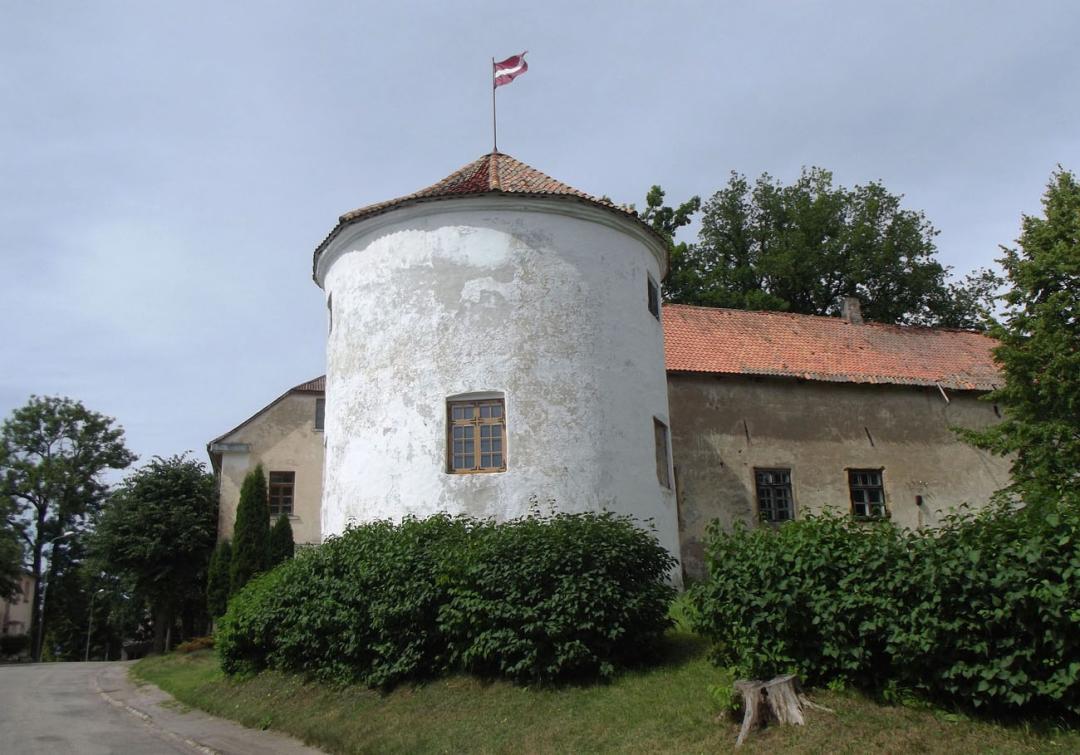
Augstrose Castle (Hochrosen)

G287+34 Slavenes, Umurga Parish, Limbaži Municipality, Latvia

Augsrose Castle (or Hochrosen, as it was called since the Middle Ages), or rather, the walls that remain of it, is located on a hill in the ancient territory of the Rozula district, about fifteen kilometers east of Limbazi. The castle was built by vassals of the Archbishop of Riga on the top of a 30-meter hill, whose steep slopes themselves served as reliable protection. And for greater security, the castle was constructed at the summit.

The Augstroze Castle (or Hochrosen, as it was called since the Middle Ages), or rather, the walls that remain of it, is located on a hill in the ancient territory of the Rozula district, about fifteen kilometers east of Limbazi.
The castle was built by vassals of the Archbishop of Riga on top of a 30-meter hill, whose steep slopes themselves served as reliable protection. And for greater security, the castle was built on the summit.
The lower part of its walls was made of boulders, the upper part of brick. The builders had to adapt to the contours of the hill. As a result, the castle’s layout resembles a kind of horseshoe. The wall, stretching in an arc, had a total length of 60 meters, with the ends of the arc connected by a straight wall 42 meters long with gates on the southern side. The thickness of the oval wall was less than two meters, while the thickness of the straight wall, from where an enemy could be expected, was more than two meters.
Fragments of the southern wall of the castle, six to seven meters high, have survived to this day. The ruins of the medieval Augstroze Castle are now an archaeological monument of national significance.
According to researchers from the 18th to 20th centuries, the construction of the castle should be dated to the 13th century. 
The first reliably known owner of the castle was Otto von Rosen. The extensive Rosen family was considered one of the most influential vassals of the Riga archbishops. Since then, the castle took its name from its owners – Hochrosen, which can literally be translated from German as “high roses.”
The local legend offers another explanation for the name. The legend says that the construction of the castle was very difficult. The old people began to say that a human sacrifice, to be walled into the castle’s wall, was necessary.
To make it easier and faster to lift all the necessary building materials to the top of the hill, the local residents were lined up and passed heavy stones from hand to hand. However, everything built during the day collapsed into the depths of the hill at night.
There were no volunteers, and the future castle’s owner resorted to a trick. He came to his people and asked: “Who wants to carry the keys to the castle?” A young girl named Rosa volunteered. The landlord gave the girl wine, which made her fall asleep, and the sacrifice was immediately walled into the castle’s wall. 
For three days and three nights, her moans were heard from the wall, but now the castle no longer collapsed, and the work was soon completed. And since the girl Rosa was walled into the castle, which now towered high above the surroundings, the place was named Augstroze. 
The castle in Augstroze was a so-called vassal castle. Its owners held the largest vassal estates in the Cesis region, large land plots, and several castles. A record from February 5, 1350, has been preserved, according to which the Riga Archbishop Fromhold von Vifhusen leased the lord’s house and castle courtyard of Rose to brothers Waldemar and Heneke von Rosen. The record mentions the castle with fields, mills, and villages. Augstroze Castle played a significant role in the history of Livonia and the masters of the Livonian Order. When in 1482 armed detachments of the Riga burgher Berens destroyed the order castles in Jaunpils, Skujene, and Piebalga, the Order’s troops surrounded Augstroze Castle, which was subordinate to the Riga archbishop. According to the Swedish land survey in 1601, the castle was owned by Heinrich von Rosen. In late June or early July 1601, during the Polish-Swedish war, the castle was besieged by Polish troops led by Shisinsky, who also brought Tatars with him. The castle was captured, plundered, and burned, and after these events, it was never rebuilt in its former form. The invaders killed all the inhabitants: young and old, rich and poor, women and children, pregnant women and the sick. 
In 1622, Swedish King Gustav II Adolf confiscated, among other estates, Augstroze Castle from its owners and gifted it to the state chancellor Count Axel Oxenstierna. In 1632, the Augstroze estate and district belonged to Fabian von Rosen, who also owned the estates of Mazstraupe, Rozula, Raiskums (Satekle), and Murjani.
From 1681, hard times came both for the Rosens and for most landowners in Livonia (the great reduction of estates). Of the over six thousand “hacks” (units of land) owned by private individuals, more than five thousand were confiscated by the treasury, and just over a thousand were left to the owners and churches. The reduction was carried out by the chairman of the reduction commission, Count Gastfer. The powerful Rosens could not prove ownership rights to Augstroze Castle because they did not present documents proving how exactly their estates and castles were acquired.
Probably because the Rosens fought on the side of the Swedes in the Great Northern War, their possessions were not returned by the Russian government despite the cancellation of the Swedish estate reduction decisions. At the same time, Mashnovskis writes that the castle and estate of Augstroze belonged to the Rosens until 1759. After that year, representatives of the Meyendorff family managed the estate. 
As late as 1801, Augstroze was devastated by Polish soldiers, after which the castle was no longer restored, and in the album of Marquis Paulucci from the 1820s, only the ruins of the castle are visible.

The buildings of the Augstroze estate were created under the Meyendorffs in the second half of the 18th century. The manor house was built in the Classicism style and was repeatedly rebuilt later. Only the granary with an arcade and the servants’ house have survived to this day. The estate had a park of regular layout covering 15.4 hectares with alleys and gazebos; the rest was of free layout. The park was neglected and became completely overgrown. 
Among the modern structures on the Augstroze hillfort, according to 1974 data, there was a watchtower, which has not survived to this day. But even now, from the ruins, there is a wide view of Lake Lielezers, the Augstrozes complex nature reserve, and the Northern swamp. In the 21st century, a stage was set up among the ruins, where music festivals were held. Later, the stage was removed, wooden paths were laid around the ruins, and after 2020, the 30-meter ascent to the castle was cleared of trees. 

Sources:
https://gidtravel.com/
https://lr4.lsm.lv/lv/raksts/domskaja-ploschad/mestnie-primechatelnosti.-ruini-zamka-augstroze.a177957/
https://de.wikipedia.org/wiki/Burg_Hochrosen

Follow us on social media

More stories from Latvia: Castles and Manors, History and Legends

Vecaiskrukle Castle (Alt-Ascheraden) – the home of the witch Spidola from Lāčplēsis

Agricultural Institute 18, Skrīveru Municipality, Aizkraukle Municipality, LV-5125, Latvia

The Vecaiskraukle Castle is mentioned in historical documents as Asscrade, Ascrade, Ascrath, Aschrate, Castrum Asscrad, Ascharad, Asscherat, Olde borch. The documents and chronicles also mention the lords and elders of various Livonian regions, who in Latin are called "duces, principes, nobiles, meliores, and seniores." One of the better-known among them, for example, is Vievaldis from Aizkraukle. The site of the first Livonian Order castle in Aizkraukle is located 82 km from Riga, about 1 km southwest of Skrīveri (in Skrīveri parish), in the strip between the Riga-Daugavpils highway and the right bank of the Daugava River. The castle is situated in a strategically advantageous location — on the Daugava riverbank, about 25-30 meters high, between two streams flowing into the Daugava, the largest of which is called Ashkere. It is believed that the word "Aizkraukle" (Ascheraden) originates from the toponym Asscrade (in Latvian Ashkere) — a stream, a tributary of the Daugava. Today, the hills where the castle once stood are called Augstie (High) or Kraukļu (Crow) hills.

The second castle of the Livonian Order, Asheraden, in Aizkraukle

Daugavoti, Daugavoti, Aizkraukle Parish, Aizkraukle Municipality, LV-5101, Latvia

The second castle of the Livonian Order, Asheraden, in Aizkraukle. No historical documents have survived regarding the date and reason for the construction of the new castle. In most known historical works on this subject, it is assumed that the castle was founded between 1224 and 1234. Armin Tuulse believed that the castle was built in the early 13th century, as the type of fortifications on the site, in his opinion, corresponded to castles of the early period. Ieva Ose, based on archaeological research, considers that the castle's structures are more characteristic of the 14th century. Only further research can clarify this issue. It is known that until 1420 both castles operated together and housed a German garrison guarding the strategically important crossing over the Daugava River at this location.

Alsunga Castle (Latvian name Alsunga)

Skolas Street 3A, Alsunga, Alsunga Parish, Kuldīga Municipality, LV-3306, Latvia

Alsunga Castle (Latvian name Alsunga) was one of several Teutonic fortifications guarding the route through Courland, connecting Livonia with Prussia. The first records of the settlement were documented in 1230, but the castle itself was only mentioned in a document from 1341. It was built somewhat earlier and was administratively subordinate to the commandant’s office in Goldingen, now Kuldīga. It did not serve an administrative function within the Teutonic authority but held economic and strategic significance.

Alūksne Castle (Marienburg) - the hometown of Catherine I

Templakalna Street 6A, Alūksne, Alūksne City, Alūksne Municipality, LV-4301, Latvia

In the northeastern part of Latvia lies Lake Aluksne, which has several islands. On the main city island, known as Castle Island (Pils sala), or Maria's Island, there is a castle. Today, the castle is used as an open-air theater venue, and it is home to Marienburg Castle.

Bauska Castle

Brīvības Boulevard 2, Bauska, Bauska City, Bauska Municipality, LV-3901, Latvia

Bauska Castle (German name Schloss Bauska) is a massive fortress located between the Memele and Musa rivers (two branches of the Latvian river Lielupe). It was originally built as a long-term outpost of the Livonian Order knights, aimed at protecting themselves from constant raids by the forces of the Grand Duchy of Lithuania from the south and securing the Riga direction, which was dangerous for the order's power and where the Livonian town of Bauska later emerged.

Aizpute Castle (Hasenpoth)

Liepājas Street 9, Aizpute, Aizpute City, South Kurzeme Municipality, LV-3456, Latvia

Aizpute Castle (Ordensburg Hasenpoth) is a castle of the Livonian Order in the town of Aizpute in the historical region of Courland in western Latvia. It was heavily damaged during the Second Northern War (1655–1660). Since 1998, the castle ruins have been a historical monument of Latvia.

Krustpils Castle (Kreutzburg)

216B Riga Street, Jēkabpils, LV-5202, Latvia

The first mention of Krustpils Castle dates back to 1237. At that time, Riga Bishop Nikolaus von Magdeburg built Kreutzburg Castle, which became the first fortress of the crusaders in Latgale. From the late 16th century until the beginning of the 20th century, the castle was owned by the knight Nikolaus Korf (and subsequent generations). Over time, the castle was repeatedly devastated and rebuilt.

Adagi Castle

8 Jaunciema Street, Vidzeme Suburb, Riga, LV-1024, Latvia

The castle of the Adazi Order was built around 1204. It was constructed by the Livonian Order at the end of the 13th century. The name of the castle is first mentioned in a document from 1299, which notes that the Archbishop of Riga, Johan III, was imprisoned in the castle. According to the Rusov chronicle, the Lithuanians attacked the castle in 1298, as well as in 1345, when soldiers entered the courtyard of the Dadazi castle but were repelled. In 1486, a bailiff lived in the palace. In the 15th century, the master of the order stayed at the castle, during which time many documents were prepared. In 1624-1625, the palace was burned and destroyed, but in 1656 it was destroyed by Russian troops. Only the ruins of the castle, blown up in 1706, remain. It is believed that the stones from the castle were used to build the Daugavgriva fortress and the nearby Bukulti estate. From the Adazi castle of 1798, only the ruins of one tower remain, which I.K. Broche captured in his drawings. He also mentions that the castle was located on an island formed by a stream flowing from Kishezer and flowing into Baltezer, called Berzupi. At present, the exact location of the castle cannot be determined, as the construction of a new tower significantly changed the topography of the surrounding area. The appearance of the castle can only be judged by plans found in the 17th century.

Valmiera Castle (Wolmar or Vladimerets)

3 Bruņinieku Street, Valmiera, LV-4201, Latvia

The construction of Valmiera Castle began in 1283. During the Great Northern War (1702), the castle burned down, but by the end of the 17th century, the outer city walls were dismantled. The ruins of the castle and remnants of other medieval fortifications have been preserved. Some historians believe that the founder was a relative of Riga’s bishop Albert of Buxhövden, Prince Vladimir (Waldemar), who was expelled from Pskov and appointed by the bishop as the vogt of Autine in 1212. According to this version, the name Valmiera, Volmar, originates from the name Waldemar. In Russian chronicles, the city of Valmiera was called Vladimerets.

Castle in Ventspils (Windau)

Rūjienas Street, Ventspils, LV-3601, Latvia

The castle in Ventspils is the only castle built by the Livonian Order in the Courland part of Latvia that has been well preserved to this day. Architectural style: Gothic, Empire.

Marienhausen Castle (Vilyaka)

48A Liepnas Street, Viļaka, Viļaka City, Balvi Municipality, LV-4583, Latvia

The historical past of the settlement traces its roots back to the Middle Ages. In the Livonian chronicles, the settlement on the site where the city of Viļaka now stands is first mentioned at the beginning of the 13th century under the name Marienhausen. In 1293, the crusaders built a wooden castle on an island in the lake (now Lake Viļaka), which was later rebuilt in stone.

Dinaburg Castle

55°54'40.6"N 26°43'36.2"E, Vecpils, Naujene Parish, Augšdaugava Municipality, LV-5462, Latvia

In the mid-13th century, the German sword-bearers, in order to keep the local Latgalian population under control and to resist the Russian princes, decided to establish strongholds. The site for one of these strongholds was chosen on the bank of the Daugava (Dvina), where the Nevgin settlement (modern Nauene, 19 km upstream along the Daugava from Daugavpils) was located. The Nevgin settlement was part of the Gersik principality.

Grobin Castle

Lielā Street 56A, Grobiņa, Grobiņa city, South Kurzeme Municipality, LV-3430, Latvia

Grobin Castle (German: Schloss Grobin, Latvian: Grobiņas pilsdrupas) — ruins of a medieval castle with bastions in the center of the Latvian town of Grobiņa. The brick castle was built by the Livonian Knights no later than 1253. According to some historians, the castle was constructed by the order's master Dietrich of Groningen; according to other sources, by the order's master Goswin of Herike. It was repeatedly rebuilt in the 14th–16th centuries. Finally abandoned in the 18th century, when Grobiņa was under the possession of the Dukes of Courland.

Dzerbene Castle (Schloss Serben)

Lielā iela 3, Dzērbene, Dzērbenes parish, Cēsis municipality, LV-4118, Latvia

The medieval castle Dzerbene (German name Schloss Serben) was the manor castle of the Riga archdiocese in the 14th–16th centuries. It was located on the Koknese – Ergli – Piebalga – Dzerbene – Rauna highway. Today, the manor building of Dzerbene estate stands on its site. The medieval castle was built on an elevation, which was semicircled from the west, north, and east by two ravines.

Castle Dobele (Dobelene, Doblen, Добленъ)

Brīvības Street 2c, Dobele, Dobele City, Dobele Municipality, LV-3701, Latvia

Formerly known as Doblen Castle (German name Schloß Doblen), it was the residence of the Dobele commanders of the Livonian Order from the 14th to the 16th century. The castle ruins are located in the city of Dobele (Latvia), on the right bank of the Berze River, on a castle hill 15 meters high.

Dundaga Castle (Dondangen)

Pils Street 14, Dundaga, Dundaga Parish, Talsi Municipality, LV-3270, Latvia

Dundaga Castle in Dundaga is located 60 km from Ventspils and 160 km from Riga, and is considered the largest castle in Northern Courland. It is situated in the village of Dundaga, Dundaga Parish, Talsi Municipality, at 12 Pils Street, on the left bank of the Pāce River. Originally, there was a Curonian settlement on the castle peninsula, and later it became a military camp of the Livonian Order.

Zaube Castle (Jurgenburg) ancestral home of the sculptor Klodt family

Kapiņi, Zaube, Zaube Parish, Cēsis Municipality, LV-4113, Latvia

In Zaube was the economic castle of the Sigulda vogt of the order. Historian J.G. Arnts (1753) believed that the castle was built in 1257, but this date has no documentary confirmation. Zaube Castle (Jurgenborgh) is first mentioned in a letter from the master of the order to his assistant on August 22, 1437. In the 15th century, the castle is mentioned several more times in various documents.

The Ikšķile Castle and Church (Ikšķile - Uexküll) - the first stone building in Latvia

RG82+6F Ikšķile, Ikšķile city, Ogre Municipality, Latvia

The remains of the church and castle are located on Saint Meinard's Island in the reservoir of the Riga Hydroelectric Power Plant, on the southern outskirts of the town of Ikšķile, 28 kilometers southeast of Riga, on the right bank of the Daugava River, 7 km downstream from the confluence with the Ogre River. Before the flooding, the castle stood on a high limestone rocky shore. Ikšķile was the castle of the Bishop of Livonia, later the castle of a vassal of the Riga bishop, and for a long time the castle was also occupied by the Livonian Order. The Church of St. Mary in the castle complex is a unique site, considered the first Catholic church in Latvia. The church and castle are the first stone structures in the history of Latvia (1184-1185).

Castle Kandava (Kandau - Kandau)

Pils Street 7, Kandava, Kandava City, Tukums Municipality, LV-3120, Latvia

Fortification of the Order's vogt, belonging to the Kuldīga commandery. The land of Kandava was granted to the Livonian Order in 1253, after the division of the Curonian territory. It is believed that Kandava Castle began to be built in 1257 on the initiative of the Order's master Eberhard von Seyne. The fortress is first mentioned in documents in 1312. It is known that from 1383 to 1560, 17 Kandava vogts resided in the castle. During the duchy period, the fort was inhabited by a captain – the ducal administrator. Kandava Castle held a significant strategic position as it was located above the Riga–Prussia road.

Kremon Castle (Krimulda)

Krimuldas Street 2, Sigulda, Sigulda City, Sigulda Municipality, LV-2150, Latvia

Kremuld Castle is a fortress built in the 13th-14th centuries for the Cathedral Chapter. For a long time, it was impregnable due to the terrain features (a river valley and ravines on three sides); however, in 1601 the castle was burned down and subsequently not restored. Today, only ruins of Kremuld Castle remain, among which you can see the main building with two towers and the fortress wall. The facade of the building is especially attractive, with preserved Gothic window openings. On the northern side, a small viewing platform adjoins the ruins, from which a wooden staircase leads down to the picturesque bank of the Gauja River.

Mikhail Baryshnikov - from Riga to New York

Mazā Smilšu Street 8, Central District, Riga, LV-1050, Latvia

Soviet and American ballet artist, choreographer, actor, collector, photographer, public figure. A "non-returnee" to the USSR, who stayed in Canada during a tour in 1974. Nominee for the Oscar and Golden Globe awards in the category "Best Supporting Actor" for the role in the film *The Turning Point* (1978). Commander of the Latvian Order of the Three Stars.