


The second castle of the Livonian Order, Ascheraden, in Aizkraukle. You can read about the first Ascheraden castle at https://reveal.world/story/zamok-vetsajzkraukle-alt-ascheraden-dom-ved-my-spidoly-iz-lachplesisa.
No historical documents have survived regarding the date and reason for the construction of the new castle. Most known historical works on the subject suggest that the castle was founded between 1224 and 1234. Armin Tuulse believed the castle was built in the early 13th century, as the type of fortifications on the site, in his opinion, corresponded to castles of the early period. Ieva Ose, based on archaeological research, considers the castle’s structures more characteristic of the 14th century. Only further research can clarify this issue. It is known that until 1420 both castles operated together and housed a German garrison guarding a strategically important crossing over the Daugava River at this location.
Built on a triangular peninsula between the Daugava and Karikste rivers, the castle was originally a rectangular structure with four wings of utility buildings surrounding an inner courtyard and a Southern tower, quadrangular in plan. Such a tower placement within the castle plan is not found in any other known Livonian castles. The length of the castle’s outer walls reached 60 meters, indicating that the Aizkraukle castle was one of the largest castles of this type.
A large amount of dolomite from the banks of the Daugava was used in the castle’s construction. Field stones and red bricks are found in places.
Archaeological research suggests that the interiors of the castle’s northwest wing had ribbed cross vaults (possibly even star-shaped). The walls were plastered, and the wall openings were crowned with pointed arches.
The castle peninsula was separated from the mainland by two moats. The first, 10 meters wide, was dug about 150 meters from the mouth of the Karikste, separating the castle from other fortifications. The second moat was arranged 100 meters further, dividing the first and second outer baileys. The second outer bailey was also separated from the land by a moat. On its southeast side, it was protected by an earthen rampart. In the Middle Ages, settlements of craftsmen and merchants were located on the territory of the outer baileys. It is assumed that the northern part of the castle on the peninsula side was surrounded by an additional wall. Here, in the northeast part, was the entrance to the fortifications. A few hundred meters upstream along the Karikste, a dam and mills were built in the Middle Ages for the castle’s needs.
Here intersected routes leading from Courland through Zemgale and Selija to Vidzeme, which determined the special position of the new castle and elevated it among the main castles of the Order. At that time, the Daugava served as the border between lands already conquered by the crusaders on the right bank and still free territories on the left bank. The crossing near Aizkraukle was used by Lithuanian and Zemgalian troops conducting raids into Vidzeme.
It is no surprise that military clashes between the crusaders and Lithuanians and Zemgalians (including the famous Zemgalian leaders Viesturs and Namejs) were frequent here. In 1226, the Zemgalians led by Viesturs managed to capture the castle. The Rhymed Chronicle recounts that the Germans surrounded Viesturs as he was returning to Zemgale with war trophies. However, the Zemgalian leader grabbed a burning log from the fire, knocked out the teeth of Aizkraukle’s komtur Markward von Burbach, jumped on a horse, and escaped his pursuers.
The Rhymed Chronicle mentions Markward again in connection with the military campaign of 1230. Historian Benninghofen believes Markward probably held the position of komtur from 1211 to 1231. In 1234, the castle was the residence of the Master of the Sword Brothers Order Bernhard (not to be confused with the Supreme Master of the Sword Brothers!), a title corresponding to the later title of komtur in the Livonian Order. It is known that from 1252 to 1480, the castle was governed by 21 komturs.
Near Aizkraukle, the Lithuanian prince Lengevinas was captured — the very one who terrorized the garrisons of Vidzeme castles in 1240-45.
On September 22, 1236, the Battle of Saule took place, where the Lithuanians allied with Livonian tribes defeated the Sword Brothers Order. The remnants of the knightly army joined the Teutonic Order, forming its branch in Livonia — the Livonian Order. The Battle of Saule occurred on the day of St. Maurice, and on the seal of the Aizkraukle komtur in 1271, St. Maurice is also depicted! Both the Teutonic and Livonian knights had a common enemy dividing their territories — the Grand Duchy of Lithuania, the last stronghold of paganism in the Baltics.
From 1242, Mindaugas became Grand Duke of Lithuania. A smart and far-sighted politician who united Lithuania under his rule, Mindaugas understood the danger posed by the German crusaders. To deprive them of the main pretext for invading Lithuania, Mindaugas converted to Christianity and was crowned. He made territorial concessions, gifting parts of land to the Livonian Order and the Archbishop of Riga on the occasion of his coronation. The donation was confirmed by Pope Innocent IV on August 21, 1253. Over the next three years, Mindaugas continued to renounce rights to some borderlands until a final agreement was reached in 1256 between him and the suzerains of Livonia. This treaty, confirmed by Pope Alexander IV on July 13, 1257, transferred part of the lands in Selija under the jurisdiction of the Aizkraukle castle to the Livonian Order.
The Aizkraukle castle had authority over the Altene castle located 15 kilometers east of Aizkraukle, as the Aizkraukle komturship district now spanned both banks of the Daugava. Most of the komturship’s lands were in Selija. Thanks to this advantageous deal, Livonian Order Master Anno von Sangerhausen was able to become the Supreme Master of the Teutonic Order and renounced military claims on Lithuania.
After 1257, the border between the Order’s and the Archbishop’s possessions in Selija ran near the crossing at Aizkraukle. To secure himself, in the same year Archbishop Albert donated borderlands of his territory near Aizkraukle to the female Cistercian monastery in Riga.
After Mindaugas was murdered in 1263, conflicts between Lithuania and the Order flared anew. In spring 1273, the Lithuanians defeated the Order’s troops near Aizkraukle. The Zemgalian leader Namejs, allied with Lithuania, raised a rebellion, drawing the main forces of the Order. This allowed the Lithuanians on March 5, 1279, to deal the Livonian Order a crushing blow near Aizkraukle. The entire elite of knights perished — 71 crusaders and the Order’s Master Ernst von Ratzeburg. The Lithuanians also captured the banner depicting the Virgin Mary and killed the standard-bearer Johann Tisenhausen.
One of the Aizkraukle castle’s komturs died in 1305 near Dubene during a military campaign in Zemgale. In a church near the castle in 1375, the deputy master of the Livonian Order — Land Marshal Andreas von Stenberg — was buried.
One document from 1420 mentions that by then two castles existed nearby — Aschraden and the old castle Oldenborch. In 1451, the castle’s komtur was Johann Spor, who commanded 7 knights. Around 1469, 19-year-old Walter von Plettenberg, the future master of the Livonian Order, served at Aizkraukle.
In 1477, Riga’s Archbishop Silvester Stodewescher excommunicated the city of Riga along with the Livonian Order from the church. On October 7, 1477, the interdict was confirmed at the Landtag in Valka, where the archbishop condemned the Livonian Order’s master, who had ordered the Aizkraukle komtur to poison the archbishop and burn his residence in Koknese.
In 1485, Archbishop Michael Hildebrandt sent envoys to Riga so that the town hall and cathedral chapter would recognize his appointment as archbishop; they agreed to recognize him if he freed the cathedral chapter’s warriors captured by the Livonian Order and returned goods confiscated by the knights on the Daugava. As a result, a new Landtag was convened, but since the archbishop, the Order, and the city of Riga could not agree on the prisoners in Aizkraukle castle, negotiations broke off, and the Order began preparing for a new war with Riga.
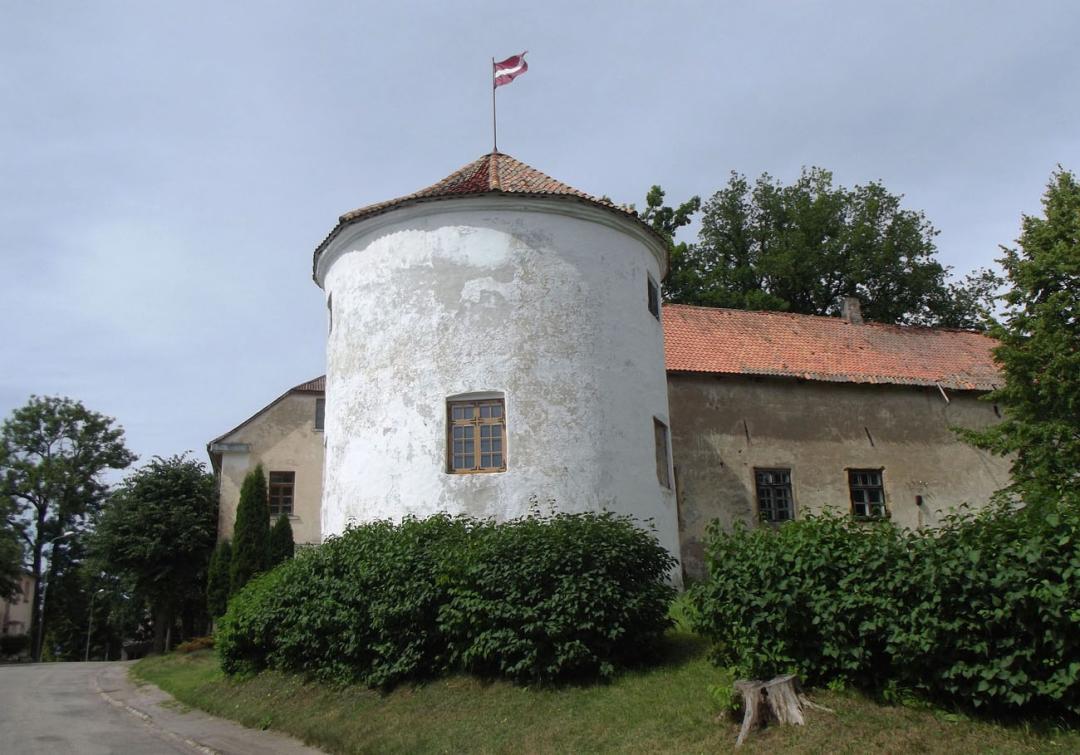
In the 15th century, two towers intended for firearms were added to the castle’s northwest and northeast corners. The tower walls were built using the so-called "shell" technology, i.e., dolomite slabs were laid outside, and gaps were filled with small dolomite fragments or bricks. The walls of the interior rooms were faced with bricks, and the hollow parts of the walls were also filled with rubble and lime mortar. The diameter of the Eastern tower was somewhat smaller. Whether it was round or semicircular, as shown on F. Kruse’s plan published at the beginning of this chapter, can only be clarified by archaeological excavations.
At the end of the 15th century, the castle gained the status of the residence of the Land Marshal (the deputy master of the Order). Since the castle was the residence of the Land Marshal—the second highest person in the Livonian Order hierarchy after the master—in the castle’s interior decoration there might have been additional decorative elements, similar to those in the master’s chambers in Cēsis. From 1519 to 1561, the castle was governed by five komturs appointed by the Land Marshal (Hauskomtur).
In January 1559, a new phase of the Livonian War began. Russian troops of Tsar Ivan the Terrible tried to capture Riga but were forced to retreat toward Salaspils, Ikšķile, and Aizkraukle, returning at the end of February to Russian territory. The war-weakened Livonian state sought help and financial resources to continue the war. Order Master Gotthard Kettler and Riga Archbishop Wilhelm of Brandenburg entered negotiations with Polish King Sigismund Augustus. On September 15, 1559, in Vilnius, the Order pawned its lands along the Daugava from Druja to Aizkraukle with a right of redemption for 600,000 guilders, and the king pledged to support Livonia with all his might, restore the integrity of its possessions, and share future conquests in Russia with the Order as brothers.
In 1577, the garrison of Aizkraukle castle received a written offer to surrender from Duke Magnus. Preferring to surrender to the young duke rather than his ally Ivan the Terrible, Land Marshal Kaspar Münster accepted the offer. However, Ivan the Terrible disliked Magnus’s excessive independence and seized his castles. On August 25, Aizkraukle was taken. The old Land Marshal Münster was blinded and shot until he died. His relative Johann Münster and the surviving warriors were taken prisoner.
In 1581, Polish troops forced the Russian garrison to leave the castle after a two-week siege, once food supplies ran out. In 1599, an inspection of the castle noted that it had been partially destroyed by the Russians, partially by Stephen Báthory, and now stood empty. The castle was not restored because, after the advent of firearms, it became vulnerable from several hundred meters away on the opposite high bank of the Daugava. During Polish times, a starostwo (district) was created on the lands of the Aizkraukle komturship, the first starosta being a certain Dobinski, followed by Jan Kazinowski.
Swedish King Gustav II Adolf in 1630 transferred the castle remains as debt payment to artillery lieutenant colonel Simon von Schulz. In 1633, the castle was further fortified, as mentioned by Swedish Chancellor Axel Oxenstierna in a letter dated October 8 from Frankfurt am Main. After Simon von Schulz’s death, until 1638, the castle was managed by his widow on behalf of their sons.
Landowner Martin von Schulz made the estate a majorat in 1674, and from then on his family was known as Schulz von Ascheraden. By 1680, the castle was almost ruined, and locals gradually took stones for their own needs. In 1694, a stone church was built less than a kilometer from the castle, with stones also taken from the ruins.

In 1685, all Schulz estates were subjected to reduction, and Karl Schulz went from owner to tenant. He actively participated in the Patkul conspiracy and was imprisoned for it. In 1700, during the Great Northern War, Saxon troops under King Augustus II the Strong besieged Riga. On November 7, the Saxons occupied Koknese. King Augustus and Patkul also arrived and stayed with Baron Schulz in Aizkraukle, stationing their army in nearby estates. After 1710, the Schulz family, like other Livonian nobility, had their estates returned to them.
Baron F. Schulz entered history as the Landrat who accompanied Russian Empress Catherine II on her journey through Vidzeme. The Empress ordered improvements in the peasants’ conditions in Livland. Baron Schulz, based on her recommendations, wrote the "Peasant Law," had it translated into Latvian, and distributed it to the peasants of his estate. However, the "peasant rights" caused great concern among Vidzeme landowners and were not brought before the Landtag. A special Landtag commission ordered Schulz to retrieve all copies of the "peasant rights" already distributed to the people. Only several years later, as a model for drafting laws for privately owned estates, landowners began to use Baron Schulz’s laws, which contained norms of peasant duties for his estates of Aizkraukle and Rimanmuiža.
As photographs taken before World War II show, the castle ruins have rapidly deteriorated over the last 50 years. The remains of the Southern tower, about 6 meters high, were blown up in 1946 and used for highway construction. Some fragments of the castle walls still rise up to 10 meters above ground. One fragment reaches 15 meters in height; on the Daugava side, the edge of a spiral staircase, a wall niche, and a doorway with a semicircular lintel have been preserved; on the Karikste river side, traces of a chimney and a ribbed vault remain in the wall. The second wall fragment is from the round northwest corner tower, where a quarter of the wall remains at the third-floor level. On the tower’s first floor, two embrasure edges and holes passing through the walls are visible, possibly used for ventilating the shooting chamber.
Sources:
https://www.castle.lv/latvija/aizkraukle.html Project by Renāta Rimša



Written by Jermaine
Discuss this with the author and others
No comments yet. Be the first to start the conversation.