

Mikhailovsky Palace is the palace of Grand Duke Mikhail Pavlovich, the fourth son of Paul I and Maria Feodorovna, and the younger brother of Emperors Alexander I and Nicholas I. It is a historic building in Saint Petersburg, constructed between 1819 and 1825 according to the design of architect K. I. Rossi, located in the city center on a square that was named Mikhailovskaya Square in 1834 (since September 26, 1940, known as Arts Square). It is a monument of late classicism architecture, or Russian Empire style. Since 1898, the building housed the "Russian Museum of Emperor Alexander III," and since 1917, the State Russian Museum.
The idea to build a new residence for Grand Duke Mikhail Pavlovich belonged to his father, Emperor Paul I. After the birth of his youngest son, who was not destined to inherit the throne, the emperor ordered that money be set aside annually for the construction of a palace "so that when the son reached adulthood, he could at least live royally." The emperor did not live to see his idea realized — as a result of a palace coup, he was killed on March 24, 1801, in his own bedroom in the Mikhailovsky Castle. When Mikhail Pavlovich turned 21 in 1819, the new emperor Alexander I decided to begin construction.
Alexander I entrusted the construction of the palace to the chairman of the Committee on Buildings and Hydraulic Works, A. Betancourt. At Betancourt's initiative, the project was assigned to K. I. Rossi. Rossi had been working on the palace project since 1817. Initially, the grand ducal residence was planned to be built on the site of the Vorontsov Palace, then on the site of the Chernyshev house (later the Mariinsky Palace was built there). Together with Betancourt, Rossi proposed a new urban planning concept and designed the reconstruction not only of the Mikhailovsky Palace but also of the extensive adjacent area between Nevsky Prospect, Fontanka River, Sadovaya Street, and Chernyshev Lane. In early April 1819, the "Commission for the Construction of the Palace for Grand Duke Mikhail Pavlovich" was established. At the same time, the demolition of greenhouses and conservatories in the former gardens of the Mikhailovsky Castle began.
The palace was laid on April 17 and completed in 1823. By imperial decree, the building was granted to the grand duke "in perpetual and hereditary ownership." Interior decoration continued for another two years, and the palace was solemnly consecrated on August 30 (September 11, new style), 1825. The acceptance of the palace was carried out by Emperor Alexander I himself. The sovereign was pleased and awarded architect K. Rossi the Order of St. Vladimir, 3rd class, and a diamond ring. The construction cost amounted to 7 million 875 thousand rubles. Grand Duke Mikhail settled in the palace with his wife, Grand Duchess Elena Pavlovna.
The palace interiors were repeatedly remodeled. For the grand duke, the palace was not only a home but also a place of service, where he daily received military and civil officials. In the 1830s, part of the interiors was remodeled for official needs by A. I. Shtakenshneider. Later, in the 1840s–1850s, living rooms for members of the large family were adapted by architect G. A. Bosse and his assistants. Only the Main Staircase and the famous White (White-Column) Hall preserved their original appearance. In other rooms, original paintings and decorative stucco of vaults and ceilings partially survived.
On the first floor of the building were the grand duke’s private chambers, including six rooms, among them the Arsenal, where a collection of weapons was kept. This Arsenal housed battle cannons gifted to the brother by Nicholas I. These cannons played a historical role in the 1825 uprising on Senate Square. The first floor also contained apartments for courtiers. On the second floor were the living room, study, library, and reception room. The ceremonial rooms, accessed via the Main Staircase, included halls intended for receptions and balls. On the second floor, at the very center of the enfilade, was the White Hall, whose decoration was especially impressive.
After Mikhail Pavlovich’s death in 1849, Elena Pavlovna, striving to preserve the memory of the grand duke, held salons in the palace attended by prominent state figures, writers, and artists of the capital: Foreign Minister Prince A. M. Gorchakov, Justice Minister Count V. N. Panin, Baron M. A. Korf, the Villegorsky brothers, writers V. A. Zhukovsky, P. A. Vyazemsky, academicians K. M. Baer, V. Ya. Struve, A. Kh. Vostokov, N. I. Pirogov, artists I. K. Aivazovsky, N. S. Pimenov, T. A. Neff, P. F. Sokolov. Occasionally, Emperor Nicholas I himself appeared. Writer and philosopher Prince V. F. Odoevsky became a kind of chronicler of these meetings. In her later years, Elena Pavlovna traveled extensively across Europe. After her death in 1873, her daughter, Grand Duchess Ekaterina Mikhailovna, lived in the palace for some time.
In 1894, Mikhail Pavlovich’s grandchildren sold the palace to the treasury. On April 13, 1895, by the personal highest decree of Emperor Nicholas II, the "Russian Museum of Emperor Alexander III" was established in the palace. Renovation works to adapt the palace interiors for museum exhibitions were carried out between 1895 and 1898 by architect V. F. Svinin.
Restoration work after the fascist blockade of 1941–1944 was completed in 1946, and the museum was reopened to visitors.
The currently existing Mikhailovsky Palace building with adjacent territories was constructed based on the third design by Carlo Rossi on the site of semi-ruined greenhouses and conservatories in the gardens of Paul I’s Mikhailovsky Castle. The first two versions of the Mikhailovsky Palace were not approved by the Committee on Buildings and Hydraulic Works, headed by A. Betancourt. Together with Betancourt, Rossi proposed a new urban planning concept that defined the formation of the entire ceremonial city center. This project was unusual in combining two seemingly contradictory ideas: a closed composition of a house of the "city estate" type and the creation of a broad spatial ensemble: a palace with an adjacent garden on the northern side, a square in front of the palace’s ceremonial facade on the southern side, an ensemble of adjacent buildings and streets, including a street connecting the entire composition with the city’s main thoroughfare — Nevsky Prospect. The full project version of the entire ensemble was completed by the architect only by 1823. At that time, Rossi was simultaneously working on projects for other city ensembles: Yelagin Island, Mars Field, Admiralty Embankment, squares in front of the Mikhailovsky Castle, and the ensembles of Palace and Senate Squares.
In his early creative period, Rossi was fascinated by the work of A. Palladio. In the ensemble of buildings on Yelagin Island and other projects, Rossi demonstrated the ability to freely interpret Palladian compositions, achieving in each case an organic connection of the building with the surrounding landscape.
Despite its scale (the southern facade of the palace stretches 105 meters), the Mikhailovsky Palace building is still compositionally conservative. Its layout follows three traditions simultaneously — Palladianism, the "French scheme" (a tripartite structure with a ceremonial courtyard: a cour d’honneur), and Russian estate architecture: the main building and two side wings with the main facade recessed relative to the red line (the so-called "estate in the city"). The large order on the arcades of the southern and northern facades develops the classical Palladian theme introduced in Saint Petersburg thanks to the work of J. Quarenghi.
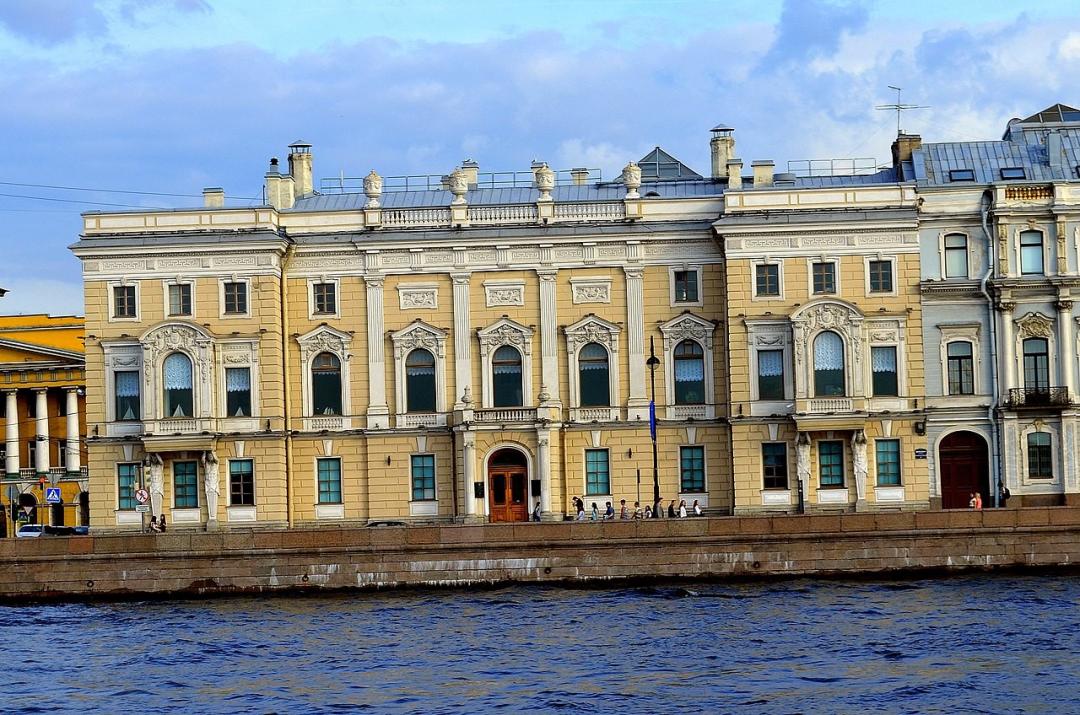
The main southern facade of the palace consists of a central building decorated with an eight-column Corinthian portico raised on an arcade, with a wide staircase and two lion figures on the sides. The portico is topped with a triangular pediment. The side buildings are decorated with three-quarter Corinthian columns and a sculptural frieze consisting of 44 bas-reliefs by sculptor V. I. Demut-Malinovsky. The palace is set deep within the ceremonial courtyard, separated from the street by a high cast-iron fence with three gates and four-sided pylons topped with military trophies (armaments). The fence, gates, and trophies give the entire composition an Empire style appearance.
The northern facade, facing the Mikhailovsky Garden, is decorated similarly but lacks strongly projecting side risalits, and the central part is not a portico but a spacious, typically Italian loggia, also on arcades, with Corinthian columns. Sculptural details of the facades were created by sculptors V. I. Demut-Malinovsky and S. S. Pimenov. These sculptors (who collaborated with architect Rossi on many buildings) also created sculptural decor in the interiors. Interior paintings were done by Italians D. and P. Scotti, A. Vigi, and B. Medici.
The Mikhailovsky Palace soon became known in many European countries. For example, King George IV of Great Britain sent a request to the Russian emperor to make a model of this palace for him. Russian craftsman Nikolai Tarasov built a model two meters long and two meters wide, which was taken to England. The interior decoration of the Mikhailovsky Palace amazed with its taste and splendor: stunning sculptures and tapestries, paintings and stucco, wallpapers produced at the Tsarskoye Selo factory, which are true works of art, parquet made from red, sugar maple, black, chephraz, and purple types of wood.
An outstanding architectural work is the palace’s grand multi-flight staircase. It opens upon entering through the main entrance in the opening of a huge semicircular arch. The staircase is encircled at the second-floor level by a Corinthian colonnade. At the level of the column capitals are sculptural panels, and on the vaults are grisaille paintings imitating sculptural telamon figures. The second-floor galleries open into the White-Column Hall, which has preserved decoration corresponding to Rossi’s project. It is a vivid example of the Russian Empire style in palace interior design. White columns of artificial marble (stucco) combine with gilding on the ceiling, bronze chandeliers, and a painted frieze imitating a bas-relief on a golden background. The hall exhibits unique works of decorative and applied arts, including a set of carved wood furniture with white "French lacquer" and gilding, upholstered in blue silk, made according to Rossi’s designs by the furniture workshop of V. I. Bobkov.
Grand Duke Mikhail Pavlovich held balls in the Mikhailovsky Palace that were in no way inferior to imperial ones. The splendor of these balls and receptions, the number of guests, music and dances, flowers and dishes impressed all foreign visitors. For several generations, the palace flourished, but in 1894 it was turned into a revenue house. Witte proposed to house the Russian Museum there, which happened in 1895. The Mikhailovsky Palace was rebuilt: the stables were demolished, and at the beginning of the 20th century, a building was constructed here to house the Ethnographic Department of the museum. The Russian Museum opened in 1898. During the Great Patriotic War, the Mikhailovsky Palace building was damaged by shells, but it was restored in the postwar years. During the blockade, maximum efforts were made to preserve museum valuables: the monument to Alexander III standing in the courtyard of the Mikhailovsky Palace was reliably protected from bombs by being covered with sand and logs. The Russian Museum is one of the largest museums in Europe. It houses rich collections of works by famous artists.
During the war, German artillerymen numbered Leningrad’s architectural monuments as targets for destruction. The museum had its own number. The Nazis dropped 11 high-explosive and about a hundred incendiary bombs on the territory of the Mikhailovsky Palace, and during artillery shelling, over 40 shells. The explosions left craters in the ground and shattered windows. Deep cracks from the bombings appeared on the Benois building and Rossi’s wing; these damages were later repaired.
Georgy Yefimovich Lebedev, deputy director of the Russian Museum, stayed in the museum during the war and blockade, organizing the storage of artworks in the Mikhailovsky Palace.
Quote from Lebedev’s diary dated May 10, 1942:
"One of the most acute moments in my entire life — extinguishing incendiary bombs that fell in the garden in front of the main facade. Nearby, the roof of the Ethnographic Museum is burning. The crimson glow illuminates the low clouds. I, Farmakovsky, Emme, and someone else are covering the hissing beast with sand; it spits fire, blinds the eyes, stinks, refuses to surrender. And all this time overhead — the bass, heavy hum of the 'Heinkel.' The whole body anxiously awaits the terrible blow of the high-explosive shell. Anti-aircraft guns thunder continuously. Into their orchestra bursts the soprano howl of shrapnel; they slap somewhere very close, knocking leaves off bushes, drumming on roofs. Soon, sitting in the bomb shelter and somewhat calmed, I try to make sense of what happened. What actually happened? It seems nothing special, significant, or unusual. We only did what many Leningrad boys are doing now. But why does the heart beat so hard, why this paleness of cheeks and nervous trembling of fingers?"
Of all the museum staff who remained in besieged Leningrad, only seven survived. And not a single exhibit from the museum’s 300,000-item collection was damaged.
On May 9, 1946, the first anniversary of the victory over fascism, the exhibition in the halls of the museum’s first floor opened to visitors, and in autumn, the second-floor halls were also able to receive visitors. A little later, on November 8, 1949, the exhibition of Soviet art was opened in the restored Benois building. One can imagine what a celebration the first postwar exhibition was. People could not believe the items were real and tried to touch them. Art was for them a part of a forgotten, different prewar world.
Sources:
https://ru.wikipedia.org/wiki/Mikhailovsky_Palace
https://kudago.com/spb/place/mihajlovskij-dvorec/
https://www.citywalls.ru/house803.html
https://dzen.ru/a/ZFnoyWtsmRL6dwyF


Written by Jermaine
Discuss this with the author and others
No comments yet. Be the first to start the conversation.