

At the beginning of the 18th century, the land plot occupied by the Mariinsky Palace belonged to representatives of various noble families — Buturlins, Urusovs, Repnins. In 1763, Empress Catherine II gifted the land to Count Ivan Chernyshov. In 1768, the count built a luxurious palace for himself according to the design of architect Jean-Baptiste Vallin de la Mothe. After Chernyshov's death, the estate was inherited by his eldest son Grigory, but soon due to debts, the estate was transferred to the State Guardianship Administration. The building was rented out partially for a long time. In 1824, it was handed over to the military department, and Grand Duke Nikolai Pavlovich decided to build a school for Guards non-commissioned officers on this site. For the school's needs, the main house of the estate was radically rebuilt, the exterior decoration of the facades and interior finishes were destroyed, the wings were demolished, and the ceremonial courtyard was abolished. The project was led by architect Alexander Staubert, and construction was completed in 1828. From 1832 to 1834, Mikhail Lermontov and Alexander Baryatinsky studied at the school.
In 1838, Emperor Nicholas I decided to erect a new palace as a gift to his daughter Maria Nikolaevna in honor of her engagement to Duke Maximilian of Leuchtenberg. The Guards non-commissioned officers' school was moved to another building and renamed the Nikolaev Cavalry School. The land previously belonging to the school was allocated for the palace, and three more nearby plots in Novy Lane were purchased. As a result, an irregularly shaped plot was formed, surrounded on all sides by ministry buildings, posing a difficult task to fit the future palace within its boundaries. Additionally, it was necessary to preserve the role of the architectural dominant of the square for St. Isaac's Cathedral.
Andrey Stakenschneider was invited to lead the construction; by December 1838, he presented his project for the reconstruction of Chernyshov's palace to the emperor. Preserving the main volume, Stakenschneider radically changed the interiors, moved door openings and the ceremonial staircase. A one-and-a-half-brick-thick wall was built tightly around the former walls, and load-bearing elements were replaced with non-combustible materials — brick and metal. The latest technical solutions of the time were applied during construction: Ammosov stoves were installed for heating the building, plumbing and sewage systems were laid, and a ventilation system was designed. On July 28, 1839, the solemn laying of the palace took place.
A special commission was established to oversee the construction progress, including renowned architects Karl Rossi and Vasily Stasov. It prepared weekly reports "on the progress of work," which were sent to the emperor. Periodically, Nicholas I personally came for inspections.
Besides the palace itself, Stakenschneider had to build service buildings: the hofmeister’s, stables, laundry, several sheds, and kitchens. To handle such a volume of work, the architect recruited a whole staff of assistants. Stakenschneider often hired young graduates of the Academy of Arts and entrusted them with important tasks. The only condition imposed by his superiors was to take a pledge from each "not to belong to secret societies," a remnant of the Decembrist uprising. The drawing department was headed by August Lange, his senior assistant was Vladimir Shreiber, and the master of stonework was Lev Adamini. Pavel Karmin and Ivan Kozlyanin helped with the service buildings.
On July 2, 1839, the day of Maria Nikolaevna's wedding

and Maximilian of Leuchtenberg, Nicholas I announced that the palace on St. Isaac's Square would become their permanent residence. However, at that moment, the interior decoration had not yet even begun, so the newlyweds lived for some time in the building at the Page Corps on Sadovaya Street.

The interior decoration was completed at the end of 1844, and on January 25, 1845, the palace was handed over to the Reception Commission, and a solemn consecration ceremony took place. After that, the palace was opened for free visits for some time. Under Maria Nikolaevna, balls, masquerades, and charity evenings were held in the palace. Christmas trees for children were held in the Rotunda, and amateur performances were staged in the Square Hall. Both professional singers and musicians and amateurs from noble families performed in the main concert hall. Among them were violinist Prince Alexey Lvov, musicians Prince Grigory Volkonsky and Princes Matvey and Mikhail Yuryevich Vielgorsky. Guests at receptions in the Mariinsky included the rector of St. Petersburg University Alexander Pletnev, writer Vladimir Odoyevsky, critic Pyotr Vyazemsky, and many others.
Stakenschneider continued working on the palace complex in the 1850s — at that time, a winter garden and a house church were arranged. A fountain was installed in the two-story winter garden, whose design was borrowed from the Bakhchisarai Palace. Thanks to steam heating, the garden was well heated all year round; palms and exotic plants grew there, and cages with tropical birds were hung.
The main decoration of the house church of St. Nicholas the Wonderworker was originally the iconostasis; the order for the icons was given to Kozroe Duzi. In 1858, Maria Nikolaevna wished to make the interior more ceremonial. To create the wall and ceiling paintings, she invited the vice-president of the Academy of Arts, Grigory Gagarin.
The spouses Maximilian and Maria were great connoisseurs and appreciators of art; they collected in the Mariinsky such a collection that Théophile Gautier called "one of the best among private collections of its time." Part of the canvases the duke brought with him from the Munich gallery belonging to his family: paintings by Giovanni Bellini, Pietro Perugino, Agnolo Bronzino, Raphael, Lotto, Dutch painters Jan Steen, Metsu, Flemish painters Hans Memling and Anthony van Dyck, Spanish painters Diego Velázquez and Bartolomé Murillo. The collection was supplemented by paintings of Russian artists — Ivan Aivazovsky, Karl Bryullov, Timofey Neff, and others. The library contained over 50,000 volumes, many of which previously belonged to Maximilian's father, Eugène de Beauharnais. In addition, the duke was fond of numismatics and geology; his collections of coins and minerals were also kept in the Mariinsky Palace.
In the early 1880s, Maria Nikolaevna's heirs sold the palace to the state treasury for 3 million rubles. On July 14, 1884, Emperor Alexander III by his decree declared the Mariinsky Palace the new residence of the State Council, the State Chancellery, the Committee of Ministers, and the Chancellery for Receiving Petitions to the Highest Name. Ludwig Peterson was invited to reconstruct the building for the new purposes; he was appointed the staff architect. Peterson had to prepare the interior premises for the work of the departments, preserving the existing decoration as much as possible. The ballroom was converted into the Committee of Ministers' hall, the Rotunda became the hall for general meetings of the State Council, the oval dining room and living room were transferred to its departments, and the former library of Duke Maximilian became the Reception of the Grand Duchess. A significant part of the premises on the 1st and 3rd floors, as well as the mezzanine, was occupied by the chancellery. By February 1885, the reconstruction was completed, and all the above-mentioned departments were housed in the palace.
In 1893, electricity was installed in the palace. In the same year, staff architect Peterson reported the urgent need for comprehensive repairs of the palace and restoration of the artistic decoration. By that time, the ceilings were leaking, and near the main entrance, rain had washed out pits half a meter deep. To assess the scope of work, a special commission was established, which concluded that 80% of the roof required replacement, the Ammosov heating should be replaced with water heating, all facades, water supply and sewage systems, and a significant part of the interior decoration needed repairs.

In 1906, it was decided to arrange a hall for the State Council meetings in the Mariinsky Palace; however, the specially created commission rejected the project to rearrange the existing premises and decided to build a separate building in the courtyard and connect it to the main building by a gallery. On May 5, 1907, the commission approved the project by Leonty Benois and Marian Peretyatkovich, and on July 21 of the same year, the solemn laying of the building took place. The electrification of the building was headed by engineer M. M. Kurbatov, and ventilation by civil engineer B. K. Pravdzik. He created a unique system of filtration, heating, and humidification of air, thanks to which ideal air exchange was achieved not only in the Large Hall but also at every workplace. The facade decoration in Benois's building differs from the main one — at Stakenschneider, the decoration of the courtyard window openings is made of stone, while Benois used plaster moldings. During construction, the winter garden with a fountain near the Pompeian Hall was dismantled. By March 1908, all major work was completed, and the finishing stage began.
After the revolution, the palace was occupied by the Provisional Government. On August 7, 1917, the All-Russian Commission for Elections to the Constituent Assembly began work there, and in November 1917, the building was transferred to the People's Commissariat for Property and the Supreme Council of the National Economy. When the Bolshevik government moved to Moscow in 1918, the palace was given to barracks and the Red Army commission.
In the 1920s, the palace was given to "Transbalt" (the administration of the maritime and river fleet of the Baltic basin), organizing 60 apartments for employees in the building. Since most of the premises remained free, in 1928 the "House of the Press" was opened in the palace, and by 1929, a dormitory of the "Soviet Tourist" society for 1,000 places. In autumn 1929, a branch of the All-Union Industrial Academy opened in the palace with dormitories, classrooms, and staff rooms. Instead of the former house church, a cinema was made, for which the iconostasis was destroyed and the paintings were painted over. In 1940, the classrooms and dormitory were transferred to the Higher Courses under the Central Committee of the VKP(b).
With the beginning of the Great Patriotic War, the palace was transferred to the Military Council; soon "Town No. 1" of recovering battalions — hospital patients sent for restorative treatment — was located there. According to preserved documents, about two thousand soldiers were in the town daily. During the blockade, the palace was damaged by bombings — it was hit by three large shells and about 40 high-explosive bombs. To preserve the interior decoration of the premises, in 1944 the building was conserved, and architect M. A. Shepelevsky headed the restoration. Since 1945, the palace housed the Leningrad Soviet and the Leningrad City Executive Committee. In 1947, the former White Hall was redesigned for its needs, and the friezes by Vigi were covered with canvases by Vladimir Serov.
In the 1960s–1970s, the first comprehensive restoration of the palace was carried out, during which the paintings of the Pompeian Gallery, interiors of the Red and White Halls were restored. In the 1990s, the house church of St. Nicholas the Wonderworker was restored and partially renovated, on the site of which a cinema was arranged in 1929.
From August 19 to 22, 1991, during the August Coup, the palace became the center of resistance to the State Committee on the State of Emergency (GKChP) in Leningrad, barricades were erected around it. In 1991–1993, the palace was the meeting place of the Petrograd Soviet, which was dissolved in December 1993 following the adoption of the new Constitution. The palace stood empty for a whole year, and only on December 14, 1994, the first meeting of the Legislative Assembly of St. Petersburg was held there.
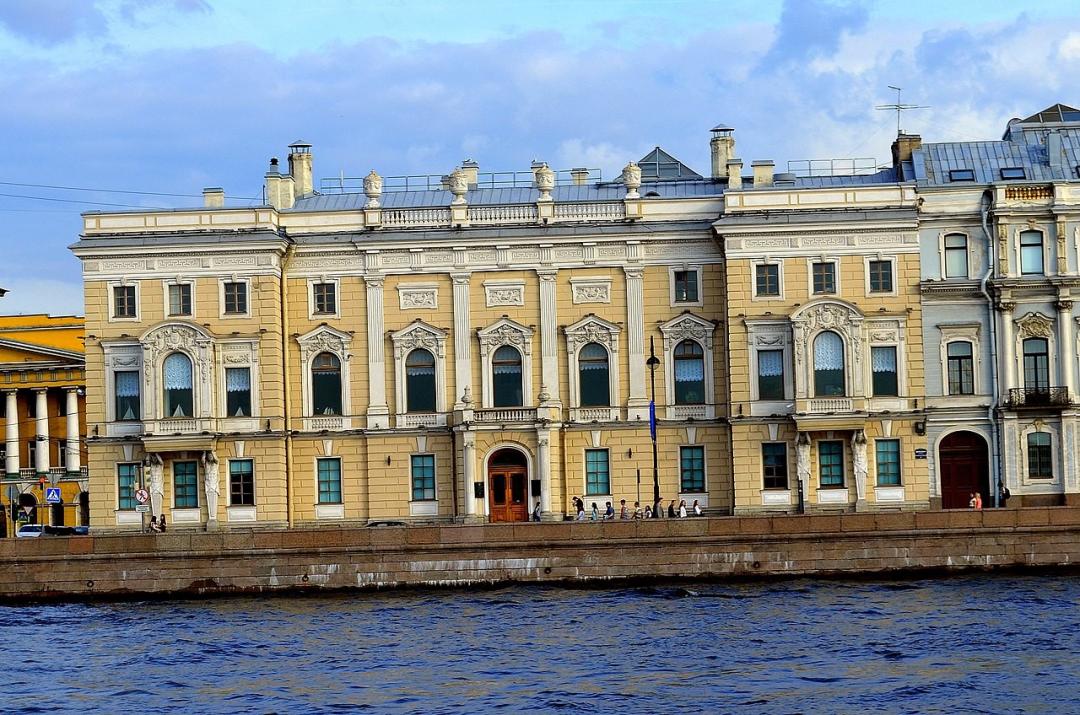
In the 2010s, a series of restoration works took place, during which the Large Dining Hall, Blue Drawing Room, doors, and parquet of the Pompeian Gallery were restored. In 2015, the painting of the house church by Grigory Gagarin was recreated. Due to the irregular shape of the plot, the palace has somewhat asymmetrical outlines. If you face it, the right wing is shorter than the left and is located at a slight angle to the square, as it runs parallel to Voznesensky Prospekt. The main facade is marked by three risalites; the left and right ones are emphasized by strict triangular pediments, while the central one is slightly set forward and topped with an attic with large volutes. The facade decoration is eclectic, combining the characteristic vertical rhythm of classicism and Baroque elements in small sculptural forms. All decorative sculpture was executed by one master — Joseph Karl Gottlieb Herman, a graduate of the Dresden Academy of Arts. In the Mariinsky Palace, Stakenschneider was the first to decorate the facades at the first-floor level with faceted ("diamond") rustication, characteristic of Italian Renaissance palazzi and previously unused in Russia.
The layout of the interior rooms was designed so that service rooms faced Voznesensky Prospekt and Novy Lane, while the living quarters were set deep inside the building, facing quiet inner courtyards. Stakenschneider was the first in the Russian Empire to make an enfilade of halls going inward, not parallel to the main facade. Two enfilades of the private chambers of the grand duchess and the duke were connected to the central corridor system.
Stakenschneider planned to erect large sandstone porticos at the eastern and western pavilions. Maria Nikolaevna suggested replacing them with smaller ones finished with marble and invited V. Moderni for the decoration, but due to the high cost, this idea was abandoned. Stakenschneider presented sketches of the small terrace portico of the southern facade to the emperor; Nicholas I ordered to replace sandstone with plastered brick, and only after long persuasion by the architect and reduction of other construction costs was it allowed to use sandstone. The material was delivered from the Bistrem quarries in the floodplain of the Luga River near Narva.
Work on the decoration began in spring 1841. Stakenschneider involved Fyodor Klages, Alexander Kolman, Alexander Katin, David Jensen, Antonio Vigi, Johann Drollinger, and others in the interior decoration of the palace. Only valuable wood species and expensive marble were used for decoration. The stucco work was done by the artel of Timofey Dylev, I. Yaishnikov, and I. Kosolapov. Furniture was created by renowned masters Vasily Bobkov and Nikolai Tarasov. As with the facades, the architect sought to achieve variety and uniqueness for each room, so eclectic techniques and motifs from different styles, from Renaissance to classicism and Baroque, were used in their decoration. Many decorative elements were personally created by Stakenschneider: for example, his sketches of copper candelabra at the ceremonial staircase have been preserved.
The ceremonial vestibule was decorated with columns made of natural pink Twidi marble, the floors were laid with Metlakh tiles, and the cross vaults were painted with arabesques. The room also had a fireplace made of Siberian green marble. Behind the vestibule was a hall leading to the ceremonial staircase, whose ceiling was painted with gilded ornamentation with the owners' monograms. Along the hall and the frieze of the staircase ran a bas-relief, a copy of Bertel Thorvaldsen's work, the original of which the artist created in 1811–1812 for the Quirinal Palace in Rome. The mold and form were purchased and brought to St. Petersburg by Joseph Herman. In the center of the ceremonial reception room stood Antonio Canova's sculpture "The Three Graces."
Behind the reception hall opened the Rotunda — the central compositional element of the entire palace. The round room with a ceiling height of almost 17 meters was surrounded around the perimeter by a two-tier white marble colonnade and covered by a dome with a skylight. The ceiling was decorated with stucco and gilding, and above the first tier were gilded griffin figures holding a lyre. Among other expressive decorative elements were a parquet floor with a complex pattern, rosewood doors inlaid with mother-of-pearl and ivory.
Behind the Rotunda was the Pompeian (also called Square or Dark) Hall, whose decoration Stakenschneider drew inspiration from his trip to southern Italy, to Vesuvius, as well as from the paintings of the Vatican Palace. Johann Drollinger worked on the painted medallions. Executed in the spirit of ancient frescoes, they contained scenes from the works of Russian literary classics — Pushkin, Derzhavin, Zhukovsky. The Pompeian Gallery was decorated in the same style: its walls and ceiling were adorned with arabesques, and it was illuminated by bronze chandeliers with griffin figures.
The Concert (Dance) Hall was decorated modestly — only the border of the smooth wall panels was decorated with a meander. The hall had a marble fireplace with caryatids, but overall the rest of the decoration sought not to overshadow the frieze painting by Antonio Vigi, the main decorative element of the room. The fresco contained ancient themes about Mars and Venus. This work was Vigi's last creation; he died before receiving his fee.
An interesting object is the ramp located in the western risalite, the area of the former Chernyshov Palace, which at that time had no analogues in the country. It was specially requested by Nicholas I for Maria Nikolaevna, who suffered from joint pain in her legs. The oval-shaped room was illuminated through a glass ceiling. The spiral cast-iron "staircase without steps" was covered with asphalt and fenced with cast-iron railings with redwood handrails.
Stakenschneider's personal style was especially evident in the interior of the living room, which was later turned into a library. Decorated with quadrangular pylons with abundant gold ornamentation, it was also adorned with many medallions, stucco, colorful painting of the frieze and ceiling. Another of Stakenschneider's "special successes" is called the palace boudoir, which imitated an elegant jewelry box and amazed contemporaries with its luxury. The boudoir walls were covered with silk and decorated with wooden frames, mirrors, painted panels; the ceiling was decorated with ornamentation and a round mirror, a porcelain fireplace was installed, and stucco and gilding were abundantly used.
Currently, the Mariinsky Palace houses the Legislative Assembly of St. Petersburg. At the same time, various conferences, symposiums, congresses of different levels are often held in the historic interiors; exhibitions, concerts, and solemn ceremonies are organized.
Sources:
https://ru.wikipedia.org/wiki/Mariinsky_Palace_(Saint_Petersburg)
https://xn--c1acndtdamdoc1ib.xn--p1ai/kuda-shodit/mesta/mariinskiy-dvorets/


Written by Jermaine
Discuss this with the author and others
No comments yet. Be the first to start the conversation.