

The documented history of the house begins in 1713, when on the future embankment, the Englishman Osip Nai, a well-known shipbuilder working at the Admiralty shipyards, bought a plot (12 by 43 sazhen) from Colonel Nikon Savenkov. Nai apparently built a wooden or clay house for himself but refused to erect stone chambers as required by the imperial decree in 1732. As a result, in the same year, the property was transferred to the Life Guards Captain Sergey Avtonomovich Golovin, son of a famous Peter the Great’s stolnik, who by 1738 had built the chambers.
In 1766, the house on the embankment changed owners, becoming the property of Second Major Alexander Grigorievich Sobakin from an old noble family, and after his death, his son—retired Major Petr Sobakin. In 1776, the building was transferred by deed to the wealthy English merchant William Porter. Since the 1760s, his trading company was one of the largest in St. Petersburg.
After the merchant sold his mansion in 1790 for 35,000 rubles, it changed hands three times in four years. The first owner was the 24-year-old beauty Olga Alexandrovna Zherebtsova, the sister of Platon Zubov, Catherine II’s favorite. At that time, she had already begun a long-term affair with the English ambassador George Whitworth. Both played an important role in preparing the conspiracy against Paul I, which, however, was planned in the neighboring house No. 52, where Zherebtsova later moved.
In 1792, the three-story mansion was acquired by the German merchant Heinrich-Rudolf Lindeman, who two years later resold it to the major negotiator Johann Christoph Bergin, son of a Narva shoemaker, who owned the house until 1815.
Bergin expanded the mansion on the embankment by three axes by acquiring part of the building from the left neighbor in 1796, after which the house had 28 rooms. Not content with this, the merchant, who became a court banker, bought another house at auction four years later, facing Galernaya Street and the Novo-Admiralty Canal. Apparently, during this period, the facade on the embankment acquired a new Empire style appearance. After Bergin, the owner of the three-story mansion became the former lady-in-waiting Princess Tatyana Vasilyevna Yusupova, wife of the famous philanthropist Yusupov, from whom she quickly divorced. The princess lived here until early 1823 (later she owned the Yusupov Palace on the Moika), after which the sold house was occupied by the Imeretian queen Anna Matveevna, widow of King David, with her son Konstantin. The royal family was poor and immediately began renting out the two upper floors.
In 1830, due to an overdue mortgage, the house on the embankment was acquired at auction by the Chief of the Main Naval Staff, His Serene Highness Prince Alexander Sergeyevich Menshikov. Architect Glinka (who had just completed the construction of the Rumyantsev Museum on the English Embankment, 44) undertook a complete reconstruction and re-planning of the house, carried out in 1831–1832. The bel étage housed the prince’s quarters: a marble study, library, blue and green drawing rooms, a round hall, and a dining room decorated with columns; the first floor contained the rooms of his wife, Ekaterina Sergeyevna. During the reconstruction, new walls, doors, and windows were made, and a water supply was installed from the Neva. "Old silk wallpapers with frames were removed from the walls"—the paper hangers Sheffer and Bogdanov replaced them with moiré and grosgrain. Merchant Babkov provided furniture made of Karelian birch and mahogany, Gambs supplied mahogany chairs and a "taffeta-upholstered Gothic-style partition." A bronze chandelier and girandoles were brought from Geren’s shop; a "two-branched lamp on a mahogany tripod with a bronze cap" was purchased from lamp master Kitner; carpets were bought in an English store. All works cost the treasury 166,500 rubles. In 1833, Menshikov was awarded the rank of admiral, although his military feats were on land—he participated in all major battles of the war against Napoleon and was awarded the Order of St. Anna, 2nd class, and a gold sword for bravery. In the Russo-Turkish War of 1828–1829, the prince distinguished himself in the capture of the fortresses of Anapa and Varna, where he was seriously wounded. After that, his life was mainly spent in the mansion on the English Embankment, dealing with naval affairs entrusted to him by Nicholas I, of whom he was a favorite. When the Crimean War began, Admiral and General-Adjutant Menshikov was appointed commander of the active army and fleet. According to most contemporaries, this command was unsuccessful, and in February 1855, after several defeats, the prince was relieved of his post and resigned a year later under heavy criticism. However, modern historians assess Menshikov’s abilities as a commander less negatively, believing that sometimes objective circumstances were stronger than him. After the prince’s death, the mansion with the house on Galernaya and the canal was inherited by his son—combat general Vladimir Alexandrovich, on whom the family line ended in the male line.
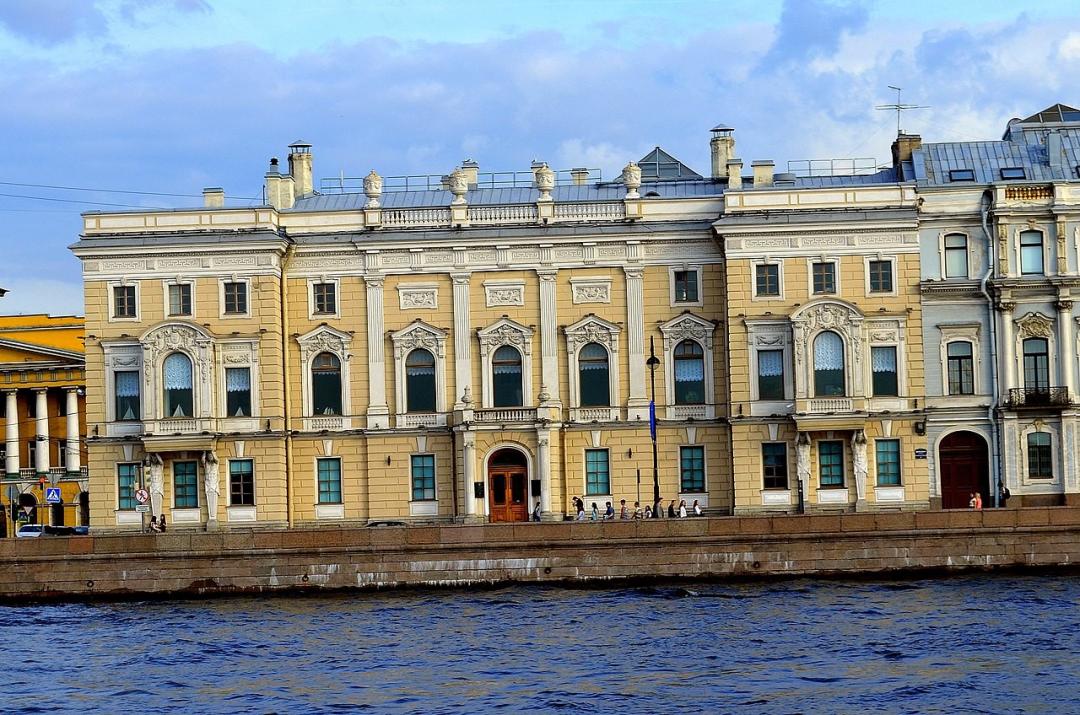
"Recently, we had the opportunity to see Prince Menshikov’s house on the English Embankment, thoroughly rebuilt by Professor of Architecture Rahau. The facade, in the style of the French Renaissance of the Louis XIV era, is modest, calm, and extremely elegant. The hanging balcony, main entrance, porch, and all details are crafted with love, great talent, and deep artistic knowledge. Inside, the rooms are almost all decorated in the style of Louis XV; under these circumstances, one might expect some monotony—but in reality, nothing of the sort is noticeable—Mr. Rahau skillfully and cleverly used architectural motifs. Especially remarkable are the ballroom and the grand staircase. On the first floor, i.e., the prince’s half, the study is decorated in the Moorish style. Mr. Rahau is a great connoisseur of styles in general, but the Moorish style is his forte, and therefore the study mentioned turned out to be the best part of the entire house; one does not know what to admire more—the richness of the decoration or the beauty of architectural lines, motifs, ornaments, and harmony in the combination of colors. The dining room is composed in the Russian style. It is especially notable for a chandelier made of oxidized bronze resembling iron. It is a pity that such high works of art are accessible to so few for viewing. Even more regrettable is that the publication of drawings and descriptions of such works finds no entrepreneurs in our country," wrote the magazine "Zodchiy" in 1874.
On May 4, 1896, the heirs sold the property to the Cabinet of His Imperial Majesty for 470,000 rubles.
During Vladimir Alexandrovich’s time, the mansion was rebuilt from 1870 to 1874 by Academician Rahau in the fashionable eclectic style. "The facade is modest, calm, and extremely elegant," wrote the magazine "Zodchiy." "...Inside, the rooms are almost all decorated in the style of Louis XV... especially remarkable are the ballroom and the grand staircase." The latter interiors have been preserved. The ballroom (now a theater hall) is decorated with choir balconies, six yellow stucco columns, and stucco figures of sileni. The marble curved staircase with a skylight is adorned on the second floor with atlantes and gilded stucco. The dining room was decorated in the Russian style, and the prince’s study—in the Moorish style. Similar decor is present in Rahau’s subsequent work—the merchant Gromov’s mansion on Millionnaya Street, 7.
Menshikov lived for twenty years in the luxurious interiors, which remained untouched for another twenty years until 1911–1913, when court architect Meltzer, a prominent Art Nouveau master, partially remodeled them for the new owner—Grand Duke Mikhail Alexandrovich, the younger brother of Emperor Nicholas II. The remodeling affected the facade, wings, living quarters of the third floor, and part of the bel étage interiors. The right wing was topped with an attic floor from the courtyard side; the entrance from Galernaya was decorated with an arch and pavilion. This is a classical echo, while the overall style is predominantly Art Nouveau. In the right wing, in the first courtyard, a large garage was equipped, as the owner was a great car enthusiast. Mikhail Alexandrovich saw his renovated palace only when World War I began, because in 1912, after a morganatic marriage with the divorced Wulfert, he was forbidden to live in Russia. At the beginning of the war, Mikhail Alexandrovich was pardoned and commanded the Wild Division at the front. He visited the capital only on short stays, mostly staying in his beloved Gatchina, where he was arrested by the Provisional Government. The Bolsheviks transported the grand duke to Perm and executed him in its vicinity.
The Soviet government nationalized the palace and in 1922 transferred it to the All-Russian Society of the Deaf, which still uses it today, carrying out extensive cultural and educational work for its 15,000 members in the city and region.
What can be seen today in the palace from the former decor? Besides the staircase and ballroom, there is the working study with a bay window of Mikhail Alexandrovich. It has wooden panels and a built-in bookcase. In the former dining room, wall paneling, doors, an Art Nouveau mirror, and even old radiators have been preserved. Also surviving are three fireplaces made of white and colored marble, wide sliding doors of Karelian birch, and some curious details, namely: the elevator frame, wrought iron outdoor lanterns, window fittings, etc.
The interiors of the building retain various types of decorative glazing from the late 19th to early 20th century: a glass ceiling with a skylight above the main staircase, 12 stained-glass windows on the 2nd floor along the courtyard facades, a glazed wooden elevator shaft on the service staircase, as well as a furniture set and street lighting lanterns. In total, 24 items have been accounted for.
Above the grand staircase is a light ceiling, in a wooden frame with four panes arranged in four rows. The glazing is double-layered: the bottom glass is clear and smooth, the top is clear smooth and textured. The texture pattern does not correspond to St. Petersburg samples of the early 20th century. A beam (channel) is installed across the opening for hanging a chandelier, with a winch mechanism for raising it. Above the glass ceiling is a room covered with a pitched skylight. It is glazed on a wooden structure. In 2021, it was not possible to inspect the structure; the description is based on photographs by S. V. Vasiliev from 2016.
On the 2nd floor, in rooms along the facades of the first inner courtyard, there are 12 windows with stained-glass fillings. The courtyard is square in plan. In the evening, the windows outlined the contours of the buildings with a patterned band, and street lamps illuminated key points of the courtyard space, thus forming a kind of "interior" of this volume, enclosed by walls and open to the sky.
On the northern facade of the courtyard is a three-part window; the transoms of the middle and right parts are filled with stained-glass panels on a brass profile. On the southern facade of the courtyard, there are five corridor windows, then a wide window on the southeast diagonal wall, belonging to the room with a fireplace. Along the eastern facade are five windows facing the corridor. The glazing of all windows is uniform, made of ribbed square clear glass with horizontal and vertical cuts relative to the ribbing. The window transoms are tilt-open. The frames retain brass window hardware, including sliding vertical bolts with button handles. The glass has losses and chips. The glass is probably of foreign origin; its relief differs from the ribbed glass samples of late 19th–early 20th century St. Petersburg architecture.
On the 2nd floor, there is a double-leaf door between the corridor and the corner room with a fireplace. It is glazed with faceted glass over the entire surface of the leaves.
In the room with a bay window on the 2nd floor of the front building facing the English Embankment, an oak furniture set has been preserved, consisting of four double-leaf glazed cabinets and an open section with shelves. All the glass in the cabinets is faceted.
On the "Private Staircase" of the front building, accessed from the courtyard, there is an elevator shaft spanning three floors with faceted glazing. The shaft is a box made of red or tinted wood, with glazing on the upper part on each floor. The side sections of the shaft are curved—bent glass is used, protected outside by brass overlays. Inside, the wooden elevator cabin and elevator mechanism are visible. The elevator shaft doors on the 2nd and 3rd floors are glazed with faceted glass. On the 1st floor landing, the lower part of the shaft, including the door, is covered with opaque material.
Above the elevator is a technical room. Its door has stained-glass glazing. The description is based on photographs from 2016; in 2021, access to the room was not possible. The door is double-leaf with hinged leaves and a blind transom. The frames are filled entirely with ribbed glass on a brass profile. The leaves contain rectangular glass panes with vertical and horizontal ribbing orientation in a checkerboard pattern. The transom has a pattern of intersecting curved lines along the axis of symmetry. The frames are wooden, painted to resemble mahogany.
In the courtyard are identical street lighting lanterns: four hanging on chains and three wall-mounted. The octagonal lanterns are made of cast iron, the facets filled with "Frost" glass with faceted edges. Each lantern has a hinged door.
The interiors feature stucco decoration and built-in furniture made at Meltzer’s furniture factory—the architect’s father.
Sources:
From the article by V. Antonov "Second Major, Admiral, Grand Duke..." in the newspaper "Saint Petersburg Vedomosti" No. 037 dated 29.02.2008
https://www.citywalls.ru/house793.html


Written by Jermaine
Discuss this with the author and others
No comments yet. Be the first to start the conversation.