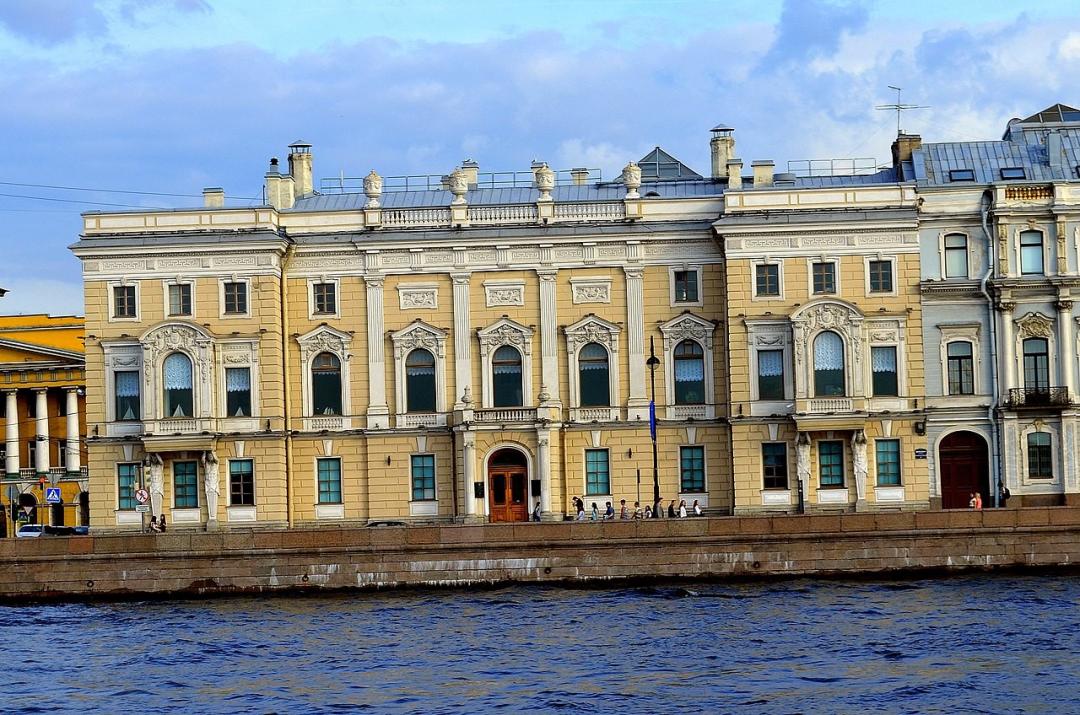
Palace of Grand Duke Alexei Alexandrovich ("House of Music," "Alexeevsky Palace")

Moika River Embankment, 122, Saint Petersburg, Russia, 190121

One of the grand ducal palaces of Saint Petersburg, located on the Moika Embankment. Built by M. E. Mesmakher for Grand Duke Alexei Alexandrovich in 1882–1885. Since February 2006, the building has housed the Saint Petersburg House of Music — an institution whose main goal is the preservation and development of the traditions of classical musical art, as well as the preparation of conservatory students and graduates for international competitions and festivals.


The choice of location for the construction of the palace in the old, traditionally maritime district of Petersburg, near the forest warehouses of New Holland, the barracks of the Guards Fleet Crew, and shipbuilding yards, is connected to the fact that Grand Duke Alexei Alexandrovich headed the Naval Department and was the supreme commander of the Russian fleet. The area was quite densely built-up, but there was a need to create an extensive estate.

Before the land plot was allocated for the construction of the palace on the territory between the Moika River, English Avenue, and Shafirovskaya Street (now Pisareva Street), there were buildings belonging to former owners — the master of ceremonies Saburov, Major General Albrecht, and others. From 1872 to 1882, the mansion was owned by the owner of engineering plants, Isaac Mironovich Malkiel; after I. M. Malkiel’s death, his widow Raisa Yakovlevna sold the mansion. In 1882, the plot was acquired by the Palace Department for the appointed supreme commander of the fleet and naval department, the son of Alexander II — Grand Duke Alexei Alexandrovich.

Already in 1883, architect M. E. Mesmakher began designing the new palace. To save costs and speed up construction, the surviving buildings on the site were incorporated into the new building. At the Grand Duke’s request, a style was chosen that slightly resembled French châteaux. After the Grand Duke’s death, the Alexeevsky Palace was inherited by his brothers — Vladimir and Pavel, as well as his nephew Mikhail Alexandrovich. The new owners rented out the vacant palace and the adjoining garden and greenhouse. For example, the German embassy occupied it for 18 months.


Three years later, the residents of Saint Petersburg were presented with a true architectural masterpiece, embodying elements of different eras and styles. The architectural solution of the Alexeevsky Palace reflected not only the creative signature of its architect Mesmakher but also, to a large extent, the personal taste and inclination of Grand Duke Alexei Alexandrovich towards a comfortable and pleasant life. The Grand Duke wished to live in a mansion reminiscent of the old romantic castles of medieval France in the Loire Valley, but with all the possible comforts typical of the late 19th century. On the grounds of the last estate built in Petersburg, near the palace, there were: a private power station, laundry and kitchen buildings, stables, a house for the retinue, greenhouses, and a private estate garden.


The interweaving of styles in the Alexeevsky Palace was like a journey through countries and eras. Moving from hall to hall, guests found themselves in the atmosphere of medieval times in the English (knightly) Hall, the carefree elegance of the Ballroom, the oriental exoticism of the Chinese Drawing Room. The dining room immerses one in the Baroque era, the Bath is designed in the Pompeian style, the Oak Study with its wood carvings and silver-embossed "Cordovan" leather on the walls returns to the era of the European Renaissance, and the lower dining room resembles the painted terem of old Moscow.

The formal dining room evoked special admiration from guests. Specifically for its unique interior, academic painter Ernst Lipgart created wall panels — 10 genre scenes in the manner of the 17th-century "Little Dutch Masters" — and decorative overdoor compositions depicting cupids with fruits and flowers. It is believed that the artist’s wife posed for some of the paintings, and one of them even features a self-portrait of Lipgart.

All these halls and drawing rooms have conveyed to us the tastes of the last General-Admiral of the Russian Empire.

The design of the Alexeevsky Palace, in its overall compositional concept, sense of style, detailing, and execution of decorative elements of the façade and interiors, is one of the best works of Mesmakher, a brilliant draftsman and outstanding master of mid-19th-century architecture.

After the revolution, the modern House of Music was the House of Pioneers, a driving school, and during the blockade it housed a warehouse; by 2005, the building was in a state of disrepair.

By decision of the Government of the Russian Federation in 2005, the building was transferred to the Saint Petersburg House of Music.

Sources:

https://www.spdm.ru/alekseevskiy-dvorec

https://ru.wikipedia.org/wiki/Palace_of_Grand_Duke_Alexei_Alexandrovich

https://www.citywalls.ru/house792.html


Follow us on social media

More stories from Petersburg: Palaces and Their Fates

The Palace of Dmitry Cantemir (Gromov House)

Millionnaya St., 9, Saint Petersburg, Russia, 191186

A historic building in the center of Saint Petersburg, at the corner of Millionnaya Street and Mramorny Lane.

Yelagin Palace

1st Elagin Bridge, 1, Saint Petersburg, Russia, 197183

What brush, what chisel, Will depict the Yelagin Palace… Attributed to A.S. Pushkin

Marble Palace - Konstantinovsky Palace

Millionnaya St., 5/1, Saint Petersburg, Russia, 191186

It is called the Marble Palace because its decor features thirty-two types of marble from quarries in Karelia, Italy, the Urals, and Altai. The palace was a gift from Catherine II to her favorite, Grigory Orlov. He did not remain in debt and gave her a Persian diamond, the value of which was equal to that of the gifted palace. The diamond was named "Orlov" and was set into the imperial scepter. Since the late 20th century, the palace has housed the Russian Museum.

Palace of Grand Duke Vladimir Alexandrovich (House of Scientists)

Palace Embankment, 26, Saint Petersburg, Russia, 191186

Among the entire "scatter" of mansions on the Palace Embankment, once belonging to members of the imperial family, there is a special diamond with an exquisite architectural cut – the Palace of Grand Duke Vladimir Alexandrovich, brother of Emperor Alexander III and uncle of the last Emperor Nicholas II. During the construction of the palace, the Grand Duke held the position of president of the Academy of Arts, and in 1884 he became the commander-in-chief of the guard and the Petersburg military district. It was he who gave the order to shoot the peaceful demonstration on January 9, 1905, after which he was removed from office. The Diogenes Club from the famous film was located here.

Palace of Grand Duke Mikhail Alexandrovich (House of A. S. Menshikov)

English Embankment, 54, Saint Petersburg, Russia, 199034

One of the grand ducal palaces of Saint Petersburg, located on the English Embankment of the Neva River. The development of this area began in the 18th century; later, the building underwent several major reconstructions and changed its appearance. At the beginning of the 20th century, the palace was renovated to meet the needs of Grand Duke Michael Alexandrovich.

Travel Palace (Small Palace of Peter I)

2 Maksim Gorky Street, Saint Petersburg, Russia, 198515

The Travel Palace (Peter I's Small Palace) is the earliest building in the suburb of Strelna near Petersburg that has survived to this day from the Petrine era. The palace is located not far from the shore of the Gulf of Finland, in the southern part of the Neva Bay, on a low hill left after the retreat of glaciers, surrounded by ravines, near the Strelka River.

Menshikov Palace

Universitetskaya Embankment, 15, Saint Petersburg, Russia, 199034

The palace of the first governor of Petersburg, Alexander Danilovich Menshikov, on Vasilievsky Island is the oldest surviving palace in the city. Under Peter I, all solemn feasts and formal dinners were held here, including the weddings of Tsarevich Alexei with Sophia Charlotte and the future Empress Anna Ioannovna with the Duke of Courland, Friedrich Wilhelm. Before being exiled for embezzlement, His Serene Highness Prince Alexander Danilovich Menshikov built one of the finest palaces in 18th-century Russia.

Naryshkin-Shuvalov Palace (Fabergé Museum)

Fontanka River Embankment, 25, Saint Petersburg, Russia, 191023

A 19th-century architectural monument in Saint Petersburg. It is located at the corner of the Fontanka River Embankment, house 21, and Italian Street, house 39. The building is typical of the era of architectural eclecticism (a combination of elements of late classicism and neo-Renaissance). On November 19, 2013, the Fabergé Museum opened in it.

Mikhailovsky Palace

4 Inzhenernaya St., Saint Petersburg, Russia, 191186

The palace of Grand Duke Mikhail Pavlovich, the fourth son of Paul I and Maria Feodorovna, and the younger brother of Emperors Alexander I and Nicholas I. A historic building in Saint Petersburg, constructed between 1819 and 1825 according to the design of architect K. I. Rossi, located in the city center on a square that was named Mikhailovskaya Square in 1834 (since September 26, 1940 — Arts Square). A monument of late Classicism architecture, or Russian Empire style. Since 1898, the building housed the "Russian Museum of Emperor Alexander III," and since 1917 — the State Russian Museum.

Summer Palace of Peter I

Building A, Saint Petersburg, Russia, 191186

For the construction of his summer residence, Peter I chose a well-established and advantageously located estate on the cape between the Neva and the Nameless Channel (now the Fontanka River), where the property of Swedish Major E. B. von Konow (Konau) was situated – a small house with a farmyard and a garden. In August 1710, by Peter’s order, construction of a stone building began on the site of the former house, following the design of architect Domenico Trezzini. In 1713–1714, work was carried out on the interior and exterior decoration of the building, in which architect and sculptor Andreas Schlüter may have participated.

Mariinsky Palace

Isaakievskaya Square, 6, Saint Petersburg, Russia, 190107

The palace in Saint Petersburg on Isaakiyevskaya Square is named after the daughter of Emperor Nicholas I, Maria, to whom it was intended as a wedding gift on the occasion of her marriage to Duke Maximilian of Leuchtenberg. It was built between 1839 and 1844 according to the design of Andrei Stackenschneider and is considered the architect's finest work. In the 1880s, the palace was sold to the treasury and became the residence of the State Council; in the 1890s, it was renovated and partially rebuilt under the direction of architect Ludwig Peterson. In 1906, under the leadership of Leonty Benois, a separate wing was added for the Large Assembly Hall. Since the late 19th century, alongside the Winter and Tauride Palaces, the Mariinsky has been one of the three "political" palaces of Petersburg. After the February Revolution of 1917, it housed the Provisional Government, and after the October Revolution, it was handed over to the Supreme Council of the National Economy. From 1945, the Leningrad Soviet convened in the palace. During the August Coup of 1991, the Mariinsky became the center of resistance to the State Committee on the State of Emergency (GKChP) in Leningrad. In 1994, after the dissolution of the Leningrad Soviet, the palace was occupied by the Legislative Assembly of Saint Petersburg.

Anichkov Palace is the oldest surviving building on Nevsky Prospect.

Nevsky Ave., 39, Saint Petersburg, Russia, 191023

The name of the palace and the nearby bridge comes from the **Anichkov Palace** and the **Anichkov Bridge** in Saint Petersburg, Russia. Both are named after Mikhail Anichkov, an engineer who supervised the construction of the first wooden bridge at this location in the early 18th century. The palace later took its name from the bridge and the area.

Sheremetev Palace (Fountain House) - Museum of Music

Fontanka River Embankment, 34, Saint Petersburg, Russia, 191014

One of the palaces of the Sheremetev counts in St. Petersburg, named after the Fontanka River on whose bank it stands. Until 1917, the Sheremetev Palace and estate belonged to five generations of the senior (count) branch of the Sheremetev family. Currently, the main building of the palace houses the Museum of Music, which includes a restored enfilade of the ceremonial halls on the second floor. In one of the wings is the Anna Akhmatova Museum in the Fountain House.

Stroganov Palace

Nevsky Ave., 5m, Saint Petersburg, Russia, 191186

Built according to the project of architect Bartolomeo Francesco Rastrelli in 1753–1754 and rebuilt by Andrey Nikiforovich Voronikhin, it is one of the examples of the unique Rastrelli "Baroque-Rocaille style." Currently, it is a branch of the State Russian Museum, to which the building has belonged since 1988.

Novo-Mikhailovsky Palace

Palace Embankment, 18, Saint Petersburg, Russia, 191186

A federal architectural monument, the Grand Duke’s Palace, located in the center of Saint Petersburg at 18 Palace Embankment and 19 Millionnaya Street (Stallmeister Corps). The architect was Andrey Ivanovich Stakenschneider. The palace is considered the third major grand ducal residence built according to the architect’s design. It was constructed between 1857 and 1862 specifically for Grand Duke Mikhail Nikolaevich, son of Emperor Nicholas I. The palace’s construction is linked to the prince’s marriage to Princess Cecilie Auguste of Baden. Since there was already one Mikhailovsky Palace in the city, the residence for Mikhail was decided to be named Novo-Mikhailovsky. Currently, the palace houses several institutions of the Russian Academy of Sciences. The palace is designed in a style defined as early eclecticism, expressed through numerous stylistic references to different eras. Although the palace does not hold active urban planning significance, being just one building among a series of Petersburg palaces and mansions, it stands out noticeably in the cityscape of the area due to its lavish, ornate facade decoration and large scale.

Kamenny Island Palace

Embankment of the Malaya Nevka River, 1, Saint Petersburg, Russia, 197045

The Kamenny Island Palace, built for Paul I, never became his home. His son Alexander I, on the contrary, made it his main residence, where he subsequently made a number of the most momentous decisions for the country. It is also here, according to legend, that the emperor dreamed of Peter I in the form of the "Bronze Horseman."

Yusupov Palace - Institute of Railway Engineers Corps - Petersburg State Transport University

Moskovsky Ave., 9b, Saint Petersburg, Russia, 190068

The estate of Prince Yusupov on the Fontanka River in the mid-18th century was one of the wealthiest in the city. On the plot stood a luxurious Baroque palace, whose layout resembled a widely spread letter H. The building, raised on high cellars, combined a central two-story volume with one-story transverse wings, connected by one-story sections. A trellis fence separated the estate from the river.

Vorontsov Palace

26 Sadovaya St., Building A, Saint Petersburg, Russia, 191023

A palace in the central part of Saint Petersburg, located on Sadovaya Street opposite Gostiny Dvor. It was built according to the project of architect Francesco Rastrelli between 1749 and 1758 for Chancellor Mikhail Vorontsov. The palace was distinguished by its rich, elegant facade decoration and lavish interior finishes, featuring more than 50 ceremonial halls and rooms. Due to the colossal expenses on construction, just a few years after completion, Vorontsov was forced to sell the palace to the treasury for 217,000 rubles. Under Paul I, the palace was given to the Maltese Order, during which the Maltese Chapel was built based on a design by Giacomo Quarenghi. In 1810, Emperor Alexander I placed the Page Corps in the palace, and the building belonged to it until the revolution. In the 20th century, the palace complex was occupied by various military schools. In 2019, the building was taken over by the Third Cassation Court of General Jurisdiction. In 2021, under the guise of major repairs, the institution initiated a tender for the demolition of three pre-revolutionary wings on the palace grounds.

Tauride Palace

Shpalernaya St., 47, Saint Petersburg, Russia, 191015

One of the most recognizable landmarks of Petersburg, it served as a residence for famous historical figures, the Provisional Government, and even as the barracks for the Horse Guards Regiment. Initially, the palace was called the Horse Guards House because it was located in the settlement of the Horse Guards Regiment, in which Potemkin once served. Its current name, the Tauride Palace, was given after Potemkin's death by order of Catherine II. This was done to commemorate the annexation of Taurida (Crimea) in 1787, which was largely made possible thanks to Potemkin himself. In 1918, after the assassination of the famous revolutionary Moisei Uritsky, the palace was renamed in his honor. However, this name did not catch on, and quite soon the historical name Tauride was restored.

Bobrinsky Palace on Galernaya Street

Galernaya St., 58-60, Saint Petersburg, Russia, 190121

This is one of the best and most cohesive examples of noble architecture from the late 18th century, built by the architect Luigi Rusca. An impressive facade faces the street, resembling an attic adorned with figures, a spacious courtyard, and gates with a grille. But the facade facing the garden is even more beautiful. Here, there is a portico with a pediment and two semicircular projections, treated on the outside with columns. The projections are topped with domes. Along the Admiralty Canal runs a grille, ending with a charming gazebo at the corner. In the other direction, there is a stone fence with busts. Old trees with their dark trunks blend perfectly into a single cohesive landscape with the architecture.