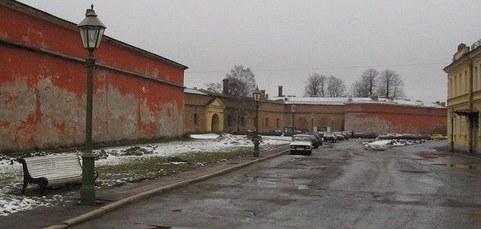
Vasilyevskaya Curtain
ter. Peter and Paul Fortress, 6, Saint Petersburg, Russia, 197198
Great Architects: Domenico Trezzini Jermaine
 For Browsing
Architect Domenico Trezzini was born in Switzerland, studied in Italy, and worked in Denmark. However, he gained recognition in Russia, where he became famous as the first and chief architect of St. Petersburg and the founder of early Russian Baroque. Domenico Andrea (according to other sources — Domenico Giovanni) Trezzini was born in 1670 into a family of modest Italian nobility living in the Swiss town of Astano. Almost nothing is known about his early years. He studied in Venice — at that time one of the centers of European artistic education, alongside Rome. During his studies, Trezzini witnessed the flourishing of Venetian art, which was based on the traditions and values of the Renaissance. This had a noticeable influence on the young architect’s style. It is known that after his studies, Domenico Trezzini returned to his hometown, where he married Giovanna di Veitis. However, he soon had to leave: he needed to support his family, and in search of work, Trezzini went to Denmark. Trezzini managed to get a job as a fortification engineer and eventually became the “architectural chief in fortress construction,” but this did not bring him the desired income. Russian envoy at the Danish court, Andrey Izmaylov, took notice of Domenico Trezzini’s work. On April 1, 1703, he signed a contract with “Mr. Tretzin,” which contained the following terms: “For his artistry, accomplished skill, I promise him 20 chervonets per month as salary and to pay it to him throughout the year, starting from the 1st of April 1703, and to pay him fully for each month, in proper and current money, at the same rate as abroad, that is, at the rate of 6 Lübeck marks per chervonets, which is also the proper rate in Danish lands. To the named Tretzin, moreover, I promise, as he has clearly shown his skill and artistry, to increase his salary.” The offered salary was absolutely fabulous for those times. Trezzini agreed without hesitation and soon found himself in St. Petersburg. One of the architect’s first Russian projects was the Kronshlot fort. It has not survived to this day, but sketches remain that allow us to reconstruct its appearance. The defensive structure was an octagonal tower and resembled a traditional Russian bell tower in outline, but was more squat and wide. Just two months after the completion of Kronshlot, it had to endure its first “combat test”: a Swedish squadron attacked the fort. The fortress withstood the assault without significant damage. In 1706, Peter I planned to rebuild the Peter and Paul Fortress: it was to be transformed from an earthen fortification into a stone one. The work was extensive. It was necessary to timely procure and deliver a huge amount of building materials — timber, bricks, lime — and find enough workers. To manage the construction, Peter established the Office of Urban Affairs. Its head was Ulyan Senyavin, and Domenico Trezzini (known in Russian as Andrey Yakimovich Trezin) was appointed his chief assistant. Just two years later, the construction of stone powder magazines for the renewed fortress was completed, and the building of soldiers’ barracks and bastions began. The fortress gates were initially wooden. However, later a special decree by the tsar was issued — “not to build wooden structures along the Great Neva and its large channels” — and the gates were replaced with stone ones. By 1716, the fortress was completed. Domenico Trezzini began the construction of the Peter and Paul Cathedral within its territory. The highest point of the architectural ensemble became the Peter and Paul bell tower with its famous needle-like spire. Trezzini himself considered the fortress construction his main work and until the end of his life began the list of his projects with the phrase “The foremost of the main works — the fortifications of St. Petersburg.” The Peter and Paul Fortress was far from Trezzini’s only work in St. Petersburg. When it was completed, the overall architectural appearance of the new capital came under the jurisdiction of the Office of Urban Affairs. Thus, Trezzini became the chief architect of St. Petersburg. From 1710 to 1714, he worked on the design of Peter I’s Summer Palace. The residence was quite modest for those times — exactly in line with the tastes of the first Russian emperor: it had only 14 rooms and 2 kitchens. The building’s facade was decorated with allegorical bas-reliefs on the theme of the events of the Northern War. In 1715, Trezzini created the project for the Alexander Nevsky Lavra — a symmetrical architectural ensemble located between the Neva and the Chyornaya Rechka. The monastery was built until 1723, and all this time it “grew” with workers’ settlements, gardens, and vegetable plots. In 1717, Peter I ordered Domenico Trezzini to build a “model house for the wealthy” — a city stone mansion. These were to replace the unaesthetic buildings that had been erected initially for the residents of the young city. The architect intended to live in the new house — beautiful and comfortable — and set an example for others. The emperor himself chose the construction site: the corner of the Twelfth Line of Vasilievsky Island. Trezzini fulfilled the emperor’s order, but for unknown reasons, he did not live in the mansion himself, and Peter transferred the building to Baron Osterman. The “Trezzini House” in modern St. Petersburg refers to another building located on the University Embankment. This house was also designed by the architect himself, and he later lived there with his family, students, personal scribe, and servants. Another famous St. Petersburg building by Domenico Trezzini is the House of the Twelve Collegia. It was constructed from 1722 to 1742. At that time, it housed the highest state administrative bodies. After the collegia were disbanded, the building was transferred to the Main Pedagogical Institute, and today it belongs to St. Petersburg State University. Among other things, Domenico Trezzini planned the architectural appearance of most of Vasilievsky Island as it has been preserved to this day: strict geometric lines in the street layout, restrained luxury in facade decoration. It was Trezzini who became the founder of the style known as Petrine Baroque. Domenico Trezzini died in 1734 and was buried in the cemetery of the Sampsonievsky Cathedral in St. Petersburg. His grave has not survived to this day. A square in the Vasileostrovsky district of St. Petersburg is named after Trezzini, where a monument to the great architect stands.
Jermaine Loading stories…
ter. Peter and Paul Fortress, 6, Saint Petersburg, Russia, 197198
Great Architects: Domenico Trezzini Jermaine 
ter. Peter and Paul Fortress, 9, Saint Petersburg, Russia, 197101
Great Architects: Domenico Trezzini Jermaine 
Peter and Paul Fortress, Tsar's Bastion, Saint Petersburg, Russia, 191186
Great Architects: Domenico Trezzini Jermaine 
Territory. Peter and Paul Fortress, 6, Saint Petersburg, Russia, 197198
Great Architects: Domenico Trezzini Jermaine 
X82C+GP Petrogradsky District, Saint Petersburg, Russia
Great Architects: Domenico Trezzini Jermaine 
terr. Peter and Paul Fortress, 15, Saint Petersburg, Russia, 197198
Great Architects: Domenico Trezzini Jermaine 
ter. Peter and Paul Fortress, 10, Saint Petersburg, Russia, 197101
Great Architects: Domenico Trezzini Jermaine 
Peter and Paul Fortress, Saint Petersburg, Russia, 191186
Great Architects: Domenico Trezzini Jermaine 
Peter and Paul Fortress, Saint Petersburg, Russia, 191186
Great Architects: Domenico Trezzini Jermaine 
Peter and Paul Fortress, Saint Petersburg, Russia, 191186
Great Architects: Domenico Trezzini Jermaine 
Peter and Paul Fortress, Nikolskaya Curtain Wall, Saint Petersburg, Russia, 197101
Great Architects: Domenico Trezzini Jermaine 
Territory. Peter and Paul Fortress, 11, Saint Petersburg, Russia, 197101
Great Architects: Domenico Trezzini Jermaine 


Anichkov Bridge, Nevsky Prospect, Saint Petersburg, Russia, 191025
Great Architects: Domenico Trezzini Jermaine 
Universitetskaya Embankment, 7/9, Saint Petersburg, Russia, 199034
Great Architects: Domenico Trezzini Jermaine 


Building 6, letter M, Liflyandskaya St., Saint Petersburg, Russia, 190020
Great Architects: Domenico Trezzini Jermaine