

According to historical records, Kamenny Island repeatedly changed hands from one owner to another. Initially, Peter I granted it to his third cousin once removed — Chancellor Gavriil Ivanovich Golovkin. The island was inherited by his eldest son Alexander. Alexander Gavrilovich Golovkin sold it to the wife of Chancellor Alexei Petrovich Bestuzhev-Ryumin. The chancellor’s son, Peter, ceded it to the treasury. In 1765, Catherine II gifted Kamenny Island to her son Pavel Petrovich.

Construction of the Kamenny Island Palace began in spring 1776 based on a project by an unknown author on the site of the wooden palace of A. P. Bestuzhev-Ryumin, the former owner of the island. Supervision of the work was carried out by architect Y. M. Felten. In 1777, work was interrupted due to flooding, after which Felten was replaced by Giacomo Quarenghi.

The construction of the building’s main body was completed in 1780, and the decorative interior finishing continued until 1782. However, already on January 18, 1780, a lavish reception in honor of the empress was held in the palace’s orangery.
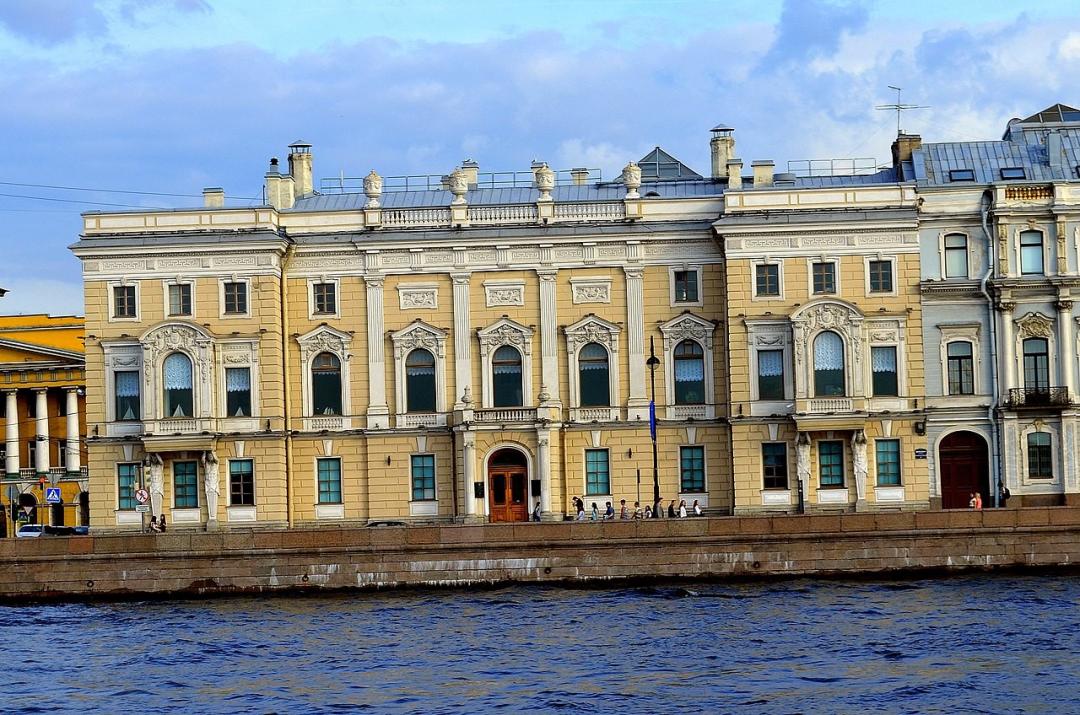
The palace is an outstanding monument of Classicism and is shaped in the plan like an elongated letter “P” with a central building and wings, designed by Giuseppe Quarenghi, set at right angles to it.

One of the palace’s facades, facing the parade courtyard and palace garden, is decorated with a six-column portico with a Tuscan order pediment. A staircase made of Finnish granite leads to the main entrance. In the center of the facade facing the Neva River is an eight-column portico topped with an attic. The central building housed the Antechamber, the Grand Hall, the Gallery, the Marine Salon, the Picture Hall, and the Cabinet. One wing contained living quarters, and the other housed the palace theater.
For the Kamenny Island Palace, through Prince N. B. Yusupov, orders for paintings were made to the famous “painter of ruins” G. Robert and the equally renowned marine artist K.-J. Verne, known for his “Storms” and “Shipwrecks.” The fate of this commission is known from a letter from Verne to Prince N. B. Yusupov (January 1784), which stated: “Mr. Robert assured me that you told him that in the house of Her Imperial Highness there are three salons that must be decorated with paintings: one hall — ‘landscapes’ by Mr. Hackert, another hall — ‘architecture’ by Mr. Robert, and the last — ‘marine views,’ executed by me.”

The three salons of the Kamenny Island Palace are the two-story Grand Hall with rounded corners, to the east of which adjoined the Sofa or Crimson Drawing Room (with a rounded wall), and to the west — the rectangular Landscape Salon. Later, the same correspondent was informed by G. Robert: “Meanwhile, I have begun working on the largest ones, one of which depicts a fire in the city of Rome, seen from a gallery with columns, on which the reflection of the fire fell. Another painting depicts the most remarkable architectural monuments of Languedoc and Provence. Two other paintings, although only just begun, have all their studies and figures drawn from life and represent — one motifs from the life of Rome, the other what we have most remarkable in the architecture of Paris.”
Robert was particularly concerned with two panels that were to be placed on the rounded corners of the Grand Hall of the Kamenny Island Palace. “Therefore,” the artist wrote to Prince Yusupov, “so as not to make the slightest mistake in measurements, I made a reduced copy of the plan (of the rooms), which I have the honor to send you so that the measurements can be checked on site. This is very important for the paintings so that they can be placed without cropping when they arrive.” This copy was made by Robert from a drawing provided by Küchelbecker. All works commissioned from Robert and Verne were completed and delivered to Russia, but not to Kamenny Island, rather to the Gatchina Palace, as the Grand Duke decided to change the decoration of the palace’s ceremonial rooms on the island: the Grand Hall was decorated with mirrors and caryatids, crimson tapestries appeared on the walls of the Sofa Room, and only the Landscape Salon was used according to the original plan until 1917.
In 1797, the palace was prepared to accommodate the deposed Polish king Stanisław August Poniatowski. Architect V. Brenna was involved in the interior decoration. The Marine Salon was converted into the Crimson Drawing Room, the Grand Hall into the Mirror Hall, and frescoes depicting views of Rome appeared in the Antechamber, executed by V. Brenna himself together with F. Labensky based on engravings by Piranesi.

After Alexander I ascended the throne in 1801, the palace became one of his favorite residences. During the early reign of Alexander Pavlovich, the “Secret Committee” gathered in the palace. It was also here on August 6, 1812, that the emperor entrusted command of the Russian army to M. Kutuzov.
From 1808 to 1811, under architect L. Ruska’s project, a third floor with Alexander I’s study was added above the second floor of the residential wing, finished in 1824 according to V. P. Stasov’s design. At the same time, under the project of Thomas de Thomon, garden master F. F. Limin redesigned the garden, transforming it from a landscape to a formal style.
In the 1820s, many palace rooms were repainted by decorator artist J.-B. Scotty. From 1824 to 1828, architect Z. F. Dildin rebuilt the theater wing.
After Alexander I, the palace was owned by Grand Duke Mikhail Pavlovich and his wife Elena Pavlovna. From 1834 to 1836, A. S. Pushkin was their guest here. From 1852 to 1854, A. Rubinstein lived here. In 1845, architect A. I. Shtakenshneider added a closed terrace to the Neva facade of the palace, arranged a Music Salon in place of the Crimson Drawing Room, and replaced the palace’s plumbing system.
The daughter of Mikhail Pavlovich and Elena Pavlovna, Ekaterina Mikhailovna, married the German Duke Georg Mecklenburg-Strelitz, who served in the Russian army as a general, and their daughter Elena Georgievna of Saxe-Altenburg inherited the Kamenny Island Palace. She was musically gifted, became the last chairperson of the Imperial Russian Musical Society, and organized high-level musical evenings at the palace.
During World War I, a hospital for lower ranks was opened on the first floor of the Kamenny Island Palace. Funds for the medical facility were provided by Princess Saxe-Altenburg.
The palace still preserves two ceremonial halls from the Pavlovian era with frescoes depicting views of Rome based on Piranesi’s engravings, the private rooms of the grand ducal couple, and two ceremonial drawing rooms.
The palace garden appeared on the site of A. P. Bestuzhev-Ryumin’s garden simultaneously with the construction of the Kamenny Island Palace. The redesign was carried out by the artist and architect of Grand Duke Pavel Petrovich, F. Viollet. Oval and octagonal flower beds (in the style of Dutch gardens), a central alley, and distant parts of the garden in landscape style appeared around the palace. From 1810, architect J. Thomas de Thomon worked on the garden’s improvement, developing Viollet’s ideas.
Between 1776 and 1778, the Parade Gates appeared at the palace entrance, the Church Gates at the end of the main alley, and the Marble Gates on the embankment side, which were moved in 1810 to the 1st Kamenny Island Bridge and in 1956 to Pavlovsky Park.
Within the palace complex were the Invalid House (architect Ivan Kreber, completely rebuilt in 1979 into a sports facility), the Kitchen Building (1785), the Utility and Wood Yards, a stone stable, a riding hall, a guardhouse (more information here: https://reveal.world/story/gauptvahta-kamennoostrovskogo-dvortsa), and the gardener’s house. According to L. Ruska’s project, from 1809 to 1811, the Large Stone Greenhouses were built, with decorative painting executed by the outstanding decorator P. Gonzago in 1813.
In 1917, after the revolution, the Kamenny Island Palace was nationalized. Precise information about the building’s use in the 1920s and 1930s is lacking. However, according to some archival data, from 1920 to 1924, the authorities housed the first Petrograd colony for homeless children named after Lunacharsky here.
During the early Soviet period, the palace gradually lost its historic furniture, marble fireplace details, and decorative door elements. At the same time, many valuable trees in the palace garden died.
During the Great Patriotic War, the building housed a hospital and a blockade hospital. In the post-war years, restoration work began on the decorative paintings of the palace’s antechamber, which had been painted over with oil paint in 1935. The caryatids and bas-reliefs in medallions in the Grand (Mirror) Hall were also restored at that time.
In Soviet times, the palace housed a sanatorium of the Leningrad Military District. As of 2007, its official name was the Federal State Institution “Leningrad Military Sanatorium of the Air Force.” Annually, about 2,500 military personnel were treated and rested here. The sanatorium, located in the very center of Leningrad, had an excellent scientific-consultative and medical base; servicemen arriving from remote regions received necessary medical care. Newspapers of the time wrote — “thousands of military pilots come here from all over the country not only to improve their health but also to see the famous city.” Officers from the farthest corners of the USSR, and later Russia, had the opportunity to visit the northern capital with their entire families.
The restoration of the palace, started in 2008, dragged on for many years. Media reports appeared about plans to turn the palace into a reception house or a residence for the city government and its head, similar to other residences on the same Kamenny Island, but a more socially useful function was realized: on December 14, 2015, the “Academy of Talents” of St. Petersburg — a budget institution for additional extracurricular education for schoolchildren, organized by the city authorities and announced in March of the same year — was presented.
Sources:
https://ru.wikipedia.org/wiki/Kamenny_Island_Palace
http://www.nasledie-rus.ru/podshivka/6619.php
https://www.citywalls.ru/house9930.html


Written by Jermaine
Discuss this with the author and others
No comments yet. Be the first to start the conversation.