

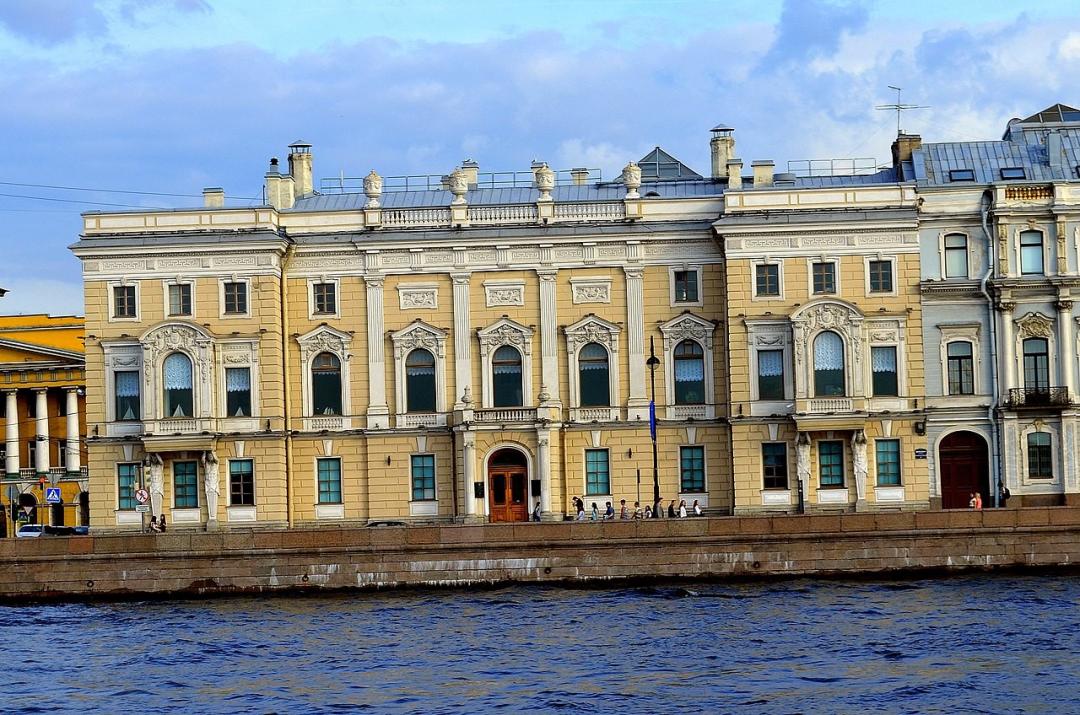
Among the whole "scatter" of mansions on the Palace Embankment, once belonging to members of the imperial family, there is a special diamond with exquisite architectural cutting – the Palace of Grand Duke Vladimir Alexandrovich, brother of Emperor Alexander III and uncle of the last Emperor Nicholas II. During the construction of the palace, the Grand Duke held the post of president of the Academy of Arts, and in 1884 he became the commander-in-chief of the Guards and the Petersburg Military District. It was he who gave the order to shoot the peaceful demonstration on January 9, 1905, after which he was removed from office.
Although it is not a standalone building, but only one of the bright links in the linear urban development chain stretching along the granite shore of the Neva, it is easily recognizable thanks to its special conceptual style.
Traditions in general, and especially if they have a dynastic origin, help to better understand the Russian reality of the 19th century. Nicholas I introduced an unwritten rule to erect grand ducal residences in St. Petersburg in the form of luxurious palaces for imperial descendants upon reaching the age of 20. Vladimir – the youngest son of Emperor Alexander II – was no exception.
Since by that time there was no free land left on the Palace Embankment suitable for building a mansion befitting the rank of a grand duke, it was decided to build it on a historic site. Already under Peter the Great, the first officially recognized owner of this plot was Rear Admiral of the rowing fleet Botsis. In the first quarter of the 18th century, the Musin-Pushkin house was located here; later, after a series of "temporary" owners, the territory passed into the possession of Prince Volkonsky. The general-intendant began erecting a new house but was soon forced to move to the Mikhailovsky Palace after his retirement.
In 1807, at the request of Alexander I, the building was transferred to the French embassy, which remained there until 1839. During the war with Napoleon, this place became popular with Russian cuirassiers, who made bets and tried to break the bust of the French emperor standing on the windowsill of the first floor with a skillful stone throw while galloping.
From 1839 to 1862, the building belonged to the Hofintendant Office under the Ministry of the Imperial Court and Domains. After repairs, it was briefly used as a Reserve Palace for receiving imperial guests. Then a company of palace grenadiers was stationed here.
Originally, Alexander II planned to build palaces on this land plot for both sons – the heir Vladimir and Alexander. But circumstances turned out so that the entire area was given for the construction of the grand duke’s palace.
The project by architect Alexander Rezanov, author of the Moscow Cathedral of Christ the Savior, won the competition in 1864.
In 1867, the walls of the previous buildings began to be dismantled, but later the foundation and some structural elements were partially preserved and used in the construction of the new palace. As architect Shreter recalled later, "cheaper, stronger, and more honest... was rarely built in Russia." The main work was completed by the summer of 1873, but the building was consecrated only on August 10, 1874. The date was chosen deliberately: just six days later, the grand duke married Princess Mecklenburg-Schwerin.

The palace is a complex of three buildings – the main four-story building faces the Neva, the service wing called the "hofmeister wing" faces Millionnaya Street, and in the middle of the large courtyard is the stable building. The wings are located around the entire perimeter of the courtyard. The construction involved Rezanov’s students – Shreter and Kitner.

The main facade facing the Neva is done in the style of Florentine Renaissance. Rusticated walls are pierced by arched windows. The facade is devoid of decorations. The projecting portico is clad with Bremen sandstone. Bronze griffins are located at the corners of the balcony.
The interiors were executed in various styles – Renaissance, Rococo, Russian, Gothic. As contemporaries of the Grand Duke noted, despite this diversity of styles, the interior decoration of the palace was harmonious, and the luxurious furnishings did not seem excessive.
Externally, the mansion resembles the Marble Palace in St. Petersburg: it has the same eclectic style, the aura of a Florentine palazzo of the Renaissance era. One of the architectural accents enhancing this perception is the arched Venetian windows.
A distinctive feature of the palace facade is the prominent forward entrance group and the abundance of coats of arms. Here are the coats of arms of:
• the Kingdom of Kazan;
• the Kingdom of Poland;
• the Kingdom of Tauric Chersonesus;
• the Grand Duchy of Kiev;
• the Grand Duchy of Vladimir;
• the Grand Duchy of Finland;
• the Grand Duchy of Georgia;
• the Kingdom of Siberia and the Kingdom of Astrakhan;
• the family coat of arms of Vladimir Alexandrovich;
• the family coat of arms and monogram of Maria Pavlovna.
The palace’s ceremonial rooms are decorated in various styles. The interior finishing work was carried out in 1870-1872. The grand staircase is ornate, with the lower part of the walls finished with colored artificial marble, and the upper part decorated with stucco and sculpture on a golden background. The painted ceiling of the staircase ("Genius of the Arts on the Banks of the Neva") was created by artist V. P. Vereshchagin.
The luxurious furnishings of the palace consisted of almost 350 rooms decorated in different styles, and stables for 36 horses. The first floor was occupied by the prince, from where the grand staircase led to the second floor, the residence of Princess Maria Pavlovna. The Crimson Drawing Room, having the largest area, contrasted with the neighboring drawing room decorated in the style of the Louis XVI era with its Italian finish. The small dining room, with its strict English Gothic decor, complemented the variety of interior solutions. The third floor housed rooms for children and servants. Above them was the house church of the Annunciation of the Blessed Virgin Mary.
The mansion was equipped with all the technical innovations of the time. It had a telephone, elevator, ventilation with heating and humidification, electricity, and water heating.
The Grand Duke was considered a passionate admirer of painting, so the house housed more than 60 canvases by great Russian artists: Repin, Surikov, Aivazovsky, Kramskoi, and others. They stood alongside decorative bronze elements and exquisite furniture purchased in France and Germany through the efforts of academicians Kitner and Shreter.
After the October Revolution, medical and military institutions were housed in the palace until 1920, after which a commission responsible for improving the living conditions of scientists in Petrograd moved into the building. This is how the modern name "House of Scientists" arose. Today, various seminars are held here, and scientific sections operate.
And today, in the "House of Scientists" in St. Petersburg, classical music by famous composers sounds, giving all visitors a wonderful atmosphere of former chic and aristocracy. Enjoy masterpieces of music together with the Russian Musical Seasons.
Since January 31, 1920, the building has housed the Petrograd Commission for the Improvement of the Living Conditions of Science Representatives, headed by Maxim Gorky. Since then, the mansion has been home to the House of Scientists, thanks to whose efforts it has been beautifully preserved – in terms of interior preservation, this palace is unique in St. Petersburg. The first scientific intelligentsia club in the USSR, "the atmosphere there is the most calming."

In the film "The Adventures of Sherlock Holmes," in the episode "The King of Blackmail," this luxurious building turns into the "Diogenes" club, where visitors do not speak to each other.

In the film, you can see Holmes and Watson ascending the marble staircase of the building’s main entrance, created by Maximilian Messmacher. On the way to Mycroft’s office, Holmes and Watson first pass through the Crimson Drawing Room (if they had not turned left into the side door but gone straight, they would have found themselves in Lady Huxley’s chambers, from whom the antagonist Milverton was extorting money).
Sources:
https://peterburg.center/maps/dvorec-velikogo-knyazya-vladimira-aleksandrovicha.html
https://xn--c1acndtdamdoc1ib.xn--p1ai/kuda-shodit/mesta/dvorets-velikogo-knyazya-vladimira-aleksandrovicha/
https://ru.wikipedia.org/wiki/Владимирский_дворец
https://www.citywalls.ru/house511.html
https://www.221b.ru/geo/3-diogen.htm
https://www.liveinternet.ru/community/petersburg/post94765471


Written by Jermaine
Discuss this with the author and others
No comments yet. Be the first to start the conversation.