

"Kresty" is a former detention center in Saint Petersburg, one of the most famous and largest in Russia. Its official name until December 2017 was the Federal State Institution "Detention Center No. 1".
Since the era of Empress Anna Ioannovna, the site of the current "Kresty" was occupied by the so-called "Wine Town".
The existing prison was built in brick style between 1884 and 1892, designed by architect Antonio Tomishko. Its complex included two five-story buildings shaped like crosses in plan (a traditional prison layout of that time, whose shape gave the prison its name), containing 960 cells designed for 1,150 people. Later, the number of cells, originally intended as single-occupancy, increased to 999 — each about eight square meters, where inmates were required to work. Only adult detainees were held in "Kresty".
In one of the buildings, on the top floor, there was originally a five-domed Church of Saint Alexander Nevsky.
According to legend, after the construction was completed, architect Tomishko said to Tsar Alexander III: "Your Majesty, I have built a prison for you." The Tsar replied: "Not for me, but for yourself!" — and imprisoned the architect in cell No. 1000, where he supposedly died. This cell has never been found. Under the Tsar, "Kresty" was considered a model prison. All its inhabitants were required to work. Mostly political prisoners were sent there. Their greatest number, of course, was during the years of revolutions. But even then, according to testimonies, the prison still remained a single-occupancy facility.
Saint Petersburg's "Kresty" became a model for the construction of other Russian single-occupancy prisons in the 20th century (in Samara, Chelyabinsk, and other cities).
"Kresty" housed both criminal offenders and political prisoners sentenced to solitary confinement. Among the most famous early inmates were the Narodniks Braudo, Ergin, Olminsky, and Priyutov.
The prison was built in the shape of a four-pointed cross, which is why the inmates nicknamed it "Kresty" ("Crosses"). In fact, the prison consists of two buildings connected to each other, with the second building having the exact same layout as the first, which is why it is sometimes referred to in the plural — "Kresty" (from Porfiry Infantiev's book "Kresty").
The construction of "Kresty" cost 1.5 million rubles. The prison was built conscientiously: the cement mixture used by the builders — prisoners from other penal institutions — included eggs for greater strength. The unusual name "Kresty" came from the ensemble of two five-story buildings in a style characteristic of that time. Moreover, the choice of the building shape had a practical purpose — architect Antonio (Antony) Tomishko ensured that sunlight would reach every cell throughout the day.
The entire prison was built on the panopticon principle: maximum illumination and openness for observing the inmates. The guard could be positioned at the highest point on the fourth floor and see everything happening in the gallery from the first to the fourth floor. In fact, such prisons had not been built in Russia before "Kresty".
According to legend, architect Tomishko became the first inmate of "Kresty". Allegedly, he told Emperor Alexander III that he had built a prison for him. "Not for me, but for yourself," the enraged autocrat replied to the architect, after which Tomishko spent the rest of his days in cell No. 1000. However, such a cell did not exist in "Kresty", so this story about the architect's imprisonment is most likely a myth.
Those who ended up in "Kresty" had two paths: to cleanse their soul through the Orthodox cross or to put a cross on their future fate.
In reality, the first inmates of "Kresty" were revolutionaries Alexander Braudo, Alexey Ergin, Mikhail Olminsky, and Vasily Priyutov — the founder of the first permanent cinema in Yakutsk. According to the emperor's decree, everyone in the prison was required to work daily.
According to the memoirs of writer Porfiry Infantiev, who spent a year in "Kresty", the rules there were very strict: even personal belongings and clothes had to be laid out in a certain order before sleep. Resting on metal-mesh bunks was forbidden — in the morning they were lifted and fixed to the walls. Food was meager: mainly potatoes boiled in their skins. Prisoners could order other products from the prison shop — for example, cheese and ham — but only by petitioning the prison chief. Lemons were especially popular in "Kresty", as prisoners used them to prevent scurvy.
Their number greatly increased after the 1905 revolution: the Peter and Paul Fortress and Shlisselburg penal prison were completely full, and the flow of detained rebels was redirected to "Kresty". However, their cells were not locked during the day, and they could visit each other, passing time playing chess. Meanwhile, prison staff living in building No. 9 could leave the premises only with written permission from the chief. Incidentally, in his office was a safe with the most important documents, the key to which was passed down from one chief to another for decades.
The secret of the safe's lock was known only to the chiefs of "Kresty", no one else. You had only one way to open the door — become the prison chief. Among the most famous political prisoners of "Kresty" in the early 20th century were Lev Trotsky and Anatoly Lunacharsky. Trotsky, while under arrest, worked continuously and refused to go for walks. Alexander Kerensky, who later became head of the Provisional Government, recalled his time in "Kresty" with nostalgia: "I gratefully remember the incident that brought me here. Four months of seclusion at the state's expense — it was a time of rest and reflection." From Alexander Kerensky's prison notes.
In 1906, after the dissolution of the First State Duma, the leader of the Cadet Party Vladimir Nabokov Sr., father of the famous writer and author of "Lolita" Vladimir Nabokov, was imprisoned for three months. The inmate regularly wrote to his wife on pieces of toilet paper: from these messages, it followed that Nabokov did not complain about the conditions. He was allowed to wear a silk blue shirt and use a rubber bathtub brought with him, and was supplied with fresh milk, from which he made sour milk. Surprisingly good treatment was noted by other inmates as well, which, however, was far from accidental. To pass the time in the cell, Nabokov brought many books, including manuals on criminal law. Upon release, like other inmates, he left all his books in "Kresty" — they later became the basis of the prison library.
Meanwhile, the situation in the prison radically changed after the events of 1917: all political prisoners were released, and their places in the cells were taken by supporters of the Tsar — ministers, gendarmerie generals, army commanders, and many others. The most important prisoners were held separately — in the prison hospital, under the strictest control of the All-Russian Extraordinary Commission for Combating Counter-Revolution and Sabotage (Cheka).
Members of the Provisional Government also spent time in "Kresty" — all except Kerensky, who prudently went into hiding after his first release. Trotsky, after the February Revolution, was imprisoned again: the revolutionary was so outraged by the new conditions and overcrowded cells that he wrote an article titled "Shame!".
The early 1920s brought "Kresty" a new status — the Second Special Purpose Forced Labor Camp. In 1922, the first and only successful escape in the prison's history occurred: with the help of guard Ivan Kondratyev of the 4th gallery, four bandits led by the famous robber Lenka Panteleev left the prison.
At that time, the prison chief and his deputy were dismissed — later, in 1937, they were executed. In 1923, "Kresty" was transformed again: it became the Petrograd District Isolation Prison.
During the "Yezhov purges" (1937-1938), up to 15-18 people were sometimes held in each solitary cell of "Kresty", barely fitting on three-tier bunks. It was under such conditions that, for example, poet Nikolay Zabolotsky, actor Georgy Zhzhyonov, and future Marshal of the Soviet Union Konstantin Rokossovsky survived.
During Rokossovsky's 30 months in "Kresty", his teeth were knocked out, toes broken, ribs fractured, and he was repeatedly led to a "shooting" for intimidation: the guards used blank cartridges, which the prisoner did not realize until the moment of the shots.
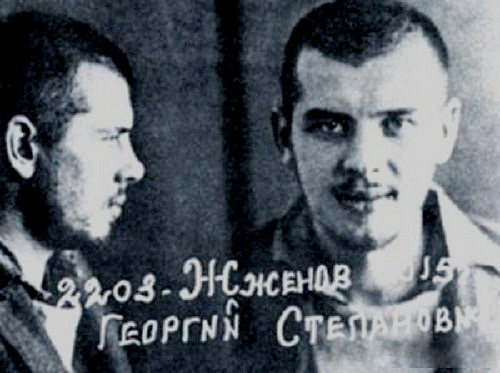
Georgy Zhzhyonov, in an overcrowded cell with 17 other people, had to stay for some time near the latrine. Incidentally, as soon as he was brought to "Kresty", the prison administration ordered his red sports pants to be taken away. "Apparently, they feared that during the anniversary of the Great October Revolution I might wave them through the muzzled barred window of the cell," recalled People's Artist of the USSR Georgy Zhzhyonov.
During the "Great Terror," Lev Gumilev — son of poet Anna Akhmatova — was also imprisoned in "Kresty". Her husband, Nikolay Gumilev, was imprisoned in the main prison of Petrograd in 1921. Akhmatova dedicated the poem "Requiem" to the terrible events connected with "Kresty" that affected her family, in which she bequeathed to erect a monument to her in the prison.
In the pre-war years, several special-purpose prisons were incorporated into the "Kresty" structure, whose inmates were scientists and military specialists. The most famous prisoner of one such prison was aircraft designer Andrey Tupolev. Interestingly, years later Tupolev, like Georgy Zhzhyonov, donated a significant amount of money for the improvement of "Kresty": thanks to them, the prison got sewage and water supply.
At the start of the war, about 400 "Kresty" staff went to the front — their places were taken by women and elderly, and all prisoners were placed in one building. On the Neva embankment, a wooden-earth firing point (DZOT) was built, which was used to defend the prison. During the terrible years of the Siege of Leningrad, many guards and prisoners died from hunger, cold, and bombings. For example, on November 7, 1941, a bomb hit the Northern Gate of the prison, killing two guards. But there was no one to bury them — the bodies of those who died on the territory of "Kresty" were stored in a utility room converted into a morgue.
The famous writer Daniil Kharms, who ended up in prison due to a false denunciation, did not survive the blockade either. In winter 1942, he died in the prison psychiatric ward, where he was placed after feigning madness in an attempt to avoid execution. The first post-war year in "Kresty" was marked by another — and quite unusual — escape attempt. A prisoner named Volkov spent many months removing bricks from the prison wall one by one and sinking them in the latrine, which was emptied daily.
Thus, Volkov made a decent hole in the "Kresty" wall, got out, and decided to start his life of freedom by visiting a bathhouse. But the prisoner managed to run into guards who came to steam on their day off and returned to the prison cell. In 1958, a school for inmates was opened on the territory of "Kresty" and a cardboard factory was launched — it quickly began to bring good income and provided work for prisoners. In 1964, the prison officially received the status of Leningrad Detention Center No. 1. In February of the same year, poet Joseph Brodsky, accused of parasitism, was imprisoned there. He spent about a year in cell No. 104, suffered a heart attack, and was then exiled to the Arkhangelsk region. In 1984, another escape attempt was made in "Kresty" — the inmates who prepared it showed remarkable ingenuity.
Two prisoners made fake IDs of senior investigators of the Main Directorate of Internal Affairs from cardboard and red threads. For photographs, they used printed images of employees cut out from magazines. The seals were taken from copies of sentences. In addition, the prisoners managed to sew white coats from sheets, under the guise of prison medics, and reached the checkpoint. Showing the guards the fake IDs, the escapees left the detention center and hid from the police for two days. After the prisoners were caught and returned to their cells, a special pass system was introduced in "Kresty". Now everyone entering had to surrender their documents and receive special tokens in return. Upon exit, these tokens were exchanged back for the documents. Meanwhile, in the turbulent 1990s, the single cells of "Kresty" were converted into six-person cells — the entire criminal elite of Petersburg passed through them. At times, the number of inmates reached 12,000 people.
From the memoirs of former "Kresty" chief Alexey Chergin: "Think about it: 12,000 — that's almost a city! I still don't know how we managed back then. No electricity, no food (we had to supply all the bakeries in Petersburg), no clothes. Prisoners wouldn't open the cell door when a new inmate was brought in — it was barely possible to shove him inside. It's scary to think: how did they survive back then?"
However, prisoners in "Kresty", despite such difficult conditions, resorted to many tricks to make life easier. For example, they made makeshift blowguns from newspapers, into which they "loaded" notes wrapped around bread balls. Prisoners with the strongest lungs could shoot these "bullets" up to 50 meters.
As a result, the notes ended up on Arsenal Embankment, where they were picked up either by addressees or couriers who delivered messages for a fee. Inside "Kresty", there was its own logistics: parcels were passed using sheets tied and thrown from cell to cell — this method was called "the horse" in prison slang.
Upon release, some former prisoners tattooed themselves with images of a ring with a cross and a crown — such tattoos were considered very honorable in the criminal world. However, some inmates sought to speed up their release: in the early 1990s, hardened criminal Sergey Maduev attempted to escape from "Kresty".

In criminal circles, Maduev was called Chervonets, and investigators dubbed him the last bandit of the USSR. The escape attempt he made was arguably the most scandalous in "Kresty" history. The cunning and charming Chervonets, who had killed ten people by that time, managed to win the affection of investigator Natalia Vorontsova. Former deputy chief of "Kresty" Yevgeny Bozhadze recalls: "Chervonets, that son of a bitch, insisted that Vorontsova be his investigator. Sometimes he would be taken out for interrogation and remain silent. Then he'd say: 'I'll tell her everything.' Vorontsova would cry, hysterical. Then she'd say: 'Oh, don't punish him, it's all my fault.' Apparently, he was already psychologically influencing her." Eventually, seizing the moment, the woman stole a Nagant revolver from her colleague investigator Leonid Proshkin's safe, smuggled it into "Kresty", and secretly handed it to her lover. The bandit used the weapon on May 3, 1991, during transfer to Moscow.
At the exit from "Kresty", Chervonets pulled out the revolver from under his coat and wounded Major Yermolov, who was escorting him. But the second guard managed to press the alarm button: the prisoner barely managed to dodge the hail of bullets from the prison guards and decided to surrender.
Memories of former investigator Leonid Proshkin: "In three days I turned gray. My heart got bad because the weapon from my safe ended up in 'Kresty'. One of the most serious detention centers in the country. And there the bandit started shooting from it."
For aiding Chervonets, former investigator Vorontsova received seven years in prison. Her lover tried to escape again: this time, a "Kresty" employee handed him a weapon, later claiming that the prisoner had allegedly hypnotized him. But this escape attempt also failed, and Chervonets was sentenced to death. Incidentally, "Kresty" was a so-called execution prison — in one of its buildings, prisoners sentenced to the highest penalty were executed.
Death sentences were carried out in this building. The executioner was a classified employee. Only the chief knew who he was. In the evening, the condemned was visited by an officer, the prosecutor of the Kalininsky district, a doctor, and two assistants. Handcuffs were put on, and the mouth could be tied. According to staff, only one out of a hundred could scream. Everyone knew what awaited them. But Chervonets ultimately avoided execution: his death sentence was commuted to life imprisonment, and in 2000 the 44-year-old prisoner died in the "Black Dolphin" colony. His story with investigator Vorontsova became the basis for the film script "Prison Romance".
A year after the story with Chervonets and Vorontsova, "Kresty" was shaken again by an escape attempt — but this time much larger and bloodier. It was led by hardened recidivist Yuri Perepelkin, who persuaded six of his cellmates to escape through a watchtower, from where they could climb onto the roof.
All conspirators were in building No. 9: originally the building was a dormitory for prison staff, then a place for female prisoners, and in the early 1990s it was converted into cells for patients with open tuberculosis. The escape day chosen by the inmates led by Perepelkin was February 23, 1992.
At first, everything went according to plan: they easily took the keys from their escort and locked him in the exercise yard cell. But the attempt to get to the watchtower failed — the duty officer noticed the prisoners, locked the door from inside, and pressed the alarm button.
The inmates then rushed back to building No. 9, where they took hostage instructor Valentina Avakumova and cynologist Alexander Yaremsky. Barricading themselves in one of the rooms, the prisoners demanded weapons and bulletproof vests, transfer to the airport, and then a flight to Sweden. The detention center chief Stepan Demchuk entered negotiations with them.
Former "Kresty" chief Stepan Demchuk recalls: "I offered them to disperse peacefully, promised that there would be no criminal prosecution, only disciplinary punishment." But the rebels refused to surrender peacefully: even the intervention of two influential criminal authorities from "Kresty" did not help. It ended with an assault, during which Perepelkin stabbed hostage Yaremsky, and three of his accomplices were killed. The remaining three surviving conspirators received from 6 to 15 years in prison.
As for their leader Perepelkin, he was sent to the Mordovian colony "Yedinichka" to serve a life sentence. Building No. 9, where the tragic events occurred, was closed some time later.
The further fate of the old "Kresty" was unclear until recently: cats and pigeons continued to live there, fed by inmates. "The pigeons come and sit under the windows, but there is no one to feed them," the guards sadly noted.
In 2016, Igor Potapenko, head of the Federal Penitentiary Service of Russia for Saint Petersburg and the Leningrad Region, announced that a museum would be established on the site of the legendary prison.
"Kresty" is a historical monument. The building will be given over to a museum, a filming location (the cells will be preserved in their original form). Part of the premises will be occupied by the Federal Penitentiary Service apparatus, there will be a citizen reception office, and much more."
Sources:
https://tass.ru/spec/kresty
https://www.mk.ru/social/2016/10/06/mistika-i-uzhasy-piterskikh-krestov-chto-tait-legendarnaya-tyurma.html
https://nvdaily.ru/info/157263.html
Written by Jermaine
Discuss this with the author and others
No comments yet. Be the first to start the conversation.