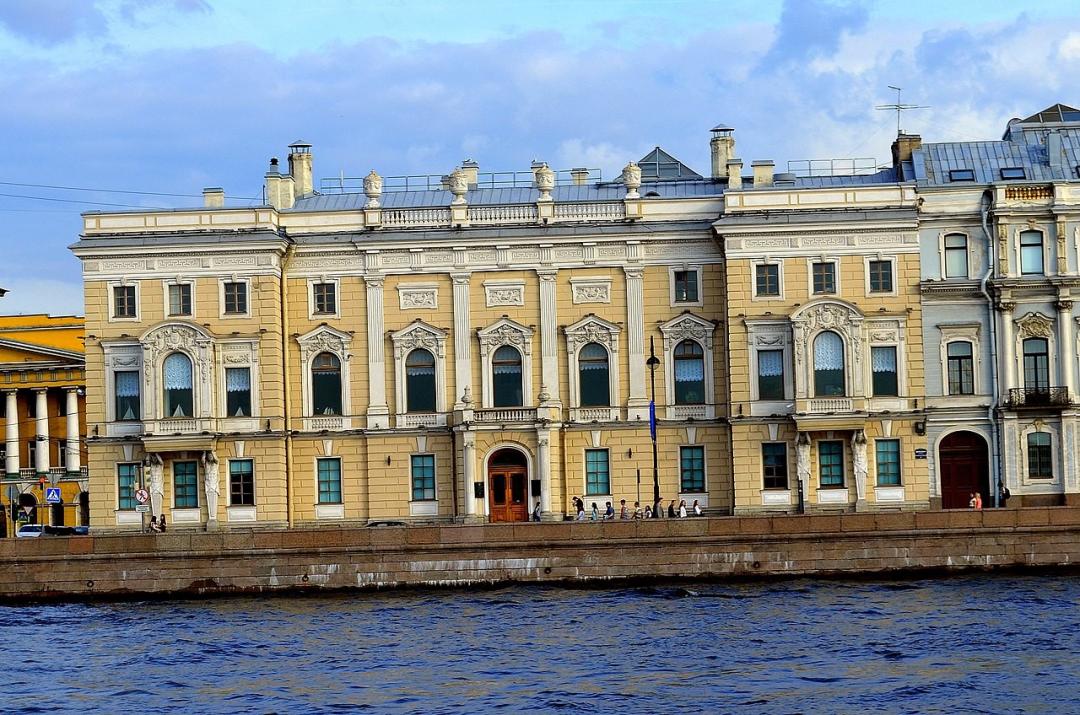

In the first quarter of the 18th century, on the site of house No. 8 on Palace Embankment and house No. 7 on Millionnaya Street, there was the house of Captain Ipat Mukhanov.
In 1715, it was purchased by the Moldavian hospodar Dmitry Konstantinovich Kantemir, who was forced to relocate to the banks of the Neva after the unsuccessful Prut campaign. The old house was demolished, and a new palace was built on its site according to the design of the young F. B. Rastrelli. This became the architect’s first independent work, executed by the young architect between 1721 and 1726, in which the future creative style of the great master could not yet be discerned.

About the palace, Antioch Kantemir’s son wrote: “Count Rastrelli is originally Italian, a skilled architect in the Russian state; due to his youth, he is not so strong in practice as in ideas and drawings. His inventions in decoration are magnificent, the appearance of the building is beautiful; in a word, the eye can rejoice in what he has built.”

The palace faced the Neva embankment with its main facade, featuring a two-story central part on high basements, flanked by three-story risalits. Unlike most noble houses located on the banks of rivers or channels, Kantemir’s palace did not have a pier.
The main facade of the three-story palace facing the Neva embankment was divided into three parts: the center and two side risalits (according to other sources, the central part of the facade was two stories, and the risalits had three stories). The facade had the characteristic clear division of that time — horizontal inter-floor moldings, vertical pilasters between windows, windows glazed with small panes, simple casings, and a gable roof. The facade of the two-story (three-story) wing facing Millionnaya Street had a large arch in the center for entry into the parade courtyard with two entrance arches. The main entrance faced Millionnaya Street. Rusticated pilasters were used in the decoration of both wings. On the first floor of the palace was a spacious vestibule, and above it, on the second floor, was a two-light hall, with stucco and fireplace carvings made by the architect’s father, Bartolomeo Carlo Rastrelli. Symmetrically, to the right and left of the large hall were smaller halls. The first floor of the palace was rusticated to appear more massive, while the second and third floors were decorated with pilasters to emphasize the building’s height. On the side of the current Marble Lane, one-story wings were built, separating the palace from the neighboring plot.
From 1723, after the death of the owner, the house passed into the possession of his children. Here lived Dmitry’s son, Antioch Kantemir, a poet, satirist, and diplomat.

Some rooms of the mansion were rented out. In 1726, the poet Vasily Kirillovich Trediakovsky lived in Kantemir’s palace, teaching Antioch the Russian language and versification. In 1727, Count Minikh lived here.
In 1737, the palace was described as follows:
The stone court of the Kantemir princes on the Great Neva… with a three-apartment palace building and all kinds of stone chambers and cellars under the palace around the entire courtyard, and next to that courtyard another separate stone building in the rear line with three apartments and cellars under it, with a shingle roof.

In 1743, a church of the Great Martyr Theodore Stratelates was arranged on the upper floor.
After Antioch Kantemir’s death in 1744, his younger brothers Matvey and Sergey entered into a lengthy legal dispute with their stepmother, Princess A. I. Trubetskaya (Princess of Hesse-Hamburg).
From 1755 to 1757, the English embassy was located in the mansion. The embassy’s secretary, Prince Stanisław Poniatowski, the future King of Poland, resided there.
In 1755–1757, the English embassy was housed in the mansion, where its secretary, the future Polish king Stanisław Poniatowski, lived. In 1762, brothers Matvey Kantemir and Sergey Kantemir sold the palace to the Senate’s General Prosecutor Alexander Ivanovich Glebov, who two years later resold it to Count Alexey Petrovich Bestuzhev-Ryumin. Some historians believe that it was acquired by Catherine II, who gave it to Count Bestuzhev-Ryumin upon his return from exile. By that time, the old house of the count was already occupied by the Senate, so he needed a new residence. The neighboring Marble Lane was called Bestuzhevsky for some time after the new owner’s name.
Four years later, Bestuzhev died, and the plot was purchased by Count Pavel Martynovich Skavronsky. According to P. M. Stolpyansky, the plot was a gift from Catherine II. Count Pavel Martynovich Skavronsky, a grandnephew of Catherine I, the last representative of his family, was known in his time as a wealthy man and music lover, chamberlain, and Russian envoy to the Neapolitan court. According to recollections, at that time there was a quadrangular turret with windows on all four sides at the corner of the house. The owner was a music lover and a great eccentric — speaking in the house was only allowed in recitative. One of the large halls had a stage where operas, plays, and concerts were performed. In 1777, the mistress of Kantemir’s palace became the wife of the count, Ekaterina Vasilievna Skavronskaya (née Engelhardt), niece of Prince G. A. Potemkin. After Skavronsky’s death, Ekaterina Vasilievna remarried Count Yuliy Pompeevich Litta, whom she met in 1788 in Naples. From 1795, the count was the representative of the Maltese Order in Russia; for the marriage, he had to request permission to be released from his vow of celibacy from the Pope. The wedding took place on October 31, 1798. The marriage was happy. Litta became the owner of his wife’s vast fortune, took Russian citizenship, and was appointed chief of the Life Guards Cavalry Regiment.
For the newlyweds, architect Luigi Rusca rebuilt the wing on the side of Millionnaya Street (house No. 7) in the Neoclassical style. After the countess’s death, Litta sold the mansion to the Ministry of Finance, settling in its part on Millionnaya Street. After the count’s death, the mansion fully passed to the Ministry of Finance. It housed the ministry’s office and printing house, as well as the minister’s apartment. At that time, in the 1840s–1850s, the ministers of finance were Yegor Frantsevich Kankrin and F. P. Vronchenko.
The parade courtyard was located on the side of Millionnaya (German) Street and was separated from it by a two-story building with entrance gates in the center of the first floor. One-story wings separated the parade courtyard from the current Marble Lane and the neighboring plot.
In 1868, the house was bought from the treasury by merchant Nikolai Dmitrievich Lokhovitsky. It was rebuilt for him by architect L. F. Fontana, who altered some interiors, reinforced the ceilings, built courtyard buildings, and remodeled the facade on the Millionnaya Street side. Lokhovitsky himself lived on Galernaya Street. His brother, a collegiate counselor and employee of the military ministry, lived here. The most famous resident at that time was General Field Marshal and Minister of War Dmitry Alekseevich Milyutin.
The next owner of the plot in 1875 was the timber merchant and philanthropist Ilya Fedulovich Gromov. In 1879, the complex of three separate residential houses was rebuilt into one large mansion according to the project of Karl Karlovich Rakhau. It was then that the building acquired its current appearance.

At the corner of Millionnaya Street and Marble Lane, the facade was decorated with a group of three female figures symbolizing fertility, art, and navigation. The interior decoration was done in various styles: Gothic, Rococo, and Louis XVI style. Some interiors have been preserved to this day.
In the 1880s, after the childless Gromov’s death, the mansion’s owner became Vladimir Alexandrovich Ratkov-Rozhnov, former manager of the Gromov family affairs. He rented out the mansion on the Palace Embankment side and later sold it to the Ministry of Finance. From 1898 to 1901, the Ottoman Empire embassy was located here, while the Ratkov-Rozhnov family lived in the buildings on Marble Lane and Millionnaya Street until 1917. After Vladimir Alexandrovich’s death, the house belonged to his son Ananiy. On January 2 (15), 1917, the Russian branch of the National City Bank of New York opened in the building.
The building facing Palace Embankment now houses the Russian Maritime Register of Shipping, while the buildings facing Marble Lane and Millionnaya Street remained residential for a long time. In 1986, this part of the building was transferred to the Institute of Culture.
Sources:
https://petro-barocco.ru/archives/3216
https://ru.wikipedia.org/wiki/Gromov_Mansion
Written by Jermaine
Discuss this with the author and others
No comments yet. Be the first to start the conversation.