

The palace is located on the 1st Admiralty Island, in a block bounded by Palace Embankment, Suvorov Square, Millionnaya Street, and Mramorny Lane.
The northern facade of the building faces the Palace Embankment, beyond which lies the Neva River, on the opposite bank of which is the Peter and Paul Fortress. The eastern half of this same block is occupied by the Northwestern State Correspondence Technical University, housed in the palace’s service wing; between them in 1994 a monument to Emperor Alexander III by Paolo Troubetzkoy was installed (previously, after being dismantled from Znamenskaya Square, it was kept in the Russian Museum’s reserves).
To the east of the building is a monument to A. V. Suvorov on Suvorov Square, created by sculptor Kozlovsky; the Trinity Bridge is also located there. To the south of the building are the barracks of the Pavlovsky Life Guards Regiment. Opposite the western facade are the Russian Maritime Register of Shipping, and on the other side of Suvorov Square is the Institute of Culture.
During Peter I’s reign, on the site where the Marble Palace now stands, there was a Post Yard with a pier, built in 1714. On March 24, 1716, it was to this Post Yard that the father and son Rastrelli arrived from Italy. Near this place, since 1714, there was the Menagerie Yard, where the first St. Petersburg elephant was kept, a gift to the Russian tsar from the Persian shah Sultan Hussein. After the elephant’s death on May 23, 1717, it was stuffed and exhibited in the Kunstkamera, and the “elephant barn” housed the Gottorp Globe, which remained there until 1726, when it was also moved to the Kunstkamera.
The fire of 1737 destroyed the Post Yard and the building in front of it, the elephant keeper’s house. The burnt area was cleared, and this site was named the “Upper Embankment Square.” The plot, which became an extension of the Field of Mars, remained empty for quite some time, and only in 1768, by order of Catherine II, did construction begin on a palace intended as a gift to her favorite Grigory Grigorievich Orlov for his help in placing Catherine on the throne. The empress intended to place an inscription in gilded letters on the building’s facade: “Building of Gratitude.”
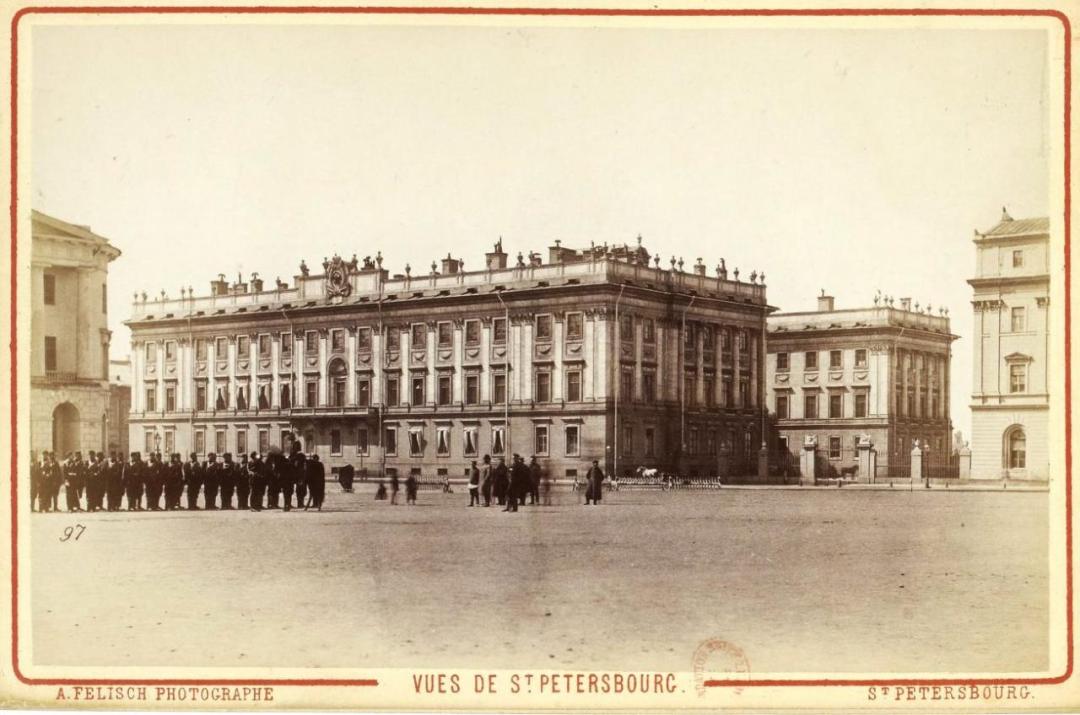
The palace was built between 1768 and 1785 according to the design of architect Antonio Rinaldi. Grigory Orlov died in 1783, never seeing the completion of the construction. That same year, Catherine II bought the building back into the treasury from the count’s heirs, and in 1796 she granted it to her grandson Grand Duke Konstantin Pavlovich on the occasion of his marriage. In 1797–98, the palace was home to the last King of Poland (and also a former favorite of Catherine), Stanisław Poniatowski, who suddenly died there in 1798.
After Konstantin Pavlovich’s death in 1831, Emperor Nicholas I transferred the Marble Palace to his second son, General-Admiral and one of the future organizers of the peasant reform, Konstantin Nikolaevich. The building, already in a dilapidated state, was restored and its interiors decorated in the 1840s by architect Alexander Bryullov.
After Konstantin Nikolaevich’s death, the palace was owned by his widow, Grand Duchess Alexandra Iosifovna. In 1911, the palace was inherited by their son Grand Duke Konstantin Konstantinovich. After him, the owner of the Marble Palace was his son, Prince Ioann Konstantinovich. Ioann’s brother, Gavriil Konstantinovich, wrote memoirs titled “In the Marble Palace.”
After the February Revolution, the palace was sold to the Provisional Government to house the Ministry of Labor. After the October Revolution, from 1919 to 1936, the building housed the Academy of the History of Material Culture, and after its abolition, a branch of the Central Lenin Museum. To accommodate the exhibition, the palace was remodeled by architects Lansere and Vasiliev.
From the 1950s until the late 1980s, an Austin-Putilov armored car was displayed on a pedestal in front of the palace (with a break in the 1970s when it was placed in the palace vestibule), installed in memory of Vladimir Ilyich Lenin’s speech from a similar armored car upon his arrival in Petrograd on April 3 (16), 1917. Later, the armored car was transferred to the Artillery Museum, and the freed pedestal was occupied in 1994 by the monument to Alexander III by Paolo Troubetzkoy.
In 1992, the Marble Palace was transferred to the Russian Museum. The halls of the Marble Palace house a permanent exhibition “Foreign Artists in Russia of the 18th – First Half of the 19th Century,” and temporary exhibitions of contemporary foreign and Russian masters are regularly held. Currently, the palace is also used for various congresses.
The Marble Palace is a masterpiece of early Catherine-era classicism architecture. It was built between 1768 and 1785 according to the design of Italian architect Antonio Rinaldi. Until the late 19th century, the palace was attributed to Quarenghi. The true author of the project was first named only in 1885 by the protodeacon of the Marble Palace church, Orlov, upon the discovery of the original drawings of the grand staircase.
This is the first building in Saint Petersburg whose facades, unlike most city buildings, are clad in natural stone — granite and marble. Hence the original name: “Marble House.” Moreover, the Marble Palace is the most Italian building in the city, evoking both the spirit of Florentine Renaissance palazzi and memories of the palace in Caserta, where Rinaldi worked under Vanvitelli before coming to Russia.
The Marble Palace building is an example not only of a distinct interpretation of the Italian palazzo composition but also, as Vlasov defined it, a “generalized image of classicist palaces of all Western European architecture.” Besides the palace in Caserta, the researcher names Palazzo Valmarana in Vicenza (Andrea Palladio’s project), the Palacio Real (Royal Palace) in Madrid (Juvarra’s project), Palazzo Chigi-Odescalchi in Rome on Piazza Santi Apostoli (Bernini’s facade), Schönbrunn Palace in Vienna (Fischer von Erlach the Elder), and many other buildings.
Rinaldi showed himself in this construction as a true painter of architecture, using a palette of colored marbles instead of paints. The building’s lower floor is clad in austere granite, while the two upper floors, 12.5 meters high (with a total building height of 22 meters), united by a large Corinthian order, are decorated with pilasters made of pink Tivdi marble from Karelia, contrasting with bluish-gray Ruskeala marble from quarries in Finland. This delicate pearly palette, beautiful both in bright sunlight and overcast weather, has somewhat dulled due to surface erosion over time and the aggressive urban environment. But in the rain, when the wet marble becomes unexpectedly saturated in color against the gray sky and leaden Neva water, Rinaldi’s design reveals its full beauty.
The harmony of light tones is skillfully complemented by a few gilded details: the balusters of the southern facade balcony and the wrought-iron fence details of the “private garden” on the eastern side, as well as panels with stucco garlands, vases on the roof parapets, creating allusions to the Rococo style. However, the composition is built according to the “French scheme”: a closed volume with a courtyard — a cour d’honneur — in the eastern part. It is known that Empress Catherine II disliked the lavish “Rastrelli Baroque” of the previous era. Nevertheless, the overall architectural style retains Baroque features, particularly in the projecting risalits, the superimposed attic, and the tower with a clock on the eastern facade. The central part of the eastern facade, with a lightly articulated entablature and attic, is decorated with half-columns. Two statues on the attic and compositions of military armor were made by Shubin. Along the entire perimeter of the roof parapet are 86 decorative vases made of light dolomitic limestone.
The “Italianisms” of the Marble Palace combine with an unusual chamber atmosphere for grand palace architecture. And in the interiors, as researchers note, “the Rococo principle is laid down, where each group of rooms… existed as if closed off.”
The grand staircase of the Marble Palace is clad in marble of bluish-silver shades. It is covered by cylindrical vaults and high pendentives decorated with finely drawn wreaths and garlands, and with round dormers. The sculptural decoration of the staircase and other rooms, executed by Shubin, one of the best sculptors of Russian classicism, allegorically tells of Count Orlov’s exploits: eagles holding wreaths in their beaks, eagles on the capitals of columns and pilasters, palm and oak branches in the main “marble hall” on the second floor. On the wall of the grand vestibule is a bas-relief with a profile portrait of architect Rinaldi by Shubin — a kind of “sculptural signature” of the building’s author. In the niches of the grand staircase are allegorical statues: “Night,” “Morning,” “Day,” “Evening,” “Autumn,” and “Spring Equinox.” The quality of the bas-reliefs and sculptures and their placement indicate that Rinaldi discussed all matters with the sculptors, inspecting plaster models before their realization in marble.
A masterpiece of Russian classicism architecture is the two-story grand Marble (Orlov) Hall, located on the second floor of the northeastern risalit. The enfilade of the palace’s grand rooms began from this hall. The hall’s walls are clad with marbles of seven types in more than thirty shades: Ural, Karelian, Greek, Italian marble, as well as Baikal lazurite. Pilasters made of pink marble with white veins, Corinthian capitals and bases are gilded. Allegorical bas-reliefs on themes of ancient Roman history, unmistakably recalling Orlov’s military exploits, were made by sculptors Kozlovsky and Shubin. The composition of 14 bas-reliefs and desudeports includes images of eagles with garlands and wreaths and the famous “Rinaldi flower” — the architect’s “calling card” made of intertwined oak and palm branches.
The painted ceiling of the hall, “The Wedding of Cupid and Psyche,” was painted in 1775 by the Italian Stefano Torelli (in documents, the ceiling is called “The Triumph of Venus”). The interior decoration involved stucco artists Focht and Bernasconi, miniaturist Danilov, and carpenter Meyer.

From 1843 to 1851, the palace was reconstructed according to architect Bryullov’s project. Another story was added, turning the Marble Hall into a two-story space (with wall and window heights spanning two floors). The upper story was finished with artificial marble (stucco). The original decoration was preserved only in the grand staircase and the first story walls of the Marble Hall. In the early 1800s, the palace’s living quarters were remodeled under architect Voronikhin’s supervision.
The grand courtyard from the south and the Neva side is enclosed by a wrought-iron fence on pink granite pillars with marble vases. The fence connects the palace with the service building, constructed by architect Egorov in 1780–1787. The building was rebuilt by architect Bryullov in 1844–1847. Bryullov added a third floor to the building and decorated its facades with pilasters, thus giving the service building features resembling the Marble Palace. The facade facing the garden is decorated at the top with a continuous frieze band about two meters high, consisting of four bas-reliefs on the theme “The Service of the Horse to Man” by Klodt. He also created the bas-relief compositions for the two side pediments. Until 2011, the former service building housed the Northwestern State Correspondence Technical University.
Sources:
https://ru.wikipedia.org/wiki/Marble_Palace_(Saint_Petersburg)
https://www.citywalls.ru/house29816.html
Written by Jermaine
Discuss this with the author and others
No comments yet. Be the first to start the conversation.