Russia: Lost Monuments

For Browsing

In place of many architectural monuments, only fragments remain that will never regain their former appearance. Which historical buildings will we never be able to see as they once were, and what stands in their place now?

English Palace - The Executed Masterpiece of Quarenghi

VVJJ+7P Petrodvortsovy District, Saint Petersburg, Russia

The English Palace was located in the center of the English Park, on the northern shore of the English Pond. The monumental three-story building with an eight-column portico was built in 1796 based on a design by Giacomo Quarenghi. This was Quarenghi's first project in Russia. The palace's patron, Catherine II, planned to rest here away from the courtly bustle.

Babolovsky Palace

P85V+FW Pushkinsky District, Saint Petersburg, Russia

The existence of the Babolovsky Palace is owed to Catherine II, who in the spring of 1779 ordered the construction of a "curious wooden building" for her favorite, Prince Grigory Potemkin, on the shore of an artificial pond formed by damming the Kuzminka River.

History of the Ropsha Estate

Krasnoselskoye Highway, 1, Ropsha, Leningrad Region, Russia, 188515

For example, what do we know about Ropsha? Many have at best heard that it is a settlement in the Leningrad region and that it once belonged to the Romanov dynasty. But few know that there was a remarkable palace and park ensemble there, created through the work of outstanding architects, sculptors, and landscape masters.

The Romance of Count Arakcheev and Nastasya Minkina – Two of the Most Cruel People of Their Era

4VWJ+PH Gruzino, Novgorod Oblast, Russia

"—…Madam Minkina, oh how beautiful! A bit nervous. Why on earth burn the maid’s face with curling tongs! Of course, under these circumstances, they’ll be killed!.."

Blokovskaya "Stranger" - Ozerki Station
Ozerki, Saint Petersburg, Russia, 197375

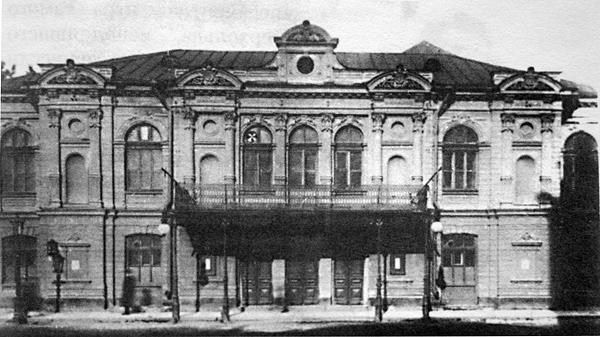
“In the evenings above the restaurants, the hot air is wild and deaf…” Who isn’t familiar with these lines from the famous Blok poem *The Stranger*? Under the poem, there is a note: “April 24, 1906, Ozerki.” It is commonly believed that the poet wrote it in the station restaurant in Ozerki. But where exactly? In this popular summer suburb, there were two stations: one on the Finland railway line, the other on the Ozerki branch of the Primorskaya (Sestroretskaya) railway…

Nemetti Theater

39 Dekabristov St., Saint Petersburg, Russia, 190121

Modern residents of St. Petersburg associate Dekabristov Street exclusively with the Mariinsky Theatre. Numerous disputes and regrets remain in history about the demolished Palace of Culture of the Fifth Five-Year Plan, and even earlier, the building of the decoration workshops destroyed by fire, which has now been rebuilt into a Concert Hall. It was precisely on this site, listed on the city’s posters as Mariinsky-3, that the best theatrical venues and the most amazing park in the city once stood.

Organ of Petrikirche

Nevsky Ave., 22 building 2, Saint Petersburg, Russia, 191186

For many decades, the organ gallery of the Petrikirche Cathedral stood empty after the building, closed in 1937, lost the historic organ that once stood there. The Walker company organ was installed in St. Peter's Church in 1840. It had 63 stops, three manuals, and one pedal keyboard.

New Cathedral (Vyborg)

Sovetskaya St., 16, Vyborg, Leningrad Region, Russia, 188800

It was called the Vyborg Notre-Dame. It was depicted in panoramic photographs and greeting cards. Everyone admired it without exception. The refinement of the Gothic spire, the monumentality of the main building, the spacious hall with painted vaults and a majestic organ. Now, only the foundation and the plinth of the building with the underground part remain of this masterpiece of northern Gothic architecture. This refers to the new cathedral (Finnish: Viipurin tuomiokirkko), the main Lutheran church of Vyborg, which no longer exists. In 1925, it was granted the status of the cathedral of the Vyborg diocese.

Chinese Theater or Stone Opera

P99P+4G Pushkinsky District, Saint Petersburg, Russia

To the left of the entrance to Alexandrovsky Park, in the center of one of the squares, is the Chinese Theater, or the Stone Opera, as it was called during the time of Empress Catherine II. Originally, it was planned to create an "open-air theater" in its place—that is, a theater under the sky with turf benches. The theater project was developed by the architect Rinaldi, and its construction in 1778-1779 was carried out under the supervision of Neelov, who made significant changes to the original design.

Musical Station of the Tsarskoye Selo Railway

Staroshaleinaya Alley, Saint Petersburg, Russia, 196620

In 1836-1837, the main line of the Tsarskoye Selo Railway was laid through the territory of Pavlovsky Park. A clearing was made through the park, and an embankment was constructed almost up to Sadovaya Street.

Elizabethan Pavilion (Krasnodoliny)

Sadovaya St., 70, Saint Petersburg, Russia, 196625

In 1801, near Glazovo (now part of Tyarlevo), in one of the most remote corners of Pavlovsky Park, the Elizabethan or Krasnodoliny Pavilion was built. This pavilion—the last work of architect Charles Cameron in Pavlovsk—so amazed and astonished contemporaries that it was called an "architectural whim." Indeed, there was much to marvel at. Cameron and his assistants—architect Shreter and master stonemason Visconti—created an unusual, original, yet extraordinarily harmonious building.

Imperial (Tsar's) Pavilion of the Imperial Branch

Akademicheskiy Ave, 31, Saint Petersburg, Russia, 196605

The Imperial (Tsar's) Pavilion is an unused building of the railway station at the junction of the Petersburg-Warsaw Railway branches and the Imperial branch. The pavilion is located in the city of Pushkin. To accommodate trains passing through the Aleksandrovskaya station of the Petersburg-Warsaw Railway, heading to Tsarskoye Selo, construction of the Tsar's Pavilion began in 1895.

Konstantinovsky Palace in Pavlovsk Park

MFQC+H9 Pushkinsky District, Saint Petersburg, Russia

The time of the creation of the Konstantin Palace dates back to the late 18th century. The construction of the palace began in the Catherine Park of Tsarskoye Selo in November 1792. The palace was built from November 1792 to June 1793 according to the design of architect Giacomo Quarenghi. It is known that it was a rectangular two-story building, 58 meters long and 23 meters wide. The central part of the main facade, with three Venetian (triple) windows, was crowned with a pediment. Ten Ionic half-columns were installed between the windows. The exterior of the palace was clad with boards, the walls were painted yellow, and the roof was green. The years of the Konstantin Palace's existence in Tsarskoye Selo represent only the first stage of its history. On August 19, 1797, when Paul I ascended the throne, a decree was issued to move the Konstantin Palace with its kitchen to Pavlovsk. The relocation began in February 1798 and lasted more than five months. The construction of the palace was carried out under the supervision of architect Brenna.

Lower Dacha in Alexandria Park

VXM2+M4 Petrodvortsovy District, Saint Petersburg, Russia

The Lower Dacha is the last palace building constructed in Alexandria, the Romanovs' suburban residence in Peterhof. The park of Alexandria dates back to 1825, when the wooded area located east of the Peterhof Lower Park along the Gulf of Finland was gifted by Emperor Alexander I to his brother — Grand Duke Nikolai Pavlovich. After ascending the throne, Nicholas I presented the estate to his wife Alexandra Feodorovna, giving the territory the corresponding name — "Her Majesty's Own Dacha Alexandria."

Lost Estates - The Levashov-Vyazemsky Estate
Mezhozyornaya St., 9, Saint Petersburg, Russia, 194362

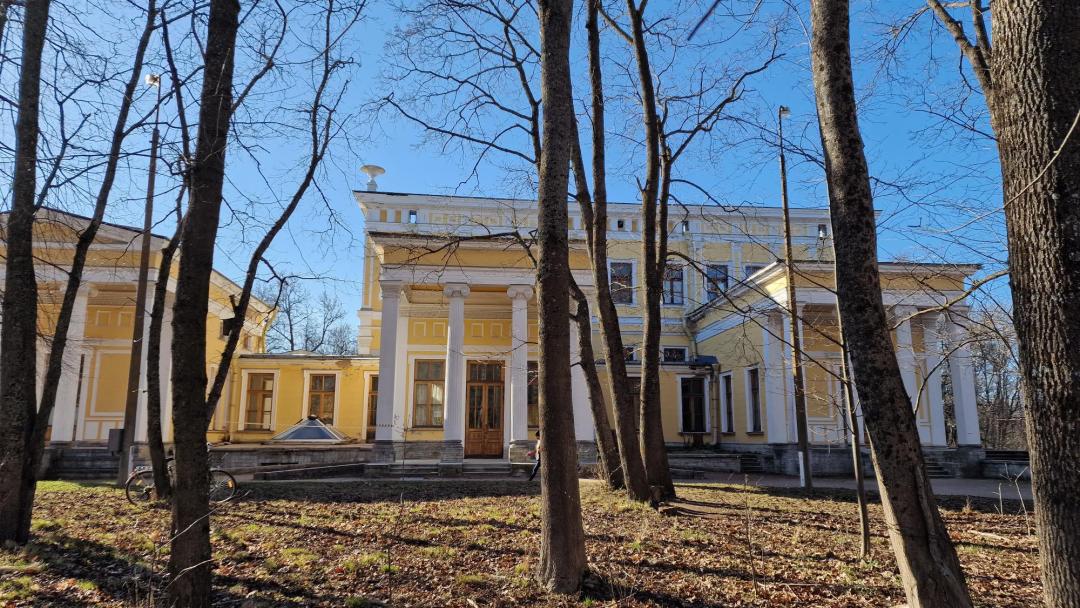
The Levashov-Vyazemsky Estate is a ruined monument of manor architecture located in the settlement of Osinovaya Roscha (now the Vyborgsky District of Saint Petersburg), at the junction of the Vyborg and Priozersk highways, 4 km from the settlement of Pesochny. It is one of the numerous Petersburg sites placed under UNESCO protection in 1990.

Palace (Estate) of the Leuchtenberg Family

Leuchtenberg Palace, Oranienbaum Highway, 2, Saint Petersburg, Russia, 198504

The Leuchtenberg Palace is an estate located on the crest of a coastal bluff in the northeastern part of the "Sergievka" park on the western outskirts of Peterhof. The building was constructed by architect Andrey Ivanovich Stakenschneider for Maria Nikolaevna, daughter of Nicholas I, and her husband Maximilian, Duke of Leuchtenberg.

Church of Saint Catherine or "The Chapel"

Oranienbaum Highway, Building 2, Block 4, Saint Petersburg, Russia, 198504

In Sergievka Park behind the Leuchtenberg Palace, on the other side of the long palace meadow, among the bushes, one can notice the ruins of a small cubic red-brick building. It seems to be the remains of some kind of wing or a gatehouse. Hardly anyone today would guess in these ruins the skeleton of the Orthodox estate church of Saint Catherine. Meanwhile, it is exactly that. Closing the perspective of the palace meadow, it compositionally echoed the cubic volume of the main part of the palace.

Water pumping station – Shtakenshneider water-lifting machine

VRXW+M6 Petrodvortsovy District, Saint Petersburg, Russia

Near the shore of the bay, between the palace meadow and the mouth of the Kristatelka River, in its steep bend, there is a picturesque clearing where, among apple trees, stands a red brick ruin with a long chimney protruding upwards. This is all that remains of the palace water pumping station after the destruction of the Great Patriotic War. Although the Sergievka park was outside the occupied territory, within the Oranienbaum bridgehead, the ensemble was heavily damaged by shells.

Renella Pavilion (Tea House or Gothic Cottage)

VXM4+Q3 Petrodvortsovy District, Saint Petersburg, Russia

The Renell Pavilion, or as it was sometimes called, the Tea or Gothic House, is one of the many diverse park pavilions that appeared in Peterhof during the reign of Nicholas I. "During the Empress's stay in Palermo (the wife of Nicholas I), she liked a Gothic house with multifaceted pointed towers at the corners of an elongated quadrangle. Rough sketches of this building made on the spot were sent to St. Petersburg with the order for Stakenschneider to build the Renell Pavilion according to them in Znamenka, on the shore."

Stable yard in Znamenka

Aleksandrovskaya St., 8, Saint Petersburg, Russia, 198517

The Znamensky Stable Yard was a spacious complex, featuring arched gates with wrought iron doors, resembling a palace. It included a riding arena for guests, ten horse stalls, an infirmary, smithies, and living quarters for the staff. Exhibitions of purebred horse breeds were held here, attracting horse breeding enthusiasts and owners of stud farms. The General Inspector of Cavalry, Grand Duke Nicholas Nikolaevich the Elder, was involved in this endeavor and had a great passion for horses.

Lost Estates - The Tragic Fate of Andrey Ivanovich Shtakenshneider's Estate in Pudost

Gatchinskaya Mill, 2, Myza-Ivanovka, Leningrad Region, Russia, 188352

In addition to his own house on Millionnaya Street, they also described Andrey Ivanovich's estate in the Pudost area, called the Ivanovka Manor — a carved wooden house near a ruined mill, the "pink dacha" on the fast-flowing Izhora River. Listed in directories and tourist maps, this estate unfortunately no longer exists today.

The History of Stakenschneider's Pink Pavilion

VV7X+92 Petrodvortsovy District, Saint Petersburg, Russia

On March 26 (March 14 old style), 1845, the Peterhof Palace Administration received an order to begin the construction of the "Ozerki" pavilion in the Meadow Park. The order stated: "His Majesty the Emperor, having approved the plan, facade, and estimate for the construction of the pavilion by the lock of the Samsonievsky Canal in Peterhof, has most graciously commanded that this construction be carried out under the supervision of architect Stakenschneider."

Lost Estates – The Fifth Mountain, the most "disappeared" of all the estates in the Leningrad Region

CQX4+FJ 5th Mountain, Leningrad Oblast, Russia

The Fifth Hill is the most "disappeared" of all the estates in the Leningrad region. Only the remains of the manor house foundation, the park gates, and a crumbling rotunda-shaped church have survived to this day. The name Fifth Hill has been recorded in history since the 18th century, but how it originated is unknown. There was never a First, Second, Third, or Fourth Hill in the vicinity. The last owner of the Fifth Hill was Fyodor Briskorn, the civil governor of the Caucasus province. Later, his widow Olga commissioned a luxurious rotunda church (the Church of the Holy Trinity) in memory of her husband. During its construction, a large amount of soft sedimentary rock was used, which has long since crumbled. This is why the church tilts first to one side, then to the other. It is hard to imagine that as recently as the 1960s it was still in use, given the church’s current state of ruin. The estate itself has practically not survived, with only the foundations of buildings visible here and there. But the outlines of the old park with huge larches, lindens, and ashes are still visible, as well as a pond with an island.

Lost Estates: The Albrechts' Estate

Kotly, 96, Kotly, Leningrad Region, Russia, 188467

The Albrekht Estate is an old manor that belonged to the Russian noble family Albrekht. It is located in the village of Kotly, Kingisepp District, Leningrad Region.

Lost Estates: The Gersdorff-Weimarn Estate Complex "Kummolova Manor"

MX4P+HH Ananino, Leningrad Oblast, Russia

Kummolovo or the Kummolovo Manor is an old estate that belonged at different times to Russian noble families — the Gersdorfs, von Weimarns, and Blumentrosts. It is located in the Lomonosovsky District of the Leningrad Region, in the village of Kummolovo of the same name, now uninhabited.

Lost Estates: The Taitskaya Estate of the Demidovs

Sverdlov Sanatorium, 2, Sverdlov Sanatorium, Leningrad Region, Russia, 198327

To create a luxurious garden and park ensemble, Demidov invited his sister’s husband — Ivan Yegorovich Starov, a young architect and adjunct professor at the Academy of Arts. Construction began in 1774 and continued until 1786. The formation of the ensemble took place in two stages. In the first stage, a manor house was built on the bank of the Verevka River, and to the west, a complex of utility buildings. Behind a long stone fence was a five-part square, which included the two-story residential wing that has survived to this day, the manager’s house, four stables, a gatehouse, a carriage house, and other structures. An alley led to the manor house, curving around an oval parterre in front of its western facade.

The Yeliseyev Estate in Belogorka

Institutskaya St., 1, Belogorka, Leningrad Region, Russia, 188338

One of the most stunningly beautiful estates has been preserved on the picturesque bank of the Oredezh River near the Siverskaya station. This is the Belogorka estate, renowned not only for its historical past but also for its manor house in the Art Nouveau style, which has no parallels in architectural features. The locals and nearby summer residents call it the Eliseevsky Castle.

Königsberg Castle - History, Secrets, and Legends

Central Square, 1, Kaliningrad, Kaliningrad Region, Russia, 236022

Königsberg Castle (Königsberger Schloß) — a castle of the Teutonic Order in Königsberg (Kaliningrad), also called the Royal Castle. Königsberg translates to "royal mountain." This is a place on a hill by the river where the Teutonic Order's castle was built.

Lost Estates: Maksimov's Dacha in Oranienbaum

Krasnoflotskoye Highway, 16, Saint Petersburg, Russia, 198412

Maximov's dacha in the town of Lomonosov (Oranienbaum) on Krasnoflotskoye Highway, 16, is a federal architectural monument. A researcher of the architectural heritage of the Peterhof Road and Oranienbaum, Gorbatenko, wrote in his monograph: “The facades and even (a rare case) the interiors of the main building have largely preserved their historical architecture.” This house is a kind of “last of the Mohicans” of the extensive dacha heritage from the turn of the 19th-20th centuries along the southern shore of the Gulf of Finland.

German Reformed Church — Palace of Culture of Communications Workers

Bolshaya Morskaya St., 58, Saint Petersburg, Russia, 190000

The Palace of Culture of Communications Workers, the Communications Palace of Culture, is a former palace of culture located in the center of Saint Petersburg at 58 Bolshaya Morskaya Street. It was rebuilt from a German Reformed Church dating from 1862–1865, created under the direction of architects Harald Bosse and David Grimm.

"Fairy Tale House." The Income House of P. I. Koltsov, Lost Masterpieces

Angliyskiy Ave., 21, Saint Petersburg, Russia, 190121

In 1909, architect A. A. Bernardazzi, commissioned by gold miner Koltsov, built an income house on the corner of Officers' Street and English Avenue, which immediately earned the nickname "Fairy Tale House" among the people of St. Petersburg due to its appearance. A whimsical blend of various romantic styles — "Northern Modern" and "National Style," windows and balconies of fanciful shapes, a corner tower, walls clad in natural stone, and colorful majolica panels, believed by some experts to be based on sketches by Vrubel, allowed the author to create, against the backdrop of the ordinary buildings of old Kolomna, a magical spectacle reminiscent of a dazzling theatrical set. On the facade, sculptor Raush von Traubenberg carved from stone a Phoenix bird, which seemed to support the corner bay window of the "Fairy Tale House" on its wings.

Prince Orlov's Dacha

Frontovaya St., 2, Saint Petersburg, Russia, 198515

The Orlov Palace is a neo-Gothic palace that is part of the estate of the Orlov princes in Strelna, a suburb of Saint Petersburg. The palace was destroyed during the Great Patriotic War, but some buildings of the former estate have been preserved and are recognized as a cultural heritage site of Russia. As of 2016, the estate includes: a tower-ruin, Gothic gates, a grotto, a gatekeeper's house, a well, a stable yard (gates, a building with an Ionic portico, two stables, a smithy, an icehouse, two greenhouses), the Tuff Bridge, and "Parnassus."

Alakirjola - the Nobel family country estate

GM5X+6R Landyshevka, Leningrad Oblast, Russia

Alakirjola - the Baltic estate of the Nobel family. Settlement. Until 1939, the village of Kirjola was part of the Johannes parish of the Vyborg province (Finland). The village was also called Alakirjola. Its name translates as "Lower Kirjola." Its history dates back to the 15th century. Today, this estate is located within the territory of the modern village of Landyshevka in the Vyborg district.

Nobel Family Mansion and the Management Office of the "Ludwig Nobel" Mechanical Plant

Pirogovskaya Embankment, 19, Saint Petersburg, Russia, 194044

The mansion from 1876 in the neoclassical style was built by the Swedish architect Karl Anderson. According to the design, the building was a two-story yellow mansion with red architectural details, modeled after an Italian Renaissance palazzo. The house served as a refuge for the large Nobel family and simultaneously as the office for the factory: the mechanical plant "Ludwig Nobel," which produced cannons and their carriages, underwater mines, and artillery shells. The enterprise utilized the inventions of Alfred Nobel.

The estate of Count P.V. Zavadovsky, Church of Saint Catherine

2G7R+V8 Lyalichi, Bryansk Oblast, Russia

Not far from Novozybkov, in the village of Lyalichi in the Surazh district, lie the majestic ruins of the Ekaterinodar estate, built in the 18th century by Count Pyotr Vasilyevich Zavadovsky. This architectural monument, alas, shared the fate of many similar structures — the estate of Catherine II’s favorite passed from hand to hand, slowly falling into ruin, and was already a pitiful sight by the early 20th century. But it is encouraging that the estate is gradually being restored, and the Church of St. Catherine located right there has almost been fully renovated.

Dacha of Adelia Fyodorovna Tasheit

Lakhtinsky Ave., 115, Saint Petersburg, Russia, 197229

A wooden building in the Art Nouveau style was constructed in 1914 based on the design of architect Sergey Osipovich Ovsyannikov for the widow of the hereditary honorary citizen, customs forwarder Karl-Friedrich-Lorenz (Karl Fyodorovich) Tasheita.

Seven-Towered Castle - Lithuanian Castle - Prison Castle

29 Dekabristov St., Saint Petersburg, Russia, 190121

Immediately behind the Kryukov Canal stands a modern monumental seven-story residential building No. 29. Before the revolution, a two-story dirty green building occupied this site, covering an entire block. This was the famous Lithuanian Castle. Its corners were adorned with round towers — seven in total. These gave the castle its original name — "Seven-Towered." Above the pediment of the castle church, facing Officer Street, were two angels holding a cross. The locals believed that some Lithuanian prince lived here, which is why the castle came to be called the Lithuanian Castle.

Lost Estates: Ulyanka Estate

Stachek Ave, 206, Saint Petersburg, Russia, 198262

Ulyánka is a former estate on the Peterhof Road near Saint Petersburg, which belonged to the Sheremetev count family from 1806 to 1917.