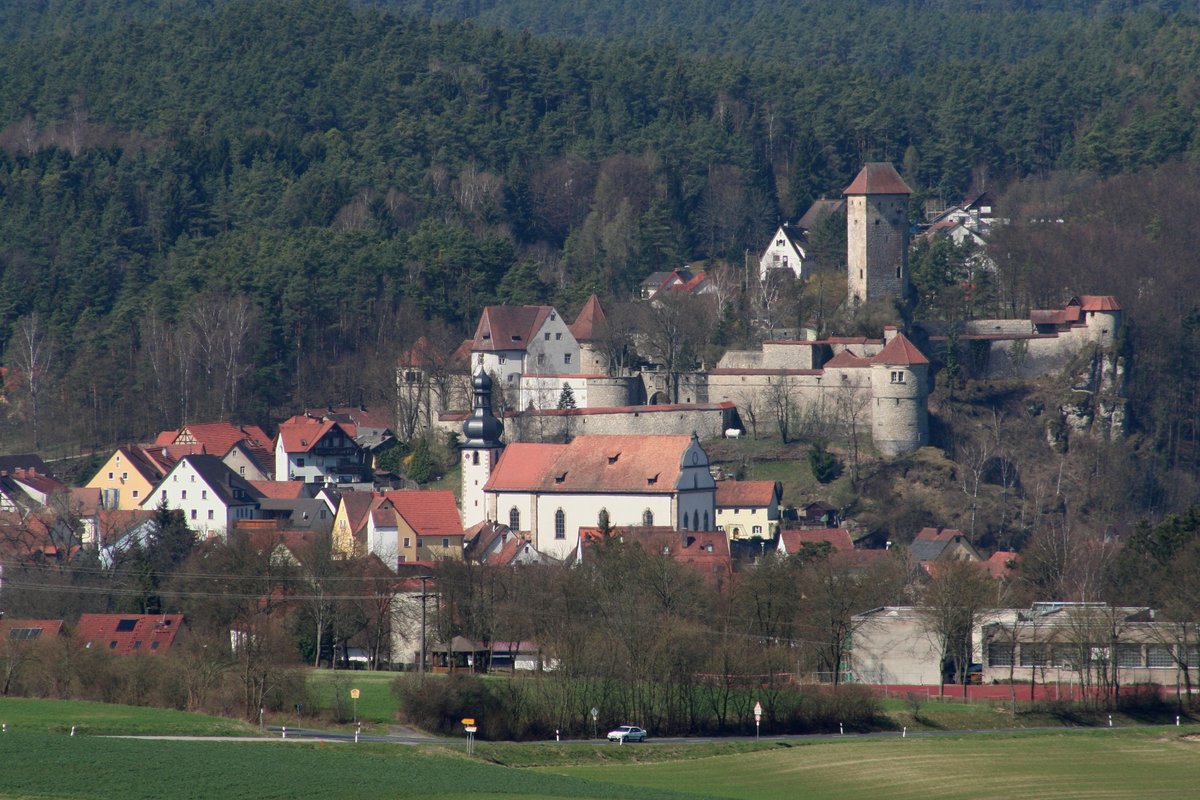
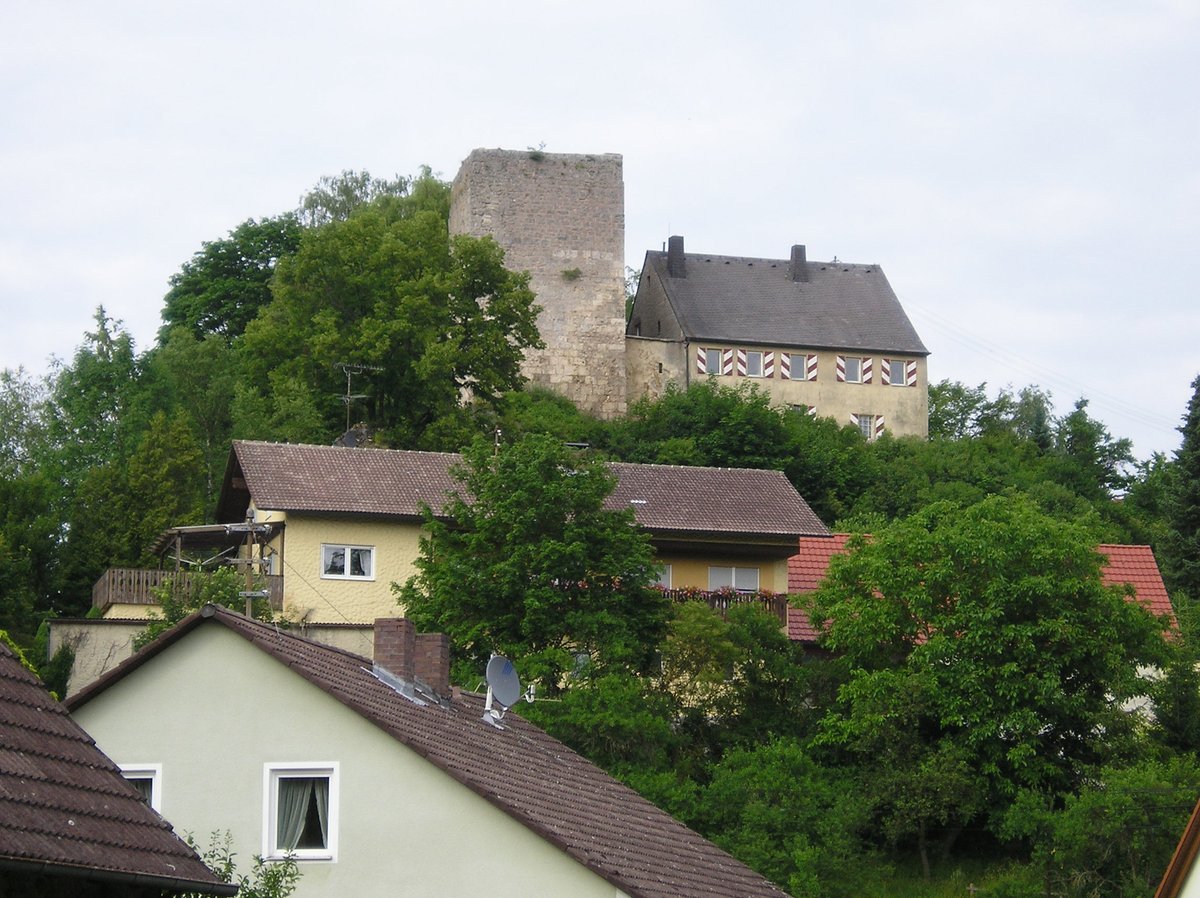
Burg Veldenstein sits above Neuhaus an der Pegnitz, a large medieval hill castle located at the southern end of the Veldensteiner Forst, roughly 50 kilometers northeast of Nuremberg. Its origins are not confirmed, though evidence suggests the Bishop of Eichstätt may have ordered border fortifications in 1008 on behalf of Konrad II.
By 1269, documents first identify it as a novum castrum, a new castle belonging to the Hochstift Bamberg. At that time, the site was an administrative seat, an Amtsburg for the Bamberger bishops. The name Veldenstein did not appear until 1323. In these early days, the castle was barely larger than its keep, the Bergfried. The men who managed the surrounding farmsteads were simple farmers, and nobles began arriving as representatives of the bishop in the 14th century.
As the centuries turned, the castle grew in stature. Noble families like von Stör and von Egloffstein received the site as a fief. In the early 15th century, Hans von Egloffstein built the inner castle. When Bishop Philipp von Henneberg took over in the late 1400s, he built the outer castle and the wall-walk enclosure. He made the castle the official residence of the bishops. From that point forward, every subsequent bishop visited Veldenstein at least once to receive the homage of their subjects.
The castle was heavily fortified and withstood several attacks. Ownership shifted frequently through the 16th and 17th centuries, held by Brandenburgers and Nurnbergers before falling into the hands of the Swedes in 1632 during the Thirty Years' War. The Bavarians moved in three years later. The Bamberger bishops resided in the castle again until 1708, when a lightning strike in the powder tower destroyed a large part of the castle. Secularization in 1803 ended the church's tenure, and the castle was sold to private owners by 1805 as it was of no interest to Bavaria.
The 19th century brought a different kind of restoration. After Carl Heinrich Friedrich August May purchased the walls and towers in 1863, engineer G. C. Hennch conducted renovations from 1871 to 1878. By 1897, Hermann von Epenstein spent one million Marks on a restoration that lasted until 1914. The Nuremberg master stonemason Johann Gröschel was commissioned to renovate the castle's walls, towers, and gates, a process that took nearly ten years.
In the 20th century, the castle entered a different chapter of ownership. Elisabeth von Epenstein sold the site to Hermann Göring in 1939. Göring had previously acquired the market-leading condom company of Julius Fromm at a bargain price through 'Aryanization'. Beneath the main house, Göring built a bomb-proof bunker in 1942 with its own power, air, and water supplies. Today, the castle remains a well-preserved piece of the Bavarian landscape.
Sources: Wikipedia, OpenStreetMap, Wikidata, Wikimedia Commons
Written by Aurora
Discuss this with the author and others
No comments yet. Be the first to start the conversation.