

Fabergé Dacha — a country estate of the Fabergé family in Levashovo, which earned the nickname "Small Hermitage" among contemporaries due to the richest collection of art objects displayed by the dacha’s owner, Agafon Fabergé, within the walls of its main house. It was built in 1901–1902 according to the project of Karl Schmidt and expanded in 1908–1910 under the guidance of architect Ivan Galnbeck.
In 1883 (according to some sources — 1882), Karl Fabergé bought a summer plot on Dibunskaya Road from Count Vladimir Levashov. At that time, there was only a small hunting lodge on the land. The petition for permission to build a dacha with service buildings was dated June 1901. By 1902, architect Karl Schmidt had built a small two-story wooden house, a wing, a stable, an icehouse, and laid out a park with a pond and a fountain for Karl Fabergé. An oak tree planted by the elder Fabergé in honor of the house’s foundation in 1901 has survived to this day.

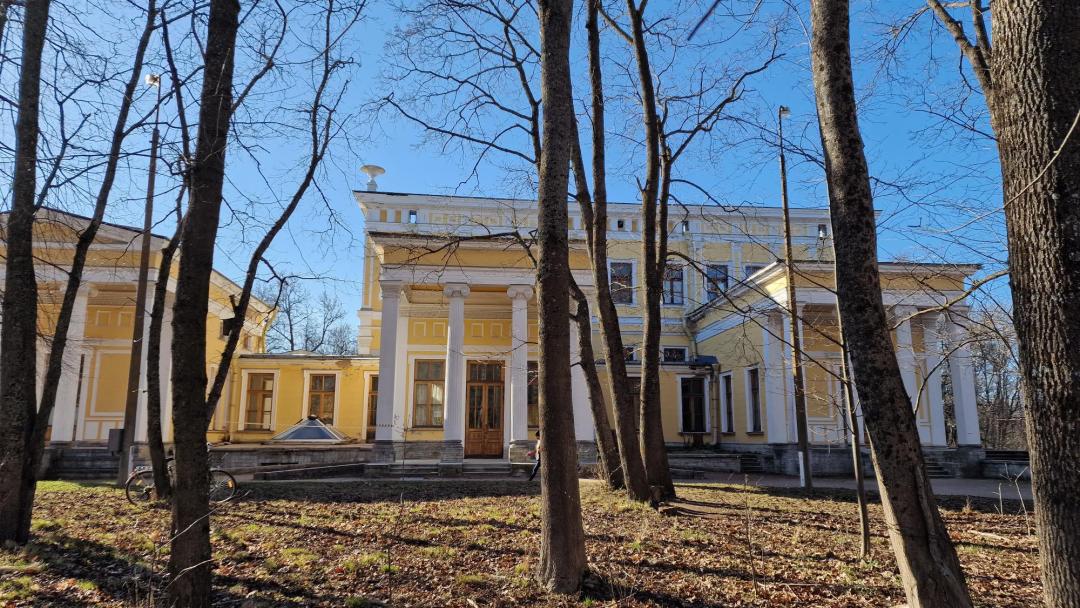
Soon Fabergé gave the dacha to his son Agafon — by 1907 he already had four children, and the family needed spacious housing. He invited architect Ivan Galnbeck to expand and rebuild the dacha. Galnbeck erected a stone mansion in Art Nouveau style with a complex layout and rich decor, incorporating the volumes of the previous house. The central part of the facade received a symmetrical composition with a portico and four columns supporting the second-floor balcony. The other facades demonstrate the characteristic "fluidity" and smoothness of Art Nouveau forms — window sizes and types vary, corners are rounded, internal extensions are prominently protruding, and doorways are decorated with wavy frames. An interesting detail is the use of height differences and multi-level rooms. For example, the salon has a two-level floor that seems to separate the audience area from the stage, and in the part of the house originally built by Schmidt, instead of a two-story stairwell, a two-tier hall with a balcony was created.
The main entrance on the first floor opened into a vestibule and lobby, followed by a spacious hall with a marble grand staircase crowned by a glass dome ceiling. Also on the first floor were the dining room, an Empire-style ballroom, a greenhouse, living rooms, as well as the kitchen and several utility rooms. The interiors were distinguished by exquisite finishes with abundant stucco and carved decor; rooms were decorated with tiled stoves and fireplaces. The second floor housed living rooms, and the central, most spacious room with a skylight was occupied by Fabergé’s working salon. Adjacent to it were an office and an armored safe-room where jewels were stored. The estate was equipped with the most modern engineering systems and even had its own power station. Agafon Karlovich lived for several years in Ceylon, where he received a live baby elephant as a gift from a maharaja. Fabergé dreamed of transporting it to the dacha in Levashovo and even began building an elephant house, but these plans were interrupted by World War I.
Among contemporaries, the Fabergé Dacha earned the nickname "Small Hermitage" for the richest collection of art objects gathered by Agafon Karlovich and displayed in the main mansion: it was adorned with antique statues, tapestries, paintings, Chinese and Japanese porcelain, a collection of 300 Buddha figurines, a collection of Japanese battle swords and netsuke. The dacha also housed two stamp collections and a collection of precious stones numbering more than 311,000 items. During World War I, Fabergé’s dacha was turned into a sanatorium for the wounded.
The February Revolution of 1917 did not cause much trouble for Agafon Karlovich. The first warning came in April 1918, when a denunciation was received by the Petrograd Cheka. Allegedly, Fabergé had stolen furniture and other royal property from the Winter Palace. He had to prove that the antique chests and bureaus, Chinese and Japanese vases, clocks, and candelabra were purchased from Count Benckendorff, who was quartered in the Winter Palace, and were removed with the permission of the palace commandant as early as September 1917. Levashov’s military commissar Petukhov, along with his assistant Novikov and military instructor Rudolf Koch, conducted a triple search at Agafon Fabergé’s dacha.
Agafon secretly sent his wife and five sons to Finland. He himself remained in Petrograd hoping to send abroad the most valuable part of his collection, hidden in a secret compartment at the dacha. However, six months later, following a new denunciation, Agafon was arrested on charges of speculation. He was accused of trying to sell jewels at inflated prices by organizing hearty breakfasts for writer Maxim Gorky and People’s Commissar Lunacharsky in hungry Petrograd.
Soon after the jeweler’s arrest, news of the tragic fate of his dacha reached the Hermitage staff. From a report by Natalia Barash, an employee of the Department for the Protection of Monuments and Antiquities, dated June 3, 1919: "On the 31st of last May, in fulfillment of the assignment entrusted to me, I inspected together with the chairman of the Levashov Executive Committee the Fabergé house located on Dibunskoye Highway, about the threatening condition of which in terms of danger of being looted information was received by the Hermitage."
Unfortunately, the Hermitage’s fears were long overdue, as the interior of this beautiful house presents a picture of complete destruction and wild vandalism. Everything has been thoroughly looted, seals torn off, everything overturned, broken; fabric and leather have been cut off the remaining furniture. In short, there is nothing left to protect there. Over the past months, more than two thousand Red Army soldiers have passed through the house, using it as a temporary station..."
Now, the former splendor of the Fabergé dacha can only be learned from archival documents of the Levashov Executive Committee. When on September 18, 1919, the mansion underwent another, more qualified search, Molas, an employee of the Department for the Protection, Accounting, and Registration of Art and Antiquities Monuments, noted in a report: "It is hard to imagine to what extent the rich and highly artistic furnishings of the dacha, without exception, were mutilated and damaged by the military unit stationed there. All paintings were pierced with bayonets; all upholstery was torn off the furniture; all inlaid and mosaic tables, especially numerous style (Louis XVI) chests, cabinets, wardrobes, and bureaus were mangled; all books were stripped, i.e., without bindings and illustrations, and most were torn into pieces."
At that time, "treasure hunters" discovered an isolated room behind a partition. In the presence of representatives of the district party committee and the Petrograd fortified district, it was opened. Inside was a large quantity of precious stones, medals, vases, and paintings. Later, representatives of the Defense Committee arrived and confiscated valuables without drawing up an act or inventory. All items were packed into 10 boxes and taken away by bus. In addition, two paintings and a large album book in an iron binding were taken. Among the removed items was a huge collection of postage stamps and more than 1,700 precious stones of various sizes.
The fate of the confiscated art valuables remains unknown. It is likely that this collection became part of the "diamond fund of the Politburo," created in the same 1919 in case of the overthrow of Soviet power. It is known, for example, that Yakov Sverdlov kept part of this "fund" at home and at work in the form of selected diamonds.
When the excitement over the jewels subsided, the former Fabergé dacha was turned into a rest home for NKVD employees. During the Great Patriotic War, a hospital operated here; then until 1991, it was a health-improving kindergarten No. 2021/92 of the Military Academy of Logistics and Transport of the Ministry of Defense. At that time, the mansion’s layout was somewhat altered. The large ceremonial and ballroom halls were completely unsuitable for such an institution. Also, tours were conducted in the house, which were later stopped due to the threat of collapse. An auto repair shop operated in the stable and carriage house at the Fabergé house, which later burned down.
Since 1920, the dacha was used for recreational and medical purposes: at different times it housed a rest home for NKVD employees, children’s sanatoriums under officers’ and transport organizations. During the blockade, a hospital operated at the former Fabergé dacha. In the postwar years, the mansion’s interior was rearranged, a cinema booth was added to the safe room, and a menagerie was placed in the basement.
In the 1980s, the complex suffered from a fire — the roof of the main house and several smaller buildings were damaged by fire.
Agafon’s brother, Yevgeny Fabergé, until the end of his days claimed that he buried a suitcase with diamonds worth about five million tsarist rubles in the dacha park. A local legend says that this suitcase has never been found, so treasure hunters still search for it in the overgrown park.

Since the early 2000s, preservationists have drawn attention to the emergency condition of the dacha but noted its high potential — with proper restoration, it could be adapted for modern use as a rest home, spa hotel, or cultural center. In 2007, the dacha was transferred to the Mining University; the new owner undertook to restore the complex and open a museum there by 2014, but in almost 10 years, no conservation work was carried out, and now the main mansion is in an emergency, near-ruinous state.
Sources:
https://ru.wikipedia.org/wiki/Дача_Фаберже
https://www.citywalls.ru/house22775.html


Written by Jermaine
Discuss this with the author and others
No comments yet. Be the first to start the conversation.