


The Saarela estate was located approximately 8 km from Vyborg on the road to Imatra. The estate building itself, along with the outbuildings, was situated on a beautiful cape on the western shore of Lake Kärstilä (now Krasnokholmskoye) at its narrowest point, from where, already in the Middle Ages, the waterway from the Vuoksi River descended into Lake Juustila. Not far from the main manor house were stone outbuildings: a barn, cowshed, stable, and pigsty, built by commercial counselor Juho Hallenberg, with water supply installed in all premises.
The surroundings of Saarela had been inhabited since the Stone Age. Then, from historical sources, it is known that in the Middle Ages these lands belonged to the state or parish. The territory of Saarela was first mentioned in 1534 when Gustav Vasa gifted the scribe of the burgomaster, Lasse, the place Prunsaari.
By the Treaty of Nystad, the lands passed to Russia. These lands, combined with Kostiala, came into the possession of officers with the surnames Sedov, Okulov, and Waxmud.

Later, in 1794, Empress Catherine II gifted the Saarela lands, consisting of 20 plots with 73 peasant households, to General Fabian Steingel (1762-1831), who later received the title of count and the post of Governor-General of Finland. He loved Finland, respected its laws, and was by nature a gentle, agreeable, and kind person.
After Steingel, the lands were inherited by his adopted son-in-law, university chancellor, Lieutenant General Alexander Stewen, who later, in 1824, received the count title and took the name Stewen-Steinheil. After the count’s death in 1842, the estate was managed for 30 years by his widow, Countess Helene, and then by their grandson, chamberlain of the imperial court, cabinet minister’s state secretary Count Alexis Stewen-Steinheil. His thoughtless spending eventually led him to repeatedly sell off his property. First, two small plots were sold, and in 1886, the entire land in Suurpero. Then came the turn of haylofts with hay and estate real estate. Furniture was sold in the same way, and by the end of 1890, all of Saarela was auctioned off. It was bought by the Russian E. Terikhov for his son. But in 1898, Saarela was again put up for sale, and this time it was acquired by Juho Hallenberg, a commercial counselor and son of a former blacksmith in Saarela. After his death in 1926, Saarela was inherited by his relatives.
At the end of the 1700s, the future site of the Saarela estate was a forested cape. The fact that a stunningly beautiful manor building appeared there can be called a happy coincidence. General Fabian Steingel and his rather young wife Natalia, a Vyborg native from the noble von Engelhardt family, spent the entire summer there. One fine summer day, the countess decided to organize a recreational trip into nature. Together with friends in luxurious carriages driven by footmen, they set off northeast on the road to Imatra. Behind followed a carriage with servants, kitchen utensils, and all the necessary provisions for a picnic and coffee. After about 8 km, the travelers reached the bridge on the western shore of Lake Kärstilä. Crossing the bridge, they found themselves on a cape whose shore amazed the countess with its extraordinary beauty. She immediately stopped the cavalcade and ordered the servants to set a dining table on the lawn.
On this picturesque glade, the company snacked, rested, had fun, and enjoyed the surrounding beauty. General Steingel was so enchanted by the place that he wanted to immediately buy the land plot to which this cape belonged, or at least this part of the shore. It was only necessary to find out who the owner was. Since the governor was in the retinue, the general asked him to find out. The next day in Vyborg, during lunch, the manager of the land surveying office reported that he had learned that the owner was a certain General Steingel, but he did not know where he lived. A hearty laugh followed!
The manager of the land surveying office was a modest and sensitive man. The laughter embarrassed him, and he went to the next room to check if his uniform was in order. No, everything was fine. But when General Steingel thanked him for his service and promised him the Order of St. Anna, he was horrified and muttered that he had enough of his Miins and did not want any Anna in addition! How the award ceremony went remains unknown.
Immediately, even before the property rights to Saarela were settled, General Steingel began planning which buildings and where would be erected. Among the first was to build a residential house or summer house that could be used before the main large manor was built. Thus, already in 1809, there was a large manor house. Presumably, this was the one called the "Belvedere," and next to it the so-called "Summer House on the Shore" ("Rantahuvila"), both in the northern part of the central estate on the shore of Lake Kärstilä. When in 1810 Steingel was appointed Governor-General of Finland, and in 1812 received the title of count, the main manor house was built, and simultaneously a two-story red brick office building was constructed.
Right at the initial stage of work, there was a need to build housing for the service staff and estate manager, as well as a barn, cattle yard, and stables. A gazebo and greenhouse also appeared at the first stage of construction. Saarela was a large estate of 8 mantals (a mantal was a tax unit in Finland), and accordingly, the construction plans were grandiose.
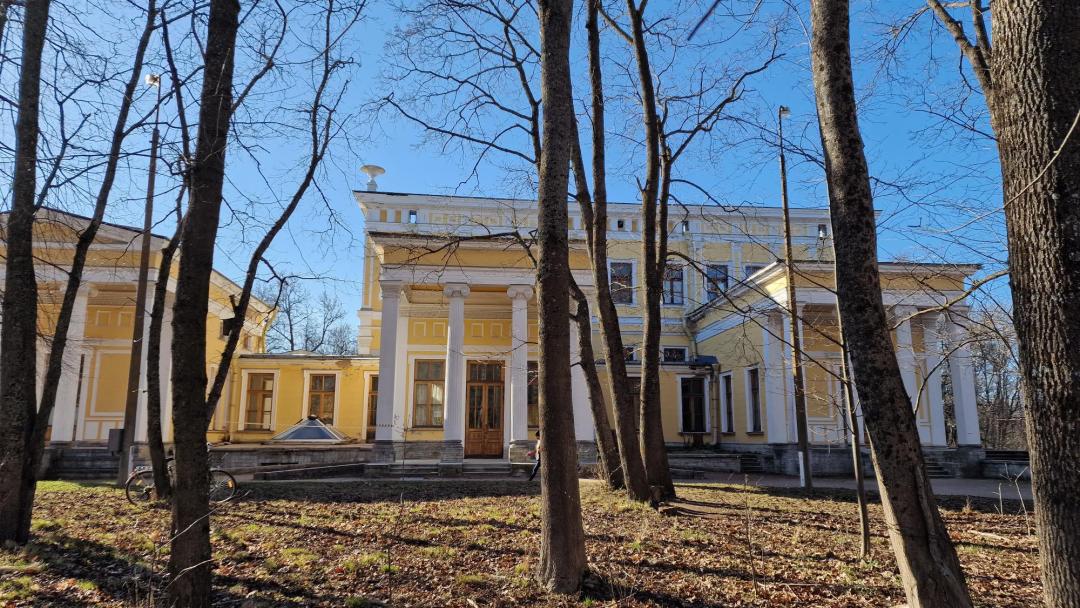
The manor house of the Saarela estate, from 1812, was located in a park planned in the English style. The house was built according to the designs of the famous Finnish architect Carl Ludwig Engel. The authenticity of Engel’s authorship is confirmed by drawings with his signature found in the attic of the house. Special emphasis is placed on simplicity and unpretentiousness, so it appears huge in size, massive, and monumental. The manor house building is one-story, wooden, with a pitched roof, featuring a central colonnade of four columns. The triangular pediment crowning the colonnade rises high above the entire structure. The columns are of the Doric order without cladding plates or abacus. The entablature is decorated with a carved dentil cornice. The main entrance, located in the very center between the columns, is visually enlarged by a beautiful semicircular window. A wide staircase is framed by a massive parapet, on which, on both sides, sit lions carved from gray granite — Imperial Empire style. The wall surfaces are clad with wide boards with a rectangular seam along the lower edge, reminiscent of antique rustication. The wings of the building on both sides of the colonnade had three windows each.
On the facade facing the lake, a pediment also rises in the center. Behind the facade, above two rooms, there was a balcony. A long corridor with a row of rooms led to the northern wing, where the kitchen and a room for kitchen workers were located.
The interior decoration of the house fully corresponded to its facade. The walls of the rooms were plastered, wallpapered; the ceiling surfaces were bordered with moldings, and a console frieze ran along the upper edge of the walls. The huge hall was heated by two light-colored tiled stoves with beautiful patterns. A feature of the interior decoration was that Count Fabian Steingel personally laid the parquet in two rooms: the hall and the boudoir, where, besides oak, three other types of wood were used. This was a true work of high art. The good artistic taste of the author was felt, revealing a true artist — the count also engaged in painting.
In the hall’s furnishings, there were at least three pieces of mahogany with gilded sculptural carving, made in the "Imperial Empire" style. Two magnificent chandeliers illuminated the hall. The walls were decorated with paintings: a portrait of the sovereign, large portraits of war heroes in uniform with orders, portraits of noble ladies, and portraits of the estate mistresses in beautiful festive dresses.
The small salon, the boudoir with parquet flooring, was simply magnificent. The ceiling edges were beautifully executed, as were the tiled stoves. Curtains on the windows, as well as the upholstery of the furniture, were made of silk; between the windows, gilded mirrored pier glasses sparkled. From the ceiling hung a chandelier with candles. Later, when oil lamps arrived, to illuminate the room, a tall lamp with a silk lampshade was placed in the center of a quadrangular marble table with bronze legs. At the end of the last century, soft furniture was added, with the lower edges of the sofas reaching the floor. A soft armchair for relaxation completed the set. The furnishings of the other rooms matched the beauty of the manor itself. In the count’s study, there was a large massive lathe.
On the south side of the house, in front of the colonnade, a park with lawns and flower beds was spread out for fuller enjoyment of summer days. There was also a small gazebo, which guests gladly visited. From there, through the trees, the strait was visible, but most of all the eastern shore of the lake. The original estate development plan briefly mentioned other Saarela objects, but they require some specific detailing.
The "Belvedere" was a two-story wooden house. It had many rooms, but the most significant was the large hall on the first floor. From there, there was a wonderful view. Lake Kärstilä was visible as if in the palm of your hand. Nearby was a winding shore with boats and bathing places. The building also had a spacious kitchen. Behind the "Summer House on the Shore," intended for guests, a small park was laid out, the central alley of which led to the lake shore.
Besides the manor house, there was the aforementioned two-story red brick office building with a turret, somewhat resembling a church building. This house was one of the first to be built, as bricks for construction were obtained from their own factory. The house was built in 1812. Steingel conceived it as the summer working office of the Governor-General. This need arose after the count was wounded in the war with Napoleon. The Governor-General’s office was located in this building. On the south side of the house, a two-story glazed veranda was attached. The house stood on the opposite side of the main estate.
During Steingel’s time, beautiful parks were laid out on the estate. Their area was about 4 hectares, and they were the constant concern of the countess herself. There were sanded paths, artificial ponds dug, bridges thrown over streams, and gazebos built. Nightingales sang in the greenery, swallows flew, white swans swam in the pond, and the Karelian cuckoo called. The hand of the mistress was felt everywhere.
Separate from the park, behind the group of outbuildings, stretched an apple and cherry orchard with many hundreds of trees. The vegetable garden was allocated near the office building. There were also a greenhouse and a large conservatory. Everything necessary for the numerous inhabitants of the estate and its guests was grown there.
Guests of Count Fabian Steingel and his close circle were sometimes high-ranking officials, sometimes scholars and artists, sometimes important bourgeois from Vyborg. Russian sovereigns themselves also visited Saarela. Luxurious social life flowed on the estate. To go for a walk or to church service, at least six carriages were prepared. Here is one episode unrelated to what has been said, in which the Steingel spouses took part.
The military governor Obreshkov invited his friends for a sleigh ride. On this occasion, a large sleigh was harnessed with seven large horses, one in front, the rest in pairs behind, two riders, one on horseback, the other behind the first pair of harnesses to the left of the sleigh. In the sleigh sat a chambermaid with children. Behind them, tied in pairs with ropes, were 12 more sleighs with low backs, in which, holding hands with their neighbors, sat other participants of the ride. In the first pair rode the military governor and Madame Steingel. This long "caravan" rushed through the narrow streets of Vyborg, heading out of town. Special skill was required on the sharp street turns to avoid overturning, but these difficulties only added to the company’s fun. Having fully enjoyed the charms of winter nature and not wanting to part with each other, the whole company was invited by the military governor to his home.
A participant in this ride was a young girl Adelaide von Hauswolff from Sweden, who described this event in her diary. The ride took place in 1809.
After the death of Count Steingel, the Saarela estate and all other real estate were inherited by his son-in-law, university chancellor, Lieutenant General Alexander Stewen-Steinheil. In 1819, he married the count’s only daughter, Helene, thus entering the Steingel family. After Count Alexander’s death in 1842, Saarela remained with his widow for another 30 years. For Countess Helene, the Saarela estate was above all. She loved her estate with all her heart and considered it the most precious jewel in her crown: “La derniere boule dans la couronne.” Life in the estate continued as before. The doors were always open to guests, especially on Helene’s birthday, when many friends came with congratulations. She, in turn, visited her neighbors, owners of estates like herself.
On the other hand, Countess Helene was a decisive and active person with extraordinary organizational abilities. She managed the estate affairs, took an interest in agriculture, and in particular introduced the method of three-field crop rotation in her farm. Even before morning coffee, at 8 o’clock, the countess inspected all the working areas of the estate, and wherever she went, she was met with respect and listened to. Being kind-hearted, she was the godmother to many children of her workers. It is worth mentioning an incident that happened in Saarela, which allows a better understanding of the mistress.
Once she saw a soldier from the military unit quartered in Saarela being driven through the ranks of soldiers, each of whom was supposed to strike him with a whip. Helene could not bear this and immediately ordered the beating to stop. She took the soldier under her care, washed his bloodied back, and bandaged it. The man was placed in the estate, and no one had the right to take him away without her permission. The next day, despite the early morning, Helene went to Vyborg to the governor. The governor was awakened, and the countess demanded that the regimental commander, a general, be immediately dismissed, otherwise she would not allow the military to remain in Saarela. The governor tried to explain that it was not within his power.
Excited, Helene rushed away. That same day, a convoy of several wagons and a kitchen wagon was sent from the estate to St. Petersburg. The kitchen wagon was equipped with a stove, there was a room for cooks, dining sets, and provisions. The next two wagons carried feed for horses and spare coachmen. There were 10 horses in this column.
Helene herself traveled with her grandson, little Alexis, a chambermaid, and one of the servants in a harness of 6-7 horses for about 5 days, stopping in Kyyrölä, where lunch was already waiting, then to Kivennapa (now Pervomayskoye), and further to St. Petersburg. The cook and his team stayed for 4 days in Kivennapa until the mistress’s return.
The reason for punishing the soldier was one apple from the countess’s garden eaten without permission. Before setting off, Helene announced that all officers and soldiers, except the general, were allowed to eat as many apples as they wanted.
The next day upon arrival in St. Petersburg, Helene had an audience with Emperor Nicholas. The emperor, who was already aware of the whole matter, greeted the guest with a smile and informed her that the offending general had already been dismissed and asked whom she would like to appoint in his place. He allowed Helene to make the choice herself. As he predicted, the choice fell on his adjutant Volshensky, who was appointed and simultaneously received the rank of General of Infantry.
Helene received an invitation from the emperor to tomorrow’s reception. The emperor was most gracious. At the end of the reception, the emperor handed Helene two packets of official papers, among which was a notification that her daughter was appointed a lady-in-waiting. The countess herself had been one for several years. The packets contained their badges made of precious stones. In conclusion, the emperor promised to personally visit Saarela.
Helene spent two more days in St. Petersburg visiting her friends and then returned to Saarela. All the horses at the end of each stage of the journey received a piece of sugar from the mistress’s own hands.
It was already well past midnight when the travelers arrived at the estate, but despite the late hour, an adjutant met them on the staircase, and when the countess entered the hall, an orchestra played. The veranda was full of officers and soldiers. A delegation led by the injured man stepped forward, who thanked the countess for saving him. Then he asked permission to return to the ranks and, on behalf of his comrades, thanked the mistress for the apples. Not a single branch was broken. Helene wished to inspect the soldier’s wounds once again. Finally, Saarela, decorated with multicolored paper lanterns, fell asleep.
The officers living in the rooms on the second floor called Helene “aunt,” and the soldiers “mommy” or “mother.”
Emperor Nicholas visited Vyborg a few months later. The reception was held in the city, in the governor’s house. Helene arrived there with her grandson Alexis. The emperor came out to meet her with open arms, and the daughters curtsied. When the last guests left, the sovereign sat little Alexis on his lap and let him play with his gold watch, hiding it and then pulling it out from behind the top of his boot. Then tea was served to the guests, and Alexis received a beautiful toy horse as a gift. Relations with the imperial court were good.
Thus, happy life flowed in Saarela for years until old age and death came. Countess Helene died in her sleep when her grandson was 23 years old.
From childhood, Countess Helene’s grandson lived in Saarela, surrounded by her care and was very attached to the estate. Here, at the estate, Alexis received his primary education; for several summer months, his teacher was Leo Mechelin. He received university education in Helsinki, where he studied law, continuing it in Moscow. In summer, he learned agricultural science in Mustila and Ultuna. After Countess Helene’s death, he became the owner of Saarela. He spent winters in St. Petersburg but often came to Saarela in his free time. In particular, he increased the sowing area in Tammisuo from 250 to 800 tunlands (1 tunland is about half a hectare) and transformed Kokkossuo into fields. He turned Saarela into a model agricultural enterprise, using advanced methods and experience. Evidence of this was the well-executed drainage system at the end of the plots.
Count Alexis was also interested in local life. He actively participated in the commune’s work, being its head for 11 years, and often communicated with other farmers on agricultural issues. He loved horses so much that he built a riding arena in Saarela and invited a riding instructor from Sweden.
It seemed that everything was going well. But unfortunately, Count Alexis was a cheerful and overly fond of entertainment young man who carelessly spent money. Holidays and recreational trips to Saarela could last two weeks, for which a private train of up to two hundred guests could be ordered for a trip to St. Petersburg and back a few days later. An orchestra played, couples danced, multicolored lanterns decorated the garden. In winter, they skated and rode long sleighs and ordered so many pastries from Vyborg that the confectioners’ shelves instantly emptied.
Once the count acted as a matchmaker at the wedding of the son of a store owner of harness equipment in St. Petersburg. The city girls who came to visit the estate decided to milk the cows themselves. They entered the cowshed, placed buckets under the cows’ udders, but no milk flowed into them. Instead, the cows, waving their tails, splattered the girls’ outfits with dirt. Men had to be called into the cowshed to hold the tails. But even then, no milk appeared in the buckets. Meanwhile, a hunt was organized for the men, for which stuffed black grouse filled with hay were sewn. But there, too, they failed to shoot a single bird and had to be content with shooting at targets.
If the initial number of guests reached 100 people, gradually this number doubled, and one can imagine that maintaining them required a whole fortune. There was plenty of fun, but at the same time, the owner’s wallet emptied. Everything that could be sold was sold from Saarela: forests, furniture, and more. A forced sale followed — an auction. The new owner was Evgeny Terikhov.
After a short time of ownership by Terikhov, Saarela passed into the hands of commercial counselor Juho Hallenberg. Everything was neglected, and he had to restore everything. Born in Saarela, the son of a blacksmith wanted to have a house exactly where he was born. In the manor house, he felt like a stranger. So he built a two-story wooden house on the shore of Lake Kärstilä, away from the aforementioned palaces, in the characteristic Swiss-Norwegian style of that time, called the "Island Summer House." Only at the end of his life did he move to live in the manor house. The "Island Summer House" passed to his son-in-law, Vyborg mayor Arno Tuurna, as a summer residence.
Before the Hallenbergs moved into the manor house, the family of the Italian ambassador to St. Petersburg lived there for many summer months. Then the ambassador of Siam lived there with his family, secretaries, and concubines. This ambassador demanded a change in the appearance of the colonnade, and a triangular cornice with an ornament crowning the columns appeared there, made by one of the Vyborg architects. The kitchen wing with a passage was dismantled in the 1930s. New cowsheds, stables, and pigsties were built in the estate’s utility block. Factories and residential buildings appeared in Tammisuo, as mentioned earlier.
The road along the edge of the estate was straightened, and now it passed a little to the left, from Kostiala, and led over a new long bridge to the western shore of the cape and further. Thus, all the estate buildings, except the pigsty located 400 meters from the manor, were arranged in one line without crossing the road. The summer house in Prunsaari was sold to conductor Boris Sirpo, and the land plot to merchant Kari.
After Saarela came into the hands of the bourgeois commercial counselor Hallenberg, life on the estate changed fundamentally. The "German spirit" disappeared, and the house took on the appearance of the owner — a Finnish entrepreneur. The manor house became the permanent residence of the owner. The estate doors, as before, were open not only to important persons but also to active entrepreneurs from Vyborg and other places. There was enough time for fun in Saarela. As before, receptions and lavish balls with fireworks were held there. A new generation was growing up there, a son and five daughters, whose husbands left a noticeable mark on the economic and cultural life of Vyborg.
During the Winter War, Saarela housed the headquarters of the defenders of Vyborg and the last commandant of the Vyborg fortress, Lieutenant General Harald Öhquist, until the war completely destroyed Saarela.

During the Winter War, the Saarela estate housed the command post of the 2nd Finnish Army Corps. The house was destroyed, but the lions survived and today are located nearby — in front of the entrance to the sanatorium "Vyborg-3," also known as Konkala. The sanatorium was built in 1911 and was very popular; for example, Mandelstam rested there.
Sources:
Meurman Otto-I: Viipurin pitäjän historia III - Kartanot // Publisher: Viipurin maalaiskuntalaisten pitäjäseura ry:1985, (Otto-I. Meurman. History of the Vyborg Parish III - Estates. 1985, pp. 369-385)
Translation: Natalia Shatilina, Pyotr Fomin


Written by Jermaine
Discuss this with the author and others
No comments yet. Be the first to start the conversation.