

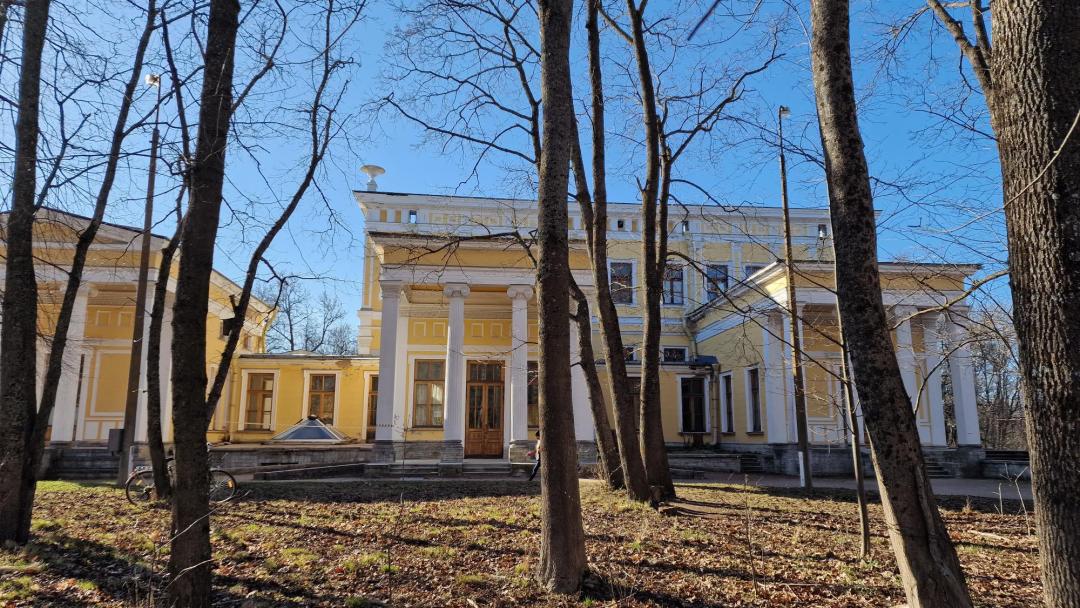
Penates is the museum-estate of the artist Repin, located in the settlement of Repino (formerly Kuokkala).
In 1899, when Repin purchased the plot of land where the estate "Penates" would later be built, he was already a renowned artist, the author of "Ivan the Terrible and His Son," "Princess Sophia," "Barge Haulers on the Volga," and "Religious Procession in Kursk Province," "Refusal of Confession," and "Arrest of the Propagandist," "Meeting of the State Council," portraits of Serov, Mussorgsky, Borodin, Glazunov, Pirogov, Witte, and Nicholas II; for many years he was a member of the Society for Traveling Art Exhibitions. Soon after settling in Penates, he became a professor and head of the art workshop at the Academy of Arts, and from 1898 — rector of the Academy.
It was precisely these numerous duties that forced Repin to look for a home near Saint Petersburg: on one hand, Kuokkala was conveniently located for traveling to the city; on the other, the place on the shore of the Gulf of Finland was secluded enough for Repin to work quietly and without disturbance. The estate was named "Penates" after the Roman gods who protected the household hearth. Images of these gods, the Penates, can be seen on the painted wooden gates of the estate, created according to Repin's drawing. Repin's house remains unique and unlike any other. The house has two floors; on the first floor there is a sculpture workshop as well as living rooms: the owner's study, living room, and dining room.
At the famous "Repin Wednesdays" held in the house, visitors included Maxim Gorky, Korney Chukovsky; Mayakovsky, Yesenin, Leonid Andreyev, David Burliuk, Korolenko, Kuprin, the narodovolets Morozov, composers Lyadov, Glazunov, and many others came here.

A. M. Gorky and M. F. Andreeva at I. E. Repin's
The hill behind the estate is called "Chuguev Hill" in honor of the artist's hometown. Near the house, Latvian workers drilled an artesian well called the "Abyssinian." By the well was the "Bench of Great Anger," where Repin criticized young artists...
The overgrown bushy plot turned into a park within two years.
In the summer of 1899, five ponds were dug on the estate with connecting canals leading to a nearby stream behind the estate called "Maryina Ditch," which flows into the Gulf of Finland.
In 1903, gates with a wicket door were made according to Repin's sketch (folk embroidery patterns), bearing the estate's name and the date "1903." From that moment, the house was inhabited permanently.
In 1906, a second floor was added with glass pavilions, weather vanes, and carved decorations made according to the owner's drawings. Construction was carried out without a plan. The result was dictated by the purpose and practicality of each annex, with plenty of light and air, making it comfortable for the artist to live and work. On the alley named after Pushkin, a clearing called Homer’s Square was cleared. It was decorated with granite boulders and uprooted tree roots, which Repin personally coated with resin. On the right side of the clearing, a gazebo called the "Temple of Osiris and Isis" was built, which often served as a stage. Its appearance has not changed since its construction. On Sundays, cooperative, thus inexpensive, folk festivities were held on the clearing: lectures were read, people sang, danced, and drank tea with buns and candies. Thus, Repin arranged additional rest for himself as prescribed by doctors.
Beyond Homer’s Square, Pushkin Alley leads to a staircase ascending to the "Scheherazade Tower" — a tall observation platform with a spyglass, two-tiered, with turned, openwork, painted railings and balusters. Nearby on the hill were two more gazebos: "Italy’s Booth" and "Rembrandt." This hill was named "Chuguev Hill," and cherry trees were planted on it. Along Chuguev Hill, Pushkin Alley and Birch Alley connect via Pine Alley. Flower beds were laid out around the house. Alpine slides were made from boulders dug out of the ponds. Small pebbles and cobblestones were used for paving paths and reinforcing banks. Wooden bridges were built on alleys and paths to cross ditches. All paths and corners of the park had names honoring friends or relatives, and names changed according to mood. Wooden houses and gazebos were built in the park. Only two have survived to this day.
By 1908, immediately behind the gates, there were two more buildings: the house of a local Finn and a newly built house for Repin’s son Yuri — a solid two-story building similar to the Penates, adapted for the work of a painter. Now a diagonal alley to the museum passes through this place.
According to Nordman’s will, drawn up in 1910, in case of the mistress’s death (which occurred in 1914 in Switzerland from open tuberculosis), the house would become Repin’s property and then pass to the Academy of Arts on the condition that a Repin museum would be established there.
In 1911, at the end of Pushkin Alley, the latest and most ornate round pond was dug, called "Raphael’s Pond." Two parallel alleys were laid through the park: birch from the gates and spruce from the house.
In 1914, a 72-meter deep well was drilled and equipped as an artesian well called "Poseidon," providing clean water with a large flow sufficient to keep the ponds and canals flowing. The water was clean, potable, with a slight iron taste. Repin considered it healing and drank it until his death. White lilies were planted in the large pond near the well, a small boat was launched on the water, and fireworks were held there on holidays. In winter, a carousel was set up on the pond’s ice, and Shalyapin even skated there.
In 1922, the estate’s entrance gates were remodeled by Repin, but the basic design remained the same. During the difficult 1920s, there was a vegetable garden in the park. Besides the house, there were sheds and a one-story janitor’s building located on the right (southern) side of the main house (in the 1920s, Repin’s nephew lived there). On the south facade side, there was a cellar with a glass roof and a glass gallery passage from the house. All these buildings blocked the view of Penates from the main road. According to Nordman’s will, all these buildings were to be destroyed for the museum. They were not restored. The house opened toward the park. All rooms with a view of the park had exits to it, making it a kind of scenic extension. Since 1922, the de facto mistress of the house on Finnish territory was Repin’s eldest daughter Vera Ilyinichna, who returned from Petrograd and was negatively disposed toward Soviet Russia.

Since October 1930, Repin’s grave has been located at the corner of Birch and Pine alleys.
In 1939, Vera and her brother Yuri evacuated to Helsinki, taking part of their belongings by their father’s order.
In 1940, the territory of Kuokkala became Soviet; the house remained intact. After the evacuation of Repin’s children, the interior was preserved, even food on plates in the dining room — apparently they left in a hurry. The floors were covered with scattered documents. A museum in memory of I. E. Repin was established in Penates, and a temporary plaster bust was installed on the grave instead of the cross.
In 1944, only foundations and stove frames were found of the house and all park buildings. Since no measurements of the house had been made earlier, restoration proceeded based on the surviving foundation and numerous photographs. In the 1930s–1940s, an inventory of items preserved in Penates was made, facilitating the search for interior objects. Based on interior photos, the Academy began acquiring similar furniture that had not survived. Exhibitions of photographs of required items were arranged. It is known that a Becker piano No. 34132 stood in the living room, chosen for Repin by composer Glazunov. A piano close in number and one on which Glazunov had previously played was found by chance. The piano’s owner was a student of the composer. Some furniture from the artist’s Petersburg apartment, whose authenticity is indisputable, was preserved by distant relatives of Repin: an inlaid pseudo-Oriental table depicted in the painting "The Negress," a music stand with Repin’s autograph. This furniture and items supplemented the Penates interior. The dining table with a rotating center was remade thanks to drawings with construction explanations preserved in the Russian Museum archive. Stoves and fireplaces were restored based on paintings and interior sketches. Artist Muntyan, who made sketches for stove restoration, collected tile fragments for samples from the house ruins in 1944. For small stoves in the winter workshop, tiles from dismantled stoves of the Russian Museum were used.
In 1946, a monument was installed on the grave in the form of a granite pedestal with a bronze bust of the artist, created in 1909 by Andreev.
In 1960, the "Scheherazade" gazebo was restored in Penates. From 1969, it was repaired annually and regularly included in the major repair plan, remaining in a condition dangerous for visitors.
In 1994, after restoration work in Penates, the monument was replaced by a beautiful wooden cross, as it had been before 1940.
In 2019, the Finnish auction house Hagelstam donated to the Repin museum "Penates" a family archive purchased from relatives of the artist’s daughter Vera Ilyinichna.
Instead of some lost works that were in Penates, mainly works by Repin’s students, paintings by the same artists from the same period were found. Thus appeared Serov’s study "Pirate," portraits by Kustodiev, Kulikov, Brodsky, Petrov, Malyavin. Currently, about 600 works of painting and graphics are housed in Penates.
The park, house, and interior of the rooms have been recreated as they were in 1905–1912, the most significant period of Repin’s life. Ten rooms were restored, including the winter veranda. The kitchen, bathroom, and other utility annexes were not restored according to the will, so they now serve as the museum wardrobe and offices for scientific work. These three rooms retained the old layout, but their interior decoration was not restored due to lack of necessary photographs, and the rooms changed their purpose several times. It is known that the corner room was Nordman’s bedroom, then Nadezhda Ilyinichna’s; the middle served as a small dining room, and the first room housed servants. Large photographs of the artist’s main works are displayed on the walls of these rooms in the museum. Archive documents and biographical materials are exhibited in display cases along the walls.
At the beginning of the 20th century, the entrance hall was accessed directly from the porch. It is a small, very bright room, with the entire southern wall occupied by a patterned window. By the window on a bamboo stand is a copper gong — "Tam-Tam." It was ordered by Nordman in 1909 from Paris. Above the gong is a handmade poster: "Self-help… Take off your coat and galoshes yourselves… Strike the Tam-Tam cheerfully and strongly… Open the dining room door yourselves…". Self-help was the motto of Repin’s house. There was no doorman here. Everyone worked on equal terms, including the owners. Servitude was considered unacceptable. The room from which visitors now view the entrance hall was a small dining room where the owners dined every day except Wednesday. Telephone devices — local and long-distance — were also located here. By the entrance door on the right stands the old Penates flag. It was blue and raised over the house on Wednesdays. On the coat rack nearby is Repin’s winged cap, on the table a hat and beret. The winged cap was depicted by Soviet sculptor M. G. Manizer.
A bust by his work is installed in the center of the settlement of Repino. By the window stands an old wooden chest. In the 1920s, it was given to the servant Mina Lautanen when she got married. In the summer of 1962, the chest returned from Finland to Penates as a gift from Mina’s husband. Opposite the entrance doors is a simple mirror; instead of a mirror shelf, there is a box made of planks covered with a homespun woolen tablecloth. Nearby is Repin’s small leather travel bag. In the corner are homemade canes and a digging tool. In the entrance hall by the mirror is a large photograph taken on July 20 (August 2), 1912. Guests on the steps of the "Scheherazade Tower" gazebo. Repin and Nordman sit on the left; opposite Repin is artist Botkin.
The study is attached to one of the rooms and seemingly opens into the garden. The room with a semicircular glass wall is always full of light. This is the latest annex to the house, built in 1911. In the center of the study stands a writing desk. On it are personal items and pages of memoirs. In display cases in front of the study are books with gift inscriptions from Chekhov, Korolenko, Bunin, Leskov, Leonid Andreyev, Mendeleev, and others. There are also books about Lenin and his works, sent to Penates at Repin’s request in 1926. According to the memories of Repin’s student and old friend from the academy, Komashko, who lived in Penates for about three years, the artist often used the study as a workshop because it had a lot of light. Repin wrote his memoirs "The Distant Near" in the study. Along the walls are shelves with books and statues of Russian giants in small form by sculptor Ginzburg. On the writing desk in simple frames are photographs of close ones: portraits of father, mother, and ten-year-old son Yuri. Here also lie folders with congratulatory addresses, blotters, and a briefcase with the monogram "I. R." A large piece of green glass served as a paperweight — a memento of a visit to the Bryansk factory. To the left stands a box with a large magnifying glass in a wooden frame — a device used for examining photographs. A carved casket containing 436 letters of sympathy sent to Repin regarding the unfortunate incident around the painting "Ivan the Terrible." A small slab of pink marble, serving as an inkwell stand, was gifted by architect Svinin on August 21, 1910, the day of the opening of the Russian Museum wing built to his design. Next to the writing desk is a plaster cast of Michelangelo’s statue "The Crouching Boy" (original in the Hermitage). On the tiled stove to the left is a bronze statuette "Narcissus" — a memento of a trip to Naples. Guests gathered here on Wednesdays. The room was distinguished by the simplicity of its decor. Its main decoration was paintings — works by Repin’s students and friends. At the entrance is a cast of the famous Venus de Milo sculpture (the living room was sometimes called the "Venus Room"). On ordinary days, this room was Natalia Nordman’s study. There was always a piano here. Near it on the wall hangs a photograph of young Gorky with a gift inscription. On the wall to the left of the piano hangs a handmade carpet embroidered with a cross according to architect Gun’s design — a gift from singer Molas, a promoter of Mussorgsky’s work. Above the door near the staircase leading to the workshop hangs a portrait of Chukovsky, painted by Brodsky in 1915.
On Nordman’s work desk, covered with a silk gray fabric with lilac stripes that has survived to this day, you can see photographs of Repin and Nordman herself. On the left wall is a portrait drawing of Nordman done by Repin. Every Sunday in winter, public lectures on various topics were held in the living room. Lecturers included the listeners themselves. Vasily Nikolaevich Kipyatov (janitor of the city of Bashmakov) gave a lecture on beekeeping, etc. The audience was very diverse: prisoners, clerks, janitors, cooks, maids, farmers, etc., from 10-year-olds to 60-year-olds. The large room was never locked for anyone, always packed and astonishing lecturers with unusual attention. According to Repin, it was a mini-people’s university. In summer, lectures were held in the garden, ending with singing folk factory songs, ditties, and dancing. Sometimes lectures were moved to the summer theater "Prometheus," purchased by Repin for Nordman on the shore of the bay in the village of Ollila. In 1911, Nordman opened a summer day nursery there for local children. The living room contains works by Repin’s students and friends.
Above Nordman’s small table hangs the work of artist Pervukhin "Bridge in Venice," above the entrance to the dining room hangs "Winter Landscape" by Repin’s student Skalon, below on the door — a photograph of a group of traveling artists. As a memory of the "Society" — a small still life "Vase with Flowers" signed by Repin, Makovsky, Pryanishnikov, and Polenov. Below hangs a landscape with a sailboat painted by Vasilyev during a trip with Repin on the Volga in 1870. Near the large wall clock is one of Repin’s early works — Serov’s study with a red hunting dog "Pirate." To the right of the entrance to the winter veranda is the work of Chuguev painters — Repin’s first teachers. At the top right hangs a double portrait of Major Kupriyanov with his wife, painted by artist Shamanov. Small portraits of Leonty Ivanovich Persanov hang in the living room. Among them are paired portraits of the Nechitailovs, a profile of Yakov Logvinov, and a portrait of a boy on the riverbank, painted in the mid-19th century. In the lower row is a small Repin study depicting the house where he lived in Chuguev. The portrait of a red-bearded man in a blue robe depicts Repin’s landlord in his first room on Vasilyevsky Island — architect Alexander Dmitrievich Petrov. Above the door to the winter veranda hangs a "Landscape" painted by his son Yuri. Under the large Repin clock is a watercolor self-portrait of Vera Alekseevna — Repin’s first wife. In the photograph next to the self-portrait, Repin is with his children. On the right — eldest daughter Vera, on the left — second daughter Nadezhda, then son Yuri, youngest daughter Tatyana.
The octagonal veranda crowned with a transparent tent roof is almost two-thirds glass. This is the earliest annex (kiosk) to the house, built in 1904 and initially served as a workshop. Later, a second floor with a spacious workshop was added, and the log winter veranda was sheathed with boards and painted. Its exterior walls were decorated with carved images of fantastic beasts. The brightest room in the house, facing the park, although located in the northern part of the house. Guests were received here, tea was drunk, and sometimes, with doors open and the piano pulled out, home concerts were held. Through the glass doors of the veranda, a large amount of light penetrates into the living room. In the summer of 1905, it was turned into a workshop for painting the double portrait of Gorky with Andreeva. On a high stand, in a soft chair, which can still be seen on the veranda, Andreeva settled, and nearby, on the windowsill, with legs crossed and chin resting on her hand, sat Gorky.
This room was also called the "veranda of busts," with Repin’s sculptural works along the walls. Three sculptural portraits remain in their original places, the earliest of which (1881) is the bust of Russian surgeon Pirogov. The bust of Tolstoy was modeled in 1891 in Yasnaya Polyana; nearby is the sculptural portrait of Nordman from 1902. Here is also Repin’s bust, modeled by painter Viktor Vasnetsov in 1880 in Abramtsevo. It is considered Vasnetsov’s only sculptural work. In 1930, Repin’s coffin stood here and was taken from here on his last journey.
From the living room, a door leads to the dining room. This is a spacious room with a large window overlooking the garden. On the walls are Repin’s works — portraits of people close to him: a portrait of Nordman painted in 1905 in Italy, a portrait of daughters Vera and Nadia (1877), a pastel portrait of Ge — an actor of the Alexandrinsky Theater, nephew of the famous artist, a sketch painting on a historical theme "The Call of Minin to the People of Nizhny Novgorod. The Interregnum of 1612" (1876–1915), and other works. Wednesday dinners were held here. In the center stands a special round table for 20 people, made to order by Nordman from Finnish carpenter Pekko Hanekainen in 1909 (a replica since 1962). The rotating central round element of the table with a handle did not require the presence of outside servants; guests could serve themselves without help from servants or even neighbors. Clean dishes stood nearby, and dirty ones were placed in pull-out lower drawers. By dinner at six o’clock in the evening, only close acquaintances remained (the dining room could not accommodate all who came to Repin that day). To the sound of the gong and organ music, everyone entered the dining room. At the small table with the bread slicer, everyone took bread (this table has not survived). Seats at the table were determined by lot. Number one became the chairman, responsible for removing lids from pots with dishes. Some dishes were kept in the "magic chest." This chest, ordered by Nordman from Dresden, functioned as a thermos and stood by the window in the dining room. Vegetarian menu cards with round table rules have survived. Deliciously prepared vegetables, fruits, dishes from various herbs (hay) — soups, cutlets. One card dated 10.08.1911 is on the table. For violating self-help rules, one had to deliver an ideological speech impromptu from the podium located in the corner of the dining room on a platform; toasts were not allowed. The more violations, the merrier the dinner. Chukovsky and Evreinov stood out the most.
Repin often changed paintings on the dining room walls, some he sold or gave away, and new ones appeared in their place. Now the dining room contains early works created in Chuguev and works from later years. To the right of the buffet hangs the watercolor "Bandurist" (1859), to the left by the tiled stove is a small portrait of a red-haired girl knitting (on the back is the inscription "Ilya Efimych photographed Anyuta Petrova, 20 years old"), next to it a landscape "Normandy" without signature or date. The central place in the dining room is occupied by Nordman’s 1905 portrait; in 1929, there was an attempt to sell this portrait, but the sale did not take place due to the high price. To the left of Nordman’s portrait is a painting (1877) depicting two girls standing among scattered toys. These are Repin’s daughters. In 1902, this painting was gifted to granddaughter Tasa (married name Tatyana Nikolaevna Dyakova), daughter of Tatyana Ilyinichna Yazova, who emigrated to Paris in the 1920s. Descendants on this line regularly visit Penates on memorable dates.
Here is also Ge’s pastel — actor and director who posed for Repin when painting "Pushkin on the Neva Embankment." Below is a small study-portrait of Pavlov painted in the park in the 1920s. On the same wall to the left is a portrait of sculptor Ginzburg (1907 in Penates). On the far left of this wall are portraits of Professor Denisyuk and a study for the painting "Pushkin on the Banks of the Neva."
The sketch-painting "The Call of Minin to Nizhny Novgorod" (1876–1915) was started in Chuguev but never finished. In the lower row is the sketch "Meeting of Troops." In 1914, the sketch was sold; after 1917, it ended up in the Russian Museum and was transferred to Penates in 1940. The landscape "Pond in Penates" is painted in dark tones. In the wall space by the podium hangs a portrait of Vera Ilyinichna (1926), made with lithographic pencil. In the late 1920s, Repin could not climb to the second floor, and the dining room served as his bedroom and workshop; between the podium and stove, separated by a screen, stood a small sofa where he slept. On August 1930, on his 86th birthday, Repin received guests in the dining room — for the last time. He died in this room on September 29, 1930.
The artist’s workshop is located on the 2nd floor, accessible by a narrow steep staircase. It was built according to the artist’s own design in 1906. The log walls are natural in color, with carved window and door trims, stair railings with balusters — all testify to a distinctive stylization of Russian folk architecture motifs.

The workshop occupies almost the entire second floor. It can be divided into three parts with curtains. There is an abundance of light coming through the glass ceiling and large windows.
In the central part on a large easel is Repin’s last self-portrait from 1920. The artist was 76 years old. It can be considered one of the best works of his late period. The hat in which Repin depicted himself has been preserved; it lies nearby on a stool to the right of the self-portrait. Repin’s working smock hangs on the wardrobe. Nearby on a table in a blue vase are Repin’s brushes. On a low stool to the right is his famous hanging palette. Interesting works related to the painting "Solemn Meeting of the State Council" (1903) are here. The painting was made in Petersburg, but sketches of the composition — painted and graphic — ended up in Penates. Here are also studies for portraits of State Council members made by Repin’s students — Kulikov and Kustodiev. These artists helped Repin with the painting.

The workshop walls were always filled with Repin’s studies and sketches. Work was underway on several paintings simultaneously, and several easels with canvases stood in the workshop. On Wednesdays, outsiders could enter the workshop to see paintings and give critical opinions. Repin could work and talk with visitors simultaneously, which is reflected in his paintings. But he worked on large paintings alone and did not show them until completion.
In the Penates workshop, the paintings "Pushkin at the Lyceum Act on January 8, 1915" (1911), "What a Space" (1903), "Manifestation of October 17, 1905" (1907–1911), "Golgotha" (1922–1925), "Hopak" (1927) were painted. According to the artist, he spent the best hours of his life in the workshop. K. Chukovsky recalled how Repin "in the morning, barely awake, ran to the workshop and tortured himself with creativity, because he was an unparalleled worker and even a little ashamed of that passion for work that forced him from dawn to dusk, without putting down brushes, to give all his strength to the huge canvases surrounding him in the workshop."
At the entrance to the balcony on the easel is a large canvas depicting a large white-columned hall, rows of chairs, and seated figures — this is a sketch of the "Solemn Meeting of the State Council." The painting itself is in the Russian Museum. Repin was helped by his students. Early works of students are placed in the first part of the workshop. Above the ladder leading to the costume room hangs a large full-length portrait of a girl — a portrait of Thorzhevskaya-Petrova painted by Malyavin. Here is also an early work by Kustodiev — a profile portrait of an elderly gray-haired woman, and above a small "prison" window hangs a portrait of Kustodiev himself, painted by Kulikov. The young man is depicted semi-reclining with a book in his hands. In the central part of the workshop, near the fireplace, are authentic items of Zaporozhian Cossacks from the collection belonging to scholar Yavornitsky (who became the model for the scribe) and used in the work on the paintings "Zaporozhians Write a Letter to the Turkish Sultan," "Black Sea Freedom," "Hopak."
On the table near the "Shalyapin" sofa stand only three surviving figurines of Zaporozhians sculpted by Repin, which have come down to us, albeit without heads and hands. Above the small window, as in Repin’s time, hangs a drawing depicting a boy with a forelock tucked behind his ear. This is a portrait of Yuri Repin. On the wall by the fireplace, on a Ukrainian plank, hangs antique weaponry — a curved Turkish saber with a beautifully curved handle made of pale green horn and a matchlock rifle of Eastern Turkish origin. Such trophy weapons were used by the Zaporozhians. Below on a stand lie sheaths for sabers and shashkas, a leather wine flask, a fringed leather pouch, and homemade sheaths for two knives. A favorite musical instrument of the Zaporozhians — the torban — leans against the stand. To its accompaniment, old Ukrainian and Russian songs and dumy were sung in Penates. To the left in the corner by the fireplace, on a mannequin, is a "kobnyak z vidloho" — outerwear of the Cossacks made of white homespun cloth. In the corner above the Zaporozhian items hangs a Turkish flag made of green fabric with colorful appliqués. On the wall protrusion is a small round bas-relief of "Zaporozhians…" made of fired clay by Ukrainian master potter Vasily Porosny from the town of Opishnya. On the right wall hangs a small sketch of the painting "Black Sea Freedom." One study for this painting — "Praying Zaporozhian" — is preserved in Penates. It stands on an easel. On the wall next to the large window is a work by Yuri — who copied the Zaporozhian banner in the Hermitage: its central part, on a crimson background, shows a ship — the famous Zaporozhian chaika with figures of Zaporozhians. To the left of the Zaporozhian banner copy hangs a portrait of Yuri (possibly a self-portrait). In the wall space by the third staircase leading to the summer workshop hangs a study of the model boy Edy. In a photograph on the staircase landing leading to the summer workshop, a group of Repin’s guests is captured near this work. In the center of the workshop by the window is the "Shalyapin" sofa (the original has not survived; the exhibit is close in shape and upholstery color), named so because Shalyapin posed on it (the portrait was never completed). In the workshop is a bust of Shalyapin, made by Trubetskoy in an impressionist manner at the end of 1890 and gifted to Repin in 1906. To the left of the bust is a portrait drawing of Repin by Trubetskoy, as a memento of his visit to Penates on May 13, 1906. To the right of the large window on the wall are Repin’s studies: a portrait of Finnish poet Eino Leino — for the painting "Finnish Celebrities," two soldiers — for the painting "Attack with Sister," a sketch for the unrealized painting "Peter I at the Shipyard." On the gilded easel is Repin’s painting "View of Vesuvius at Night," painted in Italy in 1873. In the depth of the workshop by the window is the unfinished painting "Pushkin on the Neva Embankment," which Repin painted and repainted for over 30 years, constantly changing the composition. The painting has a dedication: on the pedestal under the bronze lion is clearly read the inscription "Dedicated to Alexander Alexandrovich, Sophia Alexandrovna, Mikhail Alexandrovich Stakhovich" — they were devoted Pushkin enthusiasts. In the depth of the workshop and on the ladder-stand are Roman warrior armor (props) used for working on paintings; here is also a chair for posing and a large vase with brushes.
Climbing from the winter workshop by one of the ladders, you can get to the next room, whose windows face north. It was good to work here in summer. Repin stored paintings here that he did not consider finished and did not want to show anyone. This workshop was called "secret," rarely visited by outsiders. Originally, there was a large open balcony here, where Repin liked to paint. The summer workshop was built in 1906, simultaneously with the winter one, and also has top lighting. There is not a single photograph of this room; only its layout is known. On the walls are drawings by Repin’s friends and students. Thousands of them accumulated, several bookcases, usually not shown to anyone, and served as material for further work. After the artist’s death, this legacy was divided among his children, who sold them. More than a hundred of his drawings of various years accidentally remained in Penates. The summer workshop room is sometimes used for temporary exhibitions.
You can get from the summer to the winter workshop through the costume room: a small room where costumes for models were stored. Now these costumes are placed in a large display cabinet. Many of these items are depicted in paintings. After Repin’s death, they were sold abroad by his daughter Vera. In 1964, the telogreya (the costume of Princess Sophia for the painting "Ruler Princess Sophia Alekseevna") returned to Penates as a gift from Czech artist Fiala. In the red hetman’s zhupan (authentic Zaporozhian clothing of the 17th century) is depicted Tarnovsky in the 1880 portrait. Here is also the national clothing of Arabs: abu — an open cloak and striped silk head covering, purchased by Repin in Palestine in 1898.
After the workshop was built, a balcony with a glass roof was erected above it, over the study. It could be reached by a ladder directly from the study. This annex was a continuation of the workshop, but outdoors. The balcony, from which the park and the bay shore were visible, was jokingly called the airplane. Repin also slept here in summer on a bench. In winter — in a special sleeping bag down to −20 degrees Celsius; when the temperature dropped lower, the artist went down to his study.
Sources:
https://repino.cronwell.com/map/muzey-usadba-i-e-repina-penaty/


Written by Jermaine
Discuss this with the author and others
No comments yet. Be the first to start the conversation.