Chernov's Dacha or Sosnovka

Oktyabrskaya Embankment, 72, Saint Petersburg, Russia, 193079

Chernov's Dacha, or Sosnovka, is a monument of the architectural eclecticism period in the Nevsky District of Saint Petersburg, located on the right bank of the Neva River, above the Volodarsky Bridge, opposite the former River Station.

The history of constructions on the site of the park dates back to the period of Swedish rule. A village was located on the site of the estate, surrounded by several brick factories that operated for a very long time—until the beginning of the 20th century. The bricks from these factories were used to build the Swedish town of Nien, which preceded St. Petersburg. Besides working at the brick factories, the local residents engaged in fishing. After the victory in the Great Northern War, the village received the Russian name Gleznevo.

Peter's decree of 1716 sent fishermen from the Oka River to permanently settle in the village; they supplied fish to the tsar’s table. The village’s name was changed to Rybatskoye (Fishermen’s). Later, when some fishermen moved to the left bank because it was more convenient to reach the markets in the city center due to the lack of bridges, the village became known as Maloye Rybatskoye (Little Fishermen’s), and the relocated fishermen formed a settlement that later developed into the Rybatskoye district. Fishing opportunities remain to this day, and during the smelt run, a temporary fishing pier is installed on the embankment directly opposite the estate on the Neva River. On the 1817 map, the village of Maloye Rybatskoye is still visible on the site of the estate. In 2022, the toponymic commission of Saint Petersburg restored the name of the microdistrict around Sosnovka to its historical name "Maloye Rybatskoye," as one of the oldest districts of the city.

Prince Gavriil Gagarin was the client of the park in its current concept of landscaped ponds and a garden on the embankment.

Plan of Prince Gagarin’s estate in 1824. The layout of Chernov’s garden during restoration was made close to this map. The pond system in Prince Gagarin’s estate was about twice the size of the current one. Around 1820, the owner of the land with the pine forest became Prince Gavriil Petrovich Gagarin, known as a minister, writer, and representative of Freemasonry in Russia. He built a wooden manor house on the estate. On the 1824 map, it can be seen that Gagarin’s estate already had a park and a pond system created by order of the prince. The garden adjacent to the Neva still largely repeats the layout of paths and planting schemes of Gagarin’s early 19th-century estate. This is due to the 2007 reconstruction, which was based on old maps. The luxurious and huge park for the early 19th century reflected the status of the prince, who traced his lineage back to Vsevolod Yuryevich "Big Nest"—the Grand Prince of Vladimir. However, the estate was used by his son Pavel Gavrilovich Gagarin, known as a brilliant diplomat, military man, and writer. Nevertheless, the estate bears witness to the drama of his personal life. The prince’s first wife was Anna Lopukhina, a lady-in-waiting to Empress Maria Feodorovna. However, she became the favorite of Emperor Paul I, which gave the prince a rapid career rise but an unhappy family. Prince Pavel was forced to move completely to Sosnovka at age 54 after his second marriage to ballerina Maria Spiridonova. The couple was happy, but the high society of St. Petersburg considered marriage to a "commoner" unacceptable for a descendant of Rurik. Therefore, the prince left the family mansion on the Palace Embankment and secluded himself in the estate near the pine forest. Prince Pavel was so in love with his chosen one that he even renamed the Sosnovka estate to Maryino, which can be seen on some 19th-century maps.

After the prince’s death, the estate was sold several times until 1889, when it was purchased by Colonel Alexander Ivanovich Chernov. Chernov planned to build a luxurious stone mansion for himself and demolish the old wooden house of Prince Gagarin.

Although he later attained the rank of general, even historians are unclear about the details of his military career and achievements. Chernov became known not as a military man but as a land businessman and charismatic personality prone to adventurous projects. He came from the wealthy Chernov family, whose coat of arms still decorates the doors of the estate today. The merchant Chernov family was ennobled only in 1838 as a reward for supplying Russian troops during wars. Wanting to maximize income from Sosnovka, Chernov decided to sell part of the land for an agricultural colony. He actively collected advance payments for a yet non-existent settlement, in which a "Chernovsky Prospect" was already planned. However, Chernov allocated swampy plots for sale and received many complaints from buyers. Eventually, the zemstvo forbade him from engaging in "land development" without proper land preparation and obliged him to return deposits to some buyers. The plots cut by Chernov that he managed to sell are still visible on the 1935 map. Later, a hospital for war veterans was built on their site. General Chernov was also prone to a dissolute lifestyle, which is reflected in the architecture of the Sosnovka estate, where he demanded from the architects to connect his "office" directly with the wine cellar and bedroom. As one of the estate’s architects, A. V. Kuznetsov, wrote, the general demanded the office be designed "for special visits" in an "intimate setting." The general’s character, who walked around the house naked and kept horses like a tsar for hunting, draws attention to his lifestyle in Sosnovka. It is evident that General Chernov tried to get the maximum pleasure from life, even in old age participating in horse races and yacht competitions as a member of the Trotting Racing Society and the St. Petersburg Yacht Club.

Chernov prepared a detailed brief for the architects on the mansion’s layout, considering his entertainments and planned guests. The architectural appearance of the new mansion’s exterior was designed by von Hogen in the Neo-Russian style but in a rather unusual free eclectic interpretation. Hogen used this variant of eclecticism inspired by Russian architecture only in one other work—the Suvorov Museum in St. Petersburg, which was built after Chernov’s dacha and became a source of his architectural solutions.

An essential attribute of the Neo-Russian style chosen by Hogen is the tented towers. Hogen placed them at different levels, giving the building dynamism. To enhance the effect, rich decor was used, including facade inserts with flower images. The basement floor was done in a European style close to medieval hunting castles. This reflects the character of the owner, who was an avid hunter. The mixing of styles allows us to say that the building is best classified as eclecticism based on a mixture of Russian and Western European traditions combined with the latest facade decoration methods of that time. The mansion’s facade includes rich decor and many viewing and walking platforms.

In issues 11-12 of "Zodchy" magazine in 1889, an article by architect A. V. Kuznetsov about the project was published.
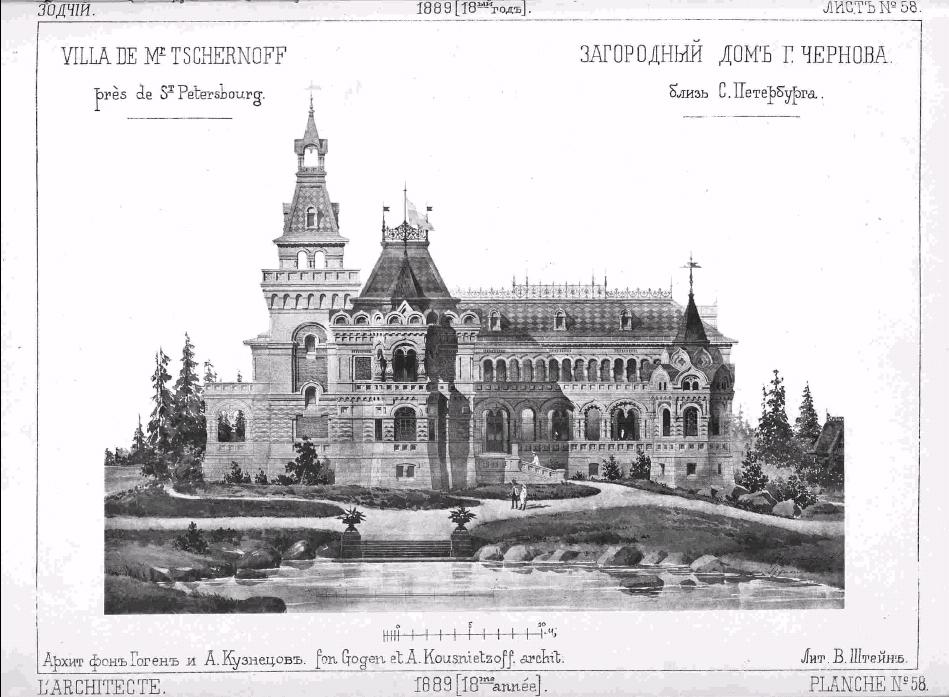
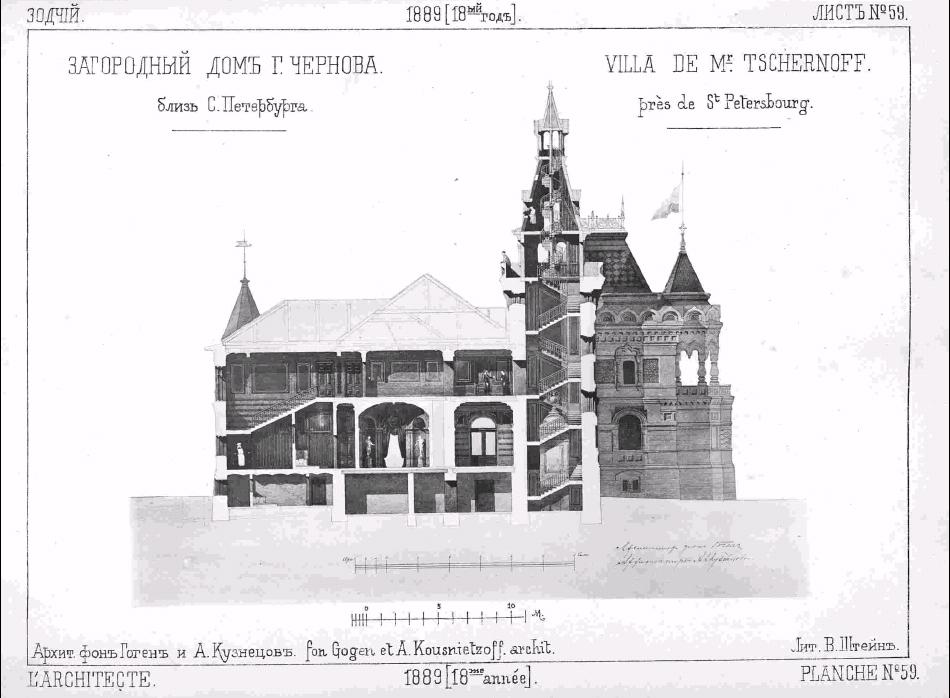

Drawings signed by A. I. von Hogen and A. V. Kuznetsov were also published there. Below is a brief description of the mansion based on the architect’s article, but later reconstructions must be taken into account.

The mansion initially had a living area of 2,000 m² over 3 floors, consisting of 25 rooms divided into ceremonial rooms for guests, private rooms for the owner, and rooms for servants. However, Radio Center No. 3 carried out a reconstruction of the mansion to accommodate radio equipment and power substations. According to Rosreestr data, the living area was reduced to 1,599 m². The remaining area is occupied by equipment. Additionally, the number of floors increased from 3 to 4. The original project included a very large, unheated attic, which was not intended for use as a room. The radio center used the attic to house communication equipment and installed a parabolic antenna on the mansion’s roof. To accommodate power substations for radio equipment, an extension was built on the front facade with air cooling through ventilation openings. Some equipment was also placed in the basement, also equipped with air cooling.

Most of the layout solutions were devised by Chernov himself as a brief for the architects; the building’s facade was implemented by the architects at their discretion.

The estate’s estimate, excluding room finishing and landscaping work in the park, amounted to 88,072 rubles. Since the gold standard for the ruble soon came into effect, the equivalent cost of the estate building was more than 100 kilograms of gold coins at the exchange rate of that time.

The basement (ground) floor is residential with a ceiling height of 284 cm. The upper part of the basement floor is raised halfway above ground level to provide natural lighting through windows. There was a spacious kitchen and several rooms for household servants, connected to the first floor by a separate servant’s staircase.

The architects actively used new technologies of the time, and the ceiling was supported by metal structures ("rails").

A highlight of the project was "Chernov’s office," which reflected his entertainments. The office was the central and largest room in the mansion. According to Chernov’s request, the office was to be designed as an intimate zone for "special visits," not for business receptions as was customary at the time. The "intimacy" of the office area meant that Chernov and his "special visitor" could use many important rooms without crossing paths with other guests or even servants in the house. The office had a separate entrance from the street through a porch with an adjoining gallery, allowing the general to bring a guest into the house through a separate intimate entrance. In fact, the mansion was divided into intimate and public parts.

The office is connected by a staircase enclosed within the tower walls to the wine cellar located below in the basement and to the bedroom located above the office on the second floor. Chernov deemed it necessary to complement the "workspace" not only with a wine cellar and bedroom but also with access from the office via a staircase to the second floor to a photographic pavilion. After the general, no photographs of his work with his "special visitors" remained, as he likely took them with him into emigration.

Access to Chernov’s office was only possible through the library, which was meant to give visitors the impression of the owner’s erudition, but as Kuznetsov ironically notes in his article, it was more a set of bookcases as decoration than a real library.

Between the turns of the staircase in the tower, a secret compartment was also arranged for storing valuables and documents.

On the first floor, there was a dining room adjoining a guest (ceremonial) hall. The idea was that the latter could also serve as a dining room during large gatherings. These rooms were connected by an arch, forming one space. Through the ceremonial entrance, one could enter the ceremonial hall via an octagonal living room or the billiard room.

The spacious billiard room on the first floor was designed to accommodate both a billiard table and sofas for guests. A passage through the gallery to the home church was planned, but the general ultimately abandoned the construction of the church.

Most of the interiors of the first-floor rooms have been well preserved in terms of windows, doors, and ceiling decoration. The ceremonial staircase has been preserved in its original form.

As noted, from the private staircase in the tower, the general and his guest could reach his bedroom and the room designated for the photo pavilion.

In the depth of the general’s spacious bedroom, there is an alcove with access to a restroom.

The long open terrace above the first-floor gallery overlooking the Neva was intended as a walking place only for the owner and his "special visitors," as it has an entrance only from his bedroom through a door in his private restroom. Also, access to the viewing balcony overlooking the Neva above the office is possible only from the general’s private bedroom. Three rooms were allocated for visiting guests. Two rooms were for the estate manager. All these rooms have separate exits to the wide platform of the ceremonial staircase.

When the mansion was converted into a hospital, most of the second-floor interiors were destroyed, but the original room layout and historic windows were preserved. The 21-meter-high tower is built of brick up to the roof’s base; above that, it is constructed from metal structures covered with wooden cladding, which is then covered with a metal roof. The tower houses a preserved cast-iron spiral staircase decorated with ornamental castings. The staircase leads to an observation deck with panoramic views of the surroundings. Chernov intended the observation deck to be higher than the crowns of even century-old trees so that guests could see to the horizon in all directions, which was meant to impress the general’s private guests. Access to the tower’s observation deck is also intimate, through the staircase in the tower adjoining the bedroom.


The dacha was built in just 3 years by 1893, and this year is reflected on the weather vane on its tower. Hogen, together with two assistants—then young but later also well-known architects A. I. Kuznetsov and G. I. Lyutsedarsky—carried out not only the dacha’s construction but also the park’s reconstruction and the shaping of the ponds to their modern state. The park quickly became popular in the area, so Chernov, by then a general, began charging an entrance fee of 2-5 kopecks. Besides the opportunity to relax, it turned out that the park and the adjoining pine forest provided good conditions for growing various mushrooms, and many visited Chernov’s estate as mushroom pickers. Mushrooms are still collected in Sosnovka’s territory today. The magazine "Capital and Estate" in 1915, issue No. 25, wrote that gazebos were built on islands in the ponds and that the huge park naturally transitioned into the pine forest.

In 1918, Chernov either emigrated from Russia or died due to his wild lifestyle. The circumstances of the general’s death are a subject of debate among historians. In any case, in 1918, the mansion was left ownerless.

In 1919, Chernov’s mansion was opened as a rest home for workers of the Nevskaya Zastava. However, the estate’s elite status made it effectively a dacha for the Leningrad House of Writers, where writers and poets could come upon recommendation. Many famous Soviet Russian writers rested at Chernov’s dacha. Visitors included Nikolai Gumilev, Erich Gollerbach, Nikolai Volkovsky, and many others. Gollerbach noted that when Gumilev read poetry at the dacha, a quite colorful society of workers, writers, and "bourgeois ladies" gathered to listen. Volkovsky wrote that at the dacha one could listen to Gumilev "without commissars, without slogans, without leather jackets and ‘party discipline.’"

In 1930, the rest home was closed, and a maternity hospital opened on the first floor, with a polyclinic on the second. In 1941, a military hospital was built nearby, and doctors moved to work there. Later, in 1946, it was repurposed into the now well-known Hospital for War Veterans.


Towers between which the antennas of Radio Center No. 3 were previously stretched

According to the decree of the Military Council of the Leningrad Front dated April 25, 1943, a radio station RV-1141 with a shortwave transmitter of 60 kW power was built on the former dacha’s territory, marking the start of Radio Center No. 3. On November 6, 1943, the radio station began broadcasting with a speech by Joseph Stalin. After the radio center was built, the dacha and its park became closed to visitors.

After the first few broadcasts, the station was heavily shelled, and the equipment had to be removed for storage. The station resumed broadcasting on June 20, 1944, after the lifting of the Siege of Leningrad.

According to Rosreestr data, construction of six "radio towers" was completed in 1949. The radio towers are 75 meters high. Various radio equipment was later installed on them.

Radio Center No. 3 was used to "jam" Western shortwave radio stations on Soviet territory. During the ideological confrontation of the two systems, it was necessary to drastically increase the power of broadcasting stations to effectively counteract capitalist bloc radio stations deployed along the USSR border. In the 1950s-1960s, radio centers around Leningrad were included in a program to deploy powerful electronic warfare transmitters. Several generations of jamming transmitters existed, such as "Sneg," "Typhoon," and "Buran." The "Buran" transmitter, with 500 kW power, was usually used in a "paired" configuration DS-1000 with about 1 megawatt power, classifying it as a super-powerful transmitter even today. "Buran" used innovative evaporative cooling of tubes. In 1963, a large garage of 515 m² was built near the estate for equipment installation and maintenance. The specific configuration of Radio Center No. 3’s electronic warfare equipment remains classified, but the standard deployment for Leningrad radio centers included several "Buran" units with a total power of about 2-4 megawatts. Such high power was required because NATO military stations for "Voice of America," "Radio Free Europe," "Radio Liberty," "BBC," and "Deutsche Welle" had 500 kW power but were deployed in multiples right at the USSR borders and could reach major cities like Leningrad in a single ionospheric reflection. To jam them over a large area of the USSR, an electronic warfare transmitter of at least 2-4 megawatts was needed.

To accommodate antennas for powerful transmitters, the radio towers were reconstructed into masts. The antennas themselves were stretched between the radio towers and were 100 meters long. A total of 32 such giant antennas were stretched between masts on two sites. During the Soviet era, the park territory was fenced with a concrete fence, alarm systems were installed, and militarized security posts were built. For security needs, most of Sosnovka’s territory was equipped with electric lighting. Due to high radiation from operating antennas, residential development adjacent to the radio center was prohibited.

After the USSR’s collapse, Radio Center No. 3 was used for medium-wave broadcasting for some time. Expensive copper antennas were cut from the towers and sold as valuable metal. The center continued broadcasting for the Orthodox Church’s Radonezh radio station. Before ceasing broadcasting, the radio center had 4 transmitters of 10 kW and three antennas. On September 20, 2016, broadcasting from Sosnovka was stopped, and the radio center’s equipment was dismantled and moved to Krasny Bor in the Tosnensky District.

Sources:

https://ru.wikipedia.org/wiki/Дача_Чернова

https://www.gov.spb.ru/gov/otrasl/c_govcontrol/news/238457/

https://www.citywalls.ru/house1410.html

Follow us on social media

More stories from Petersburg: Estates of the City and Surroundings (Leningrad Region)

Palace (Estate) of the Leuchtenberg Family

Leuchtenberg Palace, Oranienbaum Highway, 2, Saint Petersburg, Russia, 198504

The Leuchtenberg Palace is an estate located on the crest of a coastal bluff in the northeastern part of the "Sergievka" park on the western outskirts of Peterhof. The building was constructed by architect Andrey Ivanovich Stakenschneider for Maria Nikolaevna, daughter of Nicholas I, and her husband Maximilian, Duke of Leuchtenberg.

Maryino Estate - the ancestral estate of the Stroganov-Golitsyn family

72, Andrianovo, Leningrad Region, Russia, 187031

The ancestral estate of the Stroganov-Golitsyn family — the Maryino estate is located in the Tosno district of the Leningrad region, near the village of Andrianovo, 60 kilometers from Saint Petersburg. This famous 19th-century Russian estate ensemble still amazes the imagination with its magnificence today.

Roerich Museum-Estate in Izvara

Museum-Estate of N.K. Roerich, house 15a, Izvara village, Leningrad region, Russia, 188414

The Roerich Museum-Estate in Izvara is a unique complex of natural, archaeological, architectural, historical, and cultural monuments, the first state museum in Russia dedicated to the great Russian artist, scientist, traveler, and public figure Nikolai Konstantinovich Roerich. This old Russian estate is connected with Roerich's childhood and youth. Since the early 18th century, Izvara was owned by well-known noble families such as the Sheremetevs, Trubetskoys, Saltykovs, Weimarns, and others. In 1872, the estate was purchased by the artist's father. The Roerich family owned Izvara from 1872 to 1900.

Lost Estates – The Fifth Mountain, the most "disappeared" of all the estates in the Leningrad Region

CQX4+FJ 5th Mountain, Leningrad Oblast, Russia

The Fifth Hill is the most "disappeared" of all the estates in the Leningrad region. Only the remains of the manor house foundation, the park gates, and a crumbling rotunda-shaped church have survived to this day. The name Fifth Hill has been recorded in history since the 18th century, but how it originated is unknown. There was never a First, Second, Third, or Fourth Hill in the vicinity. The last owner of the Fifth Hill was Fyodor Briskorn, the civil governor of the Caucasus province. Later, his widow Olga commissioned a luxurious rotunda church (the Church of the Holy Trinity) in memory of her husband. During its construction, a large amount of soft sedimentary rock was used, which has long since crumbled. This is why the church tilts first to one side, then to the other. It is hard to imagine that as recently as the 1960s it was still in use, given the church’s current state of ruin. The estate itself has practically not survived, with only the foundations of buildings visible here and there. But the outlines of the old park with huge larches, lindens, and ashes are still visible, as well as a pond with an island.

Museum-Estate of V. Nabokov "Rozhdestveno"

Estate Bridge, Kiev Highway, 106, Rozhdestveno, Leningrad Region, Russia, 188356

According to Vladimir Nabokov's recollections: "The Christmas estate — purchased by him specifically for his elder son, who died young — was said to have been built on the ruins of the palace where Peter the Great, a master of dreadful tyranny, imprisoned Alexei. Now it was a charming, extraordinary house. After nearly forty years, I can easily recall both the overall impression and the details in my memory: the marble checkerboard floor in the cool and resonant hall, the heavenly overhead light, the white galleries, a sarcophagus in one corner of the living room, an organ in another, the vivid scent of greenhouse flowers everywhere…"

Lost Estates - The Levashov-Vyazemsky Estate

Mezhozyornaya St., 9, Saint Petersburg, Russia, 194362

The Levashov-Vyazemsky Estate is a ruined monument of manor architecture located in the settlement of Osinovaya Roscha (now the Vyborgsky District of Saint Petersburg), at the junction of the Vyborg and Priozersk highways, 4 km from the settlement of Pesochny. It is one of the numerous Petersburg sites placed under UNESCO protection in 1990.

Lost Estates: The Taitskaya Estate of the Demidovs

Sverdlov Sanatorium, 2, Sverdlov Sanatorium, Leningrad Region, Russia, 198327

To create a luxurious garden and park ensemble, Demidov invited his sister’s husband — Ivan Yegorovich Starov, a young architect and adjunct professor at the Academy of Arts. Construction began in 1774 and continued until 1786. The formation of the ensemble took place in two stages. In the first stage, a manor house was built on the bank of the Verevka River, and to the west, a complex of utility buildings. Behind a long stone fence was a five-part square, which included the two-story residential wing that has survived to this day, the manager’s house, four stables, a gatehouse, a carriage house, and other structures. An alley led to the manor house, curving around an oval parterre in front of its western facade.

The Okhotnikov Estate ("Dylitsy," "Vladimirskaya," "Elizavetino")

FQM3+M3 Verolantsy, Leningrad Oblast, Russia

In the village of Elizavetino in the Gatchina district of the Leningrad region, a monument of Russian architecture from the mid-18th century has been preserved – the palace of the Dylytsy estate. People have lived on the site where the estate is located for a long time. As early as in the land survey book of 1499-1500, there is a mention of the village of Vzdylitsy, the center of the Vzdylitsky Yegoryevsky parish, which is the predecessor of the village of Dylytsy.

Lost Estates - The Tragic Fate of Andrey Ivanovich Shtakenshneider's Estate in Pudost

Gatchinskaya Mill, 2, Myza-Ivanovka, Leningrad Region, Russia, 188352

In addition to his own house on Millionnaya Street, they also described Andrey Ivanovich's estate in the Pudost area, called the Ivanovka Manor — a carved wooden house near a ruined mill, the "pink dacha" on the fast-flowing Izhora River. Listed in directories and tourist maps, this estate unfortunately no longer exists today.

Kiryanovo Estate ("Dashkova's Dacha," "Horseshoe")

pr. Stachek, 3 92, Saint Petersburg, Russia, 198096

Kiryanovo ("Dashkova's Dacha," "Horseshoe") is a country house in the Palladian style, built in 1783–1784 for Princess Vorontsova-Dashkova according to a design by Giacomo Quarenghi at the 4th verst of the Peterhof road.

Priyutino — former estate of the first director of the Public Library

Priyutinskaya St., 1, Vsevolozhsk, Leningrad Region, Russia, 188641

Priyutino is the former estate of the first director of the Public Library, president of the Academy of Arts Olenin, one of the few estates from the first half of the 19th century near St. Petersburg that has survived to this day. It houses the literary and artistic museum "Priyutino."

Lost Estates: The Gersdorff-Weimarn Estate Complex "Kummolova Manor"

MX4P+HH Ananino, Leningrad Oblast, Russia

Kummolovo or the Kummolovo Manor is an old estate that belonged at different times to Russian noble families — the Gersdorfs, von Weimarns, and Blumentrosts. It is located in the Lomonosovsky District of the Leningrad Region, in the village of Kummolovo of the same name, now uninhabited.

Lost Estates: The Albrechts' Estate

Kotly, 96, Kotly, Leningrad Region, Russia, 188467

The Albrekht Estate is an old manor that belonged to the Russian noble family Albrekht. It is located in the village of Kotly, Kingisepp District, Leningrad Region.

The Yeliseyev Estate in Belogorka

Institutskaya St., 1, Belogorka, Leningrad Region, Russia, 188338

One of the most stunningly beautiful estates has been preserved on the picturesque bank of the Oredezh River near the Siverskaya station. This is the Belogorka estate, renowned not only for its historical past but also for its manor house in the Art Nouveau style, which has no parallels in architectural features. The locals and nearby summer residents call it the Eliseevsky Castle.

The Estate of Ilya Efimovich Repin "Penates"

74V2+W3 Mars, Leningrad Oblast, Russia

The estate "Penates" was purchased by Ilya Yefimovich Repin for Natalia Borisovna Nordman, in her name, in 1899, and in the following years was arranged according to the plans and tastes of the artist himself. In 1908, Nordman made a will according to which "Penates," after Repin's death, would be transferred to the Academy of Arts, and a museum was to be opened in the house.

The Estate of G. R. Derzhavin - Roman Catholic Spiritual Collegium

Fontanka River Embankment, 118, Saint Petersburg, Russia, 190068

In a magnificent house on the Fontanka Embankment, near the lane now named in his honor, lived at the end of his life Gavriil Romanovich Derzhavin — a Russian poet and playwright, contemporary and elder friend of Alexander Sergeyevich Pushkin. The poet's city estate, having endured many upheavals, was restored after many years of ruin.

Lost Estates: The Gostilitsy Estate

Nagornaya St., 47, Gostilitsy, Leningrad Region, Russia, 188520

The toponym "Gostilitsy" seems to mean "for guests," which was in the spirit of this residence, where mostly hospitable hosts lived, and the flow of guests and festivities never ceased. Among the estate's owners were prominent figures, statesmen, and well-known names of the most noble aristocratic families: Minikh, Razumovsky, Potemkin, Wrangel.

Alexandrino Estate or Chernyshev’s Dacha

Stachek Ave, 226, Saint Petersburg, Russia, 198262

Alexandrino is one of the old estates that has been preserved. It is an ancient Palladian estate of the Chernyshev counts located in the Peterhof Road area, now within the city limits of Saint Petersburg. Surrounding the monument is Alexandrino Park, named after the last pre-revolutionary owner — A. D. Sheremetev. It preserves traces of former grandeur, remembers its time as a communal apartment, and the period when these walls were damaged by German shells.

Agafon Fabergé Estate (Fabergé Dacha)

Pesochnoe Highway, 14, Saint Petersburg, Russia, 194362

The Fabergé Dacha is a country estate of the Fabergé family in Levashovo, which earned the nickname "Little Hermitage" among contemporaries due to the richest collection of art objects placed by the dacha's owner, Agafon Fabergé, within the walls of its main house. It was built in 1901–1902 based on a design by Karl Schmidt and expanded in 1908–1910 under the direction of architect Ivan Galnbek.

Follenweider Mansion

Bolshaya Alley, 13, Saint Petersburg, Russia, 197376

At the beginning of the 20th century, Eduard Follenweider, a tailor and supplier to the Imperial Court, turned to Roman Meltzer — an architect who was building a house for himself nearby in this settlement — with a request to design a house for him. The building is the first and most striking example of Northern Art Nouveau. This style was actively developing at the time in St. Petersburg under the influence of Scandinavian architecture. In Follenweider’s house project, the architect used a complex combination of shapes and volumes, as well as finishing materials unusual for the region. Among the locals, due to the particularly prominent large tiled roof in the overall composition, the house quickly earned the nickname "Sugar Head."

The Mansion of Countess Kleinmichel

nab. Krestovka River, 10, Saint Petersburg, Russia, 197110

The mansion of Countess Kleinmichel, a remarkable architectural monument, is located in the northwestern part of Kamenny Island, on the bank of the Krestovka River, a tributary of the Malaya Nevka, which separates Kamenny and Krestovsky Islands.

Melzer Estate ("Baba Yaga's House," "Fairy Tale House") and the Dispute Associated with It

Polevaya Alley, 8, Saint Petersburg, Russia, 197376

At the beginning of the 20th century, the master of St. Petersburg Art Nouveau, Roman Fyodorovich Meltzer, decided to build his own house on Kamenny Island. From 1901, the architect's project underwent multiple changes, and in 1904 it was finalized. The Meltzer mansion, which can be seen from the Krestovka embankment, is one of the key monuments of northern Art Nouveau in St. Petersburg. When constructing the mansion, Meltzer used motifs of ancient Russian architecture and Russian national architecture. Undoubtedly, elements of Finnish national romanticism played a significant role in the appearance of the house. The walls made of roughly hewn stone, massive logs, and the high-rising pyramidal roof give the house a picturesque quality. The most attention is drawn to the gable roof, which becomes the defining part of the silhouette and soars upward.

Mansion of V. I. Shöne

Teatralnaya Alley, 3, Saint Petersburg, Russia, 197376

Schöne worked on the design of his own house from 1900 to 1903. Initially, his mansion was supposed to represent a complex compositional group united by the symbolic theme of the "temple of labor." The idea was inspired by the work of architect J.-M. Olbrich for the Darmstadt Artists' Colony (1901). However, Schöne's original concept was not realized, possibly due to its high cost. One of the buildings in the complex planned by Schöne was a small wing, which the architect redesigned into a mansion. The city council issued a permit for the construction of this house on May 30, 1903.

E. I. Lumberg's Dacha (wooden) - Einar Kunttu's Dacha

Primorskoe Highway, 570L, Saint Petersburg, Russia, 197720

A truly fabulous example of Art Nouveau, a dacha on the edge of the forest with a facade facing a sandy beach. This neglected architectural masterpiece stands near St. Petersburg, in Zelenogorsk on Primorsky Highway, 570. This is the Lumberg dacha.

"House with a Mezzanine" - A. Gintzel's Dacha

Primorskoe Highway, 566, Saint Petersburg, Russia, 199004

In Zelenogorsk, there is a small cozy one-story mansion with a mezzanine, built at the beginning of the 20th century in the Art Nouveau style. The house is distinguished by a mezzanine with rounded walls and first-floor windows adorned with original casings featuring the flowing lines of pure Art Nouveau. The house belonged to Arthur Gintzel, who owned extensive plots here.

M. K. Kugusheva Mansion - B. M. Kustodiev Children's Art School

Side Alley, 1, Saint Petersburg, Russia, 197376

The dacha is located in the central part of Kamenniy Island. After the "highest" approval of the plan for dividing it into plots for lease in 1897, this area began to be intensively developed. In 1898, the widow of Staff Rotmistr Princess Kugusheva leased a plot between the Middle and Side alleys and the embankment of the Malaya Nevka River for 90 years. In the summer of the same year, construction began according to architect Preis's project of a two-story "large dacha," a temporary house, a stable, a janitor's house, and an icehouse, continuing until 1899.

The house of Academician V. M. Bekhterev

Embankment of the Malaya Nevka River, 25, Saint Petersburg, Russia, 197376

On Kamenny Island, on the embankment of the Malaya Nevka, there is a house that belonged to and was lived in by academician Vladimir Mikhailovich Bekhterev. This two-story historic building is not surrounded by a high wall, so it can be clearly seen. Currently, the house contains several apartments, and its history began more than 100 years ago.

The estate of Academician V. M. Bekhterev "Quiet Shore"

Primorskoe Highway, 690, Saint Petersburg, Russia, 197729

"Quiet Shore" is the name of the estate of Academician Bekhterev (owned by the scientist from 1857 to 1927), a renowned practicing scientist in the field of psychiatry. The complex of the academician's estate is located in Smolyachkovo (Ino village), Kurortny District of Saint Petersburg, at the address: Primorskoye Highway, 690. The estate, covering an area of 31.8 desyatinas, is situated on the picturesque shore of the Gulf of Finland. It was the scientist's favorite place for rest, where he spent the entire summer, swimming in the gulf. He took care of the improvement of his dacha. But he did not forget about work either: here he wrote his scientific papers and traveled to the city three times a week to see patients.

Sellgren Estate on Lodochny Island

MM7J+CP Sokolinskoye, Leningrad Oblast, Russia

The Russian island of Lodochny was owned by the commercial advisor E.V. Sellgren. In 1913, according to the project of architect Uno Ullberg, he built a beautiful villa made of red brick. The Sellgren estate was used for the filming of the Sherlock Holmes movie directed by Maslennikov, "The 20th Century Begins"; it served as the lair of the German spy von Bork.

House of P. I. Goze (Sherman the Scarecrow's House)

Side Alley, 11, Saint Petersburg, Russia, 197376

On Kamenny Island, there are few historical houses left that have remained untouched since the 1990s. The house of Petr Goze, later rebuilt into the summer residence of Mrs. Orlova, is one of the vivid examples of the Art Nouveau era, when buildings were still constructed from wood.

Annex of the Goze House

Bolshaya Alley, 12, Saint Petersburg, Russia, 197376

Wooden tongs, roof overhangs on wooden brackets projecting over the stone volume, windows of various shapes — a distinctive interpretation of the architectural traditions of Western Europe.

Dacha of E. L. Leonova (Apraksin House)

13 Akademika Pavlova St., Saint Petersburg, Russia, 197022

In 1901, the old dacha located on this plot was transferred to the actress of the Imperial Theatres, Elizaveta Leonova, for whom the architect Anatoly Kovsharov built a lavish two-story mansion with a tower in 1902. The building has a compact plan, symmetrical facade composition, with an architectural design stylized in the forms of early classicism (the so-called "Louis XVI style") and Renaissance.

Dacha Gauswald, the first Art Nouveau house in Russia

Bolshaya Alley, 14, Saint Petersburg, Russia, 197376

The Hauswald Dacha is one of the first buildings in the Art Nouveau style on Kamenniy Island, designed by the then-popular young architects Vladimir Chagin and Vasily Shene. It gained recognition across the Soviet Union and even abroad after the release of the film *The Adventures of Sherlock Holmes and Dr. Watson*, as this building "played" the role of Irene Adler's house. Additionally, it appeared in the films *Don Cesar de Bazan*, *The Bat*, *Without Family*, and *Maritza*.

The dacha of Grand Duke Boris Vladimirovich

Moskovskoye Highway, 23, Saint Petersburg, Russia, 196601

The summer residence of Grand Duke Boris Vladimirovich — an Art Nouveau estate of Grand Duke Boris Vladimirovich, built in 1896–1897 by the London firm "Maple" under the direction of architects Sherborne and Scott. The estate "played" the role of Ronald Adair's house in the film *The Adventures of Sherlock Holmes and Dr. Watson* in the episode "The Tiger Hunt," and its interior was used as a hotel in Meiringen in the episode "Deadly Fight."

The Summer House of Prince Oldenburg (Dolgorukov's Summer House)

nab. Malaya Nevka River, 11, Saint Petersburg, Russia, 197376

The Oldenburg Dacha (also known as the Dolgorukov Dacha; Saint Petersburg, Malaya Nevka Embankment, 11) is one of the most important structures on Kamenny Island, a monument of wooden architecture from the era of Russian classicism, built in 1831–1833 by the architect S. L. Shustov.

Dacha of P. S. Petrova

Embankment of the Malaya Nevka River, 12, Saint Petersburg, Russia, 197376

The wooden summer house of P. S. Petrova, the wife of a hereditary honorary citizen, was built in the 1880s by the Oranienbaum court architect G. A. Preis. Originally, the summer house was surrounded by a fence. During the Soviet era, communal apartments were located here. In 1995, the building was reconstructed as a holiday resort. The summer house was restored in 2004 (a brick frame with wooden cladding was built) and adapted into a hotel.

Vurgaft's Dacha (Blue Dacha)

Krestovka River Embankment, 2, Saint Petersburg, Russia, 197376

The mansion of M. A. Vurgaft is also known as the "Blue Dacha." The architect was Moisey Markovich Sinyaver, and it was built in 1913-1914. In the summer of 1916, the interiors of the mansion were painted by the artist-decorator P. Maksimovich. On the pylons of the central oval hall, he depicted dancing female figures — Evening, Morning, Day, Night.

The mansion of V.N. Yakovenko, "Professor's House"

Petrogradskaya Embankment, building 34, lit. B, room 1-N, office 514, Saint Petersburg, Russia, 197376

A two-story building designed in the style of French Gothic and Renaissance. The professor's house is connected by a passage to the building of the Saint Petersburg Marine Fisheries College.

Dacha of V. I. and P. I. Kozhevnikov (Ruadze House)

Embankment of the Malaya Nevka River, 33a, Saint Petersburg, Russia, 197376

The plot is located in the southern part of Kamenniy Island. At the end of the 18th century, Paul I granted an extensive territory to the wife of Lieutenant Gibler, from which the Kozhevnikovs' dacha later emerged.

The estate "Aholla – Hall," now the "Lesogorskaya" hotel

3V97+R8 Svetogorsk, Leningrad Oblast, Russia

The estate "Aholla – Hall," now the "Lesogorskaya" hotel, is located in the Vyborgsky District of the Leningrad Region, in a pine forest on the shore of a pristine lake. An astonishingly beautiful former estate of Karl Oskar Eugen Wolf, Aholan kartano (Ahola Estate), was built by the outstanding architect Uno Werner Ullberg, the chief architect of Vyborg, between 1921 and 1923.

Lost Estates: The Saarela Estate

The Saarela estate, which was formerly located 8 km from Vyborg on the road to Imatra, belonged to Count Fabian Gotthard (Faddey Fyodorovich) von Steingel. He served under the command of A.V. Suvorov, participated in the war against Napoleon, and was the governor-general of Finland.

Kiiskilä Estate, settlement

The Kiiskilä Estate is located in the Vyborg district of the Leningrad region, on the shore of the Gulf of Finland.

Lost Estates: Mutalakhti Estate

What remains of the estate are solid foundations, cellars, wells, and a staircase leading to the lake. The relatively intact structure is the former stable on the lakeshore. Currently, the area is a developing cottage settlement.

Lost Estates: Maksimov's Dacha in Oranienbaum

Krasnoflotskoye Highway, 16, Saint Petersburg, Russia, 198412

Maximov's dacha in the town of Lomonosov (Oranienbaum) on Krasnoflotskoye Highway, 16, is a federal architectural monument. A researcher of the architectural heritage of the Peterhof Road and Oranienbaum, Gorbatenko, wrote in his monograph: “The facades and even (a rare case) the interiors of the main building have largely preserved their historical architecture.” This house is a kind of “last of the Mohicans” of the extensive dacha heritage from the turn of the 19th-20th centuries along the southern shore of the Gulf of Finland.

Dachas of M.N. Benois, A.A. Grube, and L.I. Kron near Peterhof

Primorskaya St., 8 building 4, Saint Petersburg, Russia, 198504

On the southern shore of the Gulf of Finland, in a picturesque spot between Peterhof and Oranienbaum, there was a thriving summer cottage settlement at the end of the 19th and beginning of the 20th century. The owners of the local plots were famous St. Petersburg families, among them the Kronys, Meisners, Grubes, San-Gallis, and Benois. Today, only four neglected cottages remain of the once magnificent settlement.

The building of the V.I. Truveller estate.

Saint Petersburg Ave., 42, Saint Petersburg, Russia, 198510

In 1900, this building housed a telephone exchange. It is a two-story mansion with a three-story observation tower and a pointed arch connecting it to a small wing. This building was constructed in 1834-36 and was given as a dowry for the daughter Vera.

Gromov's Dacha in Lopukhin Garden

Akademika Pavlova St, 13, Saint Petersburg, Russia, 197022

However, the modern history of the garden begins in 1848, when it was acquired by the merchant, timber industrialist, and well-known philanthropist Vasily Fedulovich Gromov. By the early 1850s, a two-story wooden dacha was built for him based on a design by architect Georgy Ivanovich Winterhalter. Gornostayev constructed several greenhouses. The redesign of the park and garden was undertaken by Odintsov, who was later appointed chief gardener of Saint Petersburg. Fountains, gazebos, grottos, and hanging bridges over ponds and channels were installed here. The "Caucasian" bridge was especially interesting. Of the three bridges, two have survived to this day. A stone terrace with stairs was laid out by the pond.

Saltykova's Dacha

TD "Burda Moden, Akademika Krylova St., 4, Saint Petersburg, Russia, 197183

The history of this place begins in 1743. It was then that Baron Sergey Stroganov became the owner of the plot near the Chyornaya Rechka metro station. The construction of the building was undertaken by Petr Sadovnikov, a former serf of the Golitsyn family and an architect, while the decoration of the facades and interiors was supervised by Harald Bosse. The construction was completed in 1843. The building's facade faced Stroganovskaya Street (now Akademika Krylova Street). The mansion was surrounded by a landscaped park, part of which has been preserved as Stroganov Garden. The main entrance is marked by gates consisting of two pseudo-Tudor towers with battlements and loopholes. These have also survived to this day. One of the most famous Sherlock Holmes episodes, "The Bloody Inscription," was filmed here.

Dacha of Adelia Fyodorovna Tasheit

Lakhtinsky Ave., 115, Saint Petersburg, Russia, 197229

A wooden building in the Art Nouveau style was constructed in 1914 based on the design of architect Sergey Osipovich Ovsyannikov for the widow of the hereditary honorary citizen, customs forwarder Karl-Friedrich-Lorenz (Karl Fyodorovich) Tasheita.

Income House and Merchant Ivanov’s Mansion or the “House with a Peacock”

Bolshaya Porokhovskaya St., 18, Saint Petersburg, Russia, 195176

House No. 18 on Bolshaya Porokhovskaya Street seems to try to hide itself, standing slightly set back, concealing its narrow main facade behind tall, sprawling trees. But the elegant balcony railings and the intricate metal crest (with the initials "PI" and the year of construction – "1901") above the tented roof cap invariably draw the eye.

Utkina Dacha (Okkervil Manor)

Utkin Ave., 2A, Saint Petersburg, Russia, 195027

A former estate, a federal architectural monument in Saint Petersburg, located on a cape at the confluence of the Okkervil River into the Okhta River. It was built for Mark Poltoratsky, director of the Court Singing Chapel, and his wife Agafokleya. Later, the estate was owned by Princess Zinaida Shakhovskaya (in her second marriage — Utkina). As of 2017, Utkina Dacha is a branch of the Museum of Urban Sculpture; the building is not in use. Restoration work is planned, with the estate intended to be used for museum and scientific-educational activities.

The Bezzarov Dacha or Zhernovka

Irinovsky Ave., 9, Saint Petersburg, Russia, 195279

Former noble estate. Throughout its history, it has changed owners and names multiple times. The estate was built at the end of the 18th century, presumably by architect Giacomo Quarenghi, and was reconstructed in the 1880s. After the revolution, it fell into decline.

Bezborodko Dacha (Kushelev-Bezborodko Estate, "Kushelev Dacha")

Sverdlovskaya Embankment, 40, Saint Petersburg, Russia, 195027

An old manor and park ensemble in Saint Petersburg on the right bank of the Neva River on Sverdlovskaya Embankment (Polyustrovskaya Embankment). The manor is famous for the lion sculptures placed in front of the facade of the main building.

Lost Estates: Ulyanka Estate

Stachek Ave, 206, Saint Petersburg, Russia, 198262

Ulyánka is a former estate on the Peterhof Road near Saint Petersburg, which belonged to the Sheremetev count family from 1806 to 1917.

Cherkasov Estate in Redkino

526L+RW Redkino, Leningrad Oblast, Russia

The Redkino Estate in the village of the same name is a large and once prosperous manor, which became the ancestral home for several aristocratic and bourgeois families.

Vasilyevsky Palace (also called Vasilyev's House, Vasilyev's Dacha, Mansion of the Vasilyev Brothers)

97PP+34 Vyritsa, Leningrad Oblast, Russia

The palace in the village of Vyritsa, on the left bank of the Oredezh River (Leningrad Region), is a paraphrase of palaces in the Baroque style (Peterhof, Winter, and Tsarskoye Selo).