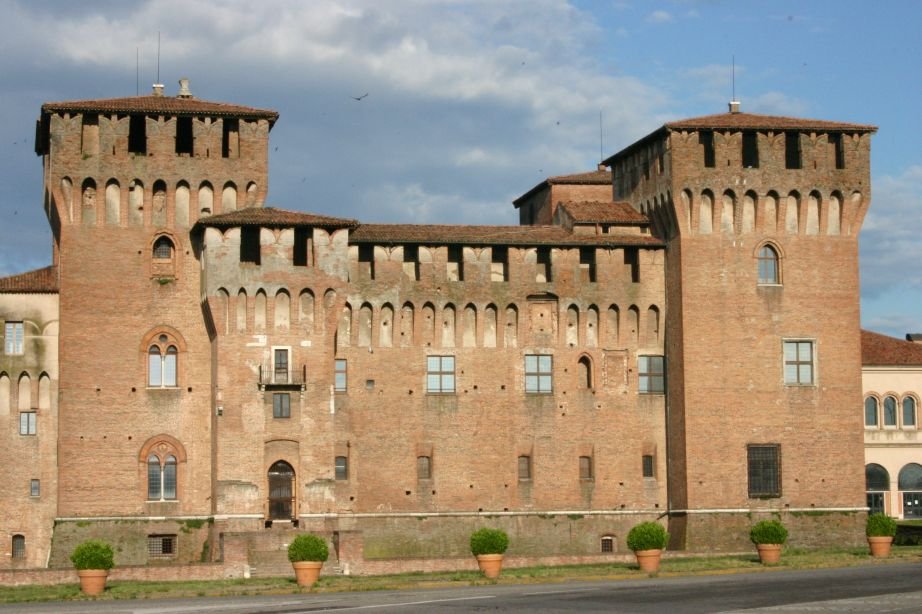

The Castle of St. George, a moated rectangular edifice in the heart of Mantua, Italy, was built between 1395 and 1406 for Francesco I Gonzaga. The castle, each of its four corners adorned with large towers, was designed by Bartolino da Novara and later rebuilt by Luca Fancelli as a palazzo in 1459, under the direction of Ludovico III Gonzaga. The structure was built upon the remains of the church of Santa Maria di Capo di Bove.
In the following centuries, the castle served as a residence for various Gonzaga rulers, and later became a prison, housing several notable historical figures.
The castle was once the site of the studiolo of Isabella d'Este in 1490. Paolo Vitelli, a renowned condottiere, was captured and imprisoned there in 1496.
In 1810, the castle became a maximum security prison for political opponents against the Kingdom of Italy, including the Tyrolean fighter Andreas Hofer. From 1852 onwards, the Belfiore martyrs were imprisoned in the castle. Other pro-Risorgimento figures imprisoned there included Ciro Menotti and Teresa Arrivabene.
The building, damaged by the 2012 Emilia earthquake, houses several rooms of interest today. The Sala dei Soli, ground floor, contains 15th century frescoes, redesigned by Giulio Romano in 1531 and then by Giovan Battista Bertani. The Sala degli Stemmi is accessed by a spiral staircase. The Salone degli Affreschi, parallel to the Sala degli Stemmi, houses even more frescoes. The Sala delle Sigle, bridal suite of Isabella d'Este, the Saletta della Grotta, part of Isabella's apartments, the Sala delle Armi, with twelve heraldic devices by Giulio Romano, the Chapel, built in 1563 by Bertani, the Sala di Mezzo, Sala del Fregio, Sala delle Cappe with barrel vaulted ceiling, Sala dello Zodiaco, with the remains of paintings by Giulio Romano, the room used to house Pietro Frattini, one of the Belfiore martyrs, and Ciro Menotti, the Camera degli Sposi.
The Scalone di Enea, designed by Bertani in 1549, connects the castle's courtyard and loggiato with the Salone di Manto in the Ducal Palace. The courtyard and loggiato, designed by Fancelli in 1472 to designs by Andrea Mantegna, complete the fascinating history and architecture of the Castle of St. George.
Sources: Wikipedia, OpenStreetMap, Wikidata, Wikimedia Commons
Written by Nicolo Ciampini
Discuss this with the author and others
No comments yet. Be the first to start the conversation.