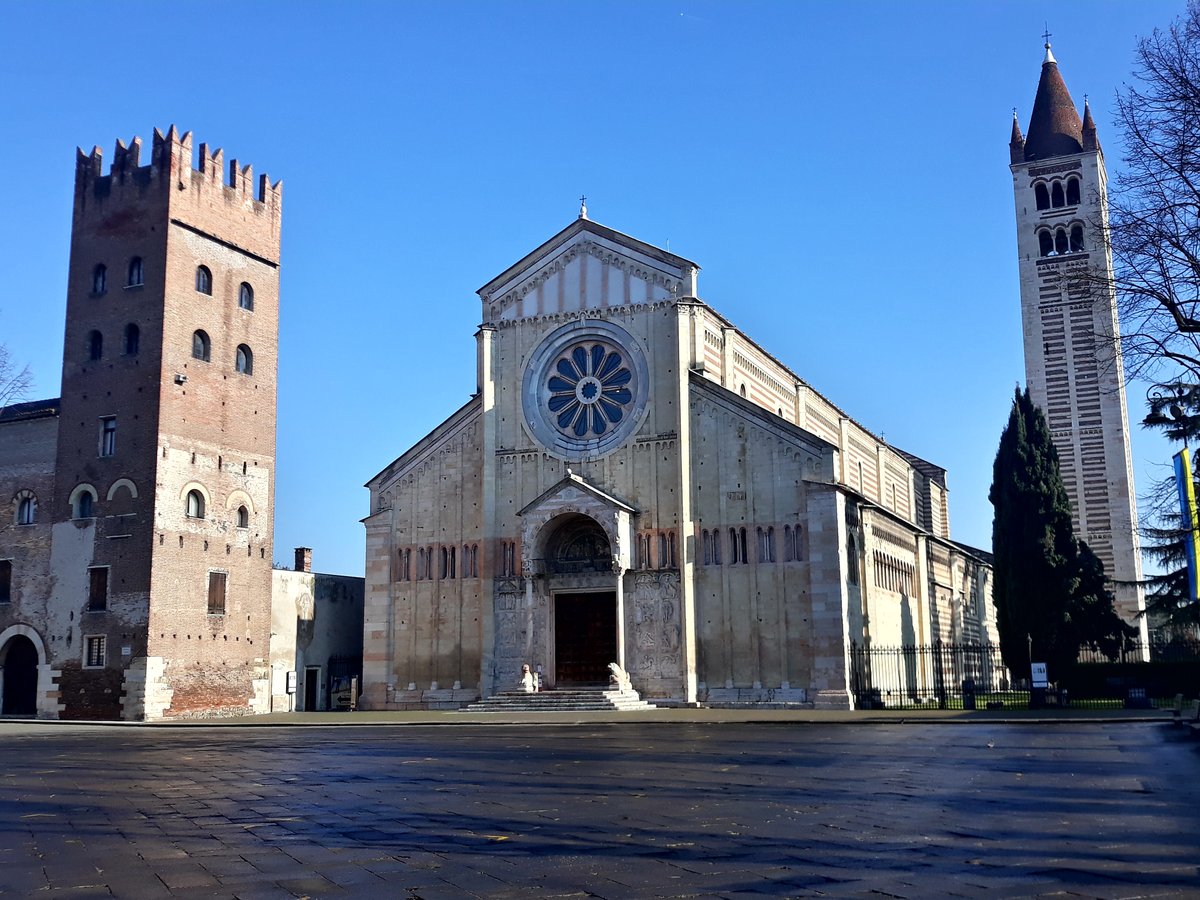

The Basilica of San Zeno, situated in the San Zeno district of Verona, is a significant religious structure of the Catholic Church. It is a medieval masterpiece, constructed on the site where at least five other religious buildings had previously stood. The church's origins seem to date back to a church built over the tomb of Saint Zeno, who died between 372 and 380.
The first building of the basilica was erected in 804 under the patronage of Bishop Ratold and King of Italy Pepin. However, this structure suffered substantial damage during the Magyar invasions between 899 and 933. The current church, with its three naves, was rebuilt in Romanesque style at the end of the 11th century. The crypt created around 804 in the new basilica is the only surviving remnant of the original basilica from the 9th century.
The monumental structure houses the tomb of Saint Zeno, a masterpiece by Andrea Mantegna, the San Zeno Altarpiece, and the bronze panels of the portal and the large rose window on the façade, known as the 'Wheel of Fortune', the work of the stonecutter Brioloto de Balneo. Throughout its history, the basilica has inspired numerous poets, including Dante Alighieri, Giosuè Carducci, Heinrich Heine, Gabriele D'Annunzio, and Berto Barbarani.
Sources: Wikipedia, OpenStreetMap, Wikidata, Wikimedia Commons
Written by Nicolo Ciampini
Discuss this with the author and others
No comments yet. Be the first to start the conversation.