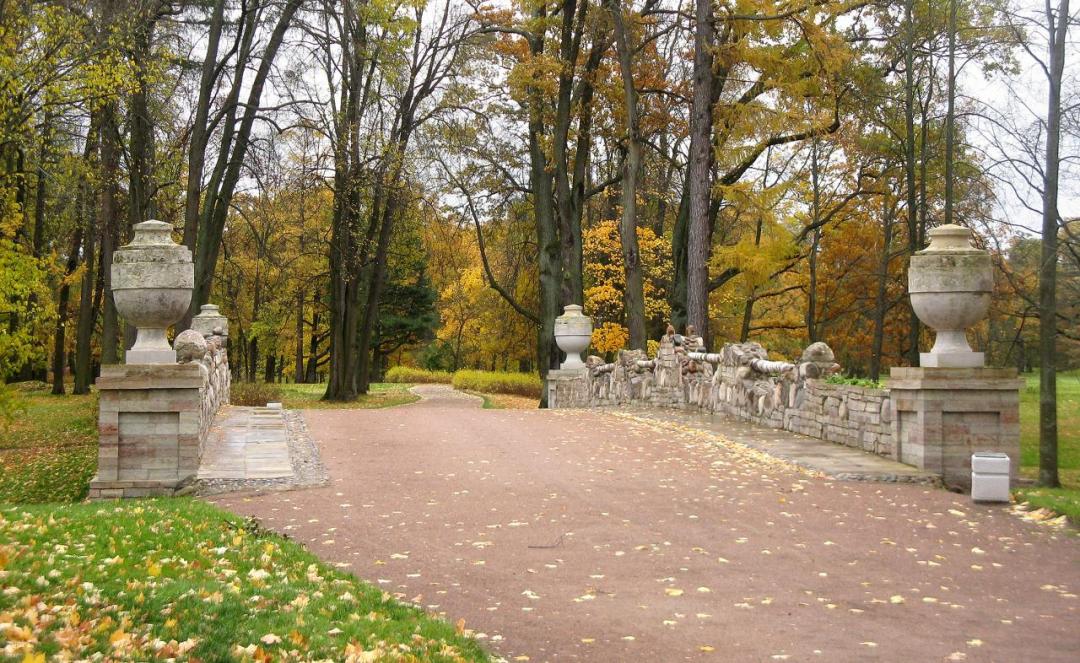
Znamenka Estate

Saint Petersburg Highway, 115, Saint Petersburg, Russia, 198517

Znamenka (formerly also known as the Znamenka Manor, Znamenka Dacha) is a former estate on the Peterhof Road. To the west, it borders the "Alexandria" park, to the east — the "Mikhailovka" estate. It is bounded by the Gulf of Finland to the north and the Peterhof Road to the south.

The founder of the Znamyenka estate was stolnik of Peter I, Prince Ivan Ivanovich Rzhevsky, and his wife Darya Gavrilovna. The tsar often visited them as a guest. Only in 1714, the "Campaign Journal" recorded about a dozen such visits. For example, on March 22, 1713, Peter I was returning to Petersburg after a months-long journey. "...He wished to travel all night... and on the same day dined at the prince-abbess Rzhevskaya's," states the "Campaign Journal." Rzhevsky, fulfilling the tsar's demands to "build amusing palaces of stone with excellent architectural work," constructed stone chambers "with wooden structures."

Peter visited the estate repeatedly. The first record of this in the "Campaign Journal" dates back to October 16, 1714. Therefore, by this time, the Rzhevskys had settled in such a way as to be able to receive such a distinguished guest. The estate's name originated during the Rzhevskys' time, at the church consecration in 1718. From then until 1787, many documents and literature refer to the estate by a paired name: "Vasilyevskoye, also known as Znamenskoye." On July 19, 1732, by order of Empress Anna Ioannovna, the former Rzhevskaya dacha was granted to Admiral Count Nikolai Fedorovich Golovin. In 1739, it was sold to the brother of the temporary ruler Gustav Biron, but after the arrest and exile of the Birons, it was returned to Golovin.

In 1755, this dacha was purchased from the Golovins by Count Alexei Grigorievich Razumovsky, the favorite and secret husband of Empress Elizabeth Petrovna. From this time began a burlesque phase in the development of the Znamenskaya estate. Razumovsky laid the foundation for the modern palace, created the Lower Park, and built greenhouses where, according to legend, the "devil's apple" — the potato — was grown.

The Empress often stayed at Znamyenka while traveling to Peterhof. It was then that the magnificent Znamensky Palace was built, presumably designed by Rastrelli, which has survived to this day, albeit in a rebuilt form. A park in the French style was laid out around the palace. Soon, a three-domed Peter and Paul Church was erected next to the palace, adorned with two four-columned Corinthian order porticos and partially rebuilt in the 19th century.

After Razumovsky's death in 1771, the owner of Znamyenka became his younger brother Kirill Grigorievich Razumovsky (1728–1803). In 1777, after a devastating flood when the water level rose 310 cm above the ordinary mark, the old Lower Peterhof Road was moved to the upper terrace on the section between Sergievskaya Pustyn and Peterhof. From this period dates the surviving stone bridge with granite railings on the Petersburg highway near Znamyenka. After the completion of the Upper Road, the southern facade of the Znamensky Palace became the main one, and the Upper Park was newly created as the ceremonial entrance to the estate.

In 1789, Znamyenka was acquired by Senator and Director of the Assignation Bank, Petr Vasilyevich Myatlev. Under him, the palace was extended with a third floor. The Myatlevs, among the wealthiest aristocrats of their time, invested considerable funds in the estate's improvement. Brilliant balls were held here, attracting the entire capital's high society. Myatlev was educated, known for his sharp mind and cheerful disposition, and was friends with many literary figures: Fonvizin, Dmitriev, Karamzin. The senator's son, Ivan Petrovich Myatlev (1796–1844), was known as a poet famous for his impromptus and puns. The first line of his poem "Roses" was used by Turgenev in his prose poem "How beautiful, how fresh were the roses." Myatlev's song "Lanterns" gained wide popularity. Among his friends were Pushkin, Vyazemsky, and Zhukovsky.

In 1835, Emperor Nicholas I bought Znamyenka for one million rubles from the heirs of Senator Myatlev and gifted it to his wife, Empress Alexandra Feodorovna, annexing the estate to the neighboring Alexandria. Connected by common management and a system of roads, Znamyenka and Alexandria became a single estate.

The Empress's favorite architect, Stakenschneider, was commissioned to rebuild the palace. Initially, he proposed giving the building a Gothic appearance to stylistically unify it with the Alexandria structures. However, Stakenschneider later abandoned the Gothic towers and preserved the Elizabethan Baroque style of the mid-18th century. According to his design, the lavish interiors of the palace's ceremonial halls, staircases, and winter garden were decorated.


Twenty years later, on September 11, 1856, the Empress gifted the estate to her third son, Nikolai Nikolaevich, who by then was married and a father. The architect of Znamyenka was appointed to be Gerald Ernestovich Bosse. By 1859, the decoration of the striking, exquisitely decorated Baroque facade of the palace—the compositional center of the grand duke's country residence—was completed, followed by the construction of the stable building, greenhouse, and kitchen wing.

In the same style, the facade of the Stable Yard (1853–1856) and the two-story Kitchen (Cavalier) wing (1856–1859), connected by fences to the one-story house of the overseer, were executed.

 The Stable wing was especially beautiful, hardly differing from the palace itself, whose quadrangle was framed by towers, and the gate arches with ornate wrought-iron gates created a brilliant perspective. The vast estate complex included a stone stable yard with a riding hall and guest boxes, a dozen horse stalls, a hospital, smithies, and living quarters for grooms and beretors in the corner towers. The Znamensky stables housed horses of all the most famous breeds in the world—the grand duke Nikolai Nikolaevich the Elder, being the general inspector of cavalry, had a passion for horses. Annual exhibitions of purebred horses were held at Znamyenka, attracting stud farm owners and horse breeding enthusiasts.

Next to the palace, on Church Alley, stands the Church of St. Peter and Paul, built in the neoclassical style: white with blue domes, it introduces a dissonance in the stylistic unity of the estate. Since 2004, services have been resumed in the church.

At the park entrance, according to Benois's design, in 1867, a chapel of St. Joseph was built in the "Russian" style from red brick with funds from a simple non-commissioned officer, in memory of the failed assassination attempt on Emperor Alexander II on April 4, 1866, near the Summer Garden.

The park around the palace was designed by the grand duke himself. In the Upper Park, from the central part of the southern facade of the palace, beautiful symmetrical straight alleys extended; the central alley crossed the St. Petersburg highway and the railway, built by 1857, and continued into the Ropsha highway.

To the north, in front of the palace, lies the Lower Park. The natural terrace on which the palace stands was decorated with a complex composition of stairs and pergolas with elegant pylons, ornate railings, and vases. From the viewing platforms, there was a charming view of the blue distant Gulf of Finland. Along the palace, just below the terrace slope, runs a straight section of the old Peterhof road, called the Lower Road, which here became a park alley. The park was adorned with numerous sculptures, pavilions, grottos, cascades, and fountains. In its center, on a small glade surrounded by benches, stood a monument to the late mother, Empress Alexandra Feodorovna, surrounded by her favorite flowers—forget-me-nots.

On the days when the grand duke's court was at the estate, a white standard with the grand ducal coat of arms, invented by Nikolai Nikolaevich himself, was raised above the palace. The double-headed eagle with the imperial crown crowning the coat of arms, the golden chain of the Order of St. Andrew around the shield, four golden and four silver lion heads on a black background as on the Romanov family coat of arms—all indicated the owner's belonging to the ruling house. The Varangian helmet, shield, and crossed golden axes testified that the estate owner was a military man. The floral wreath and blue background of the shield symbolized beauty and grandeur. From Peterhof to Strelna along the Tsar's (Lower) Road in the 19th century.

During the Great Patriotic War, German troops were stationed at Znamyenka; the estate suffered damage and was mostly restored only in the 1970s under the direction of architect Plotnikov. However, the relatively well-preserved stables, which in the 1970s were intended to be transferred to the boarding house located on the estate, were never restored and are gradually deteriorating. The Church of Peter and Paul with the chapel of Joseph the Hymnographer was restored only in the 1990s.

Sources:

https://peterhof.ru/usadba-znamenka

https://ru.wikipedia.org/wiki/Знаменка_(усадьба)

Follow us on social media

More stories from Imperial Parks of Peterhof: Alexandria, Znamenka, and Mikhailovka

Gothic Chapel in Peterhof - Church of Alexander Nevsky

VWJJ+8F Petrodvortsovy District, Saint Petersburg, Russia

The beloved home church of Nicholas I and his family is located in the western part of the former "Her Majesty's Own Dacha Alexandria." Resembling a medieval Gothic cathedral in miniature, the chapel serves as an impressive romantic decoration of the park, which is why it was named the Gothic Chapel (one of the meanings of the word "chapel" is a small home church for the prayers of a single family). It was built as the home church of the royal family and was used by the families of four generations of Russian emperors – Nicholas I, Alexander II, Alexander III, and Nicholas II. The church was consecrated in the name of Saint Blessed Grand Prince Alexander Nevsky. The church was mainly used during the summer.

Gothic Palace Stables

Avrova St., Building 2, Block 7, Saint Petersburg, Russia, 198510

The Palace Stables (also known as the Gothic Stables, Imperial Stables) are a complex of historic buildings in Peterhof. On the site currently occupied by the complex, there had been a stable yard since 1723. In 1846, architect Benois received an imperial commission to build a new Stable Yard. Demolition of the old structures (a total of 8 buildings made of wood and cobblestone) began in 1847. The new stables were constructed from 1848 to 1855. In total, the stables housed 328 horses. The complex included an arena, the equestrian department, residential houses for staff, a smithy, a veterinary clinic, a carriage house, haylofts, and fodder storage rooms.

Gothic well in Alexandria Park

VWJP+46 Petrodvortsovy District, Saint Petersburg, Russia

By the 1830s-1840s, metal gazebos became fashionable in Russia. For example, in the "Alexandria" park, there is an ornate gazebo called the "Gothic Well." In the "Alexandria" park, near the chapel built in the "Gothic style," stands an ornate gazebo forged from cast iron, called the "Gothic Well." It was created in 1835 based on the designs of the famous Russian artist and architect Charlemagne. The cast iron pavilion over the well was cast at the Berd factory.

Guardhouse (Gothic) with gates

Alexandria (upon request), Saint Petersburg, Russia, 198517

Not far from the Service Building is the main entrance to the park from the St. Petersburg Highway side. At the entrance in 1827, according to the project by A. Menelas, the Guardhouse was built in the forms of English Gothic, which is why the building is often called the Gothic Guardhouse. Currently, the building houses the International Fund for Assistance in the Restoration and Development of the State Reserve Peterhof "Capital of Fountains" and the park's excursion department.

Ruined Bridge in Alexandria Park

VWHR+F6 Petrodvortsovy District, Saint Petersburg, Russia

The bridge was designed according to the project of architect Adam Menelas, and approved in 1827 — construction began immediately. The work lasted 5 months; the supports and arches were built from brick and roughly hewn granite boulders.

Courier house in Alexandria Park

Zverinskaya St., 15, Saint Petersburg, Leningrad Region, Russia, 198510

After the Highest Approval on October 8 of the same year, the Feldjeger House was built. According to the available description, the courtyard was enclosed on three sides by a fence painted yellow and had a rectangular shape in plan.

Farmer's Palace, Alexandria Park

Alexandria Park 19, Saint Petersburg, Petrodvorets, Saint Petersburg, Russia, 198510

The Farmer's Palace is the only one in Russia created specifically for Alexander II. Later, the palace became the true family residence of the emperor. All renovations and reconstructions were carried out exclusively under his supervision.

Palace and Park Ensemble "Alexandria"

Building 60, lit. F, office 206, Saint Petersburg Avenue, Saint Petersburg, Russia, 198517

The palace and park ensemble "Alexandria" – a place of constant summer retreat for four generations of the Romanov dynasty – adjoins the eastern border of the official imperial residence, separated by a wall from the Lower Park. One of the residences of the Russian emperors from 1830 to 1917 (His Imperial Majesty's Own Dacha). Named after Empress Alexandra Feodorovna, wife of Emperor Nicholas I.

Lower Dacha in Alexandria Park

VXM2+M4 Petrodvortsovy District, Saint Petersburg, Russia

The Lower Dacha is the last palace building constructed in Alexandria, the Romanovs' suburban residence in Peterhof. The park of Alexandria dates back to 1825, when the wooded area located east of the Peterhof Lower Park along the Gulf of Finland was gifted by Emperor Alexander I to his brother — Grand Duke Nikolai Pavlovich. After ascending the throne, Nicholas I presented the estate to his wife Alexandra Feodorovna, giving the territory the corresponding name — "Her Majesty's Own Dacha Alexandria."

Renella Pavilion (Tea House or Gothic Cottage)

VXM4+Q3 Petrodvortsovy District, Saint Petersburg, Russia

The Renell Pavilion, or as it was sometimes called, the Tea or Gothic House, is one of the many diverse park pavilions that appeared in Peterhof during the reign of Nicholas I. "During the Empress's stay in Palermo (the wife of Nicholas I), she liked a Gothic house with multifaceted pointed towers at the corners of an elongated quadrangle. Rough sketches of this building made on the spot were sent to St. Petersburg with the order for Stakenschneider to build the Renell Pavilion according to them in Znamenka, on the shore."

Stable yard in Znamenka

Aleksandrovskaya St., 8, Saint Petersburg, Russia, 198517

The Znamensky Stable Yard was a spacious complex, featuring arched gates with wrought iron doors, resembling a palace. It included a riding arena for guests, ten horse stalls, an infirmary, smithies, and living quarters for the staff. Exhibitions of purebred horse breeds were held here, attracting horse breeding enthusiasts and owners of stud farms. The General Inspector of Cavalry, Grand Duke Nicholas Nikolaevich the Elder, was involved in this endeavor and had a great passion for horses.

Chapel in the name of Venerable Joseph the Hymnographer

Ropshinskoye Highway / Petergofskoye Highway, Saint Petersburg, Russia, 198517

The chapel in the pseudo-Russian style was built in 1868 with the personal funds of Petty Officer Ivan Vasilyev of the Naval Cadet Corps, in memory of the miraculous deliverance from death of His Majesty Emperor Alexander II during the assassination attempt on him on April 4, 1866. The main part of the money was contributed by the petty officer himself. The amount equaled his salary for three years. The rest was collected by local residents.

Church of the Holy Apostles Peter and Paul

Saint Petersburg Highway, 115, Saint Petersburg, Russia, 198517

The stone church was first erected on this site in 1767 by the architect Francesco Bartolomeo Rastrelli. And now, on the grounds of Znamenka, there is a unique feature, an architectural monument that has come down to us from the depths of the 18th century. The Peter and Paul Church is modest in size, concise, and elegant. It can rightfully be considered the oldest functioning church in Peterhof.

Mikhaylovka (Mikhaylovskaya Dacha or Mikhaylovskoye Estate)

Saint Petersburg Highway, 109, Saint Petersburg, Russia, 198515

Mikhaylovka (also known as "Mikhaylovskaya Dacha" and "Mikhaylovskoye Estate") is a 19th-century palace and park ensemble on the Peterhof Road, which before the revolution belonged to the descendants of Grand Duke Mikhail Nikolaevich Romanov, son of Emperor Nicholas I. The park territory is also part of the state natural reserve of regional significance, the Southern Coast of the Neva Bay.

Church of Saint Olga, Equal-to-the-Apostles Princess

VX8R+94 Petrodvortsovy District, Saint Petersburg, Russia

Sovereign Nicholas I, immensely loving his children, bought land and established country estates for each son. Thus, his youngest son, Grand Duke Mikhail Nikolaevich, was gifted the Mikhailovskaya Dacha. Among the numerous buildings of the princely estate, the house church stood out distinctly, consecrated in the name of Saint Princess Olga – the heavenly patroness of Grand Duchess Olga Feodorovna, the wife of Mikhail.

Cottage Palace

VWHW+95 Petrodvortsovy District, Saint Petersburg, Russia

The Cottage Palace (English: cottage) is the central architectural structure of the palace and park ensemble of Alexandria, built using elements of the Neo-Gothic style in 1826–1829 for the family of Emperor Nicholas Pavlovich according to the design by architect Menelas, with an extension by Shtakenshteider. In the film *The Adventures of Sherlock Holmes and Dr. Watson*, the Cottage "played" the role of Milverton's mansion.

Vorontsov Count's Palace - Novoznamenka Estate

2 Chekistov St., Saint Petersburg, Russia, 198206

Vorontsov Dacha (Novoznamenka) is the estate of Chancellor Mikhail Vorontsov located on the Peterhof Road near Saint Petersburg. Founded in the 1720s, its current appearance was shaped by several reconstructions in the 1750s, 1880s, and 1960s. It is one of the few surviving examples of an Elizabethan Baroque country estate, featuring elements of Classicism that were new to Russia. The estate ensemble includes the main house — a three-story palace with a belvedere, the "Gothic House," a landscape park, and ponds. The estate park stretches along the Peterhof Highway; other ponds of the estate, formed based on the Sosnovka River bed, are located along the modern Pionerstroya Street and extend to the Sosnovaya Polyana forest park.