

The palace and park ensemble "Alexandria" — a place of constant summer rest for four generations of the Romanov dynasty — adjoins the eastern border of the official imperial residence, separated by a wall from the Lower Park. One of the residences of the Russian emperors from 1830 to 1917 (His Imperial Majesty’s Own Dacha). Named after Empress Alexandra Feodorovna, wife of Emperor Nicholas I.
Like many other attractions, the Alexandria Park of Peterhof began to be arranged at the beginning of the 18th century by the order of Peter I. Initially, it was a territory for summer cottages of courtiers and belonged to four owners who received plots from Peter I for dachas. According to inventories, these were plots of clerk Alexander Yakovlev, Guards Lieutenant Danila Chevkin, General Feldtseikhmeister Yakov Bruce, and Peter Moshkov. The owners changed until 1725. According to some data, in 1725–1726 these lands were acquired by Alexander Danilovich Menshikov, who began building the "Monkurazh" ("My Courage") palace. The construction was never completed. After the disgrace of Peter’s favorite, the lands were transferred to his political opponents — the Dolgorukov princes, who paid little attention to their development, and the area became known among the people as the "Dolgorukov’s empty places."
In 1733, this area became the property of Empress Anna Ioannovna. Here, a Hunting Park ("Jagd-Garten") was created, where a huge number of animals were brought: deer, buffalo, boars, hares, and even tigers. In the upper part of the park, a hunter’s settlement and animal enclosures were built; in the lower part — a wooden pavilion "Tempel," from which the empress shot animals released from the enclosure and chased by dogs. In the 1770s, when Tsarskoye Selo was chosen as the summer imperial residence, the hunting estate declined, and only a small number of deer remained, many of which became tame. The area earned the name "Deer Menagerie." Part of its territory was used for pastures and gardens of the Life-Guards Dragoon Regiment. By the end of the 18th century, only ruins remained of Menshikov’s palace, and the "Tempel" pavilion was dismantled. In 1825, Nicholas I became the owner of these lands, and after ascending the throne, he gifted this estate to his wife Alexandra Feodorovna, and it was named "Her Majesty’s Own Dacha Alexandria."
In 1825, Nicholas I became the owner of these lands, and after ascending the throne, he gifted this estate to his wife Alexandra Feodorovna, and it was named "Her Majesty’s Own Dacha Alexandria." In 1826, the emperor ordered "to build on the site where Menshikov’s ruin stands a country house, or so-called 'cottage,' with all household facilities, adjoining the park." From that year, the park began to be arranged, and the construction of a summer palace in the English style, called the "cottage," started. The work was led by the architect Adam Menelas.
The construction of the palace continued until 1829. The palace, built in the Gothic style, was a two-story building of small size with a triple division of facades decorated with balconies and terraces. The coat of arms of Alexandria — a shield with a naked sword passed through a wreath of white roses — was placed on the facades of the Cottage. This romantic knightly coat of arms was invented by the poet V. A. Zhukovsky and was present on almost all buildings of Alexandria. To further emphasize the idyllic character of the residence, architect A. Menelas built the "Farm" near the Cottage in 1829–1831, with a cowshed, rooms for shepherds, kitchens, and storerooms. In the following years, up to 1859, the Farm building was repeatedly remodeled by Stakenschneider and adapted as the summer palace of Alexander II, who became emperor in 1855.
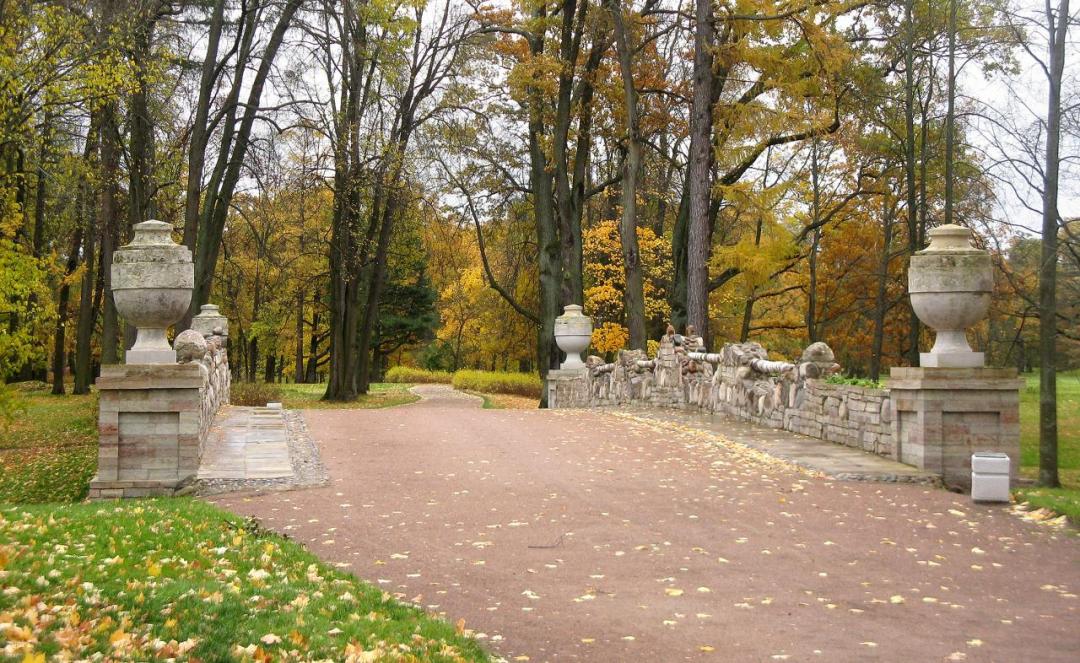
Simultaneously with the construction of the Cottage, the formation of a landscape, romantic park was underway. For twenty years, the gardener Pyotr Ivanovich Erler worked on its creation. His grave was moved to Alexandria in 1970 and is located at the southern entrance to the Farmer’s Palace. The terrain relief allowed the creation of diverse picturesque landscapes, alternating elevations and clearings, gentle slopes and a deep ravine, wide shady alleys and narrow winding paths. The sea, visible from many points in the park, adds a special uniqueness to Alexandria’s landscape. The romantic character of the park was also emphasized by the Ruin Bridge, thrown over a deep ravine. After the war, only the eastern abutment and two pedestals with giant vases carved from Pudost stone survived from the Ruin Bridge. The bridge’s name is connected with the fact that ruins of Menshikov’s palace were still visible nearby during its construction. In terms of compositional design, skillful use of relief, layout, and selection of plantings, Alexandria is an excellent example of a landscape-style park and is among the outstanding monuments of Russian landscape architecture of the 19th century. The central compositional axis of the park is Nikolskaya Alley, which crosses it straight from west to east — from the eponymous gates in the stone wall to the Large Pond, where it merges with the intersection of several alleys and, bypassing the pond, leads to the eastern border of the park. Nikolskaya Alley divides the park into northern and southern parts — coastal and upland. The other roads of Alexandria are winding, characteristic of landscape park design. The alleys are laid out with subtle calculation, allowing the landscape to be viewed from the most effective vantage points, giving the illusion of vast space, extent, and diversity of the natural surroundings.
The architectural appearance of Alexandria Park was based on neo-Gothic, and this style came to dominate thanks to the works of Menelas, Stakenschneider, and Schinkel, created in the 1830s. Many park visitors noted that the cultural-historical microclimate here is so different that it seems this is not Saint Petersburg but some Western European city. One of the most original and interesting buildings of Alexandria is the Gothic Chapel — the home church of the royal family, built in honor of Alexander Nevsky. The last major palace building of Alexandria is the four-story Lower, or New, Palace of Nicholas II, more often called the Lower Dacha, as it was located on the seashore in the northeastern corner of the park. The Lower Dacha was built according to the design of the Russian architect Tomishko. Nicholas II’s dacha witnessed events of enormous political importance. For example, the manifesto on Russia’s entry into World War I was signed here. At the Lower Dacha, Emperor Nicholas II and Empress Alexandra Feodorovna spent the summer of 1895 — the first summer of their family life. Their only son Alexei was born here on July 30, 1904.
In the 1920s–1930s, Alexandria began to turn into a museum complex. In 1929, an unusual museum was opened in the park near the Cottage: two carriages from Nicholas II’s imperial train, his last "residence," were received by the Peterhof museums from the People’s Commissariat of Railways and placed in the park. In one of them, the last Russian tsar signed his abdication. These carriages, preserving the domestic atmosphere, and a specially built room housed an exhibition: "The Imperialist War and the Collapse of Tsarism." Surrounded by a fence of posts with barbed wire, the carriages remained in place even in the early 1950s and, although not guarded, could be visited. Near Nicholas II’s carriages stood another "railway" monument — a carriage from the train that ran between Petersburg and Moscow in the times of Nicholas I.
In 1926, a historical and everyday life museum opened on the first floor of the Farmer’s Palace, and on the second floor — the Leningrad Soviet’s recreation base. Six years later, the museum was closed. At the same time, the museum in the Lower Dacha was also closed, and its building was transferred to the NKVD as a rest home. During the Great Patriotic War, the Farmer’s Palace was seriously damaged, its furnishings lost, and after the war it was converted into a dormitory for the Petrodvorets Watch Factory. Other objects of the palace and park ensemble also suffered great damage during the war. The Cottage was less damaged — most of the museum exhibits were evacuated (out of 2,500 items in the exposition, 1,980 were saved). During the war, the park became a battlefield (Peterhof landing). The palace interiors were damaged. The stucco decoration, many carved panels, and paintings suffered significantly; the furniture collection was almost completely destroyed, but the Cottage building itself was not destroyed. The Lower Dacha building was also severely damaged. By the early 1960s, it was declared unsafe and demolished.
In 1978, painters, sculptors, marble workers, and craftsmen of many specialties from the Leningrad association "Restorer," under the leadership of architect I. N. Benois, completed the restoration of the Cottage palace. The restoration of the Farmer’s Palace was practically completed by the 300th anniversary of Petersburg, but a fire on December 22, 2005, severely damaged the building. Work began again. In addition, for several years, the scientific staff of the State Museum Reserve "Peterhof" have been acquiring items from the era of Alexander II, as well as items belonging to the emperor, for the future palace exposition. As of 2006, the restoration of the Farmer’s Palace was underway, and a project for the restoration of the Lower Dacha was being developed. The Cottage is permanently open for visits. In June 2006, after another restoration, the Gothic Chapel was reopened and consecrated by the church.
Alexandria Park is located east of the Lower Park of Peterhof and is separated from it by a stone wall, which is pierced by the Beast, Nikolsky, and Sea gates, and on the other side borders the Znamenka estate. The southern boundary of Alexandria runs along the St. Petersburg — Oranienbaum (Lomonosov) highway, and the northern boundary runs along the shore of the Gulf of Finland. The park area is 115 hectares. The seaside landscape park Alexandria stretches over two terraces: the lower (coastal) and the upper, on which the main architectural structures of the ensemble were erected — the Cottage, the Farmer’s Palace, and the Chapel. The terrain relief allowed the creation of diverse picturesque landscapes, alternating elevations and clearings, gentle slopes and a deep ravine, wide shady alleys and narrow winding paths. The sea, visible from many points in the park, adds a special uniqueness to Alexandria’s landscape.
The romantic character of the park was also emphasized by the Ruin Bridge, thrown over a deep ravine. After the war, only the eastern abutment and two pedestals with giant vases carved from Pudost stone survived from the Ruin Bridge. The bridge’s name is connected with the fact that ruins of Menshikov’s palace were still visible nearby during its construction. In terms of compositional design, skillful use of relief, layout, and selection of plantings, Alexandria is an excellent example of a landscape-style park and is among the outstanding monuments of Russian landscape architecture of the 19th century.
The central compositional axis of the park is Nikolskaya Alley, which crosses it straight from west to east — from the eponymous gates in the stone wall to the Large Pond, where it merges with the intersection of several alleys and, bypassing the pond, leads to the eastern border of the park. Nikolskaya Alley divides the park into northern and southern parts — coastal and upland. The other roads of Alexandria are winding, characteristic of landscape park design. The alleys are laid out with subtle calculation, allowing the landscape to be viewed from the most effective vantage points, giving the illusion of vast space, extent, and diversity of the natural surroundings.
Sources:
https://peterhofguide.ru/alexandriya



Written by Jermaine
Discuss this with the author and others
No comments yet. Be the first to start the conversation.