Lower Dacha in Alexandria Park

VXM2+M4 Petrodvortsovy District, Saint Petersburg, Russia

The Lower Dacha is the last palace building constructed in Alexandria, the Romanovs' suburban residence in Peterhof. The park of Alexandria dates back to 1825, when the wooded area located east of the Peterhof Lower Park along the Gulf of Finland was gifted by Emperor Alexander I to his brother — Grand Duke Nikolai Pavlovich. After ascending the throne, Nicholas I presented the estate to his wife Alexandra Feodorovna, giving the territory the corresponding name — "Her Majesty's Own Dacha Alexandria."
The Lower Dacha is the last palace building constructed in Alexandria, the Romanovs' suburban residence in Peterhof. The park's chronology begins in 1825, when Emperor Alexander I gifted the wooded area located east of the Peterhof Lower Park along the Gulf of Finland to his brother, Grand Duke Nikolai Pavlovich. After ascending the throne, Nicholas I presented the estate to his wife Alexandra Feodorovna, giving the territory the corresponding name — "Her Majesty's Own Dacha Alexandria."
Until 1917, Alexandria remained the private property of the imperial family: no official events were held here, the area was closed to visitors and carefully guarded. For nearly a century, the seaside Alexandria was a favorite summer retreat for four generations of the Romanov dynasty and gradually grew with new palace buildings, various small structures of utilitarian and recreational nature. A chapel, pavilions, guardhouses, cast-iron wells, bridges, gazebos, pergolas, children's sports grounds, a fortress and fire tower, a water mill, aviaries, farms and "small farms" — the Alexandrian space was built up freely, meeting the needs of the expanding imperial family and the preferences of its members.
Alexander III's decision to build a stone dacha on the bay coast for his son, Tsarevich Nicholas, dates back to February 1882. The new dacha on the seaside terrace was to replace the optical or semaphore telegraph tower of the Kronstadt telegraph line, erected half a century earlier by I. I. Charlemagne and engineer P. Chateau. The telegraph station system connected the imperial estate with Kronstadt and the Winter Palace in St. Petersburg. The building was a rectangular four-story structure, topped with a mast featuring a movable metal semaphore mechanism. The communication system was complemented by a nearby marine telegraph mast, allowing the emperor to issue orders during naval maneuvers. By the mid-19th century, with the spread of the electric telegraph, the semaphore fell out of use, and the aging building no longer met the service's needs. At the opposite edge of Alexandria, on the St. Petersburg highway, a new telegraph building appeared, now functioning as the museum "Palace Telegraph Station," and the old tower was demolished.
The summer pavilion for the young heir was intended by Alexander III to preserve the familiar appearance of this part of Alexandria. Built in the spirit of southern Italian villas, the small building was supposed, like the telegraph, to be complemented by a tower volume. The first project by architect Anton Osipovich Tomishko was rejected. But soon the second version, proposed by the same architect, was approved by the highest authority. Now the four-story palace was crowned with a six-story square tower with a flagpole. Incidentally, Tomishko gained particular fame for constructing several prison buildings, including the complex of the St. Petersburg prison "Kresty."
Thus began the construction of not a modest park pavilion for the fourteen-year-old tsarevich, but effectively a seaside castle for the future emperor. The building's plinth and keystones were made of pink granite, the lower floor was clad with gray Putilov slabs. The walls were brick, covered with polychrome bricks of two shades — yellow and terracotta. Details of the main entrance and decorative facade finishes were made of light gray Bremen sandstone. The complex included, besides the main house, a service house, kitchen, icehouse, guardhouse with fence and gates, as well as a Swiss cottage. The towers of the Lower Dacha ensemble marked the extreme point of the eastern boundary of imperial Peterhof and served as a height dominance in its panorama from the sea.
By 1886, construction and finishing works at the Lower Dacha were completed, but Tsarevich Nicholas Alexandrovich visited it rarely; in fact, it served as a guest house.
The situation changed with the coronation and marriage of now Emperor Nicholas II. In the spring of 1895, he wrote in his diary: "With joyful and sorrowful feelings, I entered dear Alexandria and came into our house by the sea. It seems so strange to live here with my wife. Although space is tight here, the rooms are lovely and the layout is perfect. The new room (Alix) downstairs by the dining room is wonderfully decorated. But the main beauty of the whole house is the proximity to the sea!"
That same year, Nicholas decided to expand the dacha and build a separate wing for future children. The "children's wing" project was also commissioned from Tomishko. Construction of the new building and the gallery connecting the old and new wings was completed in spring 1897. The children's wing had four floors, with a semicircular two-story bay window with an open balcony, the so-called Children's Balcony, adjoining the main volume from the west. In this building grew Nicholas's elder daughters Olga, born in Tsarskoye Selo on November 5, 1895, and Tatiana, born on May 29, 1897, in the Farmer's Palace of Alexandria, while construction at the Lower Dacha was still underway. Three children were born here: Maria on June 14, 1899, Anastasia on June 5, 1901, and the long-awaited Tsarevich Alexei on July 30, 1904. The entire second floor was allocated to Alexei. The girls lived on the third floor. The children's rooms, ascetic and monotonous, were almost devoid of decoration. Above the beds were chromolithographs on religious themes, copper icons, paper icons; above the desks were photographs of relatives. Toy cabinets were located in the playrooms, the so-called "day nurseries" — two spacious, airy, and bright halls with windows facing southwest. The dacha was equipped with running water and electrified in 1909.
The Lower Dacha became the permanent and beloved country residence of the family, largely due to its isolation from the outside world, creating an illusion of security. Not being a ceremonial residence, the Lower Dacha became the site of several outstanding historical events. Here, on October 17, 1905, the emperor signed the manifesto "On the Improvement of the State Order," i.e., on convening the legislative Duma and democratic freedoms. Here also was signed the 1914 manifesto on Russia's entry into the imperialist war. After the outbreak of World War I, the royal family left Peterhof.
In 1918, the Lower Dacha was under the jurisdiction of the People's Commissariat of State Property, later transferred to the People's Commissariat of Education. Even in the summer of 1925, the former tsar's dacha faced the threat of complete liquidation because, according to contemporaries, "no one knew what to do with it." On June 3, 1927, a museum called "The Fall of Autocracy" opened at the Lower Dacha, later renamed "The Last Romanovs in Peterhof."
In 1928, F. I. Schmit, director of the State Institute of Arts, a well-known art historian and ideologist of the new museum construction, in his work "Museum Affairs. Questions of Exhibition," analyzing the exhibition opened at the Nicholas dacha, called it "a tale of how the last of the Romanovs tried to fight the revolution, and how the revolution broke him."
On November 15, 1936, by decree of the Presidium of the Leningrad Soviet, the building was handed over to establish a rest home for instructors of the Leningrad regional and city committees of the VKP(b).
During the Great Patriotic War, the Lower Dacha building found itself in territory occupied by German troops. For three blockade years, the occupiers used it as a coastal anti-landing defense point. The first-floor rooms were equipped with machine gun pillboxes. On the tower, from which Kronstadt and the harbor were well visible, artillery observers and spotters were stationed. The dacha's territory was surrounded by minefields and wire obstacles. The dacha was a constant target for Soviet artillery and aviation.

Upon retreat, the Germans blew up part of the ammunition depots located in and near the palace. Thus, by the end of the war, the building suffered severe damage, but its shell, including even the six-story tower, was well preserved. After the war, the Lower Dacha was not restored and stood as a grand ruin. In the early 1960s, the palace ruins and two collapsing service buildings were blown up, completing what the war had not.

Sources:
https://adresaspb.com/category/structures/building/nizhnyaya-dacha/
https://ru.wikipedia.org/wiki/Нижняя_дача

Follow us on social media

More stories from Imperial Parks of Peterhof: Alexandria, Znamenka, and Mikhailovka

Gothic Chapel in Peterhof - Church of Alexander Nevsky

VWJJ+8F Petrodvortsovy District, Saint Petersburg, Russia

The beloved home church of Nicholas I and his family is located in the western part of the former "Her Majesty's Own Dacha Alexandria." Resembling a medieval Gothic cathedral in miniature, the chapel serves as an impressive romantic decoration of the park, which is why it was named the Gothic Chapel (one of the meanings of the word "chapel" is a small home church for the prayers of a single family). It was built as the home church of the royal family and was used by the families of four generations of Russian emperors – Nicholas I, Alexander II, Alexander III, and Nicholas II. The church was consecrated in the name of Saint Blessed Grand Prince Alexander Nevsky. The church was mainly used during the summer.

Gothic Palace Stables

Avrova St., Building 2, Block 7, Saint Petersburg, Russia, 198510

The Palace Stables (also known as the Gothic Stables, Imperial Stables) are a complex of historic buildings in Peterhof. On the site currently occupied by the complex, there had been a stable yard since 1723. In 1846, architect Benois received an imperial commission to build a new Stable Yard. Demolition of the old structures (a total of 8 buildings made of wood and cobblestone) began in 1847. The new stables were constructed from 1848 to 1855. In total, the stables housed 328 horses. The complex included an arena, the equestrian department, residential houses for staff, a smithy, a veterinary clinic, a carriage house, haylofts, and fodder storage rooms.

Gothic well in Alexandria Park

VWJP+46 Petrodvortsovy District, Saint Petersburg, Russia

By the 1830s-1840s, metal gazebos became fashionable in Russia. For example, in the "Alexandria" park, there is an ornate gazebo called the "Gothic Well." In the "Alexandria" park, near the chapel built in the "Gothic style," stands an ornate gazebo forged from cast iron, called the "Gothic Well." It was created in 1835 based on the designs of the famous Russian artist and architect Charlemagne. The cast iron pavilion over the well was cast at the Berd factory.

Guardhouse (Gothic) with gates

Alexandria (upon request), Saint Petersburg, Russia, 198517

Not far from the Service Building is the main entrance to the park from the St. Petersburg Highway side. At the entrance in 1827, according to the project by A. Menelas, the Guardhouse was built in the forms of English Gothic, which is why the building is often called the Gothic Guardhouse. Currently, the building houses the International Fund for Assistance in the Restoration and Development of the State Reserve Peterhof "Capital of Fountains" and the park's excursion department.

Ruined Bridge in Alexandria Park

VWHR+F6 Petrodvortsovy District, Saint Petersburg, Russia

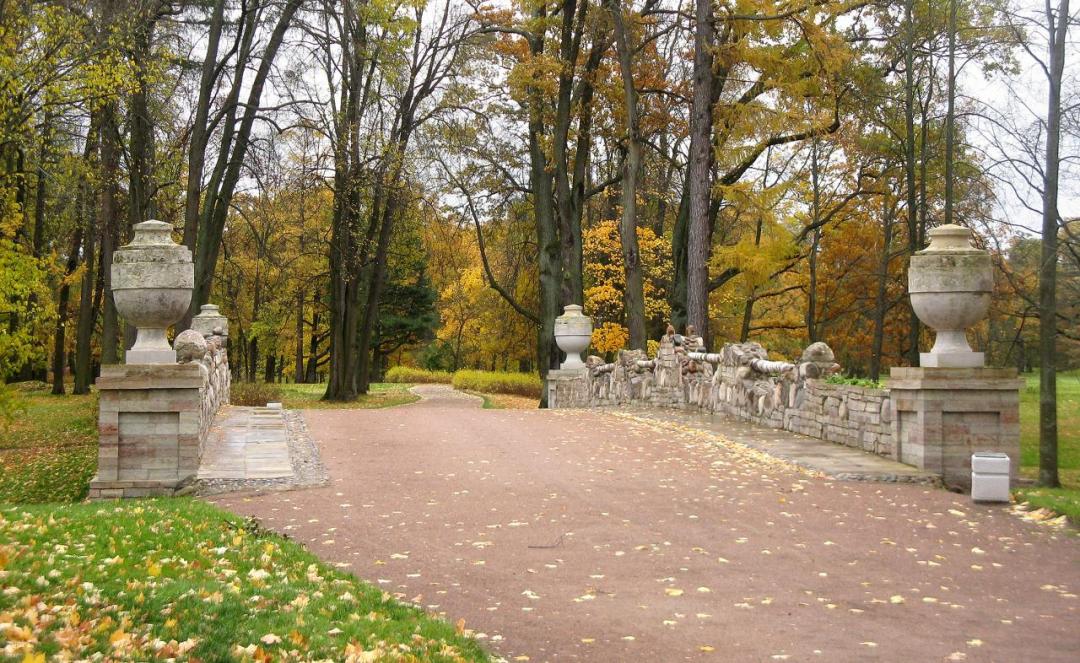
The bridge was designed according to the project of architect Adam Menelas, and approved in 1827 — construction began immediately. The work lasted 5 months; the supports and arches were built from brick and roughly hewn granite boulders.

Courier house in Alexandria Park

Zverinskaya St., 15, Saint Petersburg, Leningrad Region, Russia, 198510

After the Highest Approval on October 8 of the same year, the Feldjeger House was built. According to the available description, the courtyard was enclosed on three sides by a fence painted yellow and had a rectangular shape in plan.

Farmer's Palace, Alexandria Park

Alexandria Park 19, Saint Petersburg, Petrodvorets, Saint Petersburg, Russia, 198510

The Farmer's Palace is the only one in Russia created specifically for Alexander II. Later, the palace became the true family residence of the emperor. All renovations and reconstructions were carried out exclusively under his supervision.

Palace and Park Ensemble "Alexandria"

Building 60, lit. F, office 206, Saint Petersburg Avenue, Saint Petersburg, Russia, 198517

The palace and park ensemble "Alexandria" – a place of constant summer retreat for four generations of the Romanov dynasty – adjoins the eastern border of the official imperial residence, separated by a wall from the Lower Park. One of the residences of the Russian emperors from 1830 to 1917 (His Imperial Majesty's Own Dacha). Named after Empress Alexandra Feodorovna, wife of Emperor Nicholas I.

Renella Pavilion (Tea House or Gothic Cottage)

VXM4+Q3 Petrodvortsovy District, Saint Petersburg, Russia

The Renell Pavilion, or as it was sometimes called, the Tea or Gothic House, is one of the many diverse park pavilions that appeared in Peterhof during the reign of Nicholas I. "During the Empress's stay in Palermo (the wife of Nicholas I), she liked a Gothic house with multifaceted pointed towers at the corners of an elongated quadrangle. Rough sketches of this building made on the spot were sent to St. Petersburg with the order for Stakenschneider to build the Renell Pavilion according to them in Znamenka, on the shore."

Znamenka Estate

Saint Petersburg Highway, 115, Saint Petersburg, Russia, 198517

Znamenka (formerly also known as the Znamenka Manor, Znamenka Dacha) is a former estate on the Peterhof Road. To the west, it borders the "Alexandria" park, to the east — the "Mikhailovka" estate. It is bounded by the Gulf of Finland to the north and the Peterhof Road to the south.

Stable yard in Znamenka

Aleksandrovskaya St., 8, Saint Petersburg, Russia, 198517

The Znamensky Stable Yard was a spacious complex, featuring arched gates with wrought iron doors, resembling a palace. It included a riding arena for guests, ten horse stalls, an infirmary, smithies, and living quarters for the staff. Exhibitions of purebred horse breeds were held here, attracting horse breeding enthusiasts and owners of stud farms. The General Inspector of Cavalry, Grand Duke Nicholas Nikolaevich the Elder, was involved in this endeavor and had a great passion for horses.

Chapel in the name of Venerable Joseph the Hymnographer

Ropshinskoye Highway / Petergofskoye Highway, Saint Petersburg, Russia, 198517

The chapel in the pseudo-Russian style was built in 1868 with the personal funds of Petty Officer Ivan Vasilyev of the Naval Cadet Corps, in memory of the miraculous deliverance from death of His Majesty Emperor Alexander II during the assassination attempt on him on April 4, 1866. The main part of the money was contributed by the petty officer himself. The amount equaled his salary for three years. The rest was collected by local residents.

Church of the Holy Apostles Peter and Paul

Saint Petersburg Highway, 115, Saint Petersburg, Russia, 198517

The stone church was first erected on this site in 1767 by the architect Francesco Bartolomeo Rastrelli. And now, on the grounds of Znamenka, there is a unique feature, an architectural monument that has come down to us from the depths of the 18th century. The Peter and Paul Church is modest in size, concise, and elegant. It can rightfully be considered the oldest functioning church in Peterhof.

Mikhaylovka (Mikhaylovskaya Dacha or Mikhaylovskoye Estate)

Saint Petersburg Highway, 109, Saint Petersburg, Russia, 198515

Mikhaylovka (also known as "Mikhaylovskaya Dacha" and "Mikhaylovskoye Estate") is a 19th-century palace and park ensemble on the Peterhof Road, which before the revolution belonged to the descendants of Grand Duke Mikhail Nikolaevich Romanov, son of Emperor Nicholas I. The park territory is also part of the state natural reserve of regional significance, the Southern Coast of the Neva Bay.

Church of Saint Olga, Equal-to-the-Apostles Princess

VX8R+94 Petrodvortsovy District, Saint Petersburg, Russia

Sovereign Nicholas I, immensely loving his children, bought land and established country estates for each son. Thus, his youngest son, Grand Duke Mikhail Nikolaevich, was gifted the Mikhailovskaya Dacha. Among the numerous buildings of the princely estate, the house church stood out distinctly, consecrated in the name of Saint Princess Olga – the heavenly patroness of Grand Duchess Olga Feodorovna, the wife of Mikhail.

Cottage Palace

VWHW+95 Petrodvortsovy District, Saint Petersburg, Russia

The Cottage Palace (English: cottage) is the central architectural structure of the palace and park ensemble of Alexandria, built using elements of the Neo-Gothic style in 1826–1829 for the family of Emperor Nicholas Pavlovich according to the design by architect Menelas, with an extension by Shtakenshteider. In the film *The Adventures of Sherlock Holmes and Dr. Watson*, the Cottage "played" the role of Milverton's mansion.

Vorontsov Count's Palace - Novoznamenka Estate

2 Chekistov St., Saint Petersburg, Russia, 198206

Vorontsov Dacha (Novoznamenka) is the estate of Chancellor Mikhail Vorontsov located on the Peterhof Road near Saint Petersburg. Founded in the 1720s, its current appearance was shaped by several reconstructions in the 1750s, 1880s, and 1960s. It is one of the few surviving examples of an Elizabethan Baroque country estate, featuring elements of Classicism that were new to Russia. The estate ensemble includes the main house — a three-story palace with a belvedere, the "Gothic House," a landscape park, and ponds. The estate park stretches along the Peterhof Highway; other ponds of the estate, formed based on the Sosnovka River bed, are located along the modern Pionerstroya Street and extend to the Sosnovaya Polyana forest park.