

In 1710, the coastline of the Gulf of Finland from St. Petersburg to Krasnaya Gorka was parceled out, dividing it among members of the royal family and close courtiers for the construction of "seaside houses." The plots extended inland for a thousand sazhen, with a narrow side of one hundred sazhen facing the seaside road. Two estates on both sides of the Sosnovka River belonged to Peter and Andrey Apraksin; in the 1720s, each built a dacha here with two-story manor houses and service buildings.
In the early 1750s, the two Apraksin plots were purchased by Count Mikhail Vorontsov and his wife Anna Karlovna. In 1753, construction of a new estate complex began on the combined 200-sazhen Vorontsov estate, led by the family’s home architect Giuseppe Trezzini. The project included extensive landscaping: meadows were cleared, "self-seeded trees" were cut down, two ponds were dug, and roads were laid out. Dilapidated buildings were demolished, bridges repaired, and a vegetable garden and cattle yard were arranged. In 1754, Trezzini began working on the drawings for the main house.
By early 1755, Trezzini had left service. In a letter to Kirill Razumovsky, Mikhail Illarionovich spoke negatively of his work: "I do not find Trezzini sufficiently capable of producing good buildings." However, the real reason for his dismissal was a denunciation to the "morals commission" established by Elizabeth Petrovna, accusing him of keeping a mistress, a German subject named Charlotte Harburg. When authorities attempted to arrest the woman, Trezzini "offered armed resistance" and soon resigned.
Antonio Rinaldi was invited to complete the estate; he created sketches and drawings, while construction was carried out by architect Bartolotti (Rastrelli’s son-in-law) and decorator Veneroni. By autumn 1757, the main house was ready: letters from Anna Karlovna indicate she sent the architects to Razumovsky in Glukhov, and Mikhail Illarionovich’s archive mentions that foreign ambassadors were already visiting him "at the seaside court" during this period. Vorontsov spoke well of the "inseparable Italians" and helped them find further employment.
The three-story main house was crowned with an octagonal belvedere, and its facades combined Baroque and Classicism elements: the first floor was decorated modestly and strictly, while the second and third floors featured intricate openwork cornices, window surrounds, and keystones. The main entrance to the palace faced south, and the north side faced the sea. The interiors were finished with the most valuable materials — carved oak panels, marble, and mosaics. Art historians particularly note the "exquisitely beautiful" interior doors. The palace included a Chinese Room, whose walls were covered with painted panels on metal sheets. In the two-story hall on the third floor, tiled stoves in the Louis XVI style stood in the corners.
On August 17, 1759, Empress Elizabeth Petrovna herself visited the Vorontsov estate: according to the quartermaster’s journal, she "deigned to have lunch and then returned to Peterhof." After Catherine II came to power, in the new political climate Chancellor Vorontsov found no place for himself and retired in 1765. Due to huge debts, the palace in St. Petersburg had to be surrendered to the treasury, and the estate on the Peterhof road was decided to be sold. An announcement was published in the May 2, 1766 issue of the "St. Petersburg Gazette":
On the 18th verst along the Peterhof road, a double dacha of His Excellency Chancellor Count Vorontsov is for sale, with forest and hay meadows. The stone house has three floors, covered with iron, with household furnishings; various stone and wooden courtyard service buildings, including a grotto, terraces, greenhouses, stone fences and pillars, ponds up to 300 sazhen long, three gardens, two parterres. Also, six families of Karelian peasants, with 16 males and 18 females.
However, no buyer was found for several years. In 1769, an official division of the deceased’s property took place, after which the dacha passed to his brothers Roman and Ivan. In the early 1790s, Ivan Illarionovich Vorontsov’s son sold the estate to Actual State Councillor Alexander Zubov.
At the end of the 18th century, the estate changed hands several times. Under Paul I, in the late 1790s, the estate was purchased by the favorite Kurakin, who annexed the neighboring dacha of Field Marshal Saltykov. In 1799, the combined estate was acquired by banker Iosif Velio, but by 1803 he was declared bankrupt and the dacha was put up for auction. Alexander Naryshkin bought it for 63,000 rubles and registered it to his wife, lady-in-waiting Maria Alekseevna (née Sinyavina). Around the same time, the Naryshkins also bought the neighboring dacha east of the Vorontsov lands, which at that time belonged to Golitsyn, nephew of General Field Marshal Golitsyn. Between 1805 and 1817, the Naryshkins added a fifth plot adjoining the western side of their extensive estate. This dacha had belonged to Boyar Streshnev in Peter’s times, and after multiple ownership changes, passed to Golovkin in 1797. As a result, by the 1820s, the Naryshkins had a large plot of five "Peter’s" dachas, on which they decided to build several estate complexes at once. The estate was given a new name — Bellevue ("beautiful view"), the French version of the previous Naryshkin dacha on Krasnaya myza.
The new owners filled the palace interiors with "exquisitely luxurious furnishings," and under them, the dacha on the Peterhof road became a center of social life: even the imperial family attended receptions at the Naryshkins’. According to writer Anna de Staël’s memoirs, if "only twenty people were guests at the estate, the host felt philosophically secluded." Concerts and musical evenings were held in the palace; in July 1806, the premiere of I. A. Krylov’s comedy "The Fashionable Shop" took place at the Naryshkin dacha before a large audience: "His country residence is as pleasant as nature can be when cultivated by human hands: it is an oasis amid barren and marshy lands. Climbing to the top of the terrace, you see the Gulf of Finland and can distinguish in the distance the outlines of the palace that Peter I ordered to be built on its shores. However, the land between the sea and the palace remains almost uncultivated, and only Mr. Naryshkin’s park pleases the eye. We dined in the Moldavian rooms, that is, in a hall decorated in the taste of that people — so as to protect oneself from the summer heat — a precaution quite useless in Russia."
In 1829, two western plots of the Vorontsov estate were sold to Major General Verigina, while the main estate and part of the adjacent lands were purchased by Senator Pyotr Myatlev. Under him, Bellevue was renamed Novoznamenka: this name referred to the family’s former dacha located on Znamenka myza. The old estate was sold to Nicholas I, and Myatlev moved his personal library of 18,000 volumes to the new one.

By his order, a "Gothic house" was built on the dacha. Under Pyotr Vasilyevich, the palace interiors were enriched with new masterpieces, including Raphael’s painting "Madonna and Child." To purchase this painting, Myatlev had to buy the entire gallery and obtain written permission from Pope Pius VII to export the canvas to Russia.
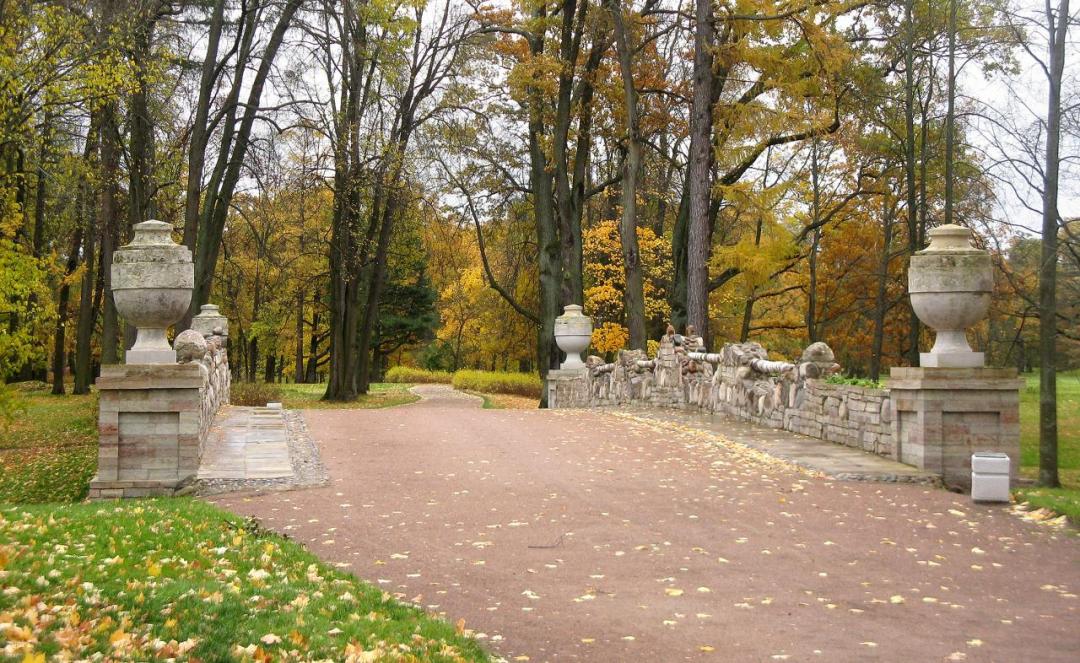
Writer Mikhail Pylyaev described the garden at Novoznamenka: "The large garden retains the character of French grand parks... endless perspectives stretch out, lawns rise with platforms where marble statues appear, surrounded by a labyrinth of fantastically intertwined trees and bushes... There are grottos, gazebos, bridges."
Under Myatlev’s son Ivan Petrovich, Novoznamenka became a center of literary life — the young owner was himself a poet and friends with Vyazemsky, Pushkin, and Zhukovsky. In 1866, composer Pyotr Tchaikovsky finished his first symphony "Winter Dreams" while visiting Myatlev. In the 1870s, grandson Vladislav Myatlev moved his grandfather’s library to the Gothic house, and for his collection of portrait paintings, he ordered three-story stone glazed verandas to be added to the east and west sides of the palace.
In 1888, Ivan Myatlev’s heirs sold the dacha to the Trusteeship for the Blind of Empress Maria Alexandrovna for 300,000 rubles. The "Gothic house" was assigned as an office, and the palace became chambers for patients from high society. Just four years later, the territory was transferred to city authorities, who planned to establish a city hospital for the mentally ill at Novoznamenka. It was here that writer Gleb Uspensky spent his last years and died. As the number of patients grew, various auxiliary buildings were erected on the grounds; in 1898, a hospital church was consecrated. In 1908, the administration attempted a major renovation of the palace, but efforts by the Imperial Archaeological Commission stopped it. However, by 1915, the building had significantly deteriorated.
After the revolution, the hospital was closed, and in 1917 the dacha was occupied by the Third Agricultural Colony: former chambers were given to prisoners, and the wooden church was converted into a theater.
In 1936, the institution was reorganized into the Novoznamenka colony for minors under the NKVD; it is possible that in 1926 Panteleev wrote some chapters of "The Republic of ShKID" here, while the palace was handed over to the Kirov Plant state farm.
Before World War II, experts tried to preserve the dacha as a cultural monument. As early as 1911, Vladimir Shchuko wrote that the palace was a "precious monument of 18th-century antiquity," preserving "clear traces of former grandeur: a two-story hall with original stoves and shelves, stylish rooms, ceiling and wall ornaments and paintings, marble fireplaces, columns, many windows, mirrors, and more." He also donated drawings of the building and watercolors depicting the palace’s painted plafonds to the Architectural Museum at the Academy of Arts, accompanied by a detailed report with step-by-step descriptions of necessary restoration work.
By the early 1940s, the palace was in an emergency state. As early as spring 1938, during an inspection, a monument protection department employee noted numerous roof leaks and floor destruction. In 1939, measurements were taken and restoration project work began, but with the outbreak of World War II, the project was halted. During a fire in 1941, the building was destroyed, and the interior decoration was completely lost. Balconies collapsed, the southern facade was destroyed, and floors and roof were ruined. Until the late 1950s, the palace remained in ruins. In 1957, restoration efforts resumed: staff of the Special Scientific Restoration Workshops under Plotnikov prepared drawings and sketches, but the project documentation lacked references to source materials. As a result, significant changes were made to the original layout to meet the needs of modern building use. Restoration was completed in 1961. The roof shapes over the verandas were altered, vaults replaced with flat ceilings, first-floor pilasters replaced by a solid wall, main and service staircases relocated, and a dormer window was installed in the attic above the main entrance instead of a clock. No funds were allocated for interior restoration. Art historian Slavina characterized the restoration as subordinated to the tastes of the project authors rather than historical accuracy.
After 1961, the dacha was used by the Central Clinical and Experimental Hospital of the Energochermet Trust.
In 1991, on Anatoly Sobchak’s initiative, the palace was transferred to the International Boarding School at Herzen University.
In 2009, the Novoznamenka estate was transferred from federal to city ownership and included in a privatization program, under which private owners could receive the building for use on condition of restoration. The Gothic house suffered from a series of fires, the last occurring in August 2011. After that, the city administration announced plans to restore the building and open a cultural and leisure center there. It was planned to restore the house’s roof by the end of 2011 and complete reconstruction by 2013. However, errors were found in the documentation provided by the contractor, whose correction was delayed, and the company was fined 332,000 rubles in court.
Sources:
https://www.citywalls.ru/house10254.html
https://ru.wikipedia.org/wiki/Воронцова_дача



Written by Jermaine
Discuss this with the author and others
No comments yet. Be the first to start the conversation.