

Mikhailovka (also known as "Mikhailovskaya Dacha" and "Mikhailovskoye Estate") is a 19th-century palace and park ensemble on the Peterhof road, which before the revolution belonged to the descendants of Grand Duke Mikhail Nikolaevich Romanov, son of Emperor Nicholas I. The park territory is also part of the state natural reserve of regional significance, the Southern Coast of the Neva Bay.
Mikhailovka includes several summer "plots" from the early 18th century: the first (from the east) plot was the "doctor's," belonging to Peter I's personal physicians R. K. Areskin and, after 1718, Blumentrost (later the first president of the Academy of Sciences). The second plot was owned by Peter I's head chef ("ober-kuchmister") Johann Felten, the third plot belonged to shipbuilder Tikhon Ignatievich Lukin, and five plots were owned by Senator Count Ivan Alekseevich Musin-Pushkin.
The territory of Mikhailovka also housed Menshikov's estate "Favorit" and the dacha of stolnik Streshnev.
Later, the houses in Mikhailovka were owned at different times by Field Marshal Minikh (estate "Ubezhishche"), Alexey Grigorievich Razumovsky, and the president of the Academy of Sciences Kirill Razumovsky. Kirill Razumovsky was also the (last) Hetman of Little Russia, and therefore the estate in the 18th century was also known as the "Hetman's Manor."
At the beginning of the 19th century, part of the plots came into the possession of Princess Shakhovskaya, who gave the combined estate the romantic name "Monkalm" (mon calme, "my peace").
In May 1834, "Monkalm" and the Hetman's Manor were acquired for the (then two-year-old) Grand Duke Mikhail Nikolaevich, son of Nicholas I, and the place received its current name. In 1836, the neighboring Malo-Znamenskoye (which was previously the northeastern part of the Hetman's Manor) was annexed to them. Under the management of the Department of Appanages in the 1830s and 1840s, a coastal Sea Road was laid in the estate, hundreds of trees were planted (linden, oak, spruce, ash, larch, birch), a pine grove was cleared, swamps were drained, and bridges were built. The wooden house of Minikh's estate with wings and a guest yard was demolished. The village of Korkuli, adjoining the estate since the 17th century, was moved a verst away, closer to the highway.
The palace project was prepared in 1850 by architect Stakenschneider. He also built two greenhouses and the gardener's house. In 1856, architect Charlemagne was chosen to work on the palace. When the court minister Count Adlerberg succeeded in removing Charlemagne, by the decision of Mikhail Nikolaevich himself, the estate was completed by Bosse. The palace foundation was laid in 1858, and the construction of two buildings (the Large and Small Palaces), connected by passages and galleries, was completed in May 1862.

The estate was conceived as an architectural and landscape complex, located on two terraces with axes running along the Hofmeister and Church drives.

The Cavalry (Hofmeister) building, rebuilt from the former Razumovsky house, includes: the huntsman's house with a kennel, greenhouses with the gardener's house, a guardhouse building, numerous garden structures: pergolas, verandas, statues, fountains.
In 1861, construction began on the Church of St. Olga on the site of Minikh's wooden house, designed by architect Grimm. With its completion in 1864, the main construction was finished; subsequently, minor structures were built — an iron chapel, a garage, a bowling alley, and tennis courts.
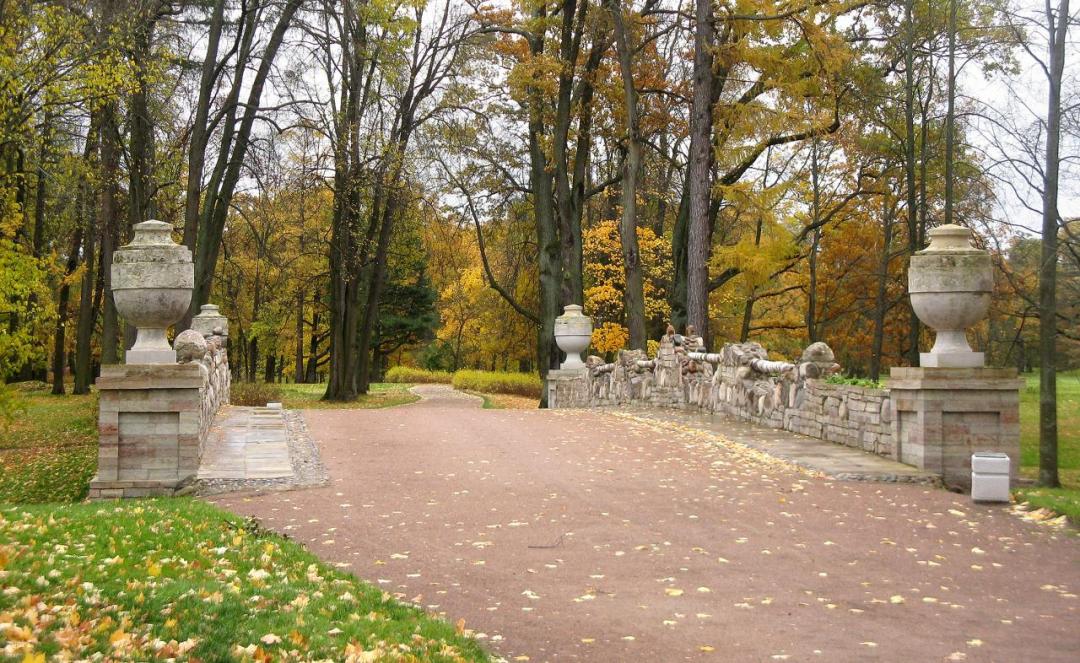
In the 18th century, the dachas were surrounded by a formal park, later transformed into an English landscape park according to the instructions of the garden master Frost, with the arrangement of new paths, clearings, and groves. New ponds were added to the old ones, connected by winding channels with bridges and dams. The park was replanned according to the project of Stakenschneider and Rezanov, and again replanned by architect Bosse in 1859–1862. Oaks planted during Menshikov's time were preserved. The total area of the park is 106 hectares.
Until 1917, the estate belonged to the descendants of Mikhail Nikolaevich. From 1919 to 1941, the estate housed the labor school-colony "Red Dawns." The main palace was heavily damaged during the Great Patriotic War, and other buildings were also damaged. In 1945, a poultry farm of the Lenmeat Combine was located on the estate, which, for the purpose of repairing individual buildings, dismantled damaged structures for building materials.
In 1967, the estate was transferred to the Kirov Plant as a recreation base and was restored from 1970 to 1979 according to the project of architect Tolstoy. The estate housed the "Red Dawns" boarding house, later renamed "Mikhailovka Estate."
Mikhailovka was declared a monument of history and culture of federal significance and from 2003 to 2006 was under the jurisdiction of the Administrative Department of the President of the Russian Federation. In July 2006, by order of the Government of the Russian Federation, the palace and park ensemble "Mikhailovskaya Dacha" was transferred to Saint Petersburg State University for the campus of the Graduate School of Management of SPbSU.
From September 1, 2015, the campus began full-scale educational activities. The fully restored and commissioned Stable building became educational. New constructions included an administrative building and a student café with 1,000 seats. In the near future, the construction of a student dormitory complex is expected (2018). The buildings of the Hofmeister building and the palace are conserved. The territory is fenced, and free access to the park is closed.
Since May 2019, access to the territory has been restored: the fence was removed, and the Lower Road is also open for pedestrian and bicycle traffic.
Sources:
https://ru.wikipedia.org/wiki/Mikhailovka_(estate)



Written by Jermaine
Discuss this with the author and others
No comments yet. Be the first to start the conversation.