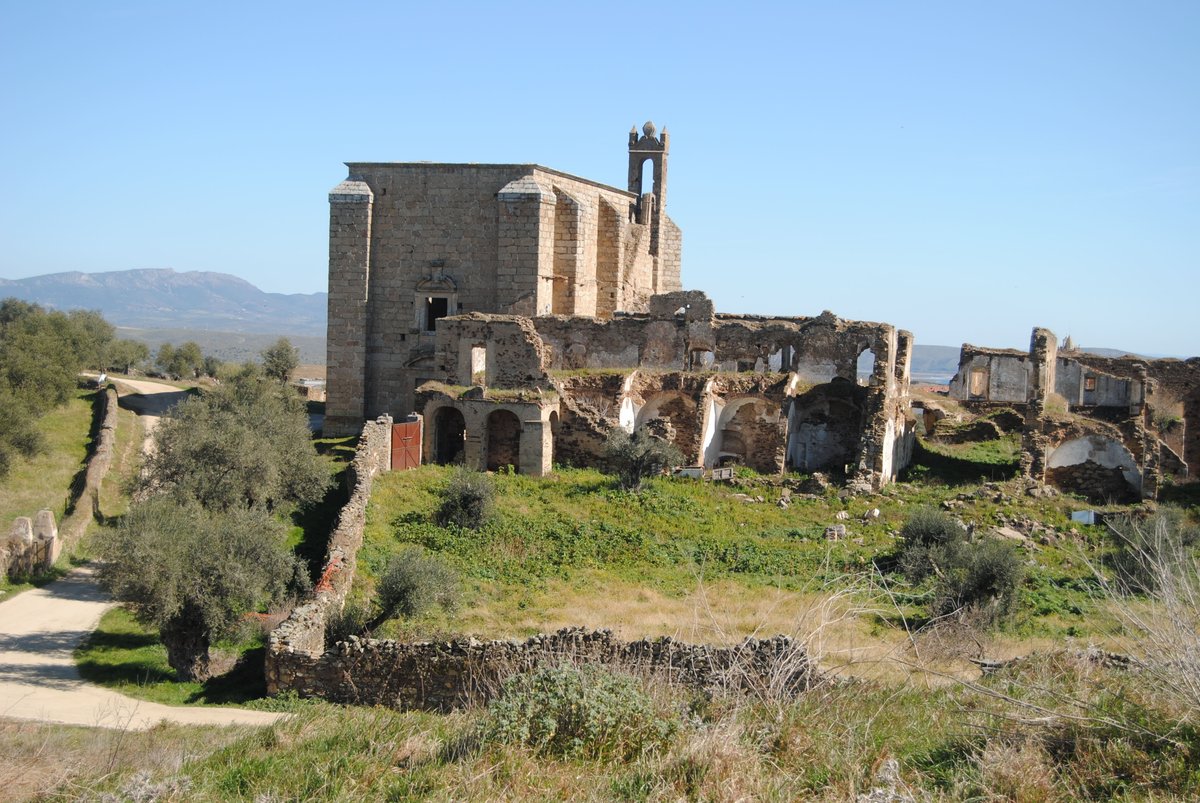

Located on the outskirts of the Spanish village of Garrovillas de Alconétar in the province of Cáceres, the Convento de San Antonio de Padua is a 15th-century Franciscan convent in ruins. Founded in 1476 by Enrique Enríquez de Mendoza, I conde de Alba de Liste, and his wife María de Guzmán, the site was established following a promise made by María de Guzmán for the release of her husband from captivity. In 1497, Queen Isabella the Catholic and King Ferdinand the Catholic visited the convent while traveling from the wedding of Isabella's daughter in Valencia de Alcántara.
The convent served as a house for Franciscan monks until the Mendizábal disamortization in 1835. Following this period, a rumor spread through the village that the convent housed great riches. In response to the threat of looting, several religious images were moved to local parish churches in May 1842. However, in December 1842, neighbors burned the altarpieces believing they contained gold. The final looting took place in January 1843, leaving the building in ruins.
Today, the convent remains in a state of decay, though the structure of the temple and the cloister are preserved. The temple, built of granite ashlar, features a Renaissance style with a single nave and a ribbed vault. Its facade displays the coat of arms of the House of Alba de Liste, depicting Enrique Enríquez de Mendoza with a noose around his neck as a reminder of the convent's origins.
Sources: Wikipedia, OpenStreetMap, Wikidata, Wikimedia Commons

Written by Nik Frost
Discuss this with the author and others
No comments yet. Be the first to start the conversation.