Alcántara Bridge (Puente de Alcántara)

Roman Temple, 10980 Alcántara, Cáceres, Spain

Ancient Roman bridge over the Tagus River in the Spanish city of Alcántara, near the Portuguese border. The tallest of the Roman bridges (72 meters)

The Alcántara Bridge (Puente Trajan at Alcantara) is a Roman stone arch bridge over the Tagus River in Alcántara, Spain. Its architect was Gaius Julius Lacer, and it was built between 104 and 106 AD by order of the Roman Emperor Trajan, who reigned from 98 AD. It was constructed on the road connecting Norba (Cáceres) with Conimbriga (now the Portuguese city of Condeixa-a-Velha). The bridge is 194 meters long, 8 meters wide, and 71 meters high. It has five piers, two abutments, and six arches between them (some of which span 30 meters).


In the center of the roadway stands a Triumphal Arch. It bears two marble plaques.

One plaque shows the construction date and dedication to Emperor Trajan, inscribed: “To Caesar Emperor, son of the divine Nerva, Nerva Trajan Germanicus Datius, Maximus Pontifex, holding tribunician power for the 8th time, imperator for the 5th time, Father of the Fatherland,” and the other reads “Pontem perpetui mansurum in saecula” (I built a bridge that will last forever). Over time, the Alcántara Bridge suffered more from wars than from weather conditions. In 1214, the smallest arch on the left was destroyed by the Moors.

The name “Alcántara,” derived from the Arabic “Al-Qantara,” meaning “the bridge,” reflects the fame this bridge enjoyed during the Middle Ages. One of the spans destroyed by the Moors was rebuilt in 1543 using material from quarries that supplied the original stone.

In 1760, the second arch on the northwest side was destroyed by the Spanish to stop the advance of an enemy army from Portugal into Extremadura and was repaired in 1762 by Charles III. In 1809, during the Peninsular Wars, to prevent Napoleon’s troops from crossing Alcántara, the allies destroyed the second arch on the right bank side. In 1818, a wooden span was built in its place. In 1836, it was burned by the Cristinos to prevent the Carlists from crossing. The bridge was restored in 1860 by order of Isabella II.
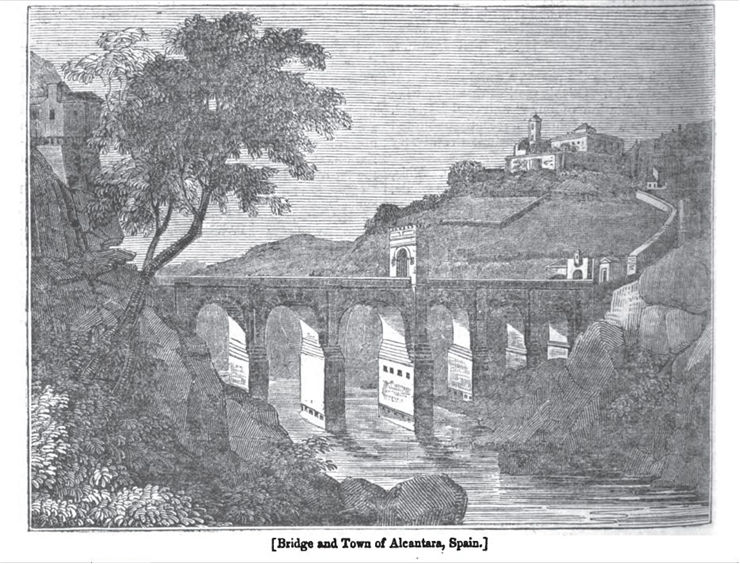

The bridge is a six-span stone arch structure. The span lengths are 13.8 + 22.6 + 27.9 + 28.2 + 22.5 + 13.5 meters. The total length of the bridge is 194 meters, with a width of 8.6 meters. The roadway is 45 meters above the water. The arch spans decrease toward the ends of the bridge due to the terrain of the banks. The springings of adjacent arches on the same pier are thus located at different levels, and all piers except the central one are asymmetrical. This asymmetry is less noticeable thanks to the introduction of buttresses on the bridge’s abutments, emphasizing the vertical element in the overall composition.


According to Professor Nikolaev’s research, the decrease in the spans of this bridge occurs as if the bridge represents a frontal projection of an equal-span arcade curved in plan along a circular arc. The composition of the entire bridge is based on the law of harmonious span reduction according to the division of a semicircle, constructed on a diameter equal to the length of the bridge (centered on the axis of the central pier), into eight equal arcs of 22.5° each. Projecting these divisions onto the diameter (the length of the bridge’s roadway) yields the axes of nine piers, corresponding in orthogonal projection to the axes of piers in a circular-plan arcade with equal spans.

The material for the bridge was gray granite, laid dry with roughly hewn blocks about 2 feet high, with clear and precise joint bonding. The arches on the facade are built from two rings. The outer ring, formed by the projection of header stones, protrudes as an archivolt outlined by a circular arc. A smooth, massive parapet crowns the bridge above a cornice molding with a goose-neck profile, corresponding to the level of the roadway.


The architecture of the bridge clearly shows Roman traditions of the late Republican era, when the central pier was highlighted as the compositional center and the composition harmoniously unfolded on both sides from it. The symmetry of the composition is emphasized by the increasing size of the arch spans toward the middle, as well as by the placement of a triumphal arch above the central pier. Judging by its architecture, the triumphal arch is Roman. It ends with battlements, likely of medieval origin.

On the left bank, next to the bridge’s outermost abutment, a small Roman temple was built. Above its entrance is an inscription dedicated to Trajan, confirming that the builder of the bridge was Gaius Julius Lacer. Nearby, a fragment of a marble slab with a poetic dedicatory inscription was also found:

…A bridge that will endure forever

of lasting peace,

Lacer raised over the river, glorious

with his skill…

The bridge is still in use.

Sources:

https://ru.wikipedia.org/wiki/Alcántara_Bridge

https://www.bridgesdb.com/bridge-list/alcantara-bridge/

Follow us on social media

More stories from World: The oldest bridges still in use

The Arkadiko Bridge or the Bridge to the Barracks

Leof. Asklipiou 27, Arkadiko 210 52, Greece

The Arkadiko Bridge (Greek name Γέφυρα του Αρκαδικού), or the Bridge to the Barracks, is one of the oldest arch bridges in the world.

Trajan's Bridge — the longest bridge of antiquity

Trajanova 23, Kostol, Serbia

The longest ancient Roman bridge, built between 103 and 105 AD according to the design of Apollodorus of Damascus, spanned the Ister (Danube) to the east of the Iron Gates. It was the first bridge in history across the second largest river in Europe.

Tarr Steps

Tarr Steps Farm, Dulverton TA22 9PY, United Kingdom

Tarr Steps — stone causeways across the River Barle in Exmoor National Park, Somerset, England. They are located in a national nature reserve 4 km southeast of Withypool and 6 km northwest of Dulverton.

Caravan Bridge (Turkish name: Kemer Köprüsü, Kervan Köprüsü)

Hilal, Gaziler St. No:173, 35170, 35170 Konak/İzmir, Turkey

An ancient bridge over the Meles River in the city of Izmir, built no later than 850 BCE in Lydia (present-day Turkey), is registered in the Guinness Book of Records as the "oldest dated bridge in the world still in use." The structure is over 2,860 years old, making it one of the oldest functioning bridges in the world.

Fabricio Bridge, also known as the Jews' Bridge or the Four Heads Bridge

Fabricius Bridge, Ponte Fabricio, 00186 Rome RM, Italy

Built in 62 BC. Also known as the "Ponte dei Quattro Capi" (Italian for Bridge of the Four Heads) — named after the two ancient two-headed herms installed at the beginning of the bridge, depicting the heads of Hercules or the two-faced Janus. In the Middle Ages, another name appeared: the "Jewish Bridge" (Latin: Pons Judaeorum), since nearby, on the left bank of the river from the 13th century, there was a Jewish ghetto.

Jendere Bridge or Septimius Severus Bridge

WJM5+77, 02402 Burmapınar/Kâhta/Adıyaman, Turkey

An ancient Roman bridge located near the ancient city of Arsameia (modern-day Kahta), 55 km northeast of the city of Adıyaman in southeastern Turkey. The bridge, situated near the road leading from Kahta to the famous Mount Nemrut, presents an exciting challenge for those who wish to learn something new and well-documented about this structure.

Pont du Gard (Roman bridge-aqueduct)

400 Rte du Pont du Gard, 30210 Vers-Pont-du-Gard, France

The Pont du Gard bridge was built shortly before the Christian era so that the Nîmes aqueduct (almost 50 km long) could cross the Gard River. The Roman architects and hydraulic engineers who designed this bridge, which is nearly 50 meters high and has three levels (the longest of which is 275 meters), created a technical and artistic masterpiece.

Alcántara Bridge (Puente de Alcántara)

Roman Temple, 10980 Alcántara, Cáceres, Spain

Ancient Roman bridge over the Tagus River in the Spanish city of Alcántara, near the Portuguese border. The tallest of the Roman bridges (72 meters)

Pergamum Bridge

The main function of the crossing, which was 196 meters wide, was to divide the river and direct its water into two channels running beneath the temple. The bridge has survived to this day. It serves not only as a support for a number of modern buildings but also as a transportation interchange.

Römerbrücke, Roman or Old Moselle Bridge

Roman Bridge, Römerbrücke, 54290 Trier, Germany

An ancient Roman bridge over the Moselle River in the city of Trier, Germany. Built between 144 and 152 AD, much of the original Römerbrücke structure has survived to this day, although some parts—particularly the roadway and its arches—date back to the 18th century. The Römerbrücke bridge is still in use and is considered the oldest bridge in Germany. Constructed by the Roman general Agrippa, it was made from large basalt blocks from the German Eifel mountains, held together with iron clamps, just like the remarkable Roman city gates of Trier, the Porta Nigra.

The bridge near Limira (in Turkish, Kırkgöz Kemeri, which means "bridge of forty arches")

The bridge near Limyra is a relatively unknown but unique stone bridge. It is considered one of the oldest segmental arch bridges in the world. It is located near the ancient city of Limyra and is the largest ancient structure in the region. The way the arches of the bridge were constructed gave it an unusually flat profile, which was unique for Roman engineering of that time.

Dezful Bridge or Roman Bridge, the oldest surviving brick bridge

Dezful, دزفول, Old Bridge, 99JR+Q49, Iran

The historic Dezful Bridge has stood for over 17 centuries and is known as the oldest surviving brick bridge in the world. It is also known as the "Roman Bridge," built during the reign of the first Sasanian, Shapur.

Julien Bridge (Julius Bridge), in French Pont Julien

Pont Julien, Les Lavandins, Rte du Pont Julien, 84480 Bonnieux, France

A Roman stone arch bridge over the Calavon River in southeastern France, dating back to 3 BCE. It was originally built on the Via Domitia, an important Roman road that connected Italy with Roman territories in France. It was used for vehicular traffic until 2005, when a new bridge was constructed to protect it from wear. It is still used as a bicycle and pedestrian path. This amounts to approximately 2,000 years of continuous use.

Tiberius Bridge (Ponte di Tiberio), Augustus Bridge (Ponte d'Augusto), or Saint Julian Bridge (Ponte di San Giuliano)

Ponte di Tiberio, Ponte di Tiberio, 47921 Rimini RN, Italy

The Tiberius Bridge (Italian: Ponte di Tiberio), historically also called the Bridge of Augustus (Ponte d'Augusto) or the Bridge of Saint Julian (Ponte di San Giuliano), is a Roman bridge in Rimini, in the Emilia-Romagna region of northern Italy.

Milvian or Mulvian Bridge (Ponte Milvio or Ponte Molle)

Ponte Milvio Bridge, Ponte Milvio, 00135 Rome RM, Italy

The bridge over the Tiber in the northern part of Rome was economically and strategically important during the Roman Empire era. It was the site of the famous Battle of the Milvian Bridge in 312 AD, which led to Constantine's imperial rule.

The Bridge of Saint Angel (Ponte Sant’Angelo) or the Bridge of Hadrian

Eliev Bridge, Ponte Sant'Angelo, 00186 Rome RM, Italy

The bridge over the Tiber in Rome, built between 134 and 139 AD by the Roman Emperor Hadrian. The bridge connected the city center with Hadrian's Mausoleum (later the Castel Sant'Angelo). Since the bridge led to Hadrian's Mausoleum, the Romans called it the "Hadrian Bridge" or the "Aelian Bridge" (Latin: Pons Aelius), after the shortened form of the emperor's full name (Publius Aelius Hadrianus).

Flavian Bridge (Pont Flavien)

70 Av. Maurice Berle, 13250 Saint-Chamas, France

Roman bridge over the Touloubre River in Saint-Chamas, Bouches-du-Rhône department, in southern France. The single-arch bridge was located on the Roman road Via Julia Augusta — between Placentia, Italy, and Arles. It is the only surviving example of a Roman bridge with triumphal arches from the Augustan period, although similar bridges likely existed elsewhere, as evidenced by depictions on coins from the late 1st century BCE.

Pont sur la Laye or the Roman Bridge of Manosque (Pont sur la Laye)

Chemin de Chateauneuf, 04300 Mane, France

An ancient stone arch bridge over the Ley River in French Provence near the town of Man.

Khoda Afarin Bridges: From Ancient Times to the Present Day

5W2Q+3J Khoda Afarin, Iran

The most famous examples of bridges in the Transcaucasus are the ancient Khudafarin Bridges. The well-known Arab traveler and geographer Yaqut al-Hamawi, who visited these places in the 1210s and 1220s, called the Aras "a remarkable river."

Kapellbrücke (Chapel Bridge)

Rathausquai 6, 6004 Lucerne, Switzerland

Kapellbrücke (literally, Chapel Bridge) is a covered wooden pedestrian bridge that crosses the Reuss River diagonally in the city of Lucerne in central Switzerland. Named after the nearby St. Peter's Chapel, the bridge is unique in that it contains a series of internal paintings dating back to the 17th century, although many of them were destroyed along with much of the centuries-old bridge in a fire in 1993. Subsequently restored, Kapellbrücke is the oldest wooden covered bridge in Europe, as well as the oldest surviving truss bridge in the world. It serves as a symbol of the city and one of Switzerland’s main tourist attractions.