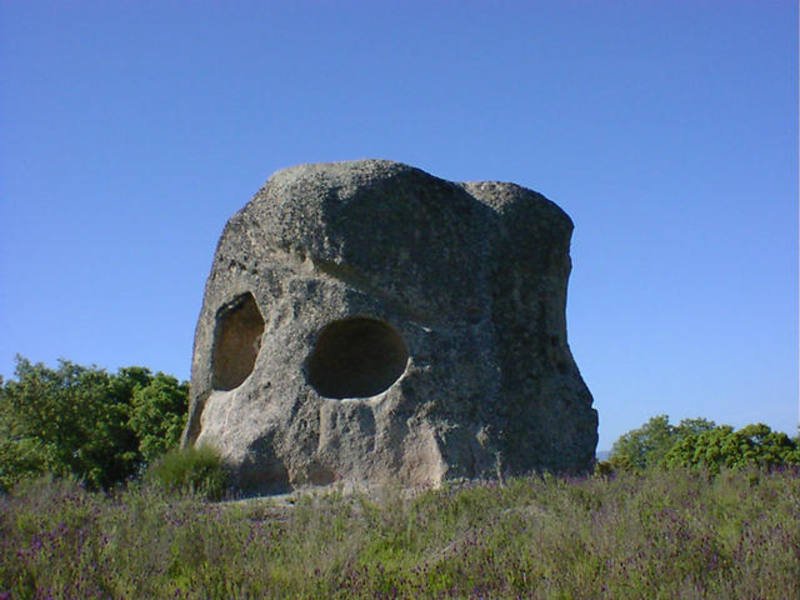

Peña Buraca is an archaeological site located in Alcántara, Spain, in the province of Cáceres. Named for its large, eye-shaped cavities, the site covers four hectares and contains a diverse array of archaeological remains. Although traditionally identified as a prehistoric sanctuary, it is now known to be part of a larger, still-incompletely-researched archaeological complex. Peña Buraca is reached from the small municipality of Piedras Albas by following the road that exits north from the plaza de Portugalillo in Alcántara.
Known structures within the site include a necropolis, rock-cut mills, and cave tombs. These tombs show a variety of orientations, which has led to hypotheses about their original purpose. The tombs, as well as the site, date back to the late Roman and early medieval periods. A second rock nearby also shows signs of a possible roof and lower-floor anchor, although they are less evident. The site's exact location is important to understand due to its small municipality size.
In the rocky area around Peña Buraca, there are numerous tombs carved into the stone, altars, pottery remains, and other structures of difficult interpretation. The 'right eye' is the largest cavity. Inside it, you can see the traces of a tool or pick that would have been used for its construction. Around the 'right eye', there is a kind of frame, raised, with a trapezoidal shape, flattened at the corners, as well as a series of large, worked holes.
In the lower part of the 'right eye', the rock has been lowered to facilitate access to the hole that might have been used as a niche or shelf. The 'left eye', although smaller and located at a lower height than the first, shares the same characteristics. In this, a rebate has also been made below the eye to make use of the space. Peña Buraca shows openings for the placement of the two-water roof of a construction. Approximately, the crest would be at a height of around 3.50 m, and the gutter around 1.90 m.
The existence of two channellets or rebates in the roof hole and another between the 'eyes' indicates that, at some point, the roof was expanded. Square holes are also identified, in which the straps would be inserted, which would rest on the rafters or knees, which in turn would rest on the ridge beam. The traces found suggest the successive execution of works on the rock itself and indicate that it would have been transformed, perhaps because it would have assumed different uses over time, adapting its characteristics to satisfy them.
There is a second rock, close to Peña Buraca, with marks of a roof and a lower floor anchor, although the ropes are not as evident. Three rock-built mills are found near Peña Buraca, with platforms for pressing and stomping and containers for collecting liquid. One of the mills, located slightly farther away from Peña Buraca in the southern part of the archaeological area, has rectangular platforms, with a platform for pressing of 1.32 x 1.94 m and a collection container of 95 x 40 cm.
Some of the mills were possibly expanded or retouched. Decades of rock-cut tombs of various structures surround Peña Buraca, including anthropomorphic, infantile, twin, with recessed heads, and even one with two holes for the head and feet. The orientation of the tombs is very diverse, but they do not follow the east-west style of the Middle Ages, instead being aligned around Peña Buraca, which has generated hypotheses about the initial use of the rock.
A zone of extraction of granite material has been identified in which traces of the extraction of blocks and circular pieces for millstones, as well as the marks of the wedges, are evident. In the surroundings of this site, there are two small rock-cut basins, whose exact use is unknown. Between the ceramic material, there are samples of Roman ceramic and medieval or modern-contemporary ceramic, as well as hand-made ceramic, rough with thick paste, of difficult chronological assignment.
The settlement originated in the Bottom Empire Roman period, based on some numismatic findings. Some tumbas near Peña Buraca are from the same period and have a different typology from the rest, with a deeper grave, an external resalte, and a canal to prevent water entry. These burials were grouped together. The settlement possibly continued in the later Middle Ages or Medieval period. The burials further away from Peña Buraca are from this period, and they are not grouped, but found isolated.
Two types of burials can be distinguished: some with internal headboards and no resaltes, and others farther away with no resaltes. Peña Buraca shows signs of tin mining from ancient times. Mined tin was used to alloy copper to obtain bronze.
Sources: Wikipedia, OpenStreetMap, Wikidata, Wikimedia Commons
Written by Nicolo Ciampini
Discuss this with the author and others
No comments yet. Be the first to start the conversation.